An article from the Telegram channel “Alexey Isaev. ‘Iron Wind’.”
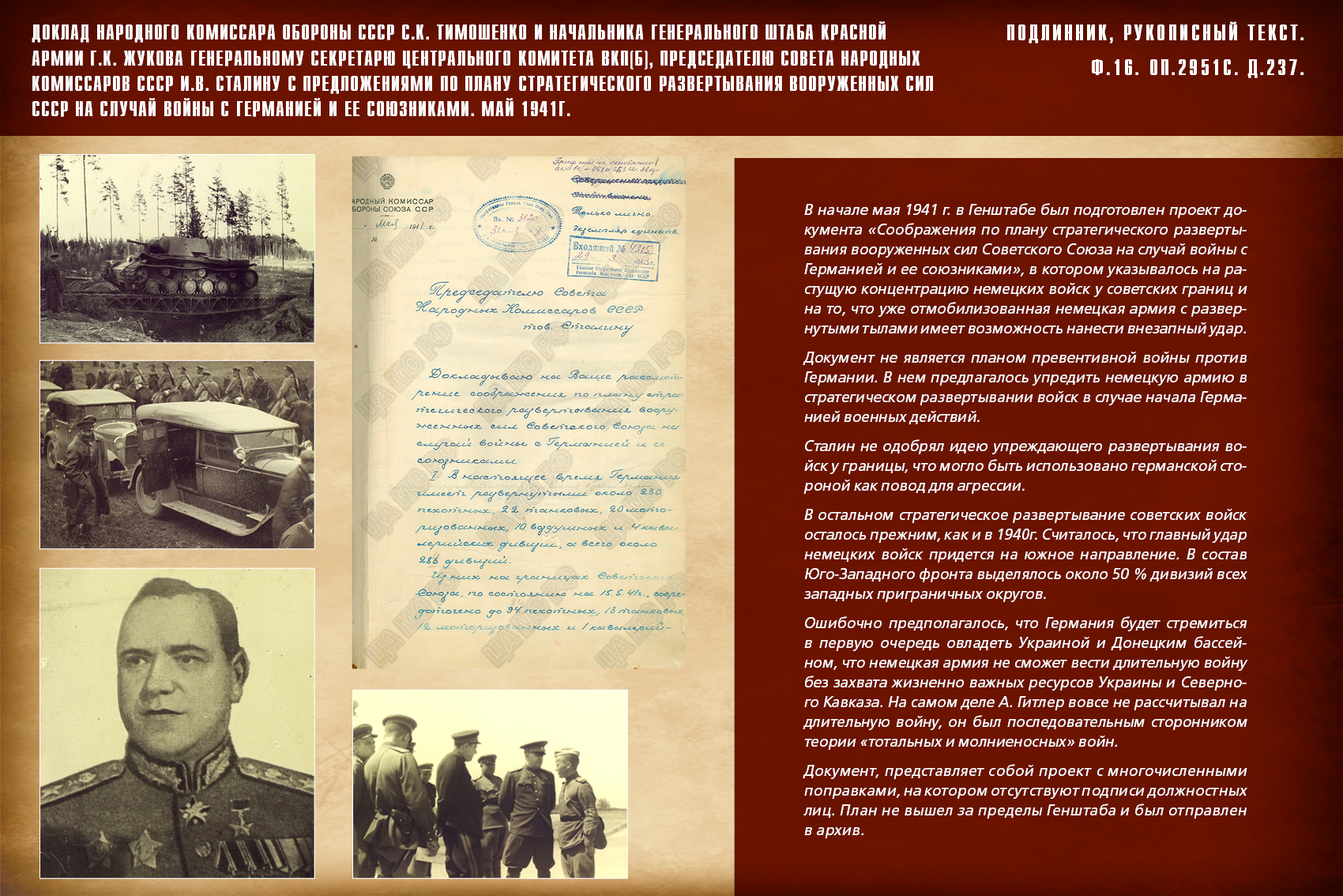
Eighty-five years ago, a document was published that continues to spark much controversy to this day. It is titled “Considerations on the Plan for the Strategic Deployment of the Armed Forces of the Soviet Union in the Event of War with Germany and Its Allies.” It is dated May 15 based on circumstantial evidence; there is no date on the document itself, but the title has become established. The document was handwritten by A.M. Vasilevsky, with corrections made by G.K. Zhukov. You can view a facsimile here
This document is often referred to as a plan for a preemptive strike against Germany, proposed by G.K. Zhukov and rejected by I.V. Stalin. But is that really the case? To answer this question correctly, one must carefully read the text of the “Considerations…” dated May 15, 1941.
First, strikes against the enemy within the territory of the General Government (German-occupied Poland) following the Red Army’s crossing of the state border were nothing new in and of themselves. The same was envisaged in the “Considerations…” of the fall of 1940. An active strategy and an offensive plan for the first operation do not in and of themselves mean that the USSR intended to take the initiative in starting a war. Crossing the border was envisaged only under conditions of war between states, with a certain pause between the formal declaration of war and the start of the first operation.
Second, let’s figure out what exactly is “preventive” about it.
The document states:
“Given that Germany currently keeps its army mobilized, with its rear areas deployed, it has the ability to anticipate our deployment and launch a surprise attack.
To prevent this and defeat the German army, I consider it essential under no circumstances to allow the German High Command to take the initiative; to preempt the enemy’s deployment and attack the German army at the very moment when it is in the process of deploying and has not yet had time to organize its front lines and coordinate the actions of its various branches of the military.”
Where does it say here that we are attacking? It only says that (according to the prevailing views at the time regarding the initial phase of the war), while already formally at war (with shooting already taking place at the border, but the war plan not yet being implemented) and, having completed the mobilization and deployment of our troops, we would finish transporting and positioning our forces before the enemy and be the first to launch the war’s opening operation.
In fact, later in “Reflections…” it is stated explicitly what Zhukov and Tymoshenko proposed to the political leadership:
“In order to ensure the implementation of the plan outlined above, the following measures must be taken in advance, without which it is impossible to launch a surprise attack on the enemy, both from the air and on the ground:
1. Carry out a covert mobilization of troops under the guise of reserve training exercises;
2. Under the guise of moving to training camps, secretly concentrate troops closer to the western border, focusing first and foremost on concentrating all of the General Headquarters’ reserve armies;
3. covertly concentrate air forces at field airfields from remote districts and immediately begin deploying air force support units.”
Closer! Not to the border, but closer. That is, move the armies from the interior districts to somewhere along the Vyazma meridian and to the right bank of the Dnieper in the area of Berdichev and Bila Tserkva. It’s still a long way to the border.
What was the proposed scenario of events outlined in the “Considerations…” of May 15, 1941, if we were to boil it down to a simple diagram? Large-scale training exercises are announced (specifically, the “Large-scale Training Exercises” [BUS] with a hidden call-up, rather than the annual training exercises that actually took place in 1941). Through the BUS, we increase the strength of the divisions.
Next, we load troops from the internal military districts onto trains and transport them to the Vyazma area, Bryansk, Sukhinichi (generally west of Moscow, far from the border, but closer than transporting them from the Urals or the Volga region), Belaya Tserkov, and Berdichev (closer to the border than from the North Caucasus).
Germany begins some sort of diplomatic manoeuvres, an exchange of ultimatums. We briskly move these troops toward the border and meet the enemy fully armed—or even manage to launch the operation sooner and bring in the main forces more quickly. It was assumed that there would be a certain time lag between the actual declaration of war and the deployment of the main forces. In the case of the actual “Barbarossa” operation, there was no such lag. But Soviet theory still counted on it.
That’s all there is to it. Now let’s read carefully what exactly Zhukov told historian V.A. Anfilov:
“…we didn’t sign this document ourselves; instead, we decided to report it to Stalin first. But he practically flew into a rage when he heard about the preemptive strike against German troops: ‘Have you lost your minds? Do you want to provoke the Germans?’”
Zhukov and Tymoshenko propose deploying a large number of troops to areas west of Moscow and on the right bank of the Dnieper. Several hundred thousand people. The Germans might have noticed this, and yes, it could prompt them to take countermeasures. This is what I.V. characterized as “provocation” in his retelling of Zhukov’s account.
“Proactive” is not the same as “preemptive”; it refers to launching the first operation before the enemy does.
There is also a paragraph in “Considerations…” that simply does not fit into the theory of “preemptiveness” at all:
“At the same time, it is necessary to vigorously accelerate the construction of fortified areas, begin construction of fortified areas along the rear line at Ostashkov, Pochep, and plan for the construction of new fortified areas in 1942 along the border with Hungary, as well as continue the construction of fortified areas along the old state border.”
Measures like these are normal from a long-term perspective. For a preemptive strike, though, this sounds absurd—after all, we’re going to “deliver the main blow with the forces of the Southwestern Front in the direction of Kraków, Katowice…” Again, nowhere in the text of “Considerations…” are there any dates along the lines of “we’ll concentrate our forces by such-and-such a date, and we’ll be able to strike by such-and-such a date.”
In short, don’t read into the document what isn’t actually there.
Sources: