America’s 1980s Arsenal Plane That Never Was: General Dynamics F/A-111X Megalodon

When people talk about the “arsenal plane” concept today, they usually imagine a large aircraft operating at a relatively safe distance from the enemy while carrying dozens of long-range missiles launched using targeting data supplied by other platforms. Yet the basic idea of turning a large aircraft into a flying missile battery could have emerged decades earlier. In fact, the United States already had an aircraft that could have served as an almost perfect starting point: the General Dynamics F-111.
In real history, the F-111 became primarily a strike aircraft, while the attempt to turn it into the F-111B heavy carrier-based interceptor ended in failure. Nevertheless, that failed program produced technologies and concepts that could have led to something extraordinary in the early 1980s. Long range, variable-sweep wings, a large internal fuel capacity, the ability to carry a heavy weapons load, and experience integrating the long-range AIM-54 Phoenix missile provided almost everything required for an entirely new type of combat aircraft.
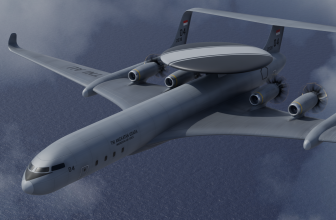
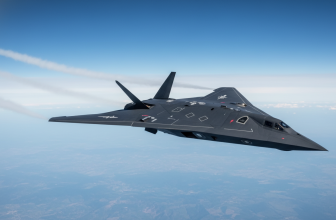
Imagine that the United States decided to revisit the old F-111B concept, but on a much larger scale. Instead of another strike variant of the F-111, General Dynamics develops the gigantic F/A-111X Megalodon — a heavy fighter, airborne command center, electronic warfare platform, and arsenal aircraft combined into a single machine.
It would be capable of detecting hostile aircraft hundreds of kilometers away, disrupting enemy radar systems, and launching dozens of missiles against an approaching formation.
And surprisingly, such an aircraft may not have been quite as unrealistic as it first appears.
The F-111 That Took a Different Path
The real F-111 originated with the TFX program, an ambitious attempt to provide the U.S. Air Force and U.S. Navy with variants of the same basic supersonic aircraft. Their requirements were dramatically different, but Secretary of Defense Robert McNamara pushed for maximum commonality.
The result was a large, twin-engine, two-seat aircraft equipped with variable-sweep wings. NASA later noted that variable geometry allowed one aircraft to combine very different flight regimes and mission requirements, making it one of the defining features of the F-111 design.
For the Air Force, the F-111A was primarily intended as a strike aircraft capable of penetrating enemy air defenses at high speed and low altitude.
The Navy’s F-111B had an entirely different mission.
It was supposed to become a heavy carrier-based interceptor capable of detecting Soviet bombers at long range and destroying them before they could launch anti-ship missiles against American carrier battle groups.
And this is where the story becomes particularly interesting.
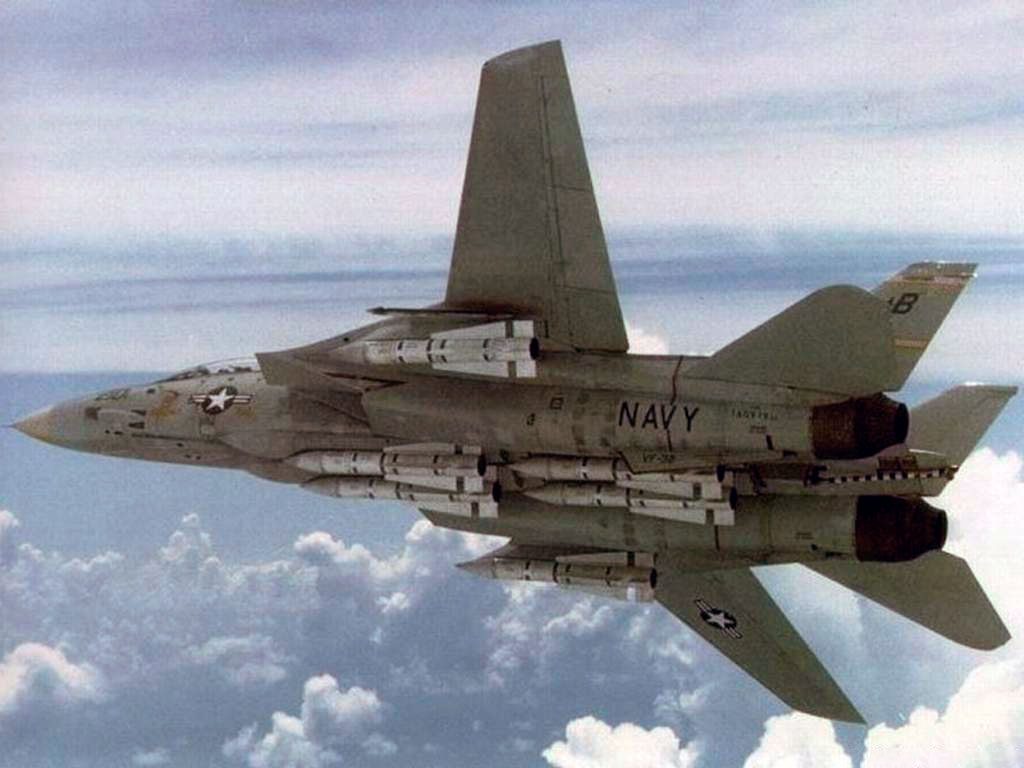
The AIM-54 Phoenix long-range missile system was originally developed for the F-111B. In April 1967, a Phoenix successfully destroyed a target after being launched from an F-111B. In January 1968, the first supersonic Phoenix launch was conducted from the aircraft. Then, in March 1969, an F-111B demonstrated the ability to attack two widely separated aerial targets with two missiles almost simultaneously.
After the cancellation of the F-111B, Phoenix eventually found its home aboard the F-14 Tomcat.
The F-111 itself went in another direction.
But what if, roughly fifteen years later, the Pentagon had decided to revisit what the aircraft had originally been intended to become?
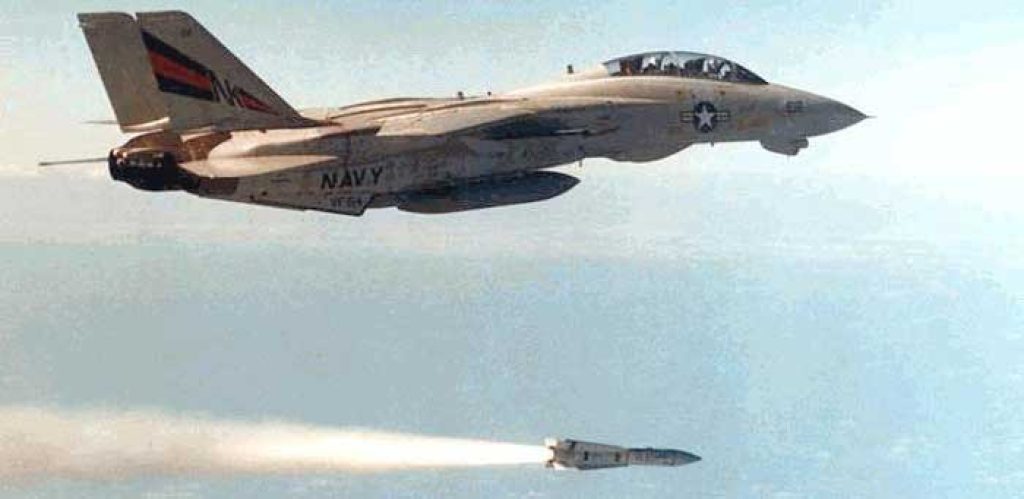
A real F-111B during AIM-54 Phoenix testing, preferably carrying missiles under the wings
1981: Soviet Aviation Makes the Pentagon Remember the F-111B
In our alternate timeline, the story begins in 1981. NATO planners are increasingly concerned about the growing capabilities of Soviet long-range aviation. The Tu-22M Backfire is becoming a serious threat to naval forces, new generations of cruise missiles are appearing, Soviet airborne early-warning capabilities are expanding, and the MiG-31 is entering service.
American analysts begin to realize that the air war of the future may no longer be a battle between individual fighters. Instead, it could become a confrontation between vast interconnected systems.
AWACS aircraft detect the enemy. Electronic warfare aircraft disrupt hostile radars. Fighters protect strike packages. Missile-carrying bombers attempt to launch their weapons without ever entering traditional dogfighting range.
That raises an uncomfortable question:
Why should the United States necessarily send one fighter after every Soviet aircraft?
What if a single large platform could carry as many missiles as an entire fighter squadron?
In our scenario, General Dynamics proposes exactly that in 1982.
The project initially receives the internal designation Model 111X Advanced Air Combat Platform, while the Pentagon establishes the Long Range Air Arsenal Demonstrator program.
The basic concept sounds almost absurd: take the technology and experience accumulated through the F-111 family, enlarge the aircraft to roughly the size of a small bomber, and transform it into a carrier for an enormous number of air-to-air missiles.
The project quickly acquires an unofficial nickname:
Megalodon.
Neither Fighter Nor Bomber
Even the Pentagon would have struggled to classify the Megalodon.
It receives the designation F/A-111X, but it is certainly not a fighter in the conventional sense.
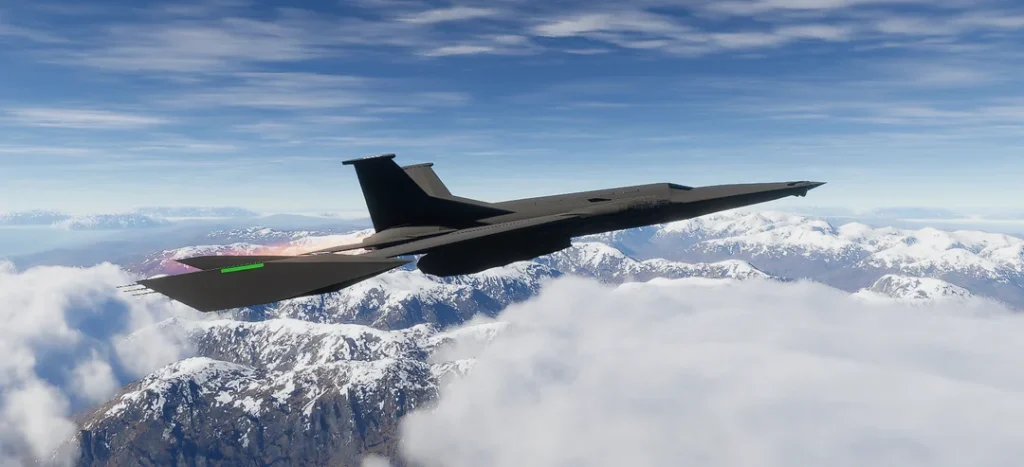
Depending on configuration, the projected weight exceeds 50 tons. This closely follows the original fictional MOTS — “Megalodon of the Skies” — whose creator envisioned an aircraft weighing approximately 50–60 tons and capable of reaching around Mach 1.2.
Those numbers work remarkably well for our alternate-history aircraft.
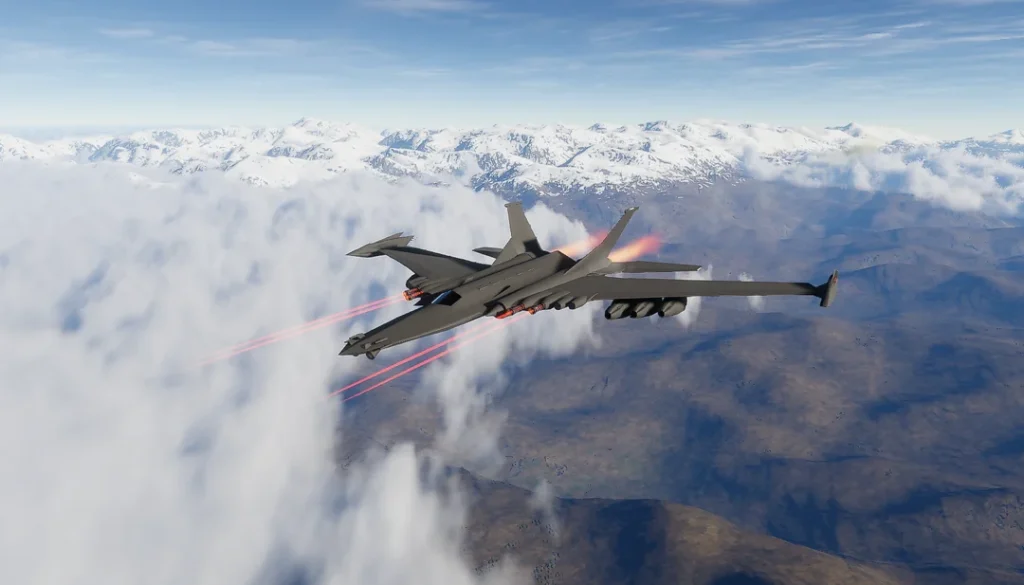
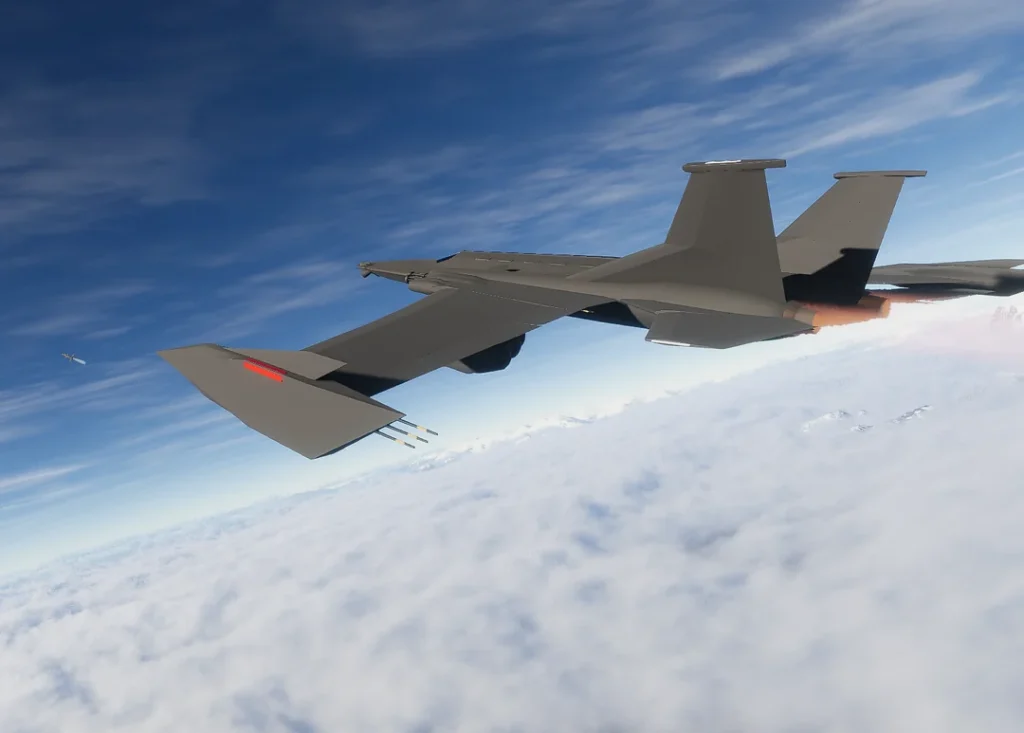
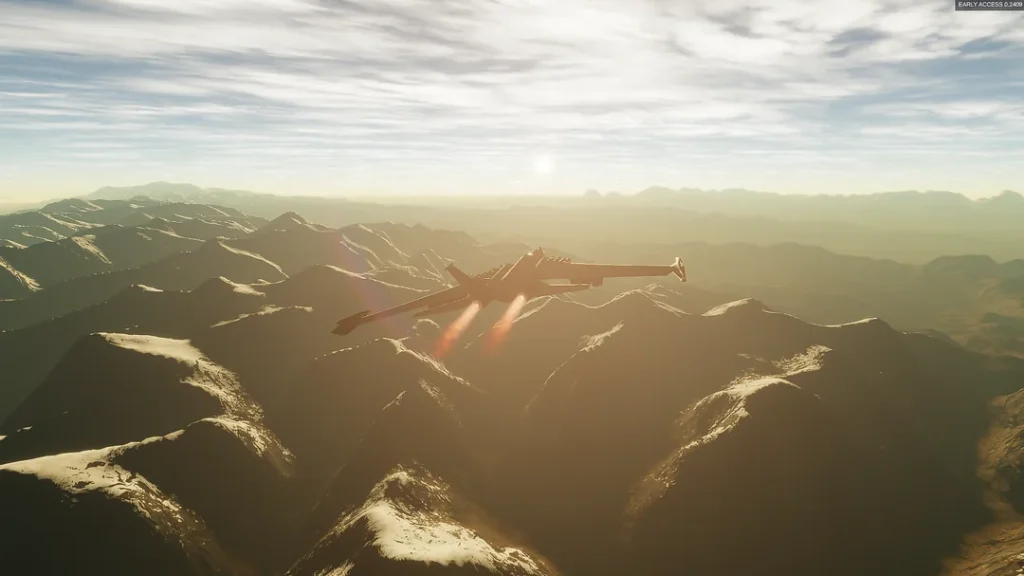
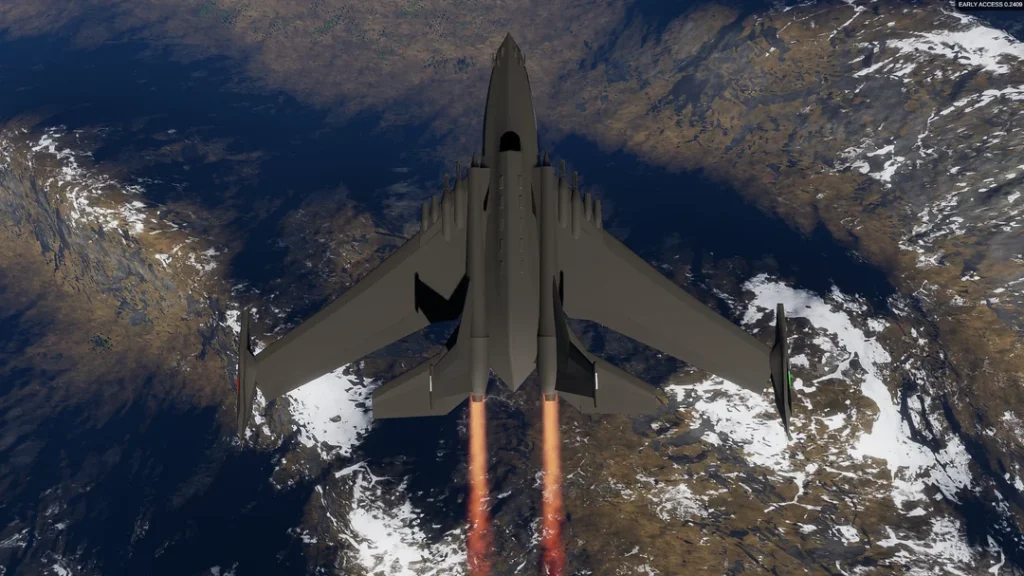
The F/A-111X becomes a gigantic twin-engine machine with variable-sweep wings. During economical cruise and patrol, the wings are extended to provide better endurance and range. When a rapid repositioning maneuver is required, the wings sweep backward and the Megalodon accelerates to approximately Mach 1.2.
That is considerably slower than dedicated interceptors such as the F-14 or MiG-31.
But the Megalodon is never intended to fight them in a traditional dogfight.
Its weapon is distance.
The aircraft operates behind conventional fighters, using its own powerful radar and targeting information provided by E-3 Sentry aircraft. Once an approaching Soviet formation is detected, the crew assigns targets and begins launching long-range missiles.
In essence, the F/A-111X is a flying missile battery.
A Radar Worthy of a Small AWACS Aircraft
One of the most impressive features of the original MOTS concept is its radar, equipped with an antenna roughly one meter in diameter and a claimed detection range of up to 300 kilometers.
In the alternate American program of the 1980s, the radar becomes the heart of the entire aircraft.
General Dynamics cannot simply install a conventional fighter radar in the nose. Megalodon requires a system capable of simultaneously tracking large numbers of targets and supporting the employment of dozens of missiles.
In our scenario, Hughes receives a contract to develop the AN/AWG-15, essentially an ambitious evolution of the philosophy behind the F-14’s AWG-9. Its enormous computing and signal-processing equipment occupies not only the nose but dedicated avionics compartments within the fuselage.
The result is something halfway between a fighter and a miniature AWACS platform.
When operating alongside an E-3 Sentry, however, the Megalodon does not necessarily need to keep its own radar active continuously. Target information can be received from external platforms, allowing the aircraft to reduce its electromagnetic emissions until the moment of engagement.
And then comes the part for which the entire aircraft was created.
106 Missiles — An Insane Idea That Needed a Little More Realism
The most spectacular feature of the original Megalodon concept is its armament.
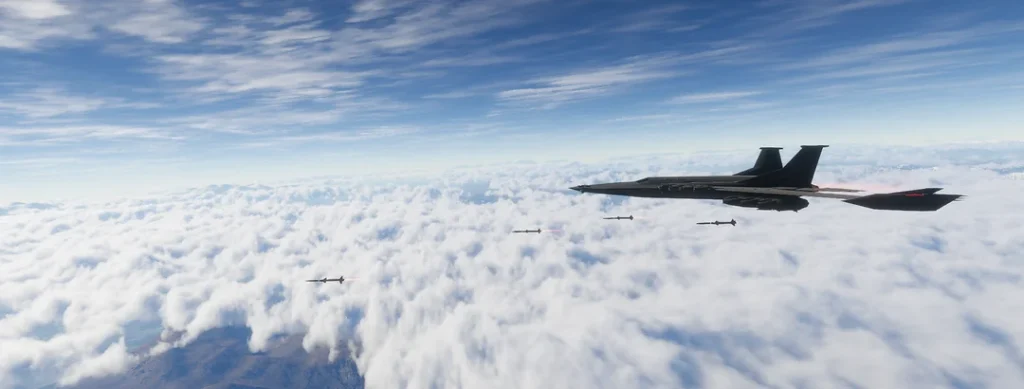
Its creator envisioned an astonishing 106 missiles, although 76 of them were small unguided weapons, leaving 30 as fully guided missiles. The designer himself acknowledged that realism had deliberately been sacrificed in favor of spectacle.
For a genuine American combat aircraft of the 1980s, carrying 76 small unguided air-to-air rockets would make little operational sense.
So in our alternate history, General Dynamics completely redesigns the weapons system.
The centerpiece becomes a load of up to 30 guided missiles.
The heaviest component of the arsenal consists of AIM-54C Phoenix long-range missiles. Historically, this creates a beautifully circular story: the missile originally intended for the F-111B returns almost twenty years later aboard its enormous distant relative.
However, filling all 30 weapon stations with heavy Phoenix missiles would impose an excessive weight penalty. A typical combat load therefore combines AIM-54C Phoenix missiles with the smaller AIM-7M Sparrow. Later development plans include integration of the emerging AIM-120 AMRAAM.
Instead of 106 largely fantastical weapons, the operational Megalodon carries around 30 genuine guided air-to-air missiles.
That is still an extraordinary arsenal.
Rather than carrying the missile load of one fighter, the F/A-111X effectively concentrates the firepower of several heavy fighters aboard a single platform.
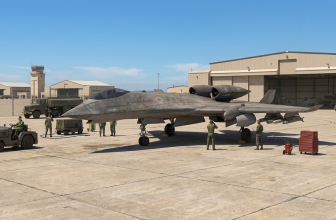
An F/A-111X on the ground with its weapons bays open and AIM-54 Phoenix and AIM-7 Sparrow missiles visible
A Flying Electronic Warfare Station
Carrying dozens of missiles alone would not be enough. Such an enormous aircraft would itself become an extremely attractive target.
Electronic warfare therefore becomes the Megalodon’s second major weapon.
The original MOTS concept features huge jamming pods located near the wingtips. Its creator claims a combined electronic warfare output of around 100,000 watts, operating across a very broad frequency range.
Our alternate F/A-111X retains this feature.
Instead of relying exclusively on conventional external jamming pods, the aircraft receives an integrated electronic warfare system with powerful transmitters housed in large wingtip fairings and additional antennas distributed around the fuselage.
The sheer size of the aircraft suddenly becomes an advantage. There is ample internal volume for electrical generators, cooling equipment, processors, transmitters, and operator stations.
The Megalodon does not merely protect itself.
It provides electronic cover for the entire formation.
This is another reason why the F/A designation becomes increasingly inadequate. The aircraft is simultaneously a heavy interceptor, electronic warfare platform, command-and-control aircraft, and missile arsenal.
A Crew of Four
The two-man crew arrangement of the conventional F-111 is no longer sufficient for such a complex aircraft.
The F/A-111X therefore receives a substantially enlarged cockpit. The aircraft commander and copilot sit in the forward positions, while a radar systems operator and a weapons/electronic warfare officer occupy stations behind them.
General Dynamics later studies an even larger five-man version with a dedicated air battle management officer.
The crew effectively functions more like the combat information center of a warship than the cockpit team of a conventional fighter.
The pilots are responsible for flying the aircraft and executing the mission. The radar operator builds the tactical picture. The weapons officer assigns missiles to targets and manages the electronic warfare system.
In a conventional fighter, the pilot chooses and attacks an enemy aircraft.
Inside the Megalodon, air combat becomes the work of an entire combat management team.
General Dynamics F/A-111X Megalodon — Specifications
- Type: Heavy supersonic arsenal aircraft / long-range interceptor / airborne command platform
- Crew: 4
- Manufacturer: General Dynamics
- Alternate program launched: 1982
- First flight: 1986
- Estimated maximum takeoff weight: approximately 58–60 tons
- Powerplant: 2 × uprated TF30-family afterburning turbofans on early prototypes; more advanced engines proposed for production aircraft
- Wing: Variable-sweep
- Maximum speed: approximately Mach 1.2
- Cruising speed: approximately 850–900 km/h
- Combat radius: approximately 1,800–2,200 km depending on mission profile
- Patrol endurance: up to 5–6 hours with aerial refueling
- Radar: Experimental Hughes AN/AWG-15
- Estimated detection range against large aerial targets: up to 300 km
- Electronic warfare suite: Integrated system with high-power transmitters in wingtip housings
- Estimated combined jamming output: up to 100 kW
- Maximum guided missile load: approximately 30
- Primary weapons: AIM-54C Phoenix and AIM-7M Sparrow
- Planned future weapon: AIM-120 AMRAAM
- Optional weapons: Anti-radiation and air-to-surface missiles in the proposed F/A-111X Block II
- Aerial refueling: Yes
How the Megalodon Would Fight
The most interesting aspect of the F/A-111X is not the aircraft itself but the tactics built around it.
Imagine Central Europe in the mid-1980s. NATO intelligence detects preparations for a major Warsaw Pact air offensive. An E-3 Sentry takes off, followed by several F/A-111Xs.
The Megalodon does not fly at the front.
Quite the opposite.
It remains deep inside the formation, protected by F-15Cs. The AWACS detects Soviet aircraft at long range and transmits the tactical picture to the F/A-111X. Its crew identifies the most dangerous targets: command aircraft, reconnaissance platforms, jammers, missile carriers, and escorting fighters.
Several Megalodons then launch dozens of missiles almost simultaneously.
The result resembles a naval missile salvo — except it is taking place in the sky.
Instead of attacking NATO aircraft, Soviet fighters suddenly have to defend themselves against a massive incoming missile wave, disrupting their formation and forcing them onto the defensive. F-15s can then attack an already disorganized enemy force.
The maritime scenario is even more compelling.
F/A-111Xs could patrol far from an American carrier battle group and intercept Soviet Tu-22M Backfire bombers before they reached anti-ship missile launch range.
In other words, nearly two decades later, the United States would have returned to the original philosophy of the F-111B: destroy the missile carrier before it can launch its weapons.
The difference is that a single Megalodon would carry the missile load of almost an entire flight of fighters.
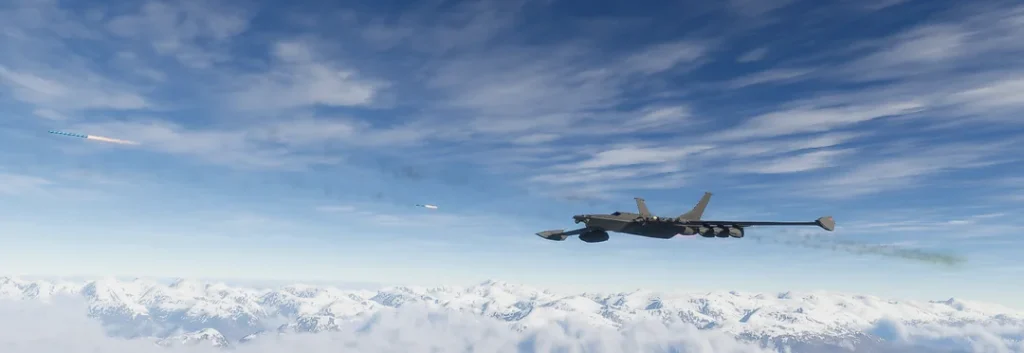
A combat scene over the North Atlantic: an F/A-111X Megalodon launches a mass salvo of AIM-54 Phoenix missiles against a formation of Soviet Tu-22M bombers and their fighter escorts
Why Such an Aircraft Could Actually Have Been Built
Perhaps the most fascinating thing about the Megalodon is that many of its individual components and concepts already existed by the 1980s.
The F-111 had proven the viability of a large supersonic variable-geometry combat aircraft. NASA studies demonstrated how variable sweep could allow one aircraft to perform efficiently across very different flight regimes.
The F-111B had already demonstrated compatibility with the Phoenix missile. More importantly, the concept of long-range multi-target interception was not science fiction. It was developed for the F-111B and subsequently became operational with the F-14 Tomcat.
The United States also continued experimenting with the F-111 platform. The AFTI F-111 flew during the 1980s with advanced flight-control and aerodynamic technologies, demonstrating that the aircraft remained useful as a research platform long after its original development.
Building an experimental heavy missile carrier therefore would not have been technically impossible.
The real problem would have been something else entirely.
A 60-Ton Fighter Would Have Been Far Too Expensive
The Megalodon would have suffered from nearly every traditional problem associated with “super weapons.”
First came cost.
A single aircraft combined an extremely powerful radar, sophisticated electronic warfare equipment, dozens of expensive missiles, a complex variable-sweep wing, and a four-man crew. Losing one F/A-111X would mean losing not merely an expensive aircraft, but a significant fraction of the entire formation’s missile inventory.
The second problem was survivability.
No matter how powerful its electronic warfare suite might have been, a nearly 60-ton aircraft could never maneuver like a true fighter. If a Soviet MiG-29 or Su-27 managed to close the distance, the Megalodon would find itself in a very uncomfortable situation.
Then came the AIM-120 AMRAAM.
The new missile allowed conventional F-15s and F-16s to engage multiple targets beyond visual range. Instead of concentrating dozens of missiles aboard one enormously expensive arsenal aircraft, the United States could distribute those weapons across many conventional fighters.
Finally, the Cold War itself was coming to an end.
1989: The End of the Megalodon
In our alternate timeline, three F/A-111X prototypes are built.
The first takes to the air in August 1986. The second receives the full radar and electronic warfare suite. The third is dedicated primarily to weapons testing.
The program’s most spectacular demonstration comes during Operation Mass Launch in the summer of 1988. A single Megalodon launches twelve guided missiles in rapid succession against a formation of unmanned targets while demonstrating the ability to track a much larger number of aircraft simultaneously.
The Pentagon is impressed.
But it does not approve mass production.
By 1989, the cost of the program has become increasingly difficult to justify, while the international situation is changing dramatically. The Soviet Union no longer appears to be the kind of adversary that justifies purchasing several squadrons of gigantic airborne missile cruisers.
The program is frozen in 1990.
It is formally cancelled in 1992.
One prototype goes into storage. Another continues flying as an electronic systems testbed. The third eventually enters the National Museum of the United States Air Force.
The story appears to be over.
But three decades later, American aerospace planners begin discussing ideas that sound remarkably familiar.
An Aircraft From the 1980s Designed for a 21st-Century War
This is where the fictional history of the F/A-111X Megalodon becomes particularly interesting.
In the 1980s, one of its greatest disadvantages would have been the need to detect targets, manage the engagement, and carry the enormous weapons load on essentially the same aircraft. That made the platform extraordinarily complex and expensive.
Modern network-centric warfare changes that equation.
Today, the aircraft carrying the weapon does not necessarily have to be the platform detecting the target.
One aircraft can detect the enemy. Another can provide tracking data. A third can launch the missile.
In such a network, the arsenal-plane concept suddenly becomes far more attractive.
Imagine a modernized 21st-century Megalodon. It no longer needs to rely primarily on its enormous radar. An F-35 detects an enemy aircraft and transmits targeting data over a secure network. Hundreds of kilometers behind it, the F/A-111X opens a weapons bay and launches a long-range missile.
To the enemy, the immediate threat appears to be the small stealth fighter in front.
The actual missile magazine is far behind it.
The Megalodon effectively becomes a flying weapons truck.
That is why the fantastical Flyout aircraft reflects a very real direction in modern air warfare: the sensor and the shooter do not necessarily need to be the same platform. Sometimes it may be more efficient to give one aircraft the best sensors and another the largest possible weapons load.
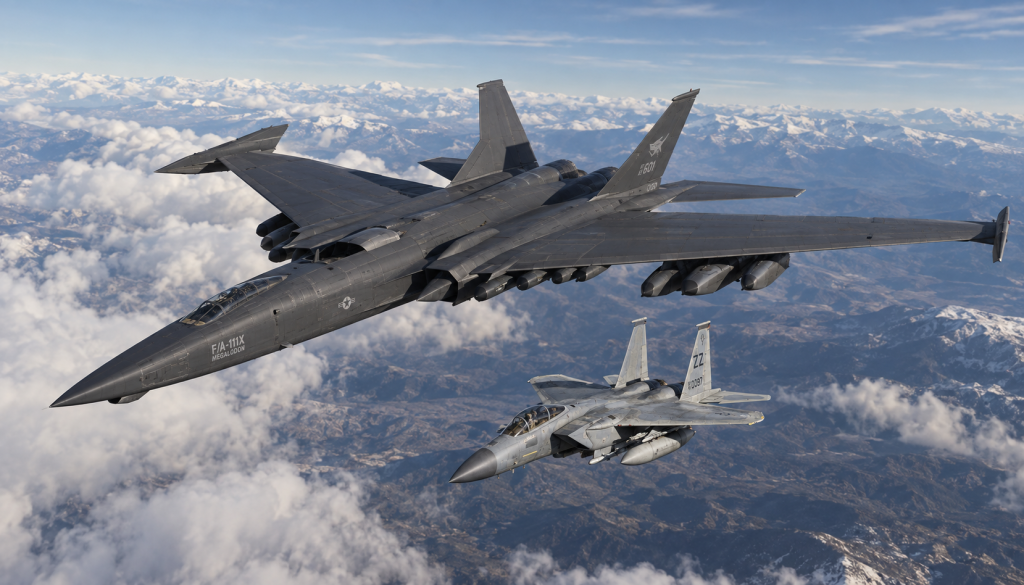
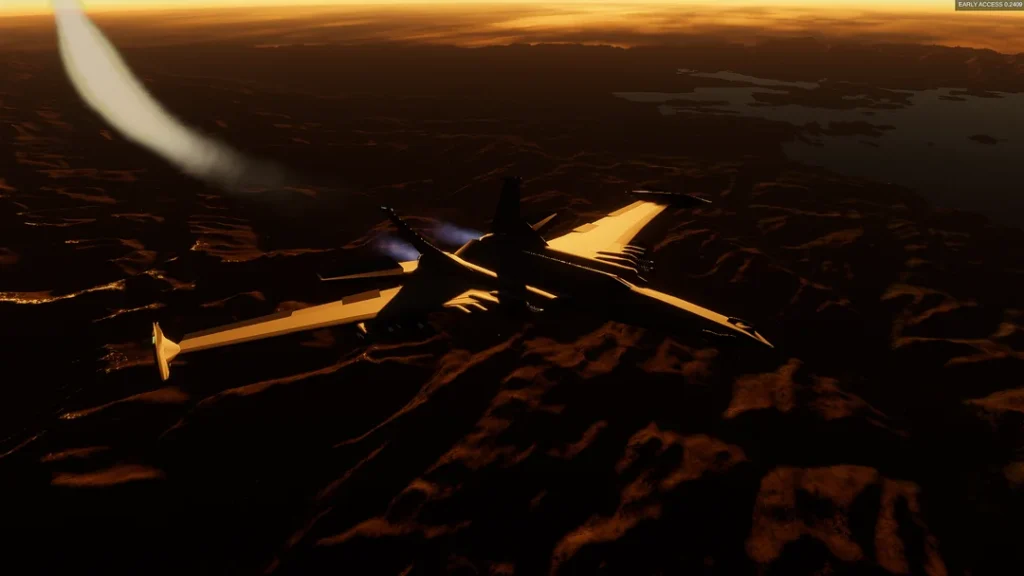
An F/A-111X Megalodon flying alongside an F-15C Eagle
The Flying Battleship That Arrived Too Early
The General Dynamics F/A-111X Megalodon never existed.
Its direct inspiration is the fictional MOTS — Megalodon of the Skies, created by Reddit user Low_Secret5634 in the aircraft-building simulator Flyout. The original concept features a 50–60-ton aircraft with variable-sweep wings, a top speed of approximately Mach 1.2, a radar detection range of around 300 kilometers, an extremely powerful electronic warfare suite, and an outrageous arsenal of 106 missiles. Its creator openly acknowledged sacrificing realism for spectacle.
But once the most fantastical elements are removed, an unexpectedly compelling alternate-history aircraft begins to emerge.
The United States really did build the F-111. It really did attempt to turn the naval F-111B into a heavy long-range interceptor. The F-111B really did test the Phoenix missile. And the United States really did develop the multi-target, long-range interception technology that later became operational aboard the F-14.
Only one decision was missing.
Instead of shrinking the heavy interceptor concept into something closer to a conventional fighter, General Dynamics could have gone in exactly the opposite direction.
Make it bigger.
Add more fuel. Install an even more powerful radar. Give it an enormous electronic warfare suite. Load it with several dozen missiles. Turn the aircraft from a simple weapons carrier into an airborne combat center.
The result would have been expensive, controversial, and almost certainly produced only in small numbers.
But it might also have become one of the most extraordinary combat aircraft of the Cold War:
the General Dynamics F/A-111X Megalodon — a 60-ton flying battleship capable of launching as many missiles as an entire formation of conventional fighters.
And perhaps its greatest problem would not have been that the concept was fundamentally wrong.
It may simply have arrived about thirty years too early.
Sources – https://www.reddit.com/r/flyoutgame/comments/1w8ykuy/the_megalodon_of_the_skies/