Air Power of the Sleeping Tiger. What Indonesia’s Future SE-7 Astrapia AEW&C Aircraft Could Look Like

Indonesia is rarely seen as a future great power, even though it possesses almost everything required to become one: a huge population, a growing economy, abundant natural resources, and a strategic position between the Indian and Pacific Oceans. For decades, the country has avoided major geopolitical conflicts and focused primarily on its own development. But the stronger its economy becomes, the harder it will be to remain on the sidelines. Sooner or later, Indonesia will have to defend its trade routes, maritime borders, and technological independence.
Indonesia has no shortage of military personnel, but its armed forces are still insufficiently equipped with modern weapons and systems. The first steps have already been taken: new-generation fighters are being acquired, Indonesia is participating in the KF-21 Boramae program, and its domestic aerospace industry continues to develop. But fighters alone are not enough. A vast archipelagic nation needs an aircraft capable of monitoring the airspace hundreds of kilometers away and linking aircraft, warships, and ground-based radars into a single integrated network.
It Began as the SE-7 Passenger Aircraft
In our alternative history, the story begins in the early 2030s, when Indonesia’s aerospace industry decides to move beyond light transport aircraft and develop its own next-generation regional airliner.
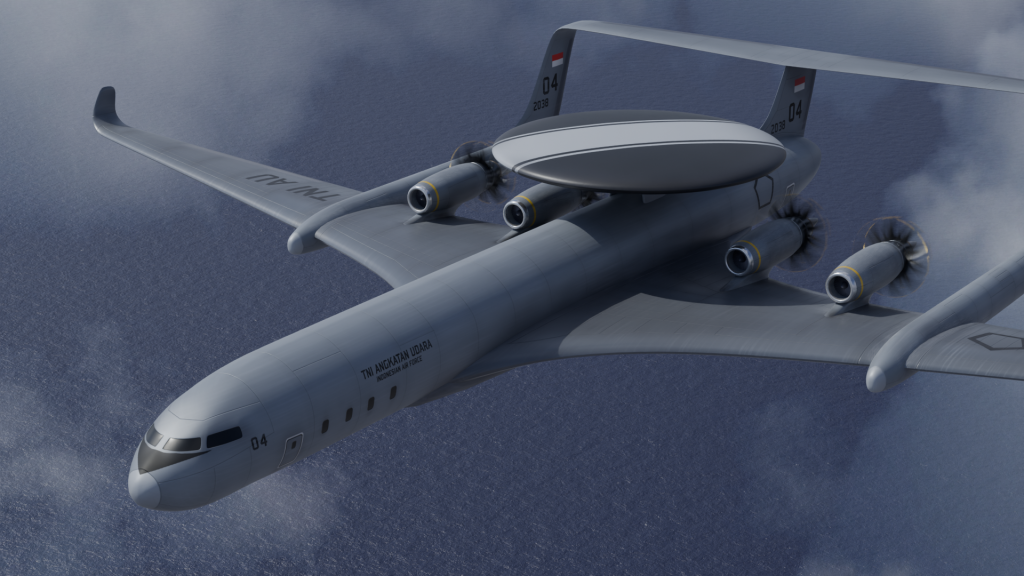
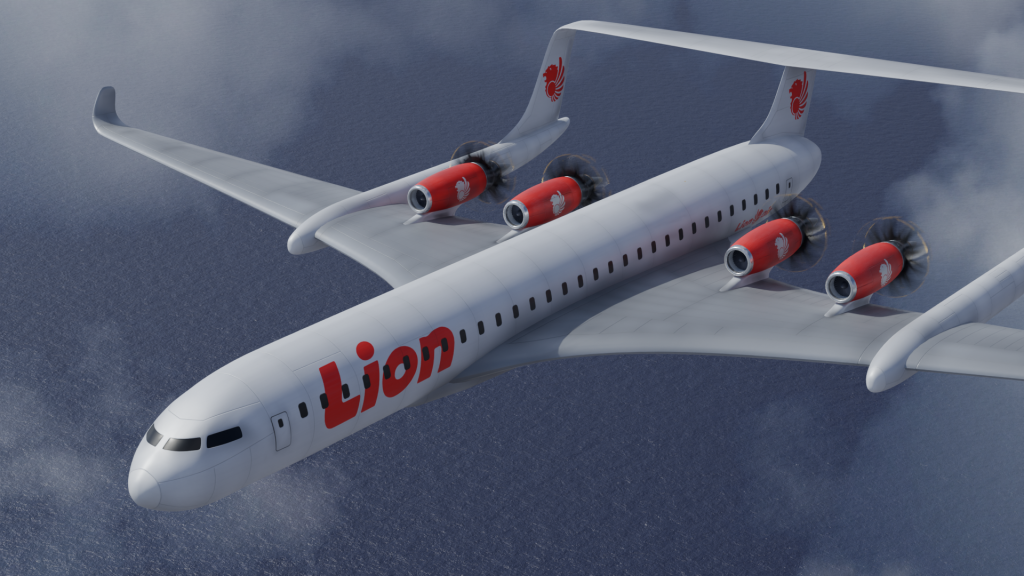
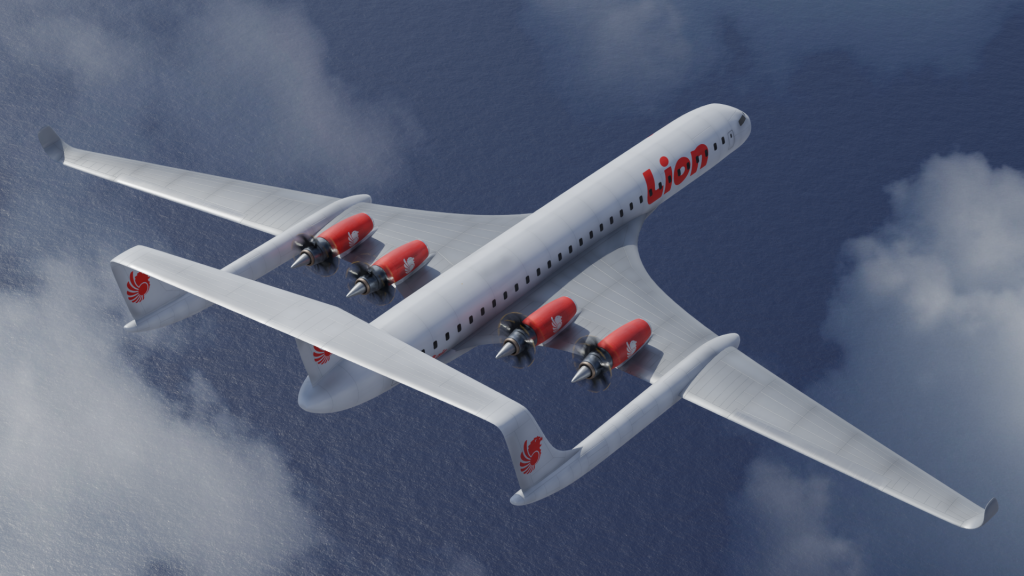
Thus the SE-7 is born — an economical passenger aircraft designed to carry approximately 60–70 people and intended primarily for inter-island routes. Its designers give the aircraft a high-aspect-ratio wing and four propfans mounted above it.
Its defining feature is a hybrid propulsion system. Two gas turbines operate primarily as generators, while electric motors drive the propfans. For a civilian aircraft, this arrangement offers improved fuel efficiency. It later becomes clear, however, that such an electrical architecture is almost ideal for a military platform.
Why the Military Became Interested in a Civilian Aircraft
By the mid-2030s, the Indonesian Air Force already operates modern fighters, but it faces a fundamental problem: ground-based radars cannot effectively detect low-flying targets far beyond the horizon, while the sheer size of the country requires continuous surveillance over enormous maritime areas.
Purchasing foreign AEW&C aircraft would solve the problem quickly, but it would also create dependence on overseas suppliers. The SE-7, meanwhile, has the right size, long endurance, and a powerful electrical system. Thus, in 2038, development of the SE-7A Astrapia begins.
An AEW&C aircraft consumes enormous amounts of electrical power. Radar, communications equipment, electronic intelligence systems, onboard computers, and cooling equipment all require megawatts of energy. On the Astrapia, however, the electrical system is already at the heart of the propulsion architecture.
During patrol operations, speed is reduced to 450–500 km/h, lowering the power demand of the propfans. The resulting surplus electrical energy can then be redirected to the aircraft’s electronic systems. Four independent electric motors also improve survivability: losing one propulsion unit does not mean losing all thrust.
An Airborne Command Center
The SE-7A is not designed merely as an early-warning aircraft. For a country made up of thousands of islands, it must be equally capable of monitoring both the air and the sea.
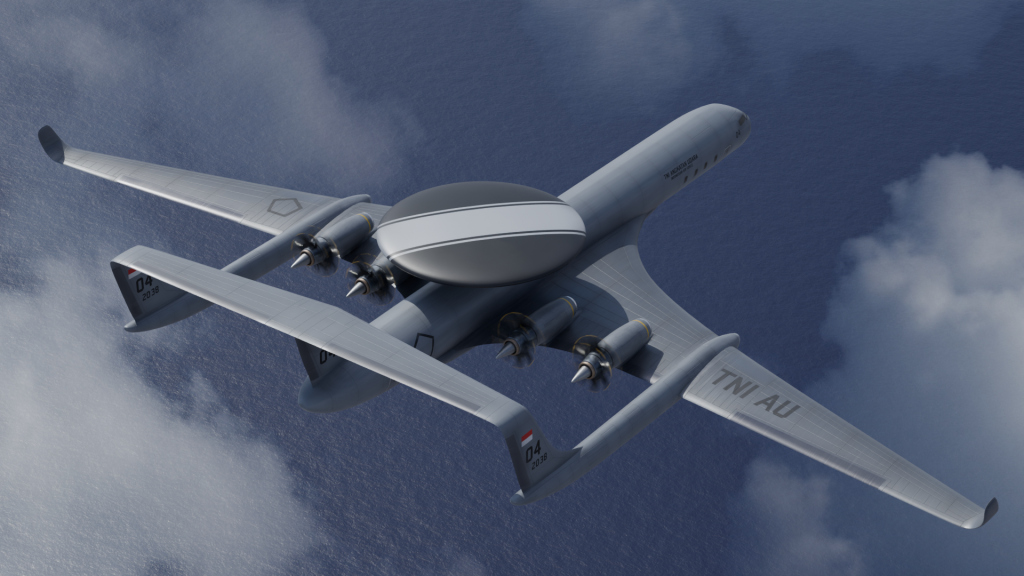
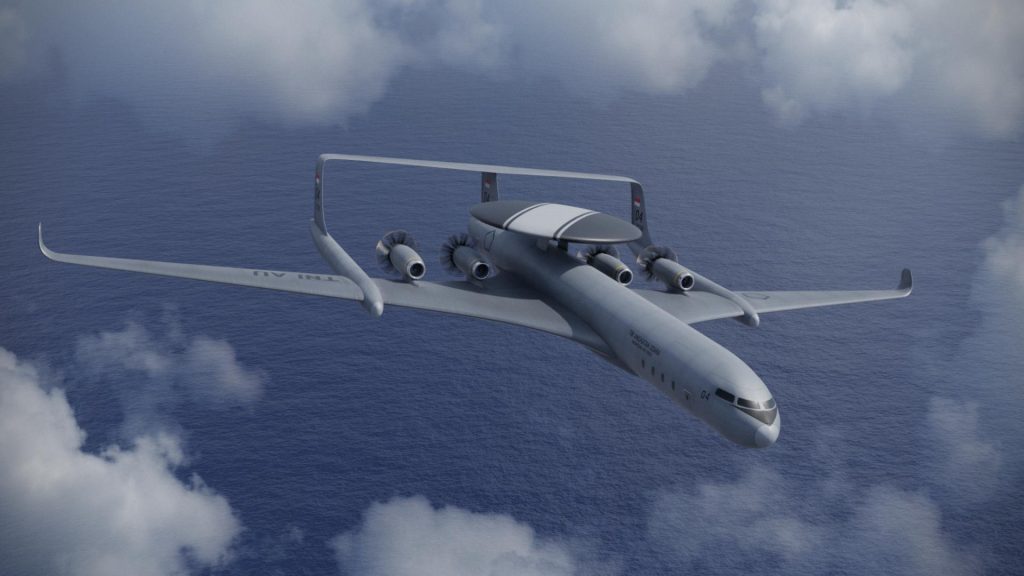
Three fixed AESA radar arrays are housed inside the disc-shaped radome above the fuselage. The radome itself does not rotate: electronic beam steering allows the radar to switch almost instantly from one sector to another. A separate maritime-surveillance radar is installed beneath the fuselage, an electro-optical sensor turret is located in the nose, and electronic intelligence equipment is distributed along the sides of the aircraft.
The estimated detection range against a large high-altitude target reaches 600–650 km, while a fighter-sized target could be detected at roughly 400–450 km. Yet the Astrapia’s most important role is not simply detection. It becomes an information hub, combining data from ground-based radars, warships, UAVs, and satellites.
A KF-21, for example, could fly with its own radar switched off and receive targeting data from the Astrapia. An opponent might still be unaware that an Indonesian fighter is nearby while the KF-21 pilot already sees its position on the display.
Why Does It Have Such a Strange Tail?
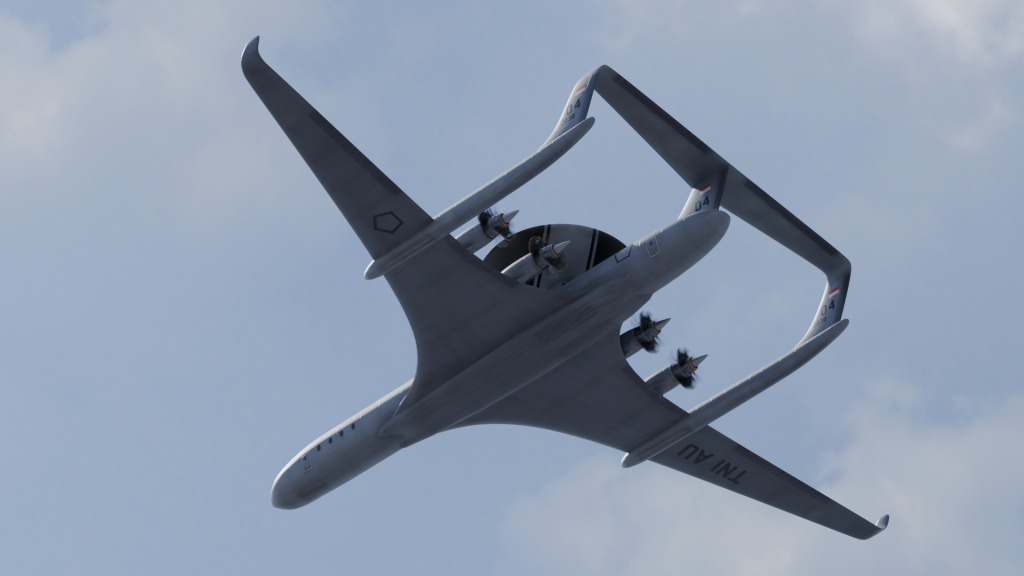
The unusual tail booms and multiple vertical stabilizers may appear excessive, but they make sense for an aircraft with distributed propulsion. The widely spaced fins improve directional stability if one of the outer propulsion units fails, while the booms themselves can accommodate high-voltage cables, cooling lines, and some of the electronic-warfare equipment.
The central vertical surface provides additional stability and carries communications antennas, while leaving the upper fuselage free for the large radar system.
From Experimental Aircraft to an Entire Family
The first civilian SE-7 takes to the air around 2036. Development of the military SE-7A begins two years later, the first prototype flies in 2041, and by the mid-2040s the Astrapia enters service.
Initially, the Air Force purchases six aircraft. They are later followed by the SE-7M maritime-patrol aircraft, the SE-7R electronic-intelligence variant, and an airborne command-post version. The civilian airframe thus becomes the basis for an entire family of special-mission aircraft.
It should be noted that while hybrid aircraft today still seem somewhat futuristic and associated with the distant future, experimental machines — and even the first production designs — already exist. By the late 2040s, hybrid propulsion could well become commonplace and perhaps even form the backbone of passenger aviation fleets. In that case, a giant propfan-powered aircraft would no longer look exotic in the second half of the 2040s; it could simply represent standard global aviation practice. At least, that is how many futurists and aerospace researchers envision the industry’s development.
What Could the SE-7A Astrapia Look Like?
Based on the chosen configuration and the aircraft’s intended role, its approximate specifications could be as follows:
- crew — 2 pilots and 10–14 mission operators;
- length — approximately 35 m;
- wingspan — 47–49 m;
- maximum takeoff weight — approximately 60 tonnes;
- powerplant — 2 gas-turbine generators rated at 8–10 MW each;
- propulsion — 4 electric propfans rated at 3–3.5 MW each;
- maximum speed — approximately 730 km/h;
- cruising speed — 630–660 km/h;
- patrol speed — 450–500 km/h;
- service ceiling — approximately 12,000 m;
- ferry range — 7,500–8,000 km;
- endurance — up to 15 hours;
- typical patrol radius — 1,800–2,200 km;
- detection range against a large high-altitude target — up to 600–650 km;
- estimated fighter detection range — approximately 400–450 km;
- number of simultaneously tracked targets — more than 1,000.
But the Astrapia’s most important parameter would not even be its radar range.
It would be time.
The aircraft could fly more than a thousand kilometers from its base, remain on patrol for several hours, and only then return home.
For an archipelago stretching more than five thousand kilometers from west to east, this capability would be difficult to overestimate.
The Tiger Truly Awakens
A country can purchase several dozen modern fighters and significantly increase the combat potential of its air force.
But developing its own AEW&C aircraft represents an entirely different level of technological maturity.
Such a project requires advanced aircraft manufacturing, radar technology, computing, power systems, software, secure communications, and the ability to integrate all of them into a single operational complex.
That is why the SE-7 Astrapia, more than any fighter, illustrates what Indonesia’s real awakening could look like.
By the middle of the 21st century, the country would no longer merely purchase foreign military hardware. It would build its own airborne information infrastructure and gain the ability to monitor the airspace hundreds of kilometers beyond its islands.
Only then would the “sleeping tiger” cease to be merely a major economy located between two oceans.
It would finally open its eyes.
A Necessary Afterword
It should be emphasized that the SE-7 Astrapia is not a real project of the Indonesian aerospace industry. The aircraft is an imaginative concept exploring one possible direction for future aviation. Its unusual configuration — four open propfans, a multi-boom tail arrangement, and a large radar radome — served as the starting point for this technical alternative-history scenario.
All information in this article concerning the development of the civilian SE-7, the SE-7A program, its development timeline, hybrid propulsion system, onboard electronic suite, and performance characteristics represents a reconstruction of what such an aircraft might look like if a program of this kind were actually launched in Indonesia.
Link – https://www.reddit.com/r/ImaginaryAviation/comments/1wxfcjx/se7_astrapia_by_me/