Behind the Iron Curtain: What the DPRK Army’s New APCs Are Hiding—First Details on Classified Equipment

Today will be something of an impromptu “APC Day,” as news has broken about three new combat vehicles of this class from different countries all at once, and the first one in our review will be the latest APC from North Korea.
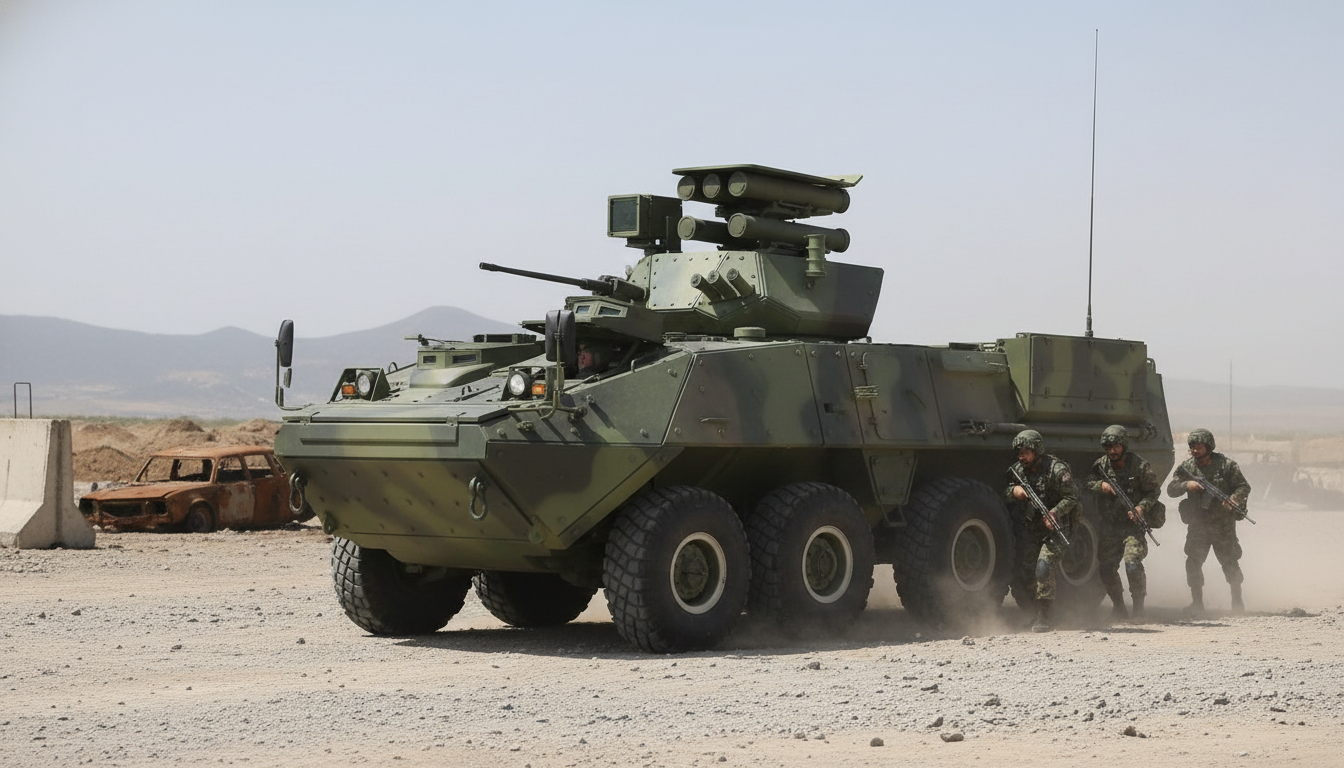
This is an unofficial rendering; the appearance of the new armored personnel carrier remains unknown. It is a neural network-generated image based on the latest North Korean developments in the field of wheeled armored vehicles.
The Evolution of North Korean Wheeled Armored Personnel Carriers
In recent years, the army of the Democratic People’s Republic of Korea has been actively modernizing its fleet of armored vehicles. While the DPRK previously relied mainly on copies of Soviet designs, it is now developing its own vehicles with unique capabilities. Particular attention is being paid to wheeled armored personnel carriers, which play a key role in infantry mobility and the delivery of weapons to the battlefield.
The M-2010 Armored Personnel Carrier — A Major Upgrade of the Soviet Legacy
For a long time, the North Korean army’s main wheeled armored personnel carrier was a copy of the Soviet BTR-80, designated the M-2010 or Chunma-D (Chonma-D). This vehicle was first unveiled at a parade in 2010 and is essentially a direct copy of the Soviet original, with only minor modifications.
The M-2010 retained the 8×8 configuration and amphibious capabilities of its prototype. The vehicle is equipped with an 8-cylinder V-type diesel engine with a power output of 240–260 l.s., which provides a highway speed of up to 80–90 km/h and a range of about 600 kilometers. Its armament includes twin 14.5-mm KPU machine guns and a 7.62-mm machine gun mounted in a turret resembling that of the PT-76B.
TTX M-2010:
- Combat weight: approximately 13.5 metric tons
- Crew: 3 people
- Landing party: 7 people
- Engine: diesel, 240–260 l.s.
- Maximum speed: 80–90 km/h on the highway, 10 km/h while afloat
- Range: 600 km
- Armament: 2 × 14.5-mm KPU machine guns, 1 × 7.62-mm machine gun
M-2020 — The Answer to the American Stryker
A major breakthrough in North Korean armored vehicle manufacturing occurred in 2020, when the all-new M-2020 wheeled armored personnel carrier was unveiled for the first time at a military parade marking the 75th anniversary of the Workers’ Party of Korea. This vehicle is not merely a copy, but an attempt to create a modern platform capable of competing with the best Western models.
The M-2020’s exterior is clearly inspired by the American Stryker armored personnel carrier—it has the same 8×8 wheel arrangement, a similar hull profile, and a similar layout. However, North Korean engineers have made their own modifications, adapting the vehicle to local requirements and manufacturing capabilities.
The M-2020 was conceived not merely as an armored personnel carrier, but as a versatile combat platform capable of carrying a variety of weapons—from anti-tank missile systems to heavy artillery systems. This approach allows for standardized production and simplifies logistics within the military.
Anti-tank variant with a combat module
One of the most interesting variants of the M-2020 is a specialized anti-tank version equipped with a powerful combat module. Mounted on the roof of this vehicle is a rotating platform equipped with a 30-mm automatic grenade launcher and five laser-guided anti-tank missiles with tandem warheads.
Based on their specifications, these ATGMs are considered the North Korean version of the Russian 9K135 “Kornet” system, although some experts initially believed them to be a copy of the 9M113 “Konkurs.” However, analysis of photographs from the “Self-Defense 2021” exhibition and subsequent demonstrations confirmed that this is indeed a more powerful system capable of engaging modern tanks at long ranges.
A video shown at a weapons exhibition in 2023 demonstrated the system’s maneuvering and firing capabilities, confirming its readiness for combat deployment. Furthermore, in August 2023, North Korean media reported that Kim Jong-un personally inspected the factory producing these vehicles and even drove one of them himself.
Technical Specifications of the M-2020 Anti-Tank Variant:
- Wheel configuration: 8×8
- Armament: 1×30-mm automatic grenade launcher, 5×ATGMs
- ATGM type: laser-guided, tandem warhead
- Field of Fire: Turret Rotation
Mobile Artillery on an M-2020 Chassis
An even more impressive variant was the self-propelled artillery system based on the M-2020. It was first unveiled at the 2020 military parade and immediately caught the attention of experts with its unusual design. A 122-mm D-30 howitzer with a turret-mounted configuration is mounted on the armored personnel carrier’s chassis.
This vehicle, nicknamed the “Korean Stryker” or “North Korean Centauro” by enthusiasts, has sparked debate over its combat effectiveness. Some experts have expressed doubts about the chassis’s ability to withstand the recoil of a 122-mm gun, especially considering that the American Stryker MGS is armed with a 105-mm gun, while the Russian “Sprut-SD” with a 125-mm gun uses special recoil-reduction systems.
In 2024, an upgraded version of a mobile artillery system with a turret resembling the Italian Centauro system was showcased at the Defence Development exhibition. And in October 2025, at the “Defense-2025” exhibition, an actual combat vehicle—not just a mock-up—was presented.
Technical Specifications of the Mobile Artillery System:
- Chassis: M-2020 8×8
- Armament: 1×122-mm D-30 howitzer
- Tower type: turret, with an automatic loading system
- Ammo capacity: increased compared to the 2020 version
Production and Deployment
It is important to note that North Korea has not only developed new models of military equipment but has also established their mass production. In May 2025, Kim Jong-un visited an armored vehicle manufacturing plant, confirming the seriousness of the country’s intentions to equip the army with new vehicles.
According to intelligence reports, North Korea plans to supply Russia with between 50 and 100 units of armored vehicles, including M-2010 (Chunma-D) tanks and M-2020 armored personnel carriers. This indicates that production has reached a sufficient level to fulfill export orders.
In addition, in August 2023, the official name of the new vehicle—the “multi-purpose combat armored vehicle”—was confirmed, underscoring its versatile nature.
Prospects for Development
Various specialized variants have already been developed and are continuing to be developed based on the M-2020 platform. In addition to the aforementioned anti-tank and artillery systems, command and control vehicles, reconnaissance vehicles, and other variants are expected to be introduced.
It is interesting to note that several new models of ground combat equipment were showcased at the “Defense 2025” exhibition in Pyongyang, which indicates a systematic approach to the modernization of the armed forces.
Particular attention is being paid to increasing firepower. For example, one of the variants is equipped with a combat module capable of destroying any modern Western tank, including the Leopard 2, M1 Abrams, and K2 Black Panther.
Conclusion
The introduction of the new M-2010 and M-2020 armored personnel carriers marks an important milestone in the development of North Korea’s defense industry. While the M-2010 was a relatively simple copy of the Soviet BTR-80, the M-2020 demonstrates efforts to create a modern platform of its own that is on par with the best Western models.
The versatility of the M-2020 chassis allows for the development of various combat vehicles based on it, which significantly increases the flexibility of the DPRK’s armed forces. The presence of anti-tank missile systems and mobile artillery on a single platform simplifies logistics and maintenance of equipment within the troops.
Although the exact tactical and technical specifications of these vehicles remain classified, the available information suggests that North Korea is significantly modernizing its ground forces, focusing on mobility and firepower.