Wolf to Replace Bradley: Why the U.S. Army Wants an IFV with a Two-Person Crew and a 50 mm Cannon

The new American Wolf infantry fighting vehicle has one fewer crew member than the Bradley. Yet the remaining two will have more to do: drive the vehicle, find targets, fire weapons, monitor their surroundings, and operate drones. General Dynamics expects automation and a redesigned crew station to help them manage the workload. How well these elements work together will help determine the fate of a vehicle competing to replace one of the world’s best-known IFVs.
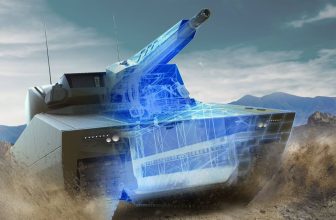
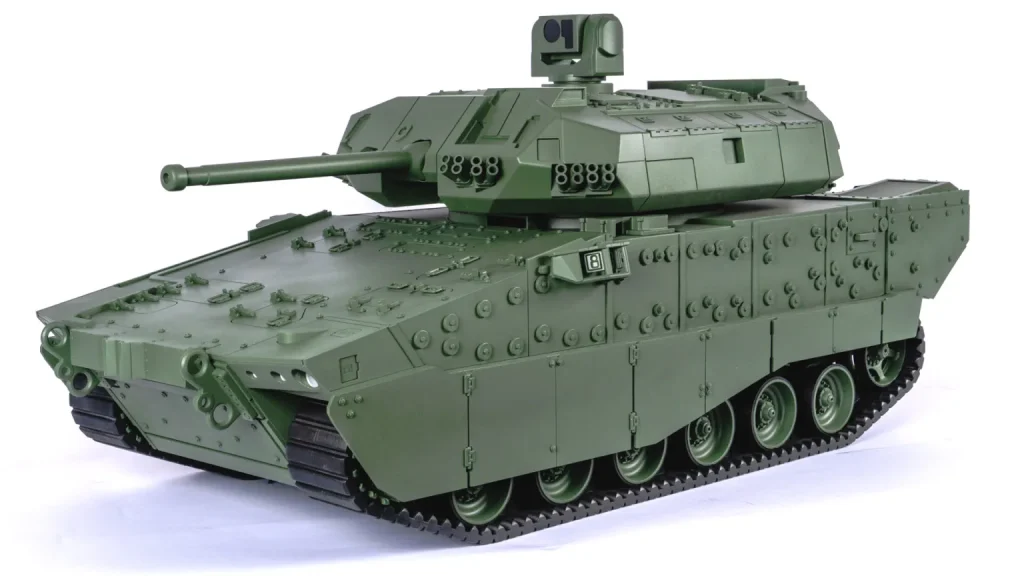
In October 2026, the company unveiled the complete Wolf design at AUSA — initially as a 1:8-scale model. A full-sized prototype already exists: the first vehicle was delivered to the U.S. Army at Aberdeen Proving Ground on 21 August. While the exhibition model introduces the public to its appearance, the real Wolf is undergoing testing.
Why Bradley Needs a Successor
The Bradley can continue receiving upgrades for years: new sights, stronger protection, and additional electronics. But every addition demands space, electrical power, and cooling. A hull designed for the equipment of an earlier era gradually becomes crowded with new requirements.
The XM30 programme aims to give the Army a platform with room for further development. Wolf is General Dynamics Land Systems’ entry in the competition. The other contender is an American Rheinmetall vehicle based on the Lynx. A winner has yet to be selected.
An open, modular architecture is central to the XM30 approach: hardware and software should be designed for upgrades throughout the vehicle’s service life. The Army’s programme office explicitly links XM30 development to modularity and digital engineering, while GDLS says it incorporated these principles into Wolf from the outset.
For an IFV expected to serve for decades, this is a practical concern. It needs one set of sensors and communications equipment today, and another ten years from now. If every upgrade requires extensive redesign, a new vehicle can begin ageing surprisingly quickly.
From Griffin to Wolf
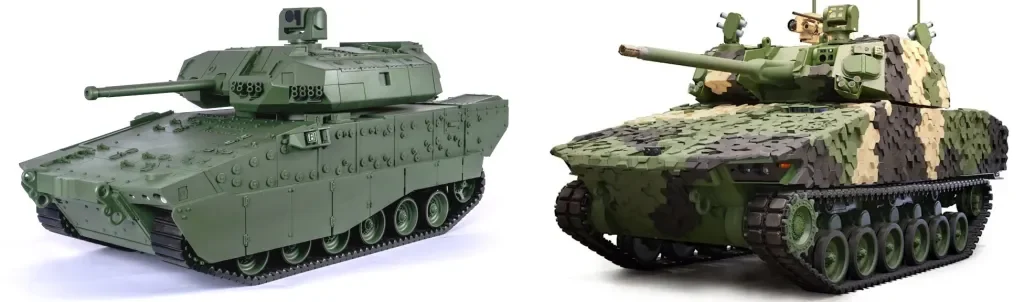
Wolf evolved from the Griffin III demonstrator unveiled in 2018. The current vehicle, however, differs substantially from its predecessor. The turret is flatter and differently shaped, the hull has been redesigned, and side skirts have been added. The main armament sits in a remotely operated turret, while both crew members occupy the hull. Behind them is a compartment for six dismounts.
This layout separates the crew from the space occupied by the weapons. It also makes them much more dependent on cameras and sighting systems. A commander seated deep inside the hull needs a clear enough view of the outside world to understand events quickly.
Wolf has a camera system providing all-round visibility. The intention is to help both the crew and the infantry see what is happening around the vehicle while remaining under armour.
That is useful before dismounting, too. A soldier about to leave the vehicle should ideally know where cover lies, which way the vehicle is facing, and what is beside it. But the quality of such a system is determined by more than the number of cameras: the picture must remain useful amid movement, vibration, dust, and poor visibility.
Two People to Run the Entire Vehicle
The driver and commander, who also serves as gunner, sit side by side. Reducing the crew is one of the project’s boldest features. In Bradley, three people divide driving, observation, and weapons operation; in Wolf, that workload falls to two.
It is easy to imagine a difficult moment: the vehicle is manoeuvring, the commander is selecting a target, a new order arrives over the radio, and the sensors report another threat. Adding several screens is relatively straightforward. Ensuring that a person notices the most important information in time is much harder.
The interface and automation therefore become part of the IFV’s combat capability. The Army tested XM30 design solutions with soldiers early in development, before the current prototypes appeared. Such evaluations help establish whether the system is convenient for the people who will have to use it inside a confined hull.
A two-person crew also faces demands outside combat. The vehicle must be maintained, prepared for missions, and repaired. Automation can make finding a target easier, but inspecting the running gear and fixing faults still require human hands.
Why an IFV Needs a 50 mm Cannon
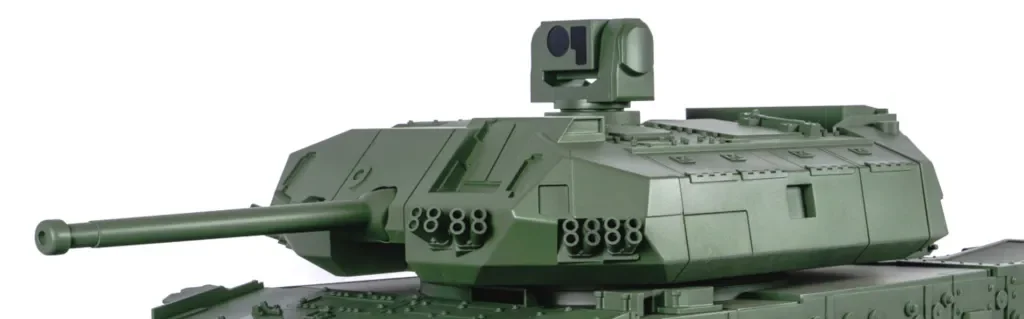
Wolf’s main weapon is Northrop Grumman’s XM913 automatic cannon, firing 50×228 mm ammunition. The manufacturer places it in the Bushmaster family and specifies the ability to fire both while stationary and on the move.
Compared with Bradley’s 25 mm cannon, the larger calibre provides more space within the projectile for its payload and more sophisticated components. Northrop Grumman is also developing medium-calibre ammunition with programmable airburst and proximity-fuzing capabilities.
The purpose of programmable airburst is clear without a ballistics table: the projectile should explode at a selected point, such as near cover, rather than merely strike the ground nearby. Its effectiveness nevertheless depends on the entire system — target detection, range measurement, fire control, and the ammunition itself.
A larger calibre comes at a cost. Bigger rounds take up more room, while the weapon places greater demands on the turret and ammunition feed. The choice of cannon therefore cannot be separated from ammunition capacity. Sufficient public information about Wolf’s ammunition load is not yet available.
The vehicle is also intended to integrate Switchblade 300 loitering munitions, extending its ability to engage targets beyond direct line of sight.
A Hybrid System Helps Even While Parked
Wolf uses a hybrid powertrain. Its stated capabilities include operating surveillance systems with the main engine switched off. For an electronics-heavy IFV, this is a significant advantage: sights, communications equipment, and computers continue consuming power even when the vehicle is stationary.
Additional electrical capacity also allows for future equipment. But batteries, power electronics, and cooling become important vehicle systems in their own right. Fuel savings and reduced noise must justify the added complexity.
Wolf’s protection cannot be assessed from the exhibition model either. Additional skirts are visible, but they do not reveal the resistance of the hull, turret, or roof. XM30 calls for improved active and passive protection; the specific capabilities will have to be established through testing.
According to an estimate reported by TWZ, both competing prototypes have combat weights in the region of 50 tonnes. This is not yet a final specification for Wolf, but it indicates the vehicle’s scale: this is a heavy IFV for which bridge capacity, transportation, and recovery matter.
What Wolf Must Prove
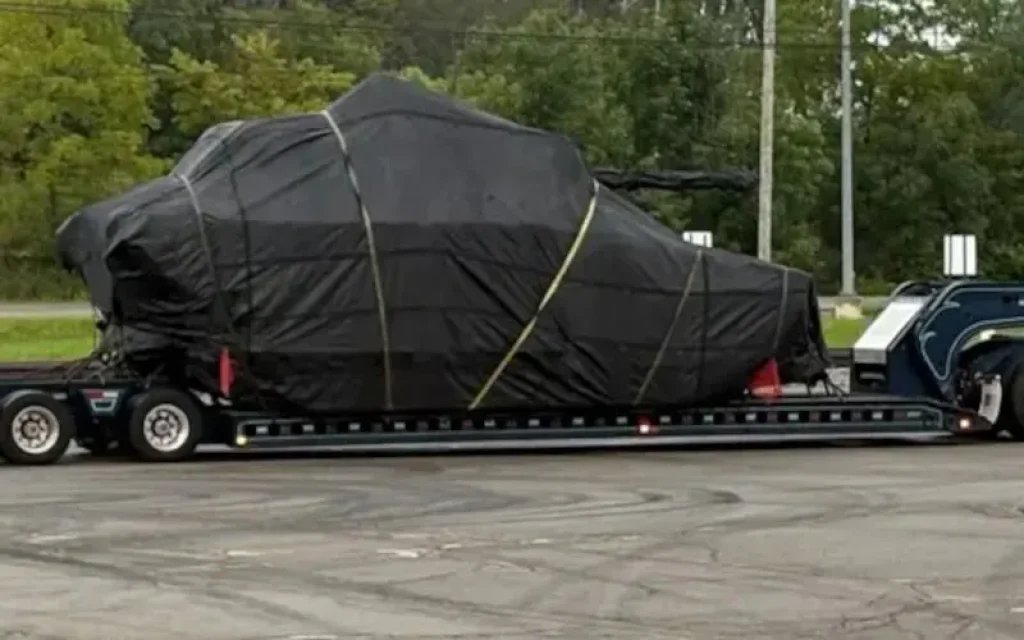
The vehicle already has one crucial distinction from the many “IFVs of the future” seen in impressive illustrations: a completed prototype has been delivered to the customer. Precise figures for protection, mobility, ammunition capacity, and cost nevertheless remain insufficient to paint a definitive picture of the production version.
Wolf must demonstrate that two people can manage its equipment, that the hybrid powertrain can withstand field use, and that the new layout benefits both the crew and the infantry. Ultimately, what matters most is how these features work together.
At an exhibition, visitors look at the vehicle from the outside. On the proving ground, soldiers will look out from within — through its cameras and sights. That is where the new Wolf will show how well it can see, move, and follow commands.