China's "Bohai Sea Monster" has reappeared—and now it looks like a spaceship of the future

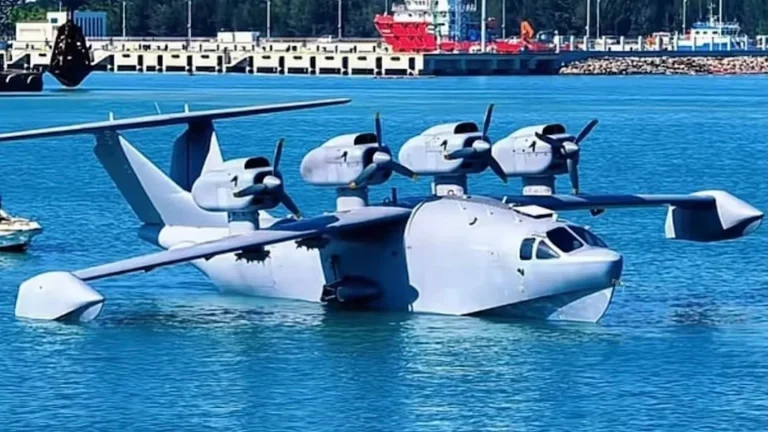
The Chinese ground-effect vehicle, unofficially nicknamed the “Bohai Sea Monster,” has reappeared in new photos—and it’s now clear that this is likely not a strange experimental transport vehicle at all. In the new photos, full-fledged underwing suspension points were spotted on the vehicle, which immediately raised the key question: Is China trying to revive one of the craziest Cold War concepts—an armed ground-effect vehicle?
And if that’s really the case, then the story becomes much more interesting than just another “exotic Chinese development.”
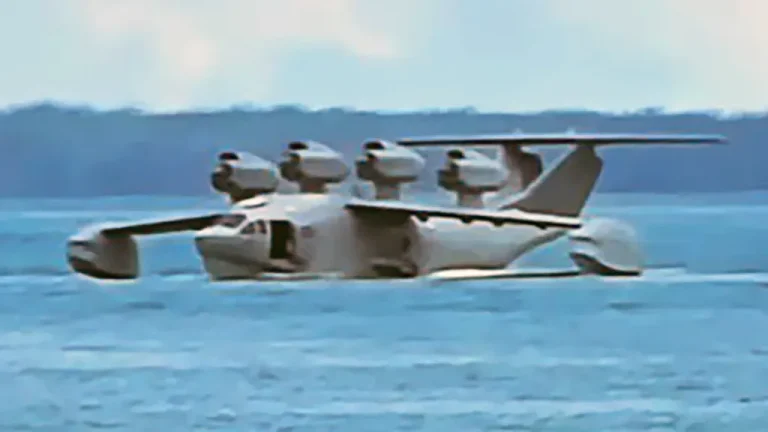
Because ekranoplans have always been a technology straight out of an alternate history. Huge machines flying just a few meters above the water at the speed of an airplane, yet remaining below the radio horizon. In the USSR, they were considered a potential weapon for future naval warfare. Then the Soviet Union collapsed—and with it, it seemed, the very idea died.
But now it seems that China has decided to try again.
The Strangest Technology of the Cold War
The history of ekranoplans generally seems like a mix of engineering genius and technical madness.
The idea itself originated in the first half of the 20th century, but it was the Soviet Union that turned it into a veritable cult. Soviet engineers took note of the so-called “screen effect”—a phenomenon in which an airplane flying very low over the water’s surface gains additional lift thanks to an air cushion between the wing and the water.
The result was an extremely strange machine.
Not quite an airplane.
Not quite a ship.
And not quite a hovercraft.
The ekranoplan could speed across the water at hundreds of kilometers per hour, while remaining literally just a few meters above the sea surface. And most importantly, it could stay below the radio horizon of most shipborne radars.
For the Cold War, it seemed like the nearly perfect breakthrough weapon.
That is precisely why the USSR began building gigantic machines like the KM—the famous “Caspian Monster”—which shocked American intelligence so much that CIA analysts at first had no idea what they were looking at in the satellite images. Later came the “Lun” ekranoplan—already a fully-fledged anti-ship missile carrier.
But then the Soviet Union collapsed.
And with him, most of the Soviet ekranoplan projects also came to an end.
China Unexpectedly Revives an Old Soviet Dream
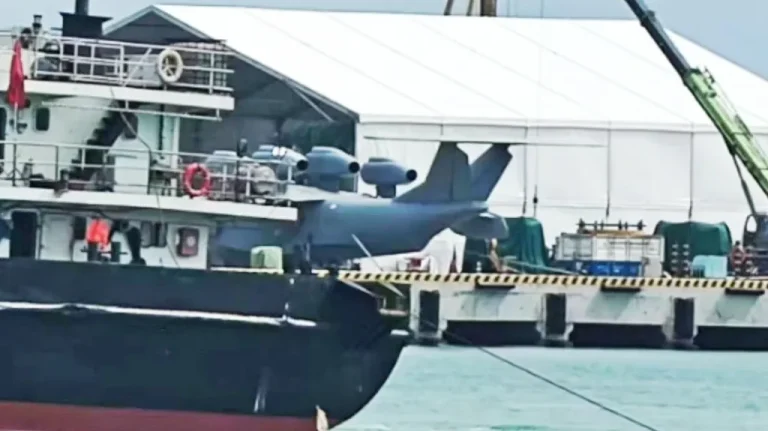
The first images of the “Bohai Sea Monster” appeared as early as 2025. At that time, analyst H.I. Sutton spotted an extremely unusual vehicle at one of the Chinese piers—it had a hydrofoil hull, a massive V-shaped tail, and a high-mounted wing.
At first, many people didn’t even understand what it was.
Some speculated that it was a seaplane.
Others thought it was a transport platform.
Still others believed it was a technology demonstrator.
But the new photos have drastically changed how the project is perceived.
Now it was clear:
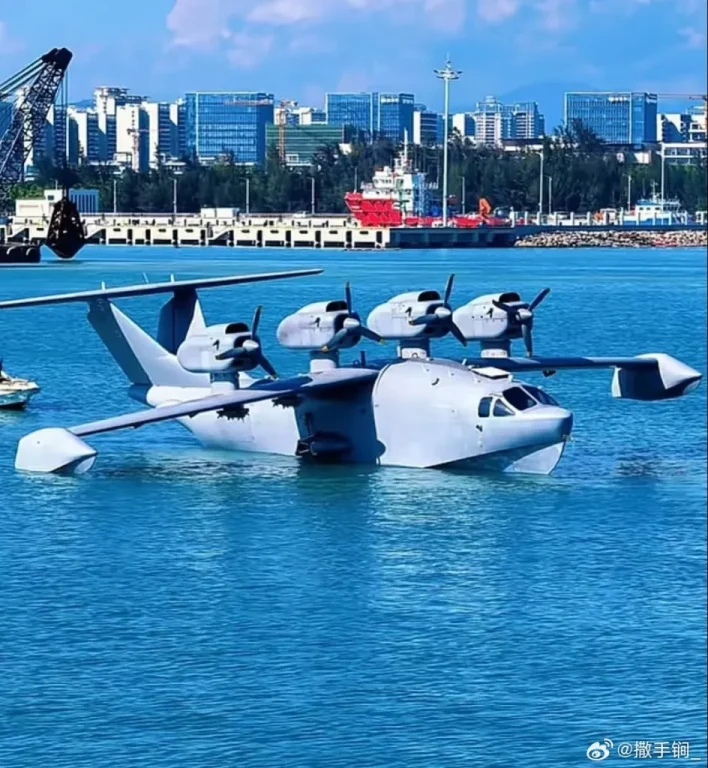
four turboprop engines,
full-size propellers,
and most importantly, underwing pylons for mounting external payloads.
And this is where things really get interesting.
Because transport aircraft generally don’t need suspension points under the wings.
But anti-ship platforms—they really do need them.
The Little “Lun” of the 21st Century
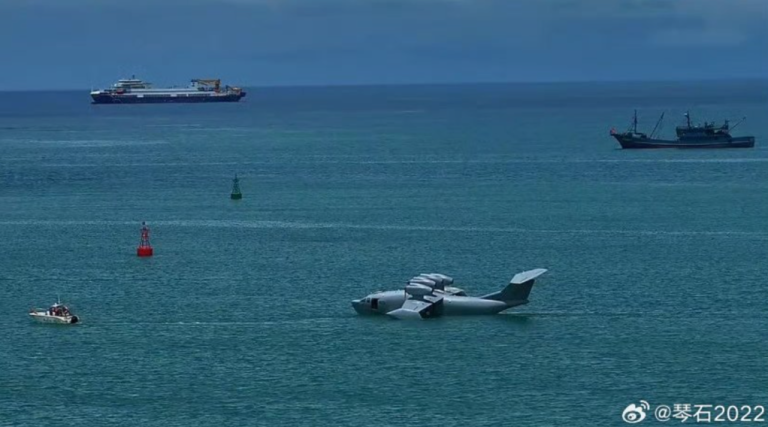
From a technical standpoint, the Chinese ground-effect vehicle looks extremely unusual even today.
The aircraft uses the WIG (Wing-In-Ground effect craft) design. This means it flies just a few meters above the water, using the ground effect to increase lift and reduce fuel consumption.
The design includes:
— a flying boat-type fuselage,
— a high-mounted wing,
— sponsons at the wingtips,
— a combined V-tail,
— and four turboprop engines with three-bladed propellers.
Moreover, the transition to a turboprop configuration is particularly interesting.
Previously, many assumed that the Chinese were using jet engines, like those on the Soviet “Lun.” But a turboprop configuration seems far more logical for a modern design:
lower fuel consumption,
greater range,
easier operation,
lower thermal signature,
and significantly better efficiency for long-duration patrols.
In fact, China is no longer building a “Cold War monster,” but rather a more practical and versatile platform.
Why does China even need a ground-effect vehicle?
And this is where the main question arises.
Why does Beijing need such strange technology in the age of satellites, drones, and hypersonic missiles?
The answer most likely lies in the geography of the Pacific Ocean.
For China today, the main potential areas of conflict are:
— Taiwan,
— the South China Sea,
— island chains,
— and vast maritime areas with a limited number of airfields.
And the ekranoplan actually fits very well into exactly this kind of war.
It is capable of:
— quickly transporting cargo,
— operating between islands,
— flying below the radio horizon,
— avoiding some naval mine threats,
— and potentially serving as a platform for missiles, drones, or anti-submarine weapons.
Moreover, the new mounting points are a clear indication of its role as a strike vehicle.
In theory, an aircraft of this size is capable of carrying:
— light anti-ship missiles,
— torpedoes,
— depth charges,
— reconnaissance pods,
— or even attack UAVs.
In essence, China may be attempting to create a kind of “maritime strike drone carrier”—a platform for rapid warfare in coastal waters.
A vehicle that’s a cross between an airplane and a ship
There’s something else about this whole story that’s particularly interesting.
For decades, ekranoplans were considered a dead-end branch of technology.
They are too complex for the navy.
Too limited for the air force.
Too dependent on the weather.
And too vulnerable in a major war.
But the current situation is gradually changing attitudes toward them.
Today, militaries are once again looking for:
— cost-effective logistics solutions,
— platforms for warfare in the Pacific,
— ways to evade radar detection,
— and delivery systems for distributed strike systems.
And suddenly, the ekranoplan seems relevant again.
It is no coincidence that the United States also worked on similar projects as part of the Liberty Lifter program, although DARPA later shut down that project.
China, however, seems to have decided to take things a step further.
The Return of the “Sea Monsters”
It is still too early to say for certain whether the “Bohai Sea Monster” will become a fully-fledged combat platform or remain an experimental technology demonstrator.
But the very fact that it has appeared is extremely telling.
Because China is increasingly trying to find asymmetric solutions instead of simply copying American military equipment.
And the ekranoplan fits very well into this philosophy.
This is a machine designed for a specific kind of warfare:
fast,
maritime,
networked,
and focused on the vast expanses of the Pacific Ocean.
And most importantly, it marks the return of a concept that the world had considered dead for nearly thirty years.
And perhaps that is precisely why the Chinese “Bohai Sea Monster” has sparked so much interest.
Because it doesn’t look like technology from the past.
And what a very strange piece of future technology.
This material is based on publications from The War Zone, Defense Blog, analyses by H.I. Sutton, and other open sources.