The Secrets of the New Version of Russia's Fifth-Generation Fighter Jet: Details on the Su-57 Trainer Version

Although there are currently not as many fifth-generation Russian fighter jets in the Russian Aerospace Forces as one might hope (open sources claim there are just under fifty), it is already clear that this will be the Russian Aerospace Forces’ primary fighter jet for the coming decades. Furthermore, it is already certain that the aircraft will be in service in other countries as well (a contract has already been signed with Algeria).
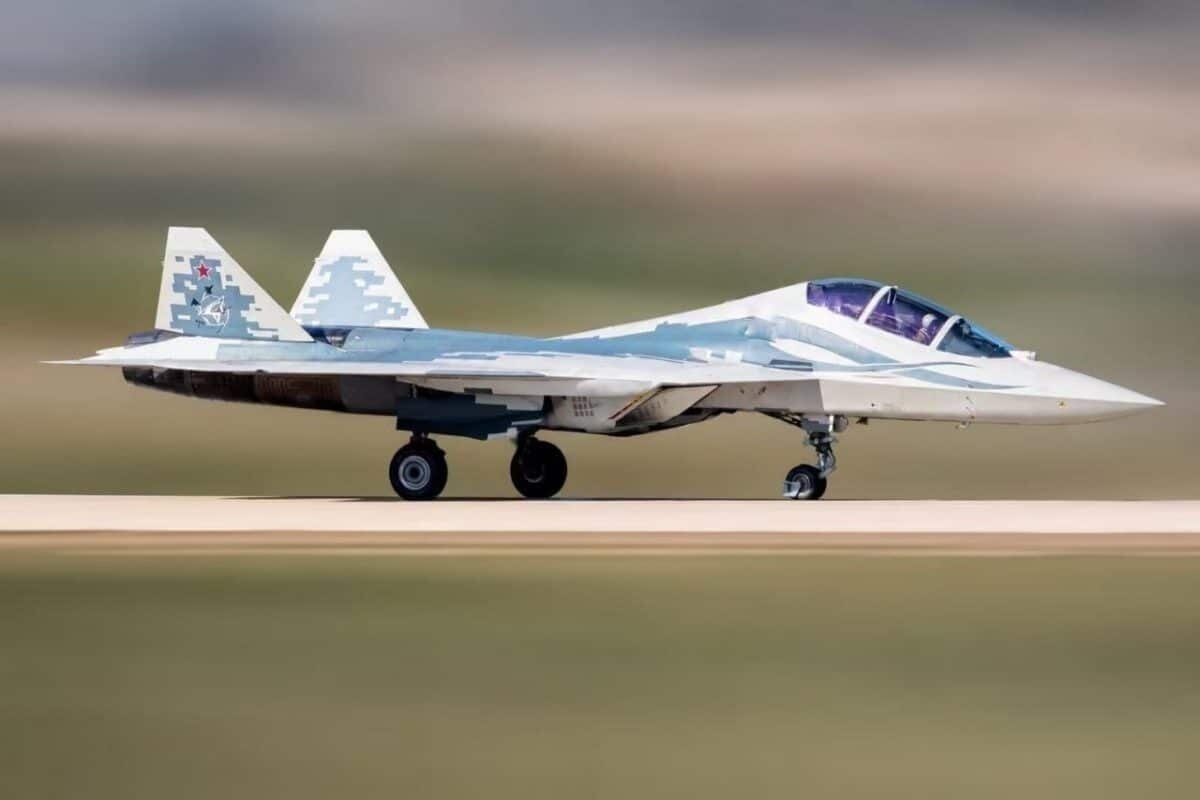
Therefore, it makes perfect sense to develop a specialized training aircraft based on the Su-57 so that future pilots can train directly on the Su-57 without having to retrain from one model to another. And this step has been taken—a photo of a Su-57 with a two-seat cockpit has surfaced online. The designation of the new aircraft—Su-57D—has also been revealed. But let’s take it one step at a time.
Initial Tests
According to a report by the popular Telegram channel Fightbomber, taxi tests have begun in Russia on a two-seat version of the Su-57 featuring a new cockpit. A modified single-seat T-50-4 with tail number 054 was used to build the prototype. On May 16, 2026, the aircraft began taxiing tests—this is the first practical step toward creating a fully-fledged training and combat aircraft.
Why do we need a two-seater version?
The primary purpose of the Su-57D is pilot training. The presence of a second seat will make it safer to train pilots to fly this high-tech, next-generation fighter, reducing the risks associated with learning to fly the aircraft on their own.
The Su-57 is an extremely complex aircraft system that combines:
- Stealth Technologies
- Superior Maneuverability
- Multifunctional onboard electronics
- The Latest Weapons Systems
Learning to fly this type of aircraft “from scratch” is an extremely difficult task for pilots, even those with experience flying previous-generation fighter jets. The two-seat version will allow the instructor to sit directly in the cockpit, monitoring the cadet’s actions and taking control if necessary.
External Changes
Judging by the published photograph, the Su-57D’s most notable external feature is its enlarged cockpit, which has altered the shape of the forward fuselage. To accommodate a second crew member, the designers had to significantly redesign the nose section of the aircraft, which inevitably affected its aerodynamic characteristics.
Official specifications for the new version have not yet been released. We can assume that:
- The increased weight and modified aerodynamics may slightly reduce flight performance compared to the single-seat version
- The portion of the interior space that previously housed fuel or equipment is now designated as a second workstation
- It is likely that a complete set of onboard equipment for training in the use of the systems has been preserved.
Export Potential
The two-seat version could boost the aircraft’s appeal to export markets, as many foreign customers are interested in combat trainer variants.
A contract with Algeria has already been signed, and that country will likely become the first foreign operator of the Su-57. The availability of a training version will significantly simplify the training process for Algerian pilots, who will not have to learn to fly the new aircraft exclusively on single-seat variants.
Other potential buyers, such as India (which views the Su-57E as a strategic option), have also traditionally shown interest in two-seat versions of fighter jets.
Historical Context
The Su-57 will be the second fifth-generation fighter to have a two-seat variant. The first was the Chinese J-20, in its J-20S version, which was first spotted in 2021.
The development of a two-seat version is an indicator of the program’s maturity. Typically, countries begin developing training variants after the fighter’s main version has proven its capabilities and entered mass production.
Outlook
The introduction of the Su-57D opens up new possibilities:
- Speeding up pilot training—the process of mastering the fifth-generation fighter will become safer and more efficient
- Practicing tactical maneuvers—the second cockpit can accommodate not only an instructor but also a weapons systems operator, which expands the aircraft’s tactical capabilities
- Development of specialized variants—based on the two-seat version, aircraft could be developed in the future to test new weapons systems, reconnaissance variants, or even unmanned versions with the capability for piloted control
Conclusion
The introduction of the two-seat Su-57D marks an important milestone in the development of Russia’s fifth-generation fighter program. The aircraft will not only simplify pilot training for the Russian Air Force but also enhance the system’s export appeal.
Given that the Su-57 will remain the Russian Air Force’s primary fighter for decades to come, the investment in establishing a full-fledged training facility is fully justified. The first ground-running tests are just the beginning. Next up are flight tests, government trials, and, we hope, the aircraft’s prompt delivery to the training centers of the Russian Aerospace Forces.
The world of military aviation continues to evolve, and Russia is demonstrating its commitment to improving its cutting-edge technologies, making them easier to adopt and more attractive to foreign partners.