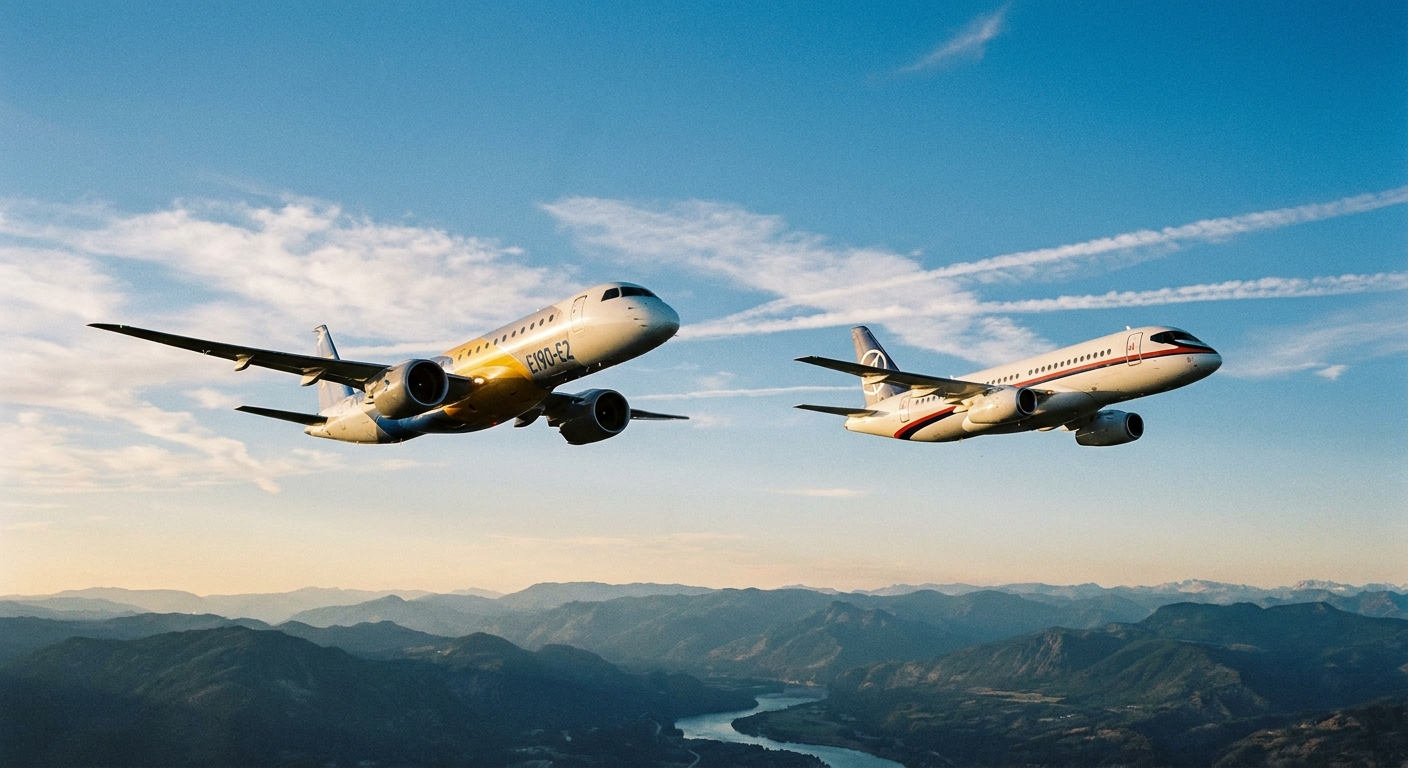
A showdown between second-tier aircraft. The Brazilian Embraer E190-E2 outperforms the “Superjet” in almost every respect. But there is potential

When we compare promising Russian aircraft with Boeings and Airbuses and conclude that our Western competitors are superior to our new models, it doesn’t really stir up any particularly negative feelings in anyone. What did you expect? They are the global leaders in passenger aviation. But the aircraft from the Brazilian company Embraer are a completely different story. They are equally ambitious newcomers, and it is with them that Russian aircraft will have to compete first and foremost. That’s why a comparison with the Brazilian counterpart is more important. So what exactly is the Brazilian counterpart to the Russian SJ-100—the Embraer E190-E2?
Fuel Efficiency: Where the Grams Go
Fuel efficiency is one of the key metrics for an airline. The Russian SJ-100, equipped with domestically produced PD-8 engines, achieves a fuel consumption rate of approximately 16–18 grams per passenger-kilometer. The Brazilian Embraer E190-E2 achieves 13–15 g/passenger-km. The difference may seem small, but over the course of a year of fleet operation, it translates into millions of dollars in savings. The secret to the Brazilian aircraft’s efficiency lies in its new Pratt & Whitney PW1900G geared turbofan engines and carefully optimized wing aerodynamics. That is precisely why, in the fuel efficiency category, Embraer confidently takes the lead.
Flight Range: The Farther You Fly, the Stronger You Are
The ability to fly longer routes without refueling is a significant competitive advantage. The Embraer E190-E2 has a range of up to ~4,500 kilometers, allowing it to confidently serve not only regional but also medium-range transcontinental routes. The Russian SJ-100, according to current estimates, is designed for distances of 3,000–3,200 kilometers. This makes it an excellent solution for short- and medium-haul regional networks, but limits its ability to expand its flight range. In the second round of the comparison, the Brazilian airliner once again comes out on top.
Capacity: More Seats Mean Better Economics
The number of passengers on board directly affects the flight’s profitability. The Embraer E190-E2 can accommodate up to 114 passengers in a single-class configuration, which boosts its revenue per seat. The SJ-100 carries between 87 and 103 passengers, maintaining its compact size and maneuverability but falling short in terms of maximum load factor. For airlines operating on heavily trafficked routes, this factor can be decisive. The score in this category is 0–3 in favor of the Brazilian manufacturer.
Speed and Cruising Mode: Parity in the Sky
In terms of cruising speed, the competitors show virtually identical performance. The SJ-100 reaches speeds of 870–900 km/h, and during flight tests with PD-8 engines, it achieved a record 990 km/h. The Embraer E190-E2 maintains a speed of 870 km/h. The difference is minimal, and in actual operation, both aircraft fly within the same speed range, offering passengers the same level of comfort in terms of travel time. In this round—a well-deserved tie.
Operations and Infrastructure: Experience vs. Prospects
This is where one of the most challenging aspects of the comparison lies. The Embraer E190-E2 is a mature platform with a proven track record, a global network of service centers, and a well-established spare parts supply chain. Airlines around the world have already accumulated thousands of flight hours on these aircraft. The Russian SJ-100 is just entering a new phase: the gradual introduction of the PD-8 engine, the development of a domestic maintenance ecosystem, and personnel training. At present, the Brazilian airliner still holds the advantage in terms of reliability and operational predictability. However, the Russian project has an important trump card—the ability to create an architecture that is completely independent of Western supplies, which, in today’s geopolitical climate, could be a decisive factor for a number of operators.
Technical and Tactical Specifications
Embraer E190-E2:
- Length: 36.2 m
- Wingspan: 33.7 m
- Height: 11.0 m
- Engines: 2 × Pratt & Whitney PW1900G, thrust 85–102 kN
- Cruising speed: 870 km/h
- Range with maximum payload: up to 5,300 km
- Maximum flight altitude: 12,000 m
- Capacity: up to 114 passengers
- Fuel consumption: 13–15 g per pass-km
SJ-100 (with PD-8 engines):
- Engines: 2 × PD-8, thrust ~78 kN
- Cruising speed: 870–900 km/h (up to 990 km/h during testing)
- Range: 3,000–3,200 km
- Capacity: 87–103 passengers
- Fuel consumption: 16–18 g/pass-km
Outlook: Why a 4-1 Score Isn’t a Death Sentence
The final score in our comparison is 4:1 in favor of the Embraer E190-E2. The Brazilian airliner does indeed outperform its Russian counterpart in key operational parameters. However, it would be a mistake to write off the SJ-100’s prospects. The Russian aircraft is being developed under unprecedented external pressure, and every step in its refinement is not merely a technical challenge but a matter of technological sovereignty. The PD-8 engine, domestic avionics, and adaptation to the requirements of domestic carriers—all of this combines to form a unique product that may prove in demand in markets where political risks outweigh short-term economic efficiency.
Furthermore, aviation history is full of examples where platforms that initially lagged behind their competitors eventually caught up with—and even surpassed—them through targeted modernization. The SJ-100 has time and room to grow. The key is to keep moving forward, consistently address identified shortcomings, and improve reliability. Then, in the next “battle of the second tier,” the Russian aircraft will be able not only to compete but also to contend for victory.