Dmitry Mazarchuk. To some, war; to others, a mother is dear

An article by Dmitry Mazarchuk from the WARSPOT website, dated March 4, 2019.
Constant conflicts among Italian states during the Middle Ages, frequent conspiracies and coups, as well as invasions by aggressive neighbors contributed to the growing importance of the military profession on the Apennine Peninsula. The region’s political structure and turbulent conflicts led to the proliferation of entire bands of warriors who, for a reasonable fee, could defend the interests of a particular signoria or city-state and protect them from encroachments by neighbors. In their spare time, these units would resort to plundering ordinary citizens to support themselves, bringing even greater chaos to the daily lives of peasants and townspeople. Italian rulers began to rely on the services of mercenaries, who were unconstrained by moral principles, as early as the 13th century. In the following century, mercenary units spread throughout Italy.
In a tight spot and feeling wronged
Throughout the centuries following the fall of the Western Roman Empire in 476, the concept of “Italy” remained strictly historical and geographical. Lacking political unity, the Apennine Peninsula—along with the adjacent islands of Sicily, Sardinia, and Corsica—constituted a complex mosaic of small principalities, signorias, and republics. Only the southern part of the peninsula, the Mezzogiorno, had been united within the political borders of the Kingdom of Naples since the Norman conquest in the 11th century. The rest of Italy was ruled by dukes, margraves, and lords, or was governed by republican regimes.
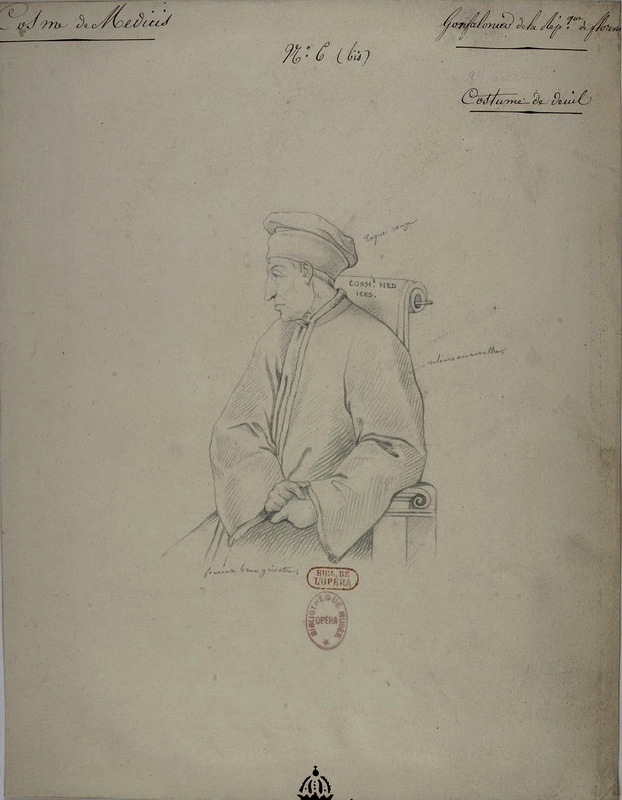
The costume of a gonfalonier of the Florentine Republic. Paul Lormier, costume illustrations for the opera *Guido et Ginevra ou la peste de Florence*, 1837–1838
Hereditary rulers took hold in many cities, bearing formal titles such as “signori,” “captains of the people,” “first citizens,” “gonfaloniers,” and so on. For example, the Visconti family ruled in Milan, the Medici in Florence, the Scaligeri in Verona, the Camino in Treviso, and the Carrara in Padua. Sometimes the signori did not possess the outward trappings of supreme power, yet their influence and patronage networks made them the de facto rulers, as was the case with the Medici family in Florence.
Small and large Italian states were constantly at war with one another or forming short-lived alliances, usually under the guise of defense. In reality, however, their goals were entirely aggressive. The Marquises of Monferrato and the Counts of Savoy vied for power over Piedmont; the Visconti family sought to subjugate all of northern Italy; the city-states of Tuscany constantly competed with one another for supremacy; feudal clans in the Kingdom of Naples challenged the ruling dynastic houses there, and the maritime trading republics of Genoa and Venice clashed in a bloody war. None of these states was able to gain the upper hand or assume a dominant position in the region. Military conflicts of varying scales flared up constantly throughout fragmented Italy, which contributed to the rise of the art of diplomacy, the development of the fiscal system, and, undoubtedly, the emergence of a professional army.
Mercenaries in Medieval Italy
The prominent modern historian M. Mallet wrote that “the history of warfare in Italy in the 14th century is filled with foreign mercenaries and adventurers.” According to another scholar, W. Caffero, “mercenaries were a defining feature of 14th-century Italian society.” Indeed, historical chronicles from Savoy and Milan in the north to Naples in the south of the Apennine Peninsula are full of references to the activities of mercenary units, the peculiarities of their way of life, and the personalities of their leaders. The role of mercenaries in the history of that time was so significant that the author of one of the chronicles remarked: “They would have conquered all of Italy if their unit had not been disbanded.”
Mercenaries is a general term for professional soldiers who earned their living through military service. They were paid by various Italian rulers and, in exchange, engaged in military operations, including battles, sieges, and raids. Often, mercenary units had to fend for themselves at their own risk. Simply put, they plundered the local population in villages and extorted money from residents in cities. Their acts of banditry are frequently mentioned in historical sources from that era.
The first mercenaries were mainly foreigners. It was more profitable for the wealthy commercial and artisan centers of Northern and Central Italy to recruit soldiers from other countries than to take the risk of entrusting their arms to their own knighthood. In the 13th and 14th centuries, Italian cities were ridding themselves of aristocratic rule en masse, and their republican authorities feared any possibility of a resurgence of the former nobility. For this reason, instead of entrusting the city’s defense to members of noble families, they entered into contracts with professional soldiers.
The history of mercenary warfare, including in Italian territories, is quite ancient. It appears that foreign mercenaries were actively recruited during the period of conflict between the Guelphs and Ghibellines in the city-states of Tuscany. For example, at the Battle of Buoncovento in 1266, French and Provençal cavalry fought on the side of the Guelphs. The armies of the pretenders to the imperial throne who invaded Italy in the first half of the 14th century included mercenaries from Germany, Brabant, and Hungary. The first known condotta (contract) with the captain of a mercenary unit dates from the period between 1260 and 1270. From that time on, it was entirely appropriate to refer to the leaders of mercenary units as condottieri.
The First Condottieri
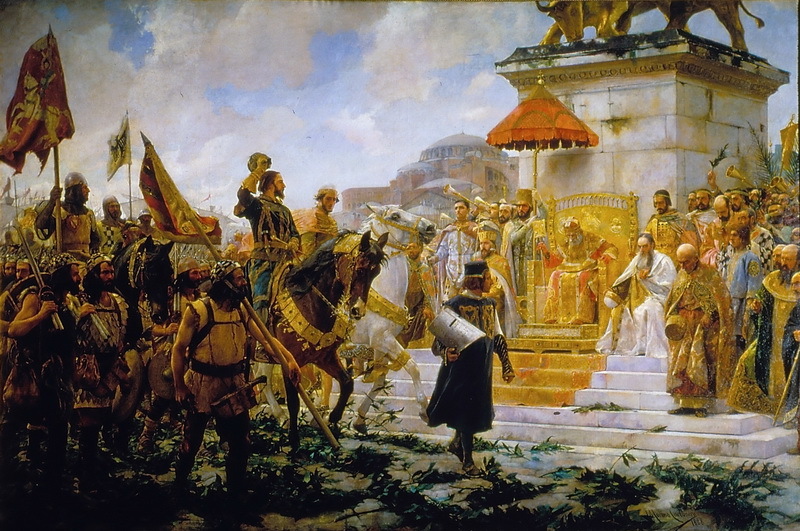
The Florentine chronicler Giovanni Villani referred to Roger Florus—a former Templar who, after the Order’s dissolution, became the leader of Catalan mercenaries in Byzantium—as the “father of the condottieri.” Researcher J. Triz agrees with this assessment, whereas, according to D. Weley, the so-called “conestabili” were the “precursors” of the condottieri. Historians J. Canestrini and D. Hay trace the history of mercenary companies in Italy back to Emperor Henry VII’s campaign in 1310. However, Michael Mallett, a recognized authority on the military history of the Late Middle Ages and the Renaissance, traces its origins to two Catalan commanders who terrorized the small states of the Apennine Peninsula at the turn of the 13th and 14th centuries.
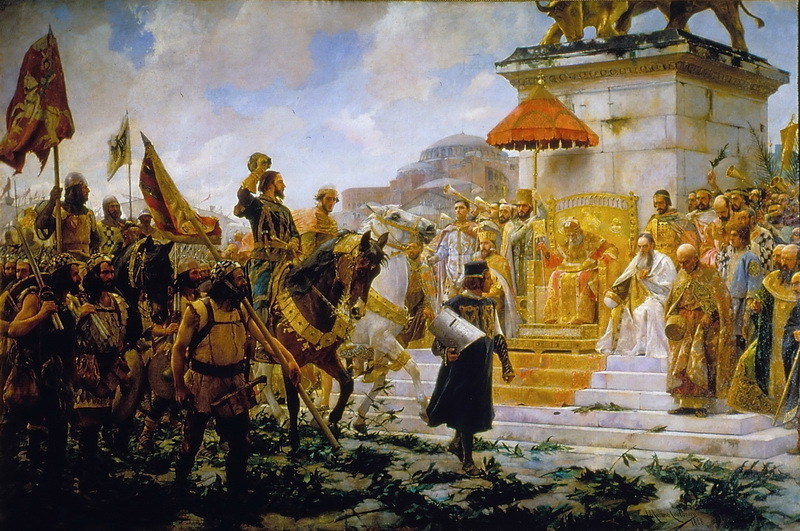
The Entry of Roger Florus into Constantinople. By José Moreno Carbonero, 1888
The first of them, Guillermo della Torre, entered the service of the Tuscan city-state of Siena in 1277. He led a group of 19 mercenaries. In the 1285 payroll register, he is already listed as the commander of 114 cavalrymen. After serving the Bolognese for some time following his service with the Sienese, della Torre entered the service of Florence and, for two years, provided garrisons for the republic’s border fortresses. Naturally, the size and composition of his unit changed over the years. It is known that in 1292, he commanded just over 100 men. The national origins of 53 of them can be identified: 28 Provençals, eight Frenchmen, two Flemings, seven Italians, seven Spaniards, and one Englishman. This motley crew was held together solely by the commander’s will and his reputation as a man capable of ensuring that his mercenaries earned their keep.
At the beginning of the next century, another Catalan—Diego de Rat—appeared in the pages of medieval chronicles. He served King Robert of Naples, and in 1305, the Florentines “borrowed” him. As it happened, Diego remained in Florence for a full eight years. The contingent under his command was larger than that of his predecessor: up to 300 cavalrymen and up to 500 infantrymen. They formed the core of the army of the Florentine Republic and the Tuscan League. Diego was such a well-known figure in the city that he became one of the heroes of Giovanni Boccaccio’s *Decameron*. The following story illustrates how the people of Florence stereotypically viewed mercenaries:
“When Messer Antonio d’Orzo (between 1309 and 1322—author’s note), a worthy and intelligent prelate, was bishop of Florence, a certain Catalan nobleman named Dego della Ratta arrived in Florence as Marshal to King Robert. Being handsome and quite the womanizer, he happened to become infatuated with one of several Florentine ladies—a very beautiful woman who was the granddaughter of the bishop’s brother. Learning that her husband, though of good family, was extremely stingy and a wretched man, he struck a deal with him: he would give him five hundred gold florins, and in return, the husband would allow him to spend one night with his wife; so, after ordering that the silver two-sold coins then in circulation be gilded, and after spending the night with his wife—though it was against her will—he gave them to him. When all this later came to light, the despicable husband suffered nothing but loss and ridicule, while the bishop, being a wise man, pretended to know nothing about any of it.”
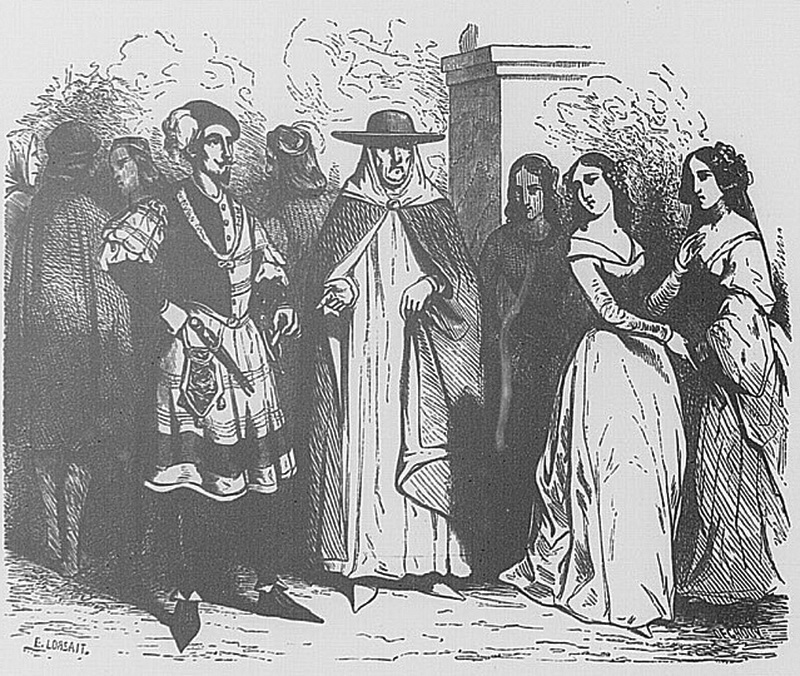
The Story of Diego de Rata and the Florentine Lady. *The Decameron* by Giovanni Boccaccio. Source: *Illustrations de Contes de Boccace*. — Paris, 1869. — p. 327.
It should be noted that one gold florin at that time was equal to 20 soldi. This story has a sequel, which anyone can read by turning to the third novella of the sixth day of *The Decameron*.
“Free Companies” of the 14th Century
At the beginning of the 14th century, organized mercenary units were not yet a common sight in Italy. It was precisely because of their exceptional and unusual nature that they found their way into the pages of historical chronicles and works of fiction. For the most part, mercenaries consisted of individual soldiers or small groups of soldiers hired to supplement the city militia of a particular Italian state. Mercenary units did not yet constitute an independent military or political force. The rise of mercenary forces and their assumption of a completely new role in the history of the Apennine Peninsula was facilitated by the Hundred Years’ War—a military conflict between the English and French kingdoms that began in 1337.
This war, which lasted for more than a century with intermittent truces and peace treaties, gave rise to a phenomenon known as bands of former soldiers. During hostilities, they were used by the opposing sides, and in peacetime they turned into robbers and looters. In France, these men were known as routiers and écorcheurs. Led by commanders such as Ségain de Badfolie, Bernard and Bertuc d’Albret, Arnaud de Servol, and others, they ravaged entire regions: Burgundy, Limousin, Auvergne, as well as the Loire and Rhône valleys. On the Iberian Peninsula, mercenary units were active during the war between King Pedro I the Cruel of Castile (1350–1369) and King Pere III the Ceremonious of Aragon (1336–1387).
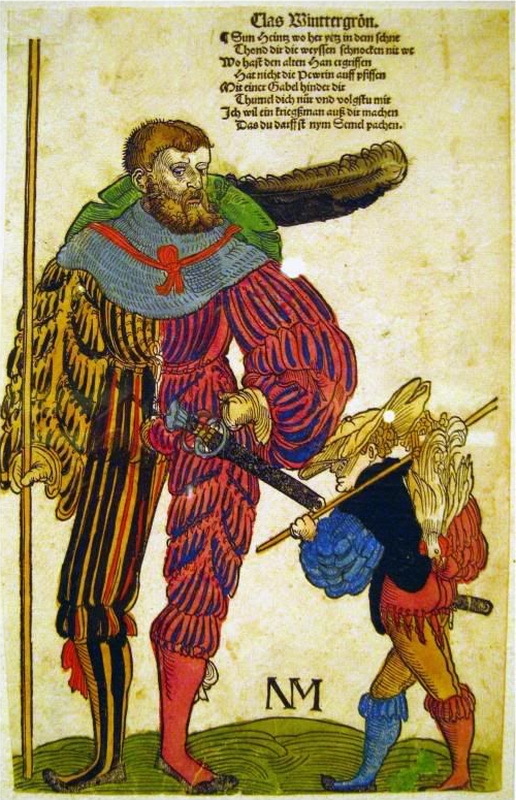
Landsknecht Klas Wintergrön with his son Heinz. Artist: Niklas Stör. Colored woodcut, ca. 1530
In Italy, they were known as “free companies” or “companies of adventurers” (compagnie di ventura), and their captains as condottieri. And it was here that they caused the most severe devastation. Italy, with its wealthy cities and the political strife among its small states, provided a particularly fertile ground for mercenaries to operate. As a result, by the mid-14th century, the Apennine Peninsula was overrun by bands of mercenaries whose path of destruction stretched from the northern borders of Savoy to the southern reaches of the Kingdom of Naples. Tuscany and Umbria—regions lying between the Visconti family’s domains in the north and the Papal States and the Kingdom of Naples in the south—suffered the most from the mercenaries.
Distinctive Features of Italian Mercenary Forces
M. Mallet identified three characteristic features of the so-called “great companies” (detachments) of mercenaries, which shaped the social and political landscape of medieval Italy for several decades.
A significant size. The number 100—the size of Guillermo della Torre’s mercenary company—is generally considered the starting point for the history of mercenary companies. However, throughout the 14th century, mercenary companies grew to much larger sizes, reaching as many as several thousand soldiers. Between 1320 and 1560, there were more than 700 German mercenary commanders alone operating in Italy, each commanding more than 10,000 soldiers. At the same time, large companies were composed of smaller detachments, so that the commanders of the latter were subordinate to the most renowned and experienced condottiero.
The foreign origins of the mercenary companies that roamed the Apennine Peninsula in the 14th century. Small detachments were usually composed of a single nationality, whereas large mercenary companies most often consisted of members of many different nationalities. Germans were the most numerous among them, but warriors of virtually every European nationality could be found in these detachments: Spaniards and Catalans, people from northern and southern France, Englishmen, Hungarians, and many others.
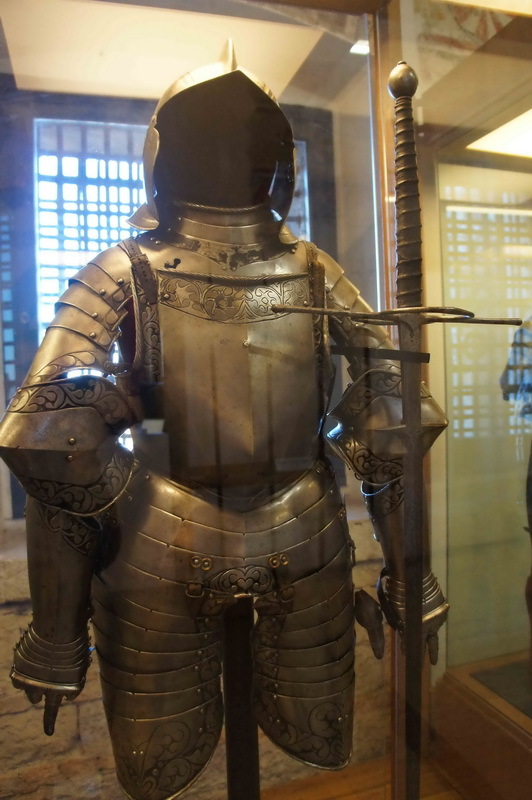
A lansquenet’s breastplate and burgonet. Northern Germany, ca. 1540–1560. A two-handed sword. Milan, ca. 1560–1570. From the collection of the Arms Museum in Brescia. Photo by the author
For many years, and sometimes even decades, they found themselves cut off from their homelands. Sometimes, in times of peace, mercenaries could return to their normal lives and visit their families or relatives. However, foreigners roaming Italy with weapons in hand did not have that opportunity. The concept of “winter quarters” in a foreign country was foreign to them, and their own homes were too far away. Therefore, in peacetime, they were forced to transform from hired defenders into marauders and extortionists. However, political instability and the attention Italy attracted from foreign rulers ensured that the mercenary units had a constant supply of “work.”
The democratic nature of these military organizations—or, in other words, their organizational integrity and autonomy. The most famous units operated as full-fledged participants in the armed conflicts that took place in Western Europe during the 14th century. Sometimes they were formed on a democratic basis, electing their own leaders. Commanders were tasked with clear objectives: to ensure the company achieved its goal—that is, to make money—by using military force or threatening to use it. In addition, a leader had to possess strong communication skills, as he was required to act as a diplomat and negotiator. The leader of the company also had to resolve internal conflicts and distribute spoils fairly.
Another historian, William Caffero, identified a very important fourth characteristic of the “free companies.” He writes that they had a “deeply entrepreneurial nature.” In other words, the captains and other mercenary commanders acted as a sort of business owners and managers. They operated in the market for military services, offering them to various rulers, while the rank-and-file soldiers served as hired workers. In the second half of the 14th century, demand for these services was very high, which gave rise to independently operating mercenary military units.
Bibliography
-
- Caferro, W. John Hawkwood: An English Mercenary in Fourteenth-Century Italy. — Baltimore, MD, 2006.
- Caferro, W. Mercenary Companies and the Decline of Siena. — Baltimore-London, 1998.
- Canestrini, G. Documenti per servire alla storia della milizia italiana del secolo XIII al XVI // Archivio Storico Italiano. — 1er ser. — 1851. — Т. 15.
- Cronica di Pisa / Rerum Italicarum Scriptores, vol. 15. Mediolanum, 1729
- Hay, D. Europe in the Fourteenth and Fifteenth Centuries. — L., 1970.
- Mallett, M. Condottieri and Captains in Renaissance Italy // Chivalric Ethos and the Development of Military Professionalism / Ed. by D. J. B. Trim. — London–Boston–Köln, 2003.
- Mallett, M. Mercenaries and Their Masters: Warfare in Renaissance Italy. —Totowa, NJ, 1974.
- Mallett, M. The Condottiere // Renaissance Characters / Ed. E. Garin. — L.–Chicago, 1991.
- Trease, G. The Condottieri. — L., 1970.
- Villani, G. Istorie fiorentine / A cura di A. Mauri. — Milano, 1834.
- Waley, D. The Army of the Florentine Republic from the Twelfth to the Fourteenth Century // Florentine Studies: Politics and Society in Renaissance Florence / Ed. by N. Rubinstein. — Evanston, Ill., 1968.
- Боккаччо, Д. Декамерон. — М., 1955.
Source: https://warspot.ru/14216-komu-voyna-a-komu-mat-rodna