Imagine a twelfth-century European king being handed a copy of the Roman military writer Vegetius. It contains almost everything a good army needs: careful selection of recruits, constant training, strict discipline, fortified camps, reconnaissance, marching order and the advice never to fight a major battle unless absolutely necessary. The king has blacksmiths capable of making swords and shields, several thousand subjects and an overwhelming desire to rival Caesar’s glory. It would seem that all he needs to do is form his men into ranks, call them legionaries and wait a few years for the finest army in medieval Europe to emerge.
Yet neither a good book nor a chest of silver could turn a feudal host into a Roman legion. The Roman soldier began long before the battlefield, with a census, a tax register, a grain depot, an armoury and an official capable of delivering wages to a distant fortress. The short sword was merely the final link in that chain. What disappeared after the fall of the Western Roman Empire was not the knowledge of how to hold a shield. It was the system capable of paying, supplying and training tens of thousands of soldiers for decades.
Which Roman Legion Was Supposed to Be Copied?
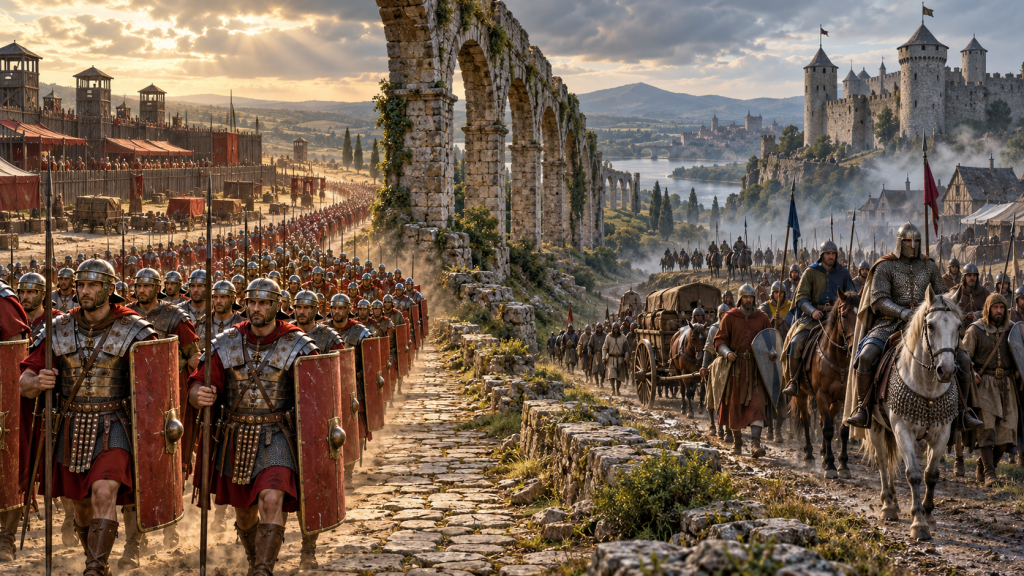
Discussions of “Roman tactics” often suggest that Rome possessed a single, perfected military system that remained unchanged throughout its history. In reality, the Roman army evolved continuously over many centuries. The citizen militia of the early Republic differed from the manipular legion of the Punic Wars, which in turn differed from Caesar’s cohorts. The imperial army was different again, and the mobile field forces of the late Empire bore only a limited resemblance to the legions that had conquered Gaul.
Weapons, unit sizes, terms of service, recruitment methods and the balance between infantry and cavalry all changed. Rome’s military strength lay partly in its willingness to abandon solutions that had ceased to work.
Even at the height of the Empire, the Roman army did not consist solely of legionaries carrying large shields and short swords. Alongside them fought auxiliary infantry, cavalry, mounted archers, slingers, engineers and units recruited throughout the provinces. The auxiliary forces may have equalled the legions in total numbers. Rome did not conquer its empire with one perfect formation. It succeeded by combining different kinds of troops, building roads and fortresses, delivering supplies and replacing losses.
A medieval ruler who decided to “bring back the legion” would therefore have faced an unexpected question: which Romans was he going to copy? The army of Scipio, Caesar, Trajan or Constantine? Rome itself never treated its military system as a sacred museum piece. Whenever old methods stopped working, the Romans changed them.
Roman Military Books Never Disappeared
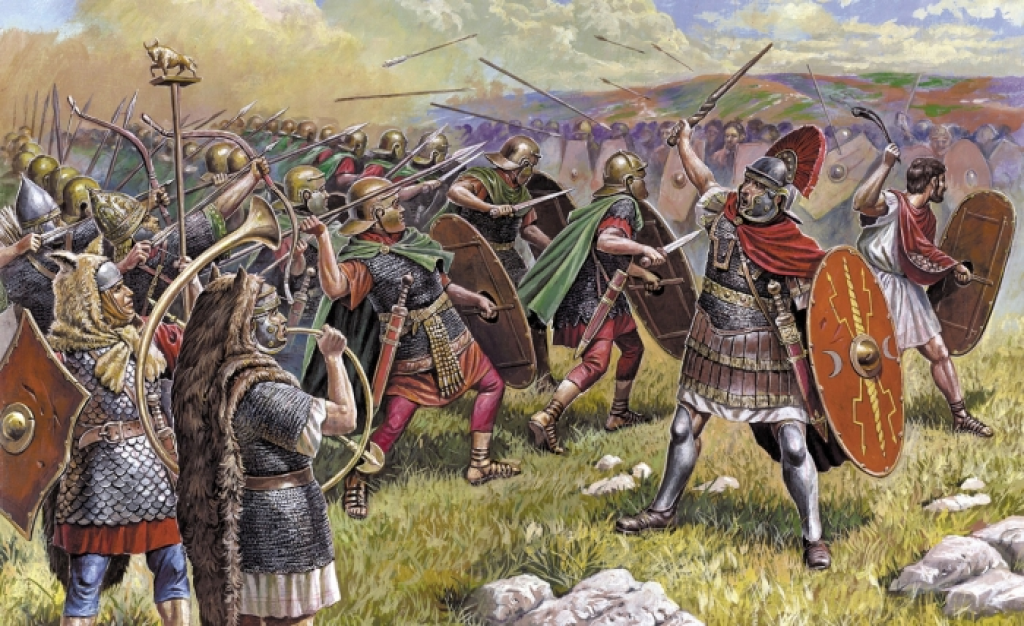
Medieval commanders did not turn their backs on the military experience of antiquity. Vegetius’ De re militari, written during the final centuries of the Empire, became one of the most popular secular works of the Middle Ages. Hundreds of Latin manuscripts have survived. The text was copied, translated into European languages, summarised and used in the creation of new military manuals. In 1410, Christine de Pizan drew extensively on Vegetius when writing The Book of Deeds of Arms and of Chivalry.
The Roman author’s advice remained remarkably relevant. Vegetius demanded careful recruitment, training before a campaign, proper camp discipline, secure supplies, reliable intelligence and caution when considering a major battle. Medieval commanders could recognise their own experiences in his work. Many medieval wars were decided not by spectacular cavalry charges but by sieges, manoeuvres, devastation of enemy territory and struggles over food and transport.
Moreover, one medieval empire had no need to resurrect Rome. The state centred on Constantinople, which we conventionally call the Byzantine Empire, considered itself the Roman Empire. Its inhabitants called themselves Rhomaioi — Romans. Its army developed directly from the forces of the late Roman Empire and retained a professional core, an effective tax system, a bureaucracy and a sophisticated tradition of military writing.
The Eastern Romans did not attempt to preserve Caesar’s legion for all eternity. Wars against Persians, Arabs, steppe horsemen and Western knights demanded cavalry, archers, mixed formations, ambushes and cautious manoeuvring. Preserving the Roman military tradition meant adapting it rather than endlessly repeating it.
Medieval rulers understood perfectly well that Rome had known how to wage war. The real difficulty began when admiration had to be converted into a payroll.
The Legion Began with a Tax Collector
A professional soldier was expensive even without magnificent armour. He had to be fed, clothed, armed and treated when injured. He expected wages, and when he retired or died, a replacement had to be found. Fortresses required repairs, horses needed fodder, weapons had to be manufactured, and a large army depended on officers, clerks and quartermasters. Thousands of men had to remain away from their homes for months without leaving to harvest their crops or turning into a roaming band that survived entirely through plunder.
The Roman Empire could manage this because it taxed and administered an enormous territory. The state recorded land and population, collected money and produce, redistributed resources between provinces, maintained depots and moved troops along an extensive road network. The legion could remain in permanent existence because millions of taxpayers and thousands of civilians who never carried a sword stood behind it.
After imperial authority collapsed in the West, the new kingdoms inherited Roman lands, cities, titles and parts of Roman law. What they gradually lost was the ability to register and tax their populations with the same efficiency. A ruler’s income became smaller and more dependent on his personal estates, relationships and ability to bargain with the local nobility.
Instead of collecting vast sums of money and paying for a unified army, monarchs granted land and rights to its revenues to men who promised to appear in wartime with their own warriors. This was a rational arrangement in a world where a king lacked the administrative machinery to pay thousands of soldiers every month. A landowner maintained his own horse, weapons and small retinue. When war began, the ruler assembled an army from his household troops, the forces of great lords, feudal contingents, urban militias, mercenaries and volunteers.
The result was an army made up of numerous smaller forces. Each had its own commander, obligations and period of service. Its men were often bound by personal loyalty to their immediate lord rather than to an impersonal state.
Calling such an army a legion would have been easy. Making it live for years under a single routine, obey one hierarchy of junior officers and respond to the same commands would have been far more difficult. The nobility would have had to surrender part of its military independence, while the king would have had to assume the cost of maintaining its warriors. A military reform would immediately have become a political revolution.
Why a Formation Cannot Be Copied from a Drawing
Roman discipline is often imagined as little more than a collection of brutal punishments. Its most important product, however, was a shared set of skills. Several thousand men could maintain order on the march, build a fortified camp, change formation, relieve tired units and continue fighting after suffering their first casualties.
Such abilities required constant training and a body of commanders capable of repeating the same procedures with every group of new recruits. A formation existed in the minds and muscles of the soldiers long before it appeared on the battlefield.
Handing large shields and short swords to a thousand farmers would not create a legion. It would produce a thousand farmers burdened with unfamiliar equipment. A short sword is effective in the hands of a man who can hold his position in a dense formation and trusts that the soldiers beside him will not run after the first charge. Without the habit of acting together, expensive Roman equipment would become little more than theatrical costume.
Medieval societies could also produce disciplined infantry, particularly in towns and communities where men regularly trained together. These troops naturally used the weapons of their own age: long spears, pikes, halberds, bows and crossbows. They adopted the central Roman principle — a stable formation of trained men — without seeing any reason to return to equipment that was already a thousand years old.
Would Knights Have Trampled the Legion Anyway?
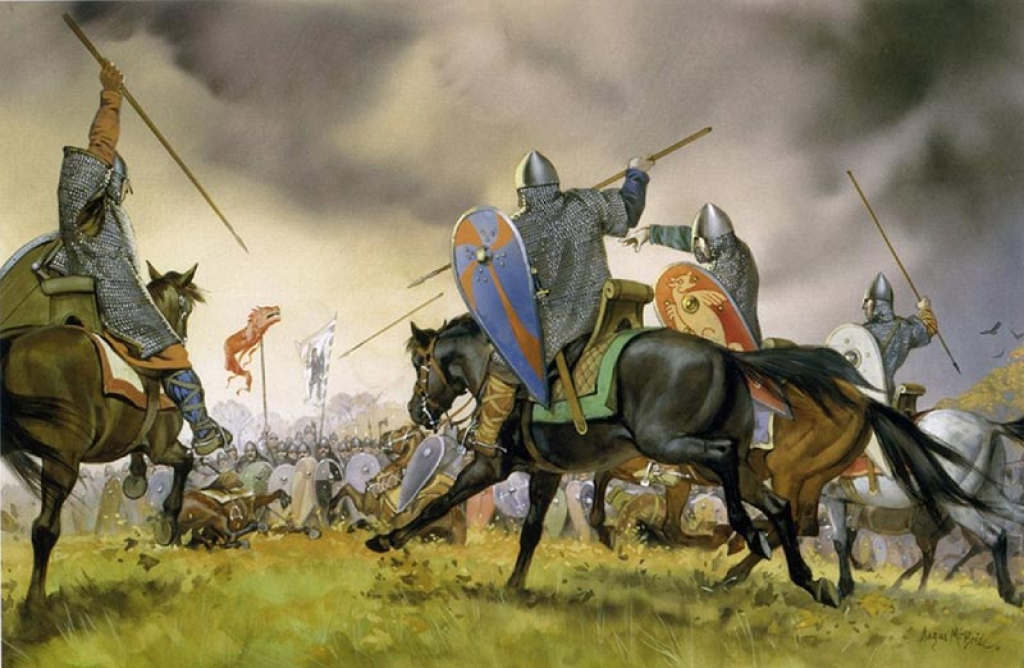
Heavy cavalry did become one of the dominant forces on medieval battlefields. A warhorse, an armoured rider, a long lance and years of training formed a formidable combination. Yet the popular image of the knight as an unstoppable “tank”, supposedly created by the invention of the stirrup, greatly exaggerates the importance of a single piece of equipment.
A rigid saddle could secure a rider even without stirrups, while ancient armies had fielded heavy shock cavalry centuries before the Middle Ages. Stirrups improved stability and control, but they did not suddenly make cavalry invincible.
The Romans fought the armoured horsemen of Parthia and Persia for centuries. The defeat of Marcus Licinius Crassus at Carrhae in 53 BC is often presented as proof that Roman legionaries were helpless against cavalry. Yet Crassus’ army was not destroyed by a simple charge of cataphracts.
Parthian mounted archers surrounded the Romans and bombarded them on an open plain. Fresh supplies of arrows arrived on camels, allowing the attack to continue far longer than the Romans expected. Heavy cavalry struck wherever the Roman formation began to weaken. Crassus’ own mistakes completed the disaster. Carrhae was the victory of a well-designed military system over a badly conducted campaign, not an eternal judgement against infantry.
Rome did not abandon its eastern wars after Carrhae. It developed its own armoured cavalry, increased the use of archers and adjusted its infantry formations to resist mounted opponents. This was what successful Roman armies had always done: after a defeat, they tried to understand the enemy rather than worship the tactics of an earlier century.
The Middle Ages themselves provide enough examples of infantry defeating knights. At Courtrai in 1302, Flemish urban militias destroyed the flower of French chivalry. At Bannockburn in 1314, Scottish spearmen withstood English attacks. Dense formations, long weapons, carefully chosen ground and confidence in the men standing nearby could matter as much as the weight of a knight’s armour. The horse remained a living animal, and it still had to approach a wall of spear points.
Medieval rulers did not reject the legion because they feared knights would simply ride through it. A knightly retinue was often the most affordable way to maintain a small core of experienced warriors in a society where the state could not support mass professional infantry. A lord fed and equipped a handful of fighting men from the revenues of his estates, and the king called them into service when war began. Such an army lacked Roman uniformity, but it matched the political structure of the kingdom that produced it.
When Rome Returned Without the Romans
By the end of the Middle Ages, the situation was beginning to change. Towns and trade expanded, money circulated more widely and governments became better at collecting taxes. Rulers increasingly hired soldiers for wages, signed contracts with commanders and maintained permanent garrisons. Infantry formations once again became large, trained and manageable, while monarchs gradually stripped the nobility of the right to wage private wars.
By then, reviving the gladius and the old legionary shield would have made little sense. The battlefield belonged to pikes, halberds, crossbows and, increasingly, gunpowder weapons and artillery. European armies revived the elements that had truly made Rome powerful: regular pay, unified command, systematic training, standardised supply and a state capable of sustaining a long war.
Medieval kings could dream of Caesar’s laurels, search for ancient manuscripts and decorate themselves with imperial titles. Yet between the dream of a legion and a real legion stood tax registers, grain depots, roads, armouries and an army of clerks. One blacksmith could copy the shape of a Roman shield. Building the state that had once stood behind that shield took Europe many centuries.