A Hundred Years Without a Master: How the Sengoku Age Tore Japan Apart and Put It Back Together

In 1477, the last armies withdrew from Kyoto. The ten-year Ōnin War ended as though no one had won it at all. The Eastern and Western coalitions had lost their leaders, the old disputes remained unresolved, and much of the capital had become wasteland. The emperor still occupied his throne, the Ashikaga shogun still bestowed titles, and the courtiers still observed their ceremonies. Yet an order from Kyoto was now worth exactly as much as the number of spears its bearer could muster in the provinces.
Japan did not break into separate countries in a single day. It simply ceased to function as a single system. Military governors discovered that their deputies were no longer forwarding taxes. Vassals decided they had no use for a weak lord. Villages formed armed leagues, monasteries maintained armies, and merchant cities purchased their own security. In place of the old hierarchy, dozens of domains emerged, each with its own laws, taxes, fortresses and troops.
This was the beginning of the Sengoku age—the era of the “Warring States”. Its boundaries are conventional. The Ōnin War of 1467–77 is usually treated as its beginning, while its end has been placed at Oda Nobunaga’s entry into Kyoto in 1568, the Battle of Sekigahara in 1600, or the destruction of the Toyotomi family’s last stronghold in 1615. To contemporaries, of course, no new historical era had arrived. They simply lived in a world where power had to be proved afresh every day.
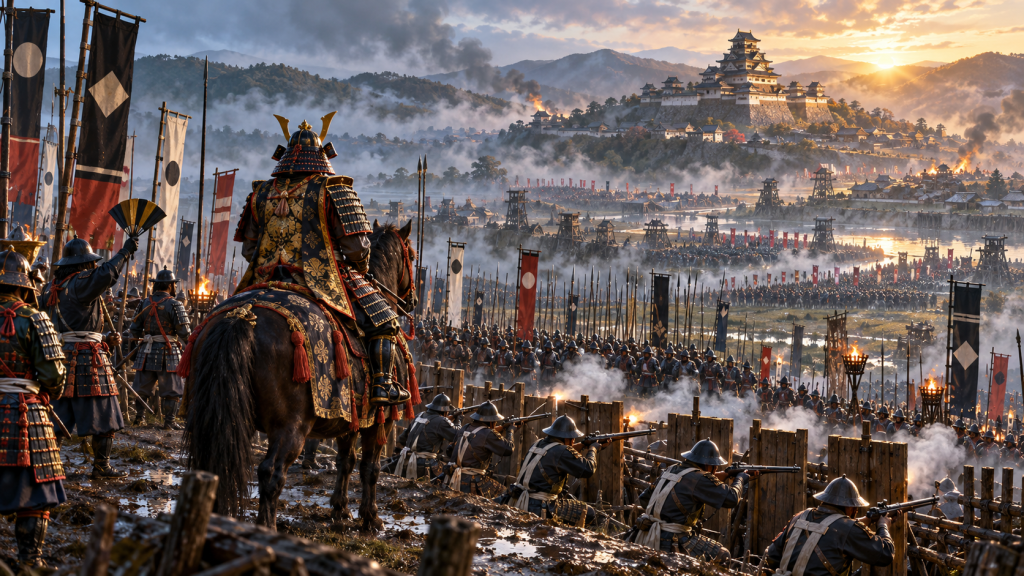
When Vassals Stopped Fearing Their Lords
The defining principle of Sengoku was gekokujō—“the low overthrow the high”. It was neither a law nor a political programme. It was a description of what people saw around them: a vassal seizing his overlord’s estates, a junior branch destroying the senior line of its own family, or yesterday’s deputy declaring himself the absolute master of a province.
The old nobility could produce a pedigree, an official post and a document bearing the shogun’s authority. The new daimyō produced an army and the ability to maintain order. One of the earliest famous examples was Hōjō Sōun. He did not belong to the region’s former ruling family, but exploited the dynastic quarrels of others, seized Izu and then advanced into the Kantō. His descendants adopted the prestigious name of the long-dead Kamakura Hōjō, although they were not directly related to them. In the Sengoku age, even the past could be appropriated if a man possessed the strength to hold the present.
Power did not always pass to a single commander. Sometimes an entire league took control. In 1488, followers of the True Pure Land school of Buddhism, together with peasants and local warriors, overthrew the governor of Kaga Province. The resulting Ikkō-ikki confederation ruled the province for almost a century. Elsewhere, village leagues negotiated taxes, raised militias and collectively resisted the demands of military houses. The collapse of the shogunate liberated more than princes.
The age did not, however, become a festival of social freedom. Victory belonged to those who collected taxes efficiently, kept their vassals loyal and fed their armies. Successful upstarts soon demanded from their own subjects the same obedience against which they themselves had recently rebelled.
War Forced Warlords to Build States
Sengoku is often imagined as pure chaos, with samurai endlessly cutting one another down among burning villages. Warfare was indeed constant, but it was precisely this pressure that forced rulers to impose order within their own lands. A daimyō who did not know how much rice his peasants harvested or how many warriors his vassals could provide was unlikely to survive for long.
The new masters of the provinces surveyed land, revised taxes and issued their own legal codes, known as bunkokuhō. They forbade vassals from starting private wars without permission, regulated inheritance, punished the concealment of criminals and attempted to move land disputes out of the cycle of blood vengeance and into their own courts. Even the marriages of important vassals became matters of state: a wedding might create an alliance dangerous to the lord.
Early Sengoku fortresses were often small strongholds on inaccessible peaks, places to which defenders could retreat during an attack. Gradually, the castle moved closer to roads and fields and became a centre of administration. Daimyō resettled vassals, craftsmen and merchants beneath its walls. Castle towns emerged around them. Rice, weapons, horses and taxes passed through their markets; from them, the ruler controlled the roads and could assemble an army at short notice.
A capable daimyō valued a good smith or merchant almost as highly as a good swordsman. He repaired roads, protected markets, invited artisans to settle in his territory and sometimes abolished the old trading privileges of temples and guilds. A prosperous town produced money, money maintained an army, and the army kept the town secure. A military domain was becoming a small state, even if its ruler continued politely requesting fresh titles from the shogun.
The Samurai Had to Make Room
The wars of the Kamakura age were remembered through duels between mounted archers and the proud pedigrees of celebrated heroes. Sixteenth-century armies looked very different. Their ranks increasingly rested on the ashigaru—foot soldiers recruited from poorer samurai and peasants. At the beginning of Sengoku, they could resemble an undisciplined mob that lived by plunder. Over time, the daimyō turned them into organised infantry.
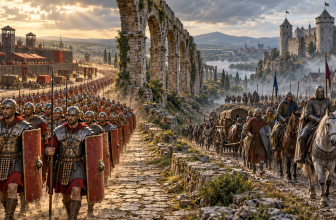
Ashigaru learned to operate in units, hold formation and follow orders transmitted by drums, conch shells and flags. The long yari spear was cheaper than a sword, easier to master and far more useful in a close formation. Archers and spearmen protected one another, sappers dug trenches, and wagon trains delivered rice, arrows and spare weapons. Victory increasingly belonged not to the most famous warrior, but to the commander who could bring several thousand men to the right place without allowing them to go hungry.
The sword retained its status as the foremost symbol of the samurai, but on the battlefield it was a weapon of last resort. Enemies were struck with arrows, spears, stones and eventually bullets. A fine blade looked impressive at a commander’s belt; wars were won with long shafts, discipline and sacks of rice.
The growth of armies changed the relationship between lord and vassal. In earlier times, a warrior could arrive with his own men and regard himself almost as an independent ally. The daimyō now sought to count every fighter, organise units and appoint commanders. Private retinues were gradually absorbed into a common military machine.
The Weapon Japan Did More Than Copy
In 1543, a Chinese ship carrying Portuguese traders arrived at the island of Tanegashima. Among its cargo were matchlock arquebuses. The local lord bought several examples, and Japanese craftsmen began reproducing them. They had to master unfamiliar details, including the screw mechanism, but within a few years firearms were being manufactured in several regions of the country.
The arquebus did not destroy the old style of warfare with a single shot. It was slow to reload, unreliable in rain and dependent on a steady supply of powder and lead. A skilled archer could shoot more quickly. A gunner, however, required less training, a bullet could penetrate many forms of armour, and a volley from a disciplined unit could halt an attack before the enemy reached its line.
Japanese daimyō quickly understood that the value of the new weapon lay in more than the gun barrel itself. It required workshops, standardised ammunition, dry match cords, trained units and commanders able to choose the right position. The arquebus strengthened rulers who had already learned how to organise resources.
The most famous example was the Battle of Nagashino in 1575, where the forces of Oda Nobunaga and Tokugawa Ieyasu defeated the Takeda army. A later legend describes three thousand gunners firing continuously in rotating ranks at recklessly charging cavalry. Contemporary sources do not support the elegant story of three-stage volley fire. The chosen ground, field fortifications, numerical superiority and the allies’ ability to maintain sustained fire mattered more. Nagashino demonstrated not the miracle of a new technology, but the superiority of a well-organised army.
The Provincial Lord Who Entered Kyoto
In the middle of the sixteenth century, Japan remained divided among powerful houses. Takeda Shingen and Uesugi Kenshin fought for years in the centre of the country. The Mōri controlled western Honshu, the Shimazu were growing stronger in Kyushu, and the Later Hōjō had built a powerful domain in the Kantō. None succeeded in turning regional strength into national rule.
The first decisive step was taken by Oda Nobunaga, ruler of the comparatively small province of Owari. In 1560, Imagawa Yoshimoto invaded his lands with a much larger army. Nobunaga did not wait to be besieged. His force launched a surprise attack on the enemy camp at Okehazama and killed Yoshimoto. The victory did not make Nobunaga master of Japan, but it transformed him from a provincial troublemaker into a man whom every neighbour had to watch.
Nobunaga expanded his territory through a mixture of war, marriage and alliances. In 1568, he entered Kyoto and installed Ashikaga Yoshiaki as shogun. Formally, Oda was defending the legitimate order. In practice, the shogun was expected to lend legitimacy to his conquests. When Yoshiaki attempted to organise a coalition against his protector, Nobunaga drove him out of the capital. The Ashikaga shogunate ceased to exist in 1573.
Nobunaga’s principal enemies were not merely neighbouring daimyō. Buddhist monasteries owned land, collected taxes, controlled roads and fielded armies. The Ikkō-ikki leagues could mobilise tens of thousands of followers. Nobunaga had no intention of tolerating independent powers inside his future state. He burned the monastic complex of Enryaku-ji on Mount Hiei and spent ten years besieging the fortified Ishiyama Hongan-ji. His brutality served a political purpose: neither antiquity nor holiness conferred the right to disobey.
At the same time, Nobunaga attracted merchants, protected roads and introduced “free market and free guild” policies in his towns, abolishing some old monopolies and tolls. His castle at Azuchi was more than a fortress. Its enormous keep towered over the trade routes and displayed a new form of power—wealthy, centralised and unapologetically magnificent.
By the early 1580s, Nobunaga controlled Kyoto and much of central Japan. Final victory was still far away, but the direction was clear. Japan would be united neither by a restored shogunate nor by an alliance of equal daimyō, but by a single military house capable of subduing all the others.
The Betrayal That Should Have Changed Everything
In June 1582, Nobunaga stopped at the Kyoto temple of Honnō-ji with only a small guard. One of his commanders, Akechi Mitsuhide, turned his troops against his lord and surrounded the temple. The reasons for his betrayal remain disputed. Unable to escape, Nobunaga died. It appeared that the realm he had built would now be divided among his generals and relatives.
One commander moved faster than the rest. Toyotomi Hideyoshi was campaigning in the west when he learned of his lord’s death. He immediately concluded a truce with his enemy, marched his army back at extraordinary speed and defeated Mitsuhide at Yamazaki. Less than two weeks separated Nobunaga’s murder from the death of his killer. Speed settled the succession before the other contenders had time to gather their forces.
Hideyoshi’s origins seemed to embody gekokujō. He had not been born a great lord and probably came from the lower ranks of military society. Later legend made him the son of a peasant and Nobunaga’s sandal-bearer. Whatever the exact details of his youth, Hideyoshi reached the summit through talent, war and his lord’s patronage rather than an ancient pedigree.
He could not claim the title of shogun with the same authority as the descendant of an aristocratic warrior house, so he sought legitimacy through the imperial system. Hideyoshi became kampaku—regent to an adult emperor—and received the family name Toyotomi. Old titles still worked when backed by a new army.
The Upstart Who Closed the Road to Other Upstarts
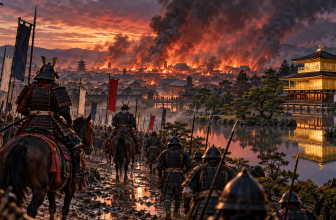
Hideyoshi continued the work of unification at remarkable speed. He subdued opponents through war, negotiation and displays of overwhelming strength. In 1587, his army forced Kyushu to submit. In 1590, an enormous host surrounded Odawara, the capital of the Later Hōjō. While the defenders waited for an assault, the besiegers built camps, opened markets and held tea gatherings, demonstrating that they could remain beneath the walls indefinitely. After Odawara surrendered, the last major independent domain was broken. For the first time in generations, all Japan recognised a single supreme ruler.
Conquest now had to be turned into a system. Hideyoshi conducted land surveys, measuring fields and assessing their yield in koku of rice. This figure determined taxation, the wealth of a daimyō and the number of troops he was obliged to provide. Land, peasants and military service were joined within a single system of accounting.
The famous “sword hunt” began in 1588. Peasants were ordered to surrender their weapons, depriving villages of the ability to become armies in their own right. Hideyoshi simultaneously hardened the division between cultivators and warriors. The man who had built his career through the social mobility of Sengoku now closed the ladder behind him. A united Japan had no need for another Hideyoshi.
Osaka Castle rose under his rule, while the culture of the military elite reached heights of ostentatious luxury. Hideyoshi staged vast tea gatherings and used a portable golden tea room. Refinement existed alongside suspicion: the celebrated tea master Sen no Rikyū was ordered by the ruler to take his own life. In Hideyoshi’s world, even a tea bowl remained an instrument of power.
At the height of his success, Hideyoshi attempted to carry the war beyond Japan. In 1592, Japanese armies invaded Korea with the intention of advancing against Ming China. Their early victories gave way to a prolonged conflict. The Korean navy disrupted supply lines, Chinese armies intervened on land, and Japanese garrisons held steadily less territory. A second invasion likewise failed to produce victory. After Hideyoshi died in 1598, the armies withdrew from Korea, having suffered enormous losses and gained none of the land for which the campaign had begun.
The Man Who Waited for His Battle
Hideyoshi’s heir, Hideyori, was five years old. Councils of leading officials were meant to govern the country until he came of age. The most powerful man among them was Tokugawa Ieyasu, a veteran daimyō who had outlived both Nobunaga and Hideyoshi.
Ieyasu had learned the value of patience in childhood. He was passed as a hostage between military houses, submitted to stronger neighbours, made alliances and abandoned them when the balance of power shifted. Hideyoshi moved him to the Kantō, far from his old territories, in the hope of weakening a potential rival. Ieyasu turned the punishment to his advantage: he established himself at Edo, brought the rich region under control and created one of the strongest armies in the country.
The balance collapsed rapidly after Hideyoshi’s death. A coalition organised by Ishida Mitsunari, one of the leading administrators of the Toyotomi regime, moved to check the growing power of Tokugawa. In the autumn of 1600, the two armies met in the valley of Sekigahara. The weather was wet, fog concealed the field, and several daimyō had not yet decided which side they would support.
That uncertainty became Ieyasu’s most effective weapon. He had negotiated in advance with enemy commanders, promising them land if they changed sides. At the height of the battle, Kobayakawa Hideaki attacked his former allies. Others followed. The Western Army collapsed, and by the end of the day Ieyasu had gained the power to redistribute Japan.
Victory at Sekigahara did not destroy every rival, but it decided who would act as the supreme arbiter. Defeated houses lost their domains or were moved elsewhere, Tokugawa’s allies received rewards, and the victor took control of the key roads and cities. In 1603, the emperor granted Ieyasu the title of shogun. The new military government established itself at Edo.
One last door to the past remained open at Osaka, where Toyotomi Hideyori lived. In 1614–15, Tokugawa armies besieged the castle and destroyed the Toyotomi house. After the fall of Osaka, no remaining rival could offer the country another centre of power.
Sengoku did not end because the Japanese had grown tired of war. They had been tired before. It ended when one house acquired enough land, vassals and resources to make another great war appear hopeless to everyone else. Over a century and a half, the provincial lords had created armies, laws, markets and cities; the three unifiers assembled those inventions into a national system.
An age that had opened a path for a peasant’s son to reach the summit of power ended in a rigid social order. Castles from which daimyō had waged endless wars became the administrative centres of a peaceful country. The samurai retained their swords, but increasingly took up the writing brush and the account book. The winner of Sengoku was not the man who prevailed in the last magnificent duel, but the one who made the next war impossible.