In 2023, researchers at ETH Zurich unveiled a robotic hand with its own “bones,” “ligaments,” and “tendons.” All of these were produced from polymers of different stiffnesses in a single printing process. Rigid elements maintained the structure, while elastic ones allowed the fingers to bend. Actuators were connected separately, but the printer could already produce the complex mechanical structure as a whole. Not long before, people had expected little more than a plastic figurine or a housing mock-up from such a machine. Now it was learning to reproduce the workings of a moving hand.
Four decades of development separate those capabilities. During that time, 3D printing moved beyond design laboratories into home workshops, racing teams, hospitals, aircraft factories, and a space station. Some of the most interesting changes took place inside the objects themselves. Printers learned to create channels, lattices, cavities, hinges, and combinations of materials that previously required numerous separate components. This growing internal complexity offers a useful way to trace the technology’s progress.
From Early Models to Formula 1
The commercial history of 3D printing began in the 1980s. One of its key figures was American engineer Charles Hull, who developed stereolithography. Ultraviolet light cured a thin layer of liquid photopolymer, followed by another layer. An object defined by a computer model gradually emerged from the vat. Hull co-founded 3D Systems in 1986, and the SLA-1 machine reached the market in 1987. At first, the achievement was the ability to turn a digital design into something that could be held in the hand.
For a designer, this meant much more than an impressive demonstration. A proposed housing could be checked against surrounding components, mounting points examined, and mistakes in its shape spotted. Such a sample did not yet have to withstand operating temperatures, vibration, or years of use. It answered an initial question: had the object been designed correctly in the first place? This explains the technology’s early role in rapid prototyping. A working engine remained a distant prospect, but the journey from an idea to a physical test had already changed.
Development proceeded in several directions. Some machines cured resin with light. Others deposited molten plastic filament. Still others worked with powder, selectively joining its particles with a laser; in metal systems, the material could be fully melted. The term “3D printer” came to describe a family of different machines. They shared a principle: an object was built up progressively from a digital model. But the material and the way it was joined determined whether the result would be a display model, a flexible clip, or a heat-resistant engine component.
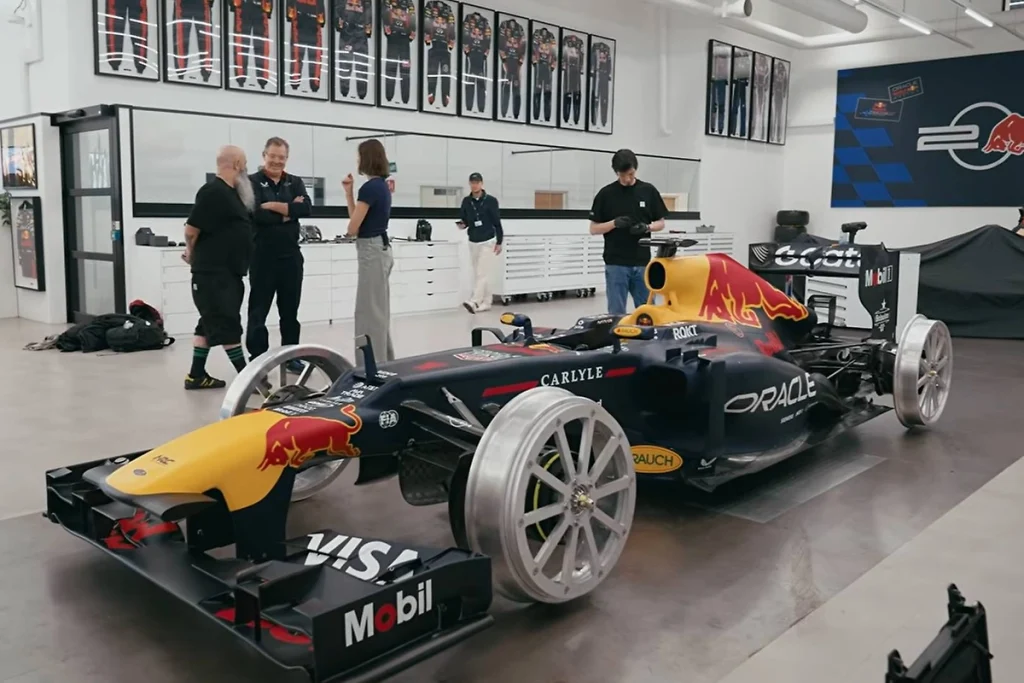
Formula 1 was among the early fields to make these capabilities part of everyday engineering. The Enstone-based team now racing as Alpine began using 3D Systems equipment in 1998, during its Benetton years. Initial applications included prototypes and checks of how components fitted together. Parts for wind-tunnel models then became increasingly important. Even a small change to a surface could demand another test, and printing made it possible to evaluate successive variations.
Gradually, printing moved beyond models. Teams began using it to produce tooling and selected working components for their cars. In 2017, McLaren described printing soluble cores for carbon-fibre brake-cooling ducts. Composite material was applied around the core, and the internal form was removed after curing, leaving a hollow component with a complex shape. This marked an important step: the printer could create a tool that made another structure possible. That season, McLaren also brought a printer to tests and races to manufacture parts and tooling on site.
Spare Parts and Drones: The Printer Becomes a Working Tool

The next change brought the technology to people far beyond large companies. RepRap, a project developed around the University of Bath, proposed an open-source printer capable of producing some of its own components. By the late 2000s, printed elements had been used to assemble a functioning copy of the machine. Electronics, motors, and other components still had to come from elsewhere, but the idea proved infectious: designs and knowledge could be shared, while machines could be built and improved collaboratively. The home printer was gradually becoming a practical workshop tool.
The most familiar result of this transition is a spare part. A cracked handle, an unusual bracket, or a housing cover can be reproduced from measurements, reconstructed from a surviving example, or redesigned. The engineer does not have to copy the original exactly: a weak point can be reinforced, a fit adjusted, a rib added, or several elements combined. Printing enabled many more people to carry out a small manufacturing cycle themselves: measure, design, make, test the fit, and revise.
On the railway, this approach grew into an established maintenance activity. Deutsche Bahn has used 3D printing since 2015. In a release marking the programme’s tenth anniversary, it reported more than 200,000 components produced for over 1,000 applications. These included brackets, covers, special tools, and other items. Different processes are involved: sometimes the part itself is printed, and sometimes a mould is printed for subsequent casting. Behind each digital file lies the ability to obtain the required object again, including when the original supplier has stopped making it.
Drones became another natural setting for the technology. They make the transition from a simple housing to a structure that must carry loads, retain its geometry, and operate in motion particularly clear. As early as 2011, University of Southampton engineers built and flew SULSA, a small aircraft whose structural components were produced by laser-sintering nylon. Its wings, fuselage, access hatches, and control elements were printed. Parts snapped together, while some hinges and control surfaces were formed directly during manufacturing. The motor, control electronics, and power supply remained separate components.
This distinction helps explain today’s “3D-printed drones.” In one case, a printer makes only camera mounts, fairings, and protective covers. In another, it produces a substantial part of the airframe. The fuselage shape, internal partitions, and equipment mounting points can all be changed through the digital model. But the presence of printed parts does not mean that an entire aircraft emerged from a single machine. The engineering challenge lies in integrating the printed structure with actuators, electronics, a power source, and the demands of flight.
What Printers Learned to Build Inside a Part
Working with metals brought particularly significant changes. A plastic model could show the shape of an engine component; metal printing made it possible to manufacture the component itself. A good example is the fuel nozzle tip for the LEAP engine, developed by CFM International, the GE–Safran joint venture. Engineers replaced an assembly of roughly twenty separate elements with a single printed part incorporating complex internal features. According to GE, it was approximately a quarter lighter than the previous version. In 2021, the company’s Auburn plant shipped its 100,000th such nozzle tip. The technology had progressed from an experimental sample to large-scale production of aircraft components.
This provides one of the clearest explanations for why printing developed beyond conventional models. Branching channels, cavities, and lattice structures can be formed inside a metal component. Material can be distributed according to where it needs to carry a load, guide a flow, or transfer heat. The ability to create a complex external surface was only the beginning. The possibilities for designing an object’s internal structure changed much more profoundly.
Yet producing complex geometry is not enough: engineers must demonstrate that it works. A metal part can contain pores, areas of incomplete fusion, and residual stresses. Internal channels are difficult to inspect, and material properties may depend on the build direction. Industrial printing therefore developed alongside heat treatment, machining, and inspection methods. A component removed from the printer’s build platform may still need several manufacturing operations. In aviation and spaceflight, reliably obtaining the required properties matters as much as producing the shape.
Medicine took the technology in another direction: here, complexity is often defined by an individual person. Scan data can be used to create a patient-specific model, surgical guide, or implant matched to the patient’s anatomy. The FDA lists cranial plates, joint components, dental restorations, and external prostheses among medical products already made using 3D printing. This represents another level of working with a digital model: the human body itself supplies the geometry. Printing living organs remains a separate research field and should not be confused with the established manufacture of metal and polymer implants.
The Zurich robotic hand illustrates another direction: combining materials with different properties in a single process. Producing it required working with polymers that cure differently and precisely monitoring each new layer. A laser scanner measured the printed surface, and the system adjusted subsequent material deposition. The printer did more than follow a predetermined path: it took account of what had actually been produced in the preceding step. This made it possible to combine a rigid “skeleton” with elastic connections.
From Desktop Machines to Construction Robots

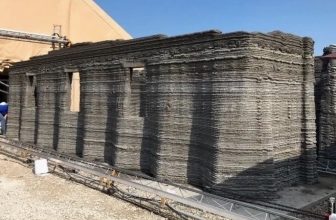
Buildings appeared at the other end of the size scale. In construction printing, a thin plastic filament was replaced by a much thicker bead of specially formulated material, while a large gantry or robot took the place of a desktop frame. Behrokh Khoshnevis, the inventor of Contour Crafting, actively developed this approach in the 2000s. Real housing projects followed. A printer was used for a two-storey house in Beckum, Germany, while ICON and its partners built a neighbourhood of one hundred homes at Wolf Ranch in Texas, completed in 2025. Printing generally produces the walls; roofs, windows, utilities, and finishing require other work.
The military has also tested construction printing and already uses it for infrastructure. In January 2025, three barracks buildings constructed using the technology opened at Fort Bliss. However, accommodation and protective structures present different engineering problems. The method of depositing material does not, by itself, establish resistance to blasts or impacts: structural design, reinforcement, the material mix, and test results all matter. Scaling a printer from a spare part to a wall expands the range of possibilities, but each new task requires its own engineering approach.
Rocket Engines: Printed Parts Take Flight
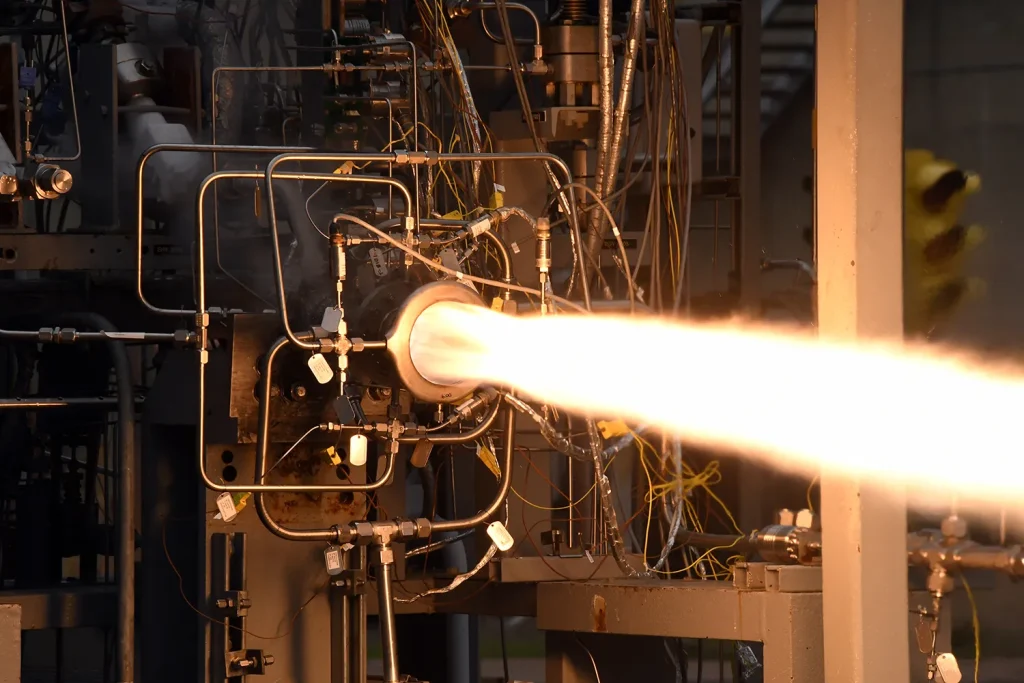
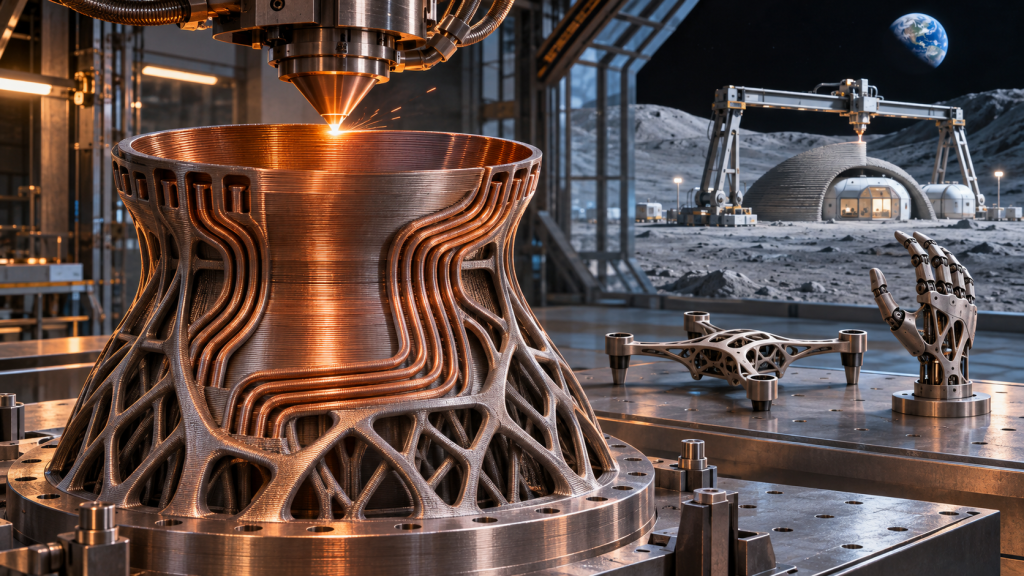
Space technology brings many of these achievements together. Complex internal channels, combinations of materials, fewer joints, and precise quality control all have important roles. Rocket engines provide a particularly striking example: combustion takes place inside them while their walls require continuous cooling. Printing allows cooling channels to be formed as part of the component itself. Engineers can design a chamber or nozzle with its required internal geometry, then test it on a firing stand.
Such components already fly. Rocket Lab uses additive manufacturing for primary components of the Rutherford engines that power its Electron rocket: combustion chambers, injectors, pumps, and main propellant valves. The first engines reached space in 2017. This does not mean that a complete engine, with every wire and connection, emerges from a printer. But critical components operating in actual rocket flights are already manufactured this way.
The range of materials is expanding too. In the RAMFIRE project, NASA and its partners manufactured and tested aluminium nozzles with internal cooling channels. Aluminium is attractive because of its low density, but engine temperatures and the challenges of processing it create significant difficulties. The project required a suitable material, an appropriate printing process, and cooling built into the structure. In 2023, NASA reported successful hot-fire tests of two such nozzles. This illustrates how progress happens: capabilities expand when the printer, the material, and the component’s design advance together.
The Moon and Mars: A Workshop Beyond Earth
So far, the story has largely concerned objects manufactured on Earth. The next step is to move production to wherever a space expedition is operating. In 2014, a plastic ratchet wrench was printed aboard the International Space Station from a design file transmitted from Earth. It was produced as part of a technology demonstration and intended for subsequent analysis. The small tool demonstrated a fundamental possibility: hundreds of kilometres of space could separate the designer from the machine, while the object itself was manufactured in orbit.
In 2024, a European experiment aboard the ISS moved into metal. An ESA–Airbus machine used a laser to melt and deposit stainless-steel wire inside a sealed working enclosure. It completed its first metal sample in August; by July 2026, ESA reported that it had produced a fifth. These remain research samples, allowing the results of orbital and terrestrial manufacturing to be compared. But the experiment addresses an essential question: could a space workshop manufacture strong metal items as well as plastic objects?
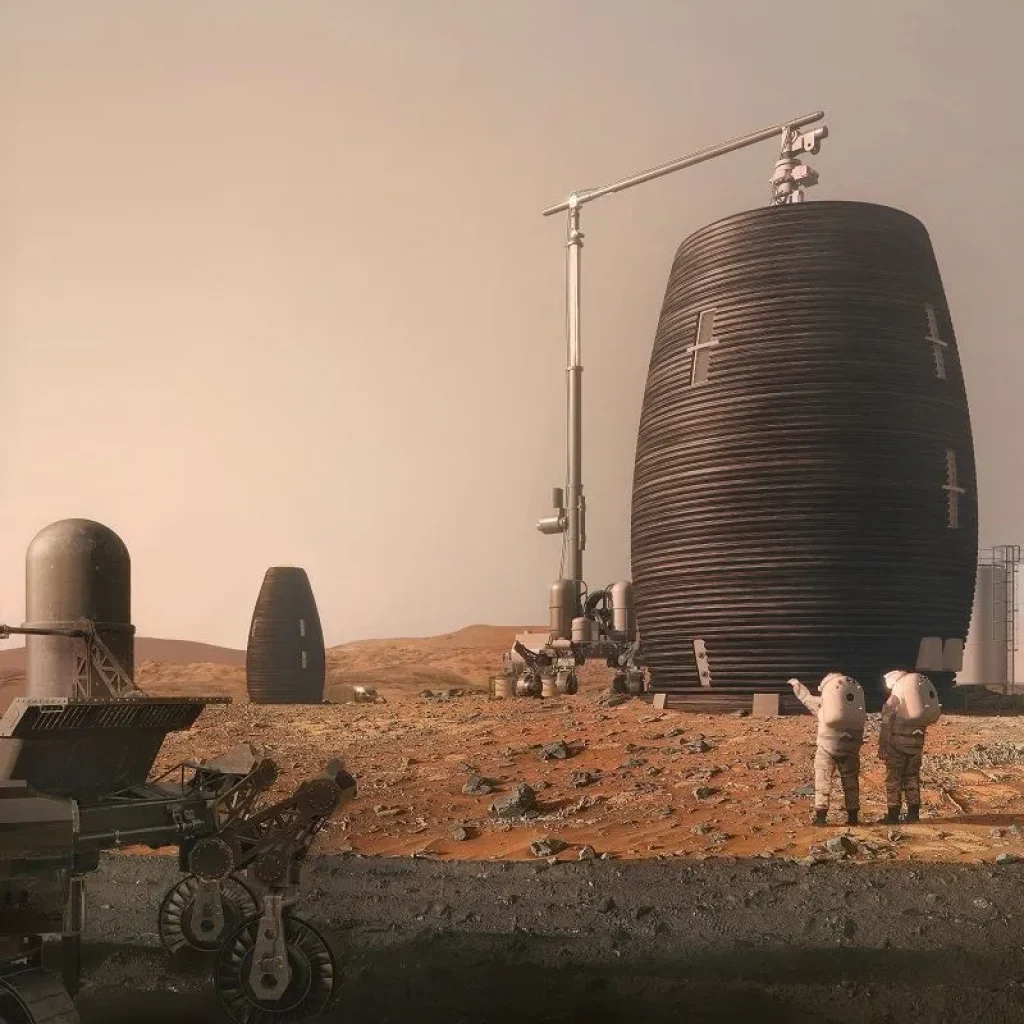
For a lunar base, another task enters the picture: learning to process local raw materials. Regolith—the fragmented material covering the surface—is being considered as a feedstock for construction. In 2013, ESA and its partners presented a base concept in which a printed shell would protect a pressurised habitation module inside it. In 2017, European researchers demonstrated bricks made from simulated lunar soil by sintering successive layers with concentrated sunlight. Such experiments gradually connect the manufacture of individual blocks with the prospect of building large infrastructure.
NASA and ICON’s work on extraterrestrial construction represents another approach. Olympus investigates turning surface material into strong structures, with landing pads, roads, and protective structures among the potential applications. In one process under development, a powerful laser melts regolith, which then solidifies into a ceramic-like material. But a terrestrial construction printer cannot simply be placed on the Moon: gravity, thermal conditions, material behaviour, and the operation of mechanisms in dust and vacuum all change. A substantial programme of testing therefore separates a ground demonstration from a working lunar construction site.
The longer-term prospect extends beyond bricks. In April 2026, ESA described a project investigating materials for printed electronics derived from simulated lunar regolith. Researchers are studying whether the metal-rich residue left after oxygen extraction can be processed into conductive inks and powders. An initial step is to demonstrate the manufacture of a conductive element, with antennas among the potential future applications. Producing microprocessors locally remains a vastly more distant goal. Nevertheless, the question itself shows how far the ambition has expanded: lunar soil is being considered as a raw material for electrical components too.
A picture of a future expedition’s manufacturing workshop is gradually emerging. One machine could produce polymer housings and brackets, another metal tools and mechanical parts, while a construction system makes large infrastructure elements. Processing, assembly, and quality control would also be needed. NASA, for example, investigated FabLab, a system in which a printed part made from a polymer–metal powder mixture was subsequently treated in a furnace to remove the binder and consolidate the metal. This is a sequence of connected manufacturing processes that must be adapted for work in space.
On Mars, the idea takes on particular significance. A long expedition cannot anticipate every failure or every new tool it might need. The ability to manufacture a tool, alter a scientific instrument’s mount, or replace part of a mechanism would give crews greater freedom to solve problems as they arise. Complex equipment would still have to be assembled from components, and some materials and products would still come from Earth. The degree of independence would grow with the range of manufacturing operations people could perform locally.
Conclusion: From Reproducing Shapes to Creating Complex Systems
The central change over four decades has been the increasing complexity of what can be manufactured. First, a printer reproduced the external shape of a proposed object. Then it learned to make working components, form internal channels and lattices, combine multiple elements, and bring rigid and elastic materials together. Those capabilities now appear in aircraft fuel nozzles, rocket-engine components, and experimental robotic mechanisms. Progress can be measured by the internal structure and properties an engineer can build into a printed object.
The next step is to bring these capabilities together in a manufacturing workshop that can operate far from Earth. A universal machine that produces a complete spacecraft remains a distant prospect: printing requires suitable feedstock, energy, post-processing, assembly, and inspection. But the direction of development is already visible. Future expeditions could manufacture some of their tools, spare parts, and large structures where they are needed. For a lunar or Martian base, this would mean the ability to repair equipment and build new structures locally—an important step from a temporary expedition towards a permanent presence.