Two Containers Instead of a Factory: The US Wants to Build Attack Drones Near the Point of Use

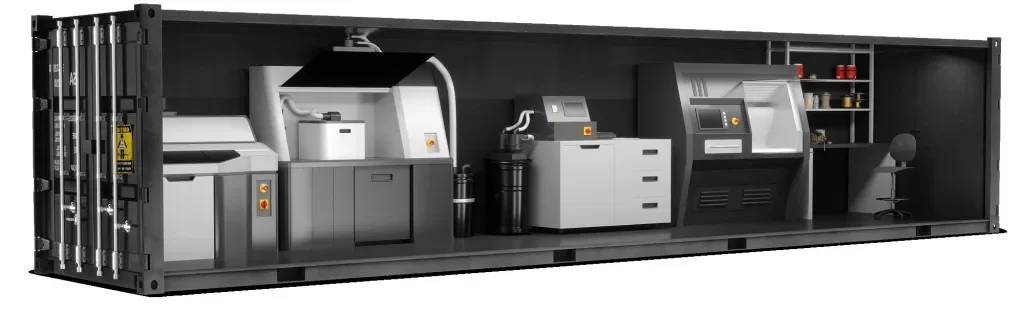
American company Machina has received a $9 million contract to develop mobile robotic factories capable of producing airframes for LUCAS attack drones. The idea sounds almost revolutionary: instead of transporting completed aircraft across an ocean, the military could deliver two standard containers, deploy the equipment, and begin manufacturing drones at a forward base.

The RoboCraftsman system consists of two industrial robots that shape sheet metal using a digital model. Heavy dies and dedicated tooling are unnecessary. Operators enter the required range, payload, and other parameters, after which the software prepares a modified airframe. This approach could allow production to switch between drone variants within weeks, while retooling a conventional factory may take months.
Under the 18-month trial, Machina will deploy two experimental “Edge Factories.” A single robotic cell should be capable of producing one metal LUCAS airframe every two to five days. The company estimates that each airframe will cost between $15,000 and $40,000, depending on its complexity. A network of at least ten such cells would be required for genuine mass production.

There is, however, an important limitation: the containerized factory will manufacture primarily the drone’s airframe, not a complete weapon. Engines, electronics, navigation systems, communications equipment, and warheads will still have to arrive through conventional supply chains. The 55-ton production complex also needs electricity, skilled engineers, and protection, making it neither especially small nor easy to conceal.
Nevertheless, the project’s military value extends beyond shortening supply lines. The same equipment could manufacture several types of aircraft: a long-range attack drone, a reconnaissance platform, or a carrier for another payload. An unsuccessful design could be corrected digitally, with the updated file sent immediately to every distributed factory. Machina’s first reduced-scale prototype already required modification after experiencing crosswind problems, but repositioning its engine took months rather than years.
Conclusion: Machina has not yet created an autonomous factory capable of building drones from locally available scrap metal. It is testing something potentially more important: whether airframe production can be separated from enormous fixed industrial plants and turned into a distributed network. If the experiment succeeds, LUCAS may become only the first product manufactured by a factory that can be shipped in the same way as a container of ammunition.