Goodbye, Fennek. Why the Russian Army Has Relyed on Tracked Vehicles for Reconnaissance

A key element of any reconnaissance vehicle is a suite of specialized surveillance and communications equipment. Typically, detailed information about the composition, functions, and technical specifications of onboard reconnaissance systems is not made public. However, in addition to electronic equipment, the chassis—which serves as the platform for mounting the equipment—is critical to the successful execution of missions. Let’s take a look at which models are currently in service with the Russian Army and the armed forces of NATO countries.
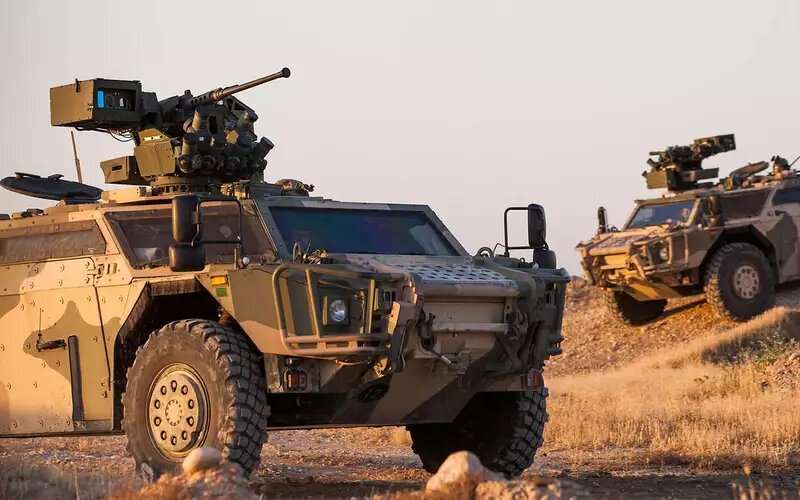
The Fennek reconnaissance vehicle. The focus is on autonomy and range. It even comes equipped with a saw, axes, a shovel, bolt cutters, snow chains, and three water canisters.
The All-Wheel-Drive Fox
The Fennek, a joint development by German and Dutch engineers, is considered the most representative example of the Western school of reconnaissance technology. The name was not chosen at random: in the wild, the fennec is a miniature desert fox distinguished by its unusually large ears. These natural “radar” ears allow the animal to scout its surroundings, picking up the faintest sounds from a considerable distance. European designers embodied this animal’s iconic image in their traditional style by mounting the equipment on a specialized wheeled chassis.
The Fennek reconnaissance vehicle was designed with a focus on autonomy and impressive range. It is equipped with a survival kit that includes a saw, axes, a shovel, bolt cutters, snow chains, and three water canisters. This compact, low-profile armored vehicle is equipped with a 4×4 all-wheel-drive system and a 5.7-liter Deutz BF6M2013C six-cylinder diesel engine. The all-welded hull protects the crew from shrapnel and 7.62 mm armor-piercing bullets; however, it is vulnerable to, for example, RPG-7 rocket-propelled grenades.
To ensure self-defense during firefights, the vehicle is equipped with its own armament. The remotely controlled combat module can be fitted with an automatic 40-mm grenade launcher or a 7.62-mm or 12.7-mm machine gun. There are various options for special equipment, but the basic and most common configuration includes a high-resolution camera, a laser rangefinder, and a thermal imager mounted on an extendable mast up to three meters high. Additionally, the vehicle is equipped with a navigation system, information displays, shortwave and ultra-shortwave radios, control systems, and equipment for integration into army command and information systems. The Fennek is in service with the Bundeswehr, the armed forces of the Netherlands and Qatar, and is also used by the Ukrainian Army. The Fennek’s large 20-inch wheels are equipped with a centralized tire inflation system. As a result, the vehicle sets out on missions without a spare tire—all reliance is placed on tires with reinforced run-flat inserts.
Key Specifications of the Combat Vehicle
- Dimensions (length, width, height): 5,580 × 2,550 × 2,290 mm.
- Gross vehicle weight: 11,800 kg.
- Crew: 3 people.
- Engine power: 240 l.s.
- Maximum speed: 112 km/h.
- Range: 1,000 km.
On a reconnaissance mission on tracks
For the Russian military, the concept of four-wheeled reconnaissance vehicles such as the BRDM can be considered a thing of the past. Gathering intelligence using a vehicle optimized for highways, gravel roads, and relatively firm ground does not seem to be the most effective solution. A full-fledged all-terrain vehicle is required, and that leads directly to tracked vehicles. To avoid having to design an entirely new vehicle from scratch, domestic designers chose to modernize an existing platform. The result of this work was the debut of the upgraded BRM-1KM combat reconnaissance vehicle at the 2025 Victory Day Parade.
A telescopic mast for a communications antenna is mounted on the rear of the vehicle’s hull, and anti-cumulative grids are mounted on the weapons module. This event served as a demonstration for the general public, even though by that time the combat reconnaissance vehicle had already been delivered to the troops and had seen its first combat during a special military operation.
The upgraded BRM-1KM is based on the well-known chassis of a first-generation infantry fighting vehicle, but has been equipped with modern weaponry, enhanced armor, and advanced specialized equipment. Bulky blocks of reactive armor are mounted on the front, rear, and sides of the steel armored hull. Detailed information about its specifications is classified, but it is evident that the protection is designed to counter large-caliber machine guns, small-caliber projectiles, and cumulative ammunition from hand-held grenade launchers in all directions.
The BRM-1KM’s armament consists of a combat module standardized with the BTR-82A, which replaced the previous turret equipped with the “Grom” cannon. The module’s arsenal includes a 30-mm 2A72 automatic cannon with a 300-round ammunition load, a 7.62-mm machine gun with a 2,000-round ammunition supply, smoke grenade launchers, and a modern combined day/night sight equipped with a stabilized field of view and a laser rangefinder. The engine and transmission compartment houses a V-shaped six-cylinder UTD-20S1 diesel powerplant with a displacement of 15.9 liters, ensuring standardization with second-generation infantry fighting vehicles (IFVs). The armored hull of the BRM-1KM tracked reconnaissance vehicle is reliably protected on all sides by dynamic protection screens.
Special equipment has also been replaced. It is confirmed that new communication devices operating in various frequency bands have been installed on board. One of the antennas can be mounted on a special mast, which doubles the communication range; in transport mode, the mast is secured at the stern of the hull. For round-the-clock detection of enemy equipment and personnel, the BRM-1KM is equipped with an SBR-5M portable close-range reconnaissance radio. Its antenna is mounted on the combat module, although the system can also be used in a portable configuration. In addition, the vehicle is equipped with topographic referencing equipment. Taken together, this provides all the necessary capabilities for target detection, target designation, and fire correction.
Key Specifications of the BRM-1KM
- Dimensions: 6,735 × 3,150 × 2,550 mm.
- Gross weight: 14,200 kg.
- Crew: 6 people.
- Engine power: 300 l.s.
- Maximum speed: 65 km/h.
- Range: 600 km.
Compared to the high-speed Western “Fox,” which has a substantial range on highways (on dirt roads, this figure drops to 460 kilometers on a single tank of fuel), the domestic reconnaissance vehicle has three significant advantages. The BRM-1KM provides the crew with a higher level of protection, is equipped with significantly more powerful armament, and, most importantly, is capable of conducting reconnaissance in terrain where wheeled vehicles cannot operate.