Not a Swamp Machine but an Off-Road Supercar: How VISUVA Is Turning All-Terrain Vehicles Into Objects of Desire

A conventional all-terrain vehicle is usually purchased after a careful reading of its specification sheet. How much can it carry? How much pressure does it exert on the ground? How deep into the snow can it go, and can it be repaired far from the nearest workshop? With the machines built by the Krasnoyarsk-based company VISUVA, the process works the other way around. First you see one — low, angular, standing on enormous wheels or broad tracks — and only then do you begin asking what it actually is.
Open the company’s social-media pages and the difference between VISUVA and most manufacturers of all-terrain machinery becomes immediately obvious. Its feed is not filled with utilitarian boxes designed for geologists, hunters, and rescue crews. VISUVA’s machines jump, attack rocks, enter the water, and pose against Siberian landscapes as though they have arrived from the set of a science-fiction film.
This is still serious off-road machinery, but it is being sold as an adventure: beautiful, expensive, and just a little insane.
The company currently has only two core models. That has been enough to give a young brand a remarkably recognizable character.
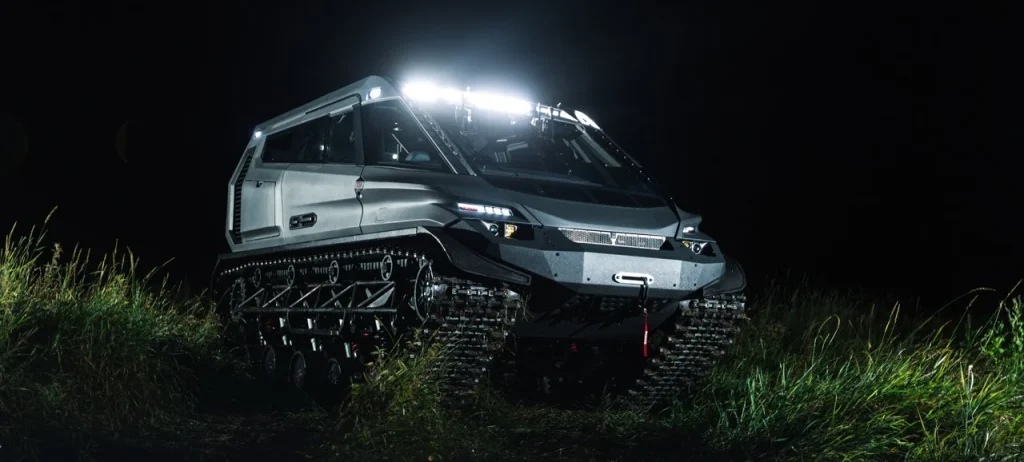
The Machine They Drew as Children
VISUVA’s story began in Krasnoyarsk in 2020 with the Visuva Tank project. The idea was almost provocatively simple: why must an all-terrain vehicle look like a tool when it could become an object of desire?
Company founders Pyotr Ivanov and Igor Kitaev set out to combine the mobility of a heavy-duty specialist vehicle with dramatic styling, a comfortable cabin, and the kind of “wow factor” normally found in an entirely different corner of the automotive market.
The first tracked prototype emerged after three years of design work and testing. In 2024, the company began producing its extensively redesigned successor, the T8, while also testing the faster wheeled S2.
Neither machine was created by a giant carmaker. They came from a small team. At the company’s presentation in Krasnoyarsk, Ivanov recalled approaching Great Wall for engines. The Chinese manufacturer initially discussed deliveries in the thousands — and then learned that VISUVA needed five.
That exchange captures the scale of the enterprise. For now, VISUVA is building vehicles almost one at a time. The advantage is that every example can be treated almost as a separate creation.
VISUVA S2: A Supercar That Does Not Fear Mud
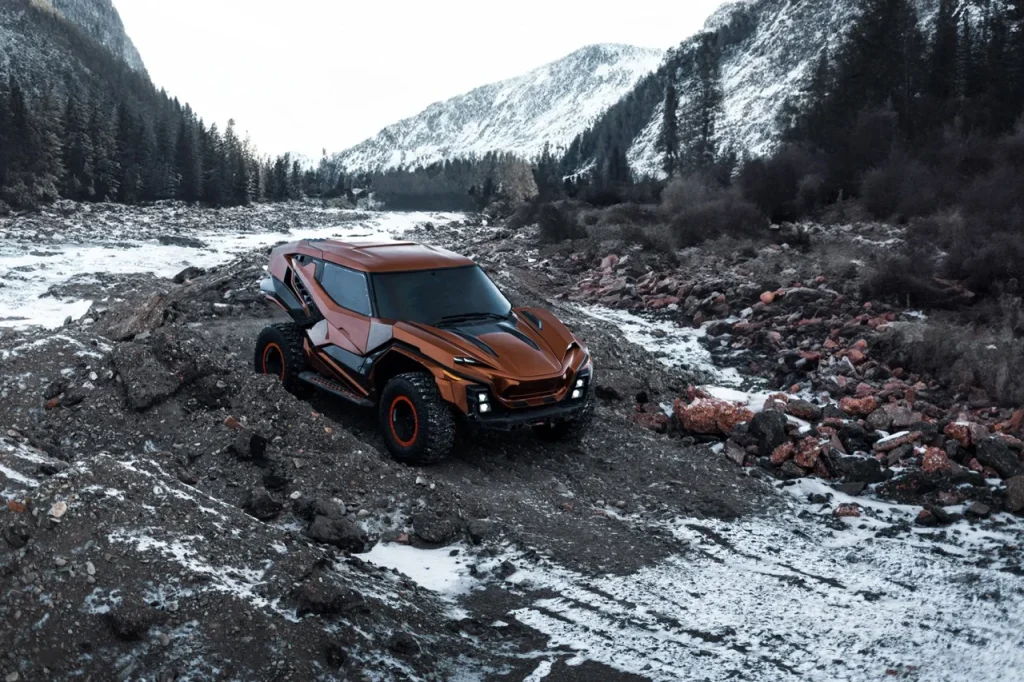
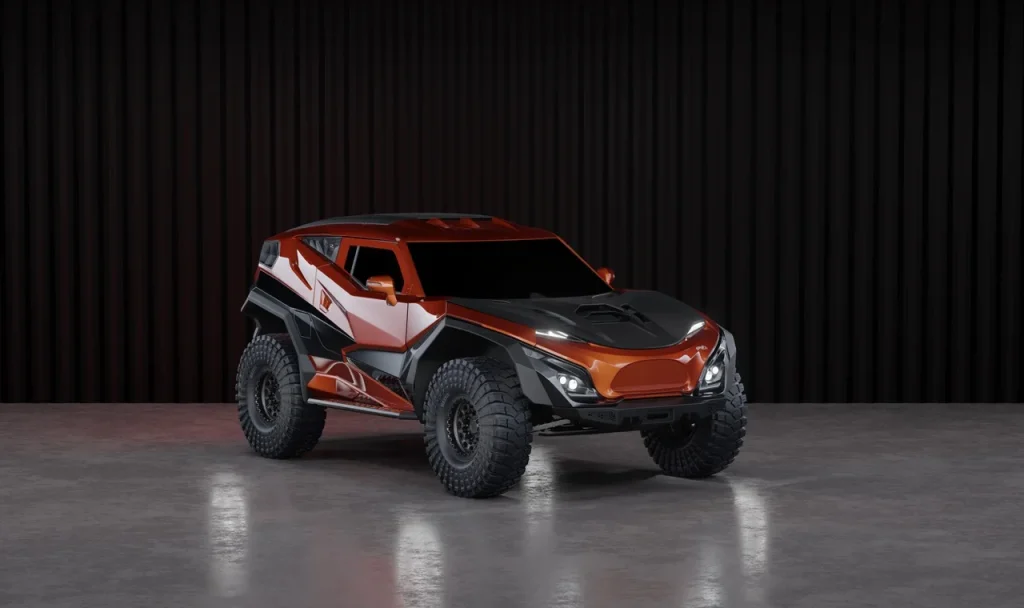
The S2 is the company’s most striking machine and probably the main source of all the excitement on social media. There are hints of the Batmobile, a rally prototype, and a desert-racing buggy in its appearance.
Its low roof, short overhangs, faceted bodywork, and 40-inch tires deliberately break the familiar proportions of an off-roader. It looks as though the designers began with the wheels and carefully fitted the body into whatever space remained.
The S2 is 4,590 millimeters long and 2,340 millimeters wide, with 400 millimeters of ground clearance. Beneath its corrosion-resistant composite and carbon-fiber panels is a steel space frame built according to motorsport principles.
It has independent multi-link suspension at both ends, offering 300 millimeters of travel. The chassis can accept either mud tires measuring up to 40 inches or 1,050-millimeter low-pressure tires without requiring structural modifications.
That package explains why VISUVA calls the S2 an off-road supercar. It is not supposed to chase a Ferrari down a paved highway. Here, “supercar” means an excess of capability and sensation: permanent four-wheel drive, low-range gearing, locking center, front, and rear differentials, vast suspension travel, and the ability to attack an obstacle with speed and visible enthusiasm instead of crawling over it painfully slowly.
Two gasoline engines are offered. The naturally aspirated 4.3-liter Toyota 3UZ-FE V8 produces 280 horsepower and is paired with a six-speed automatic transmission. The alternative is Great Wall’s twin-turbocharged 3.0-liter 6Z30 V6, producing 350 horsepower and 550 Nm of torque through a nine-speed automatic.
The fuel tanks hold approximately 160 liters, while the cabin seats four.
One particularly interesting detail is that the S2 does not have to be carried to the beginning of every adventure on a trailer. In Russia it is registered as self-propelled machinery and may use public roads, although the driver needs a Category AII tractor operator’s license.
Legally it is not a conventional passenger car, but its owner can leave the pavement under the vehicle’s own power without organizing a separate transport operation.
The first Founders Edition is limited to just five vehicles. When the project was announced, prices started at 16 million rubles. That is a fantastic sum for the mass market, but the S2 is not aimed at the mass market.
Its likely buyer already owns several cars and is looking for something beyond transportation — a new toy capable of surprising even someone accustomed to expensive machinery.
VISUVA T8: A Tracked Expedition Lounge
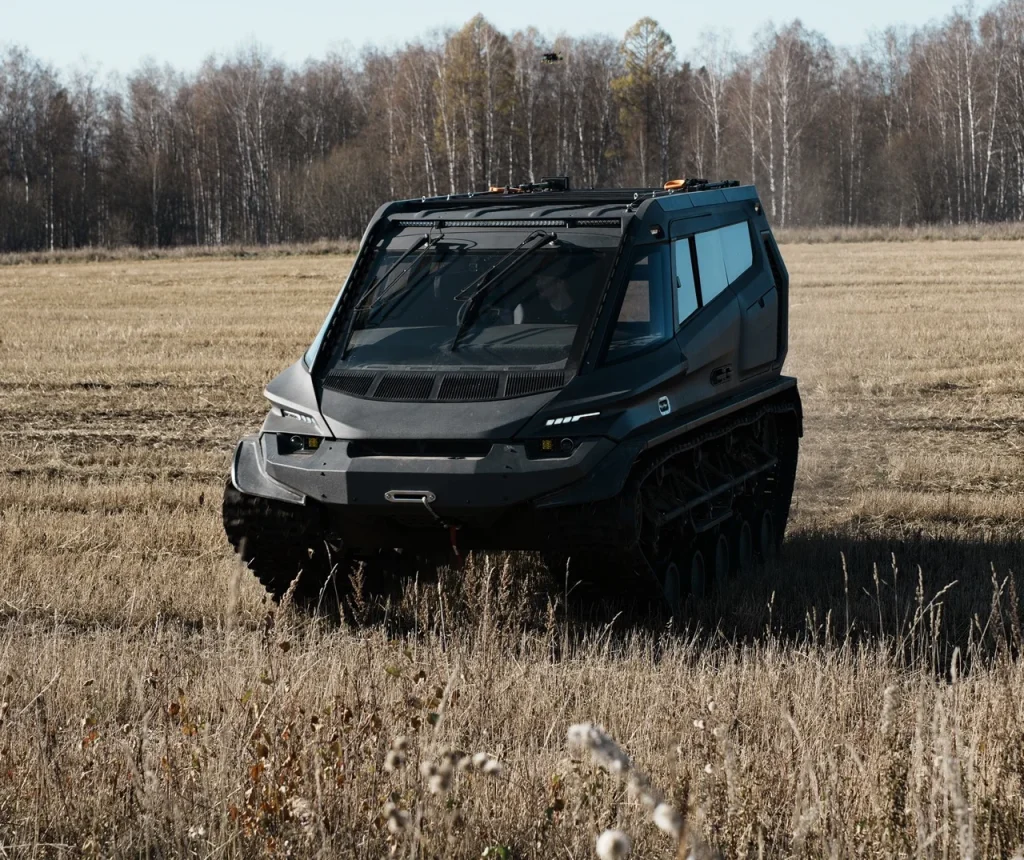
If the S2 is intended for a driver who wants to jump, slide, and attack obstacles at speed, the T8 offers a very different kind of luxury.
It is a tracked vehicle measuring 5.18 meters long and 2.48 meters wide, with a mass of approximately 4.5 metric tons. It does not drive around a bad road or search for a convenient place to turn. Most of the time, it simply does not need a road.
Each track is 600 millimeters wide, while ground pressure is approximately 0.13 kilograms per square centimeter. That allows this heavy machine to cross deep snow and marshy ground where a wheeled off-roader would begin to dig itself in.
The removable polymer track pads are mounted on a reinforced rubber-fabric belt, while suspension travel reaches 280 millimeters. The early Tank prototype was tested not only in the mountains and at temperatures down to –40°C, but also on water.
The T8 has a claimed top speed of 70 kilometers per hour — a serious figure for a large tracked all-terrain vehicle. The company’s current specifications list a choice of proven Toyota gasoline V8s: the 4.3-liter 3UZ-FE with at least 280 horsepower or the 5.7-liter 3UR-FE with at least 383 horsepower and 546 Nm of torque.
The driveline combines components from several established machines. The main drive is derived from the GAZ-71, the final-drive units come from the GAZ-34039, and parts of the transfer system are related to the Toyota Land Cruiser 200. VISUVA’s own engineering lies in the chassis, body, steering system, and the integration of those components into one distinctive vehicle.
The T8’s defining feature, however, is revealed only after opening its heavy door. The cabin can carry up to eight people, and its seating can be converted into four full-size sleeping berths. Equipment includes panoramic glazing, heating, air conditioning, a 360-degree camera system, navigation, radios, multimedia, and an 11-inch instrument display.
An upscale four-seat version receives individual captain’s chairs, a refrigerator, an auxiliary cabin heater, 220-volt power outlets, and even Bose aviation headsets.
The result is not a tractor with a sofa bolted inside, but a compact expedition lounge capable of carrying its passengers to places that would normally require a helicopter.
It is easy to imagine the T8 operating at a snowbound resort, a remote hunting lodge, an isolated base, or as the centerpiece of an unusual adventure-tourism project. Prices begin at approximately 33 million rubles, although the final figure depends heavily on specification. VISUVA emphasizes that no two T8s are identical and that customers participate in selecting materials and equipment.
Two Machines, One Philosophy
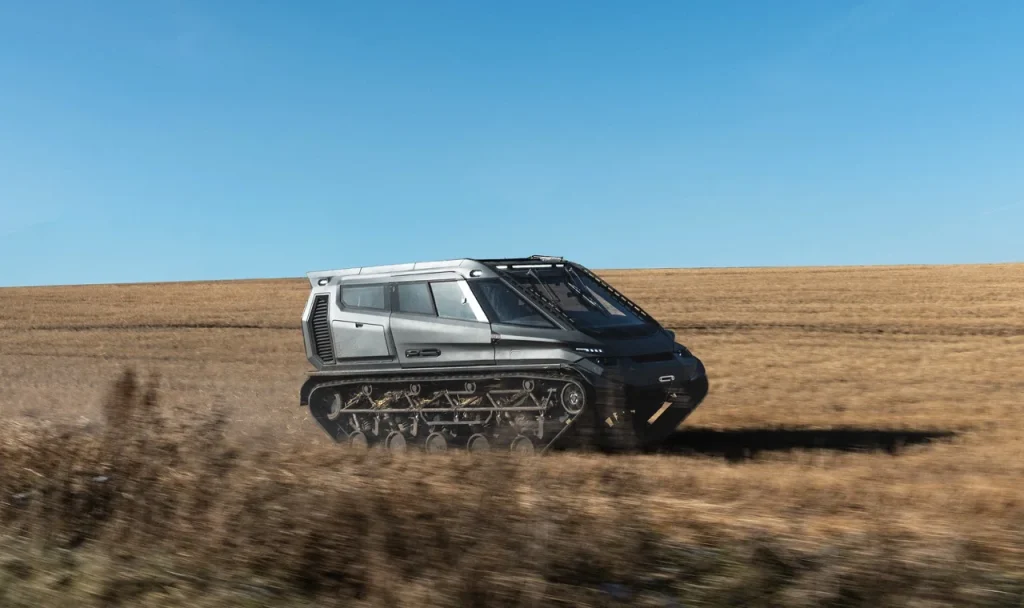
The S2 and T8 hardly look like direct relatives. One rides on enormous wheels, the other on tracks. One is built primarily around the driver, while the other turns the journey into an expedition for an entire group.
Yet both are based on the same idea: traveling across difficult terrain does not have to feel like hard work.
VISUVA did not invent the tracked all-terrain vehicle, nor has it introduced a revolutionary new type of four-wheel drive. Its machines contain plenty of purchased components, including Japanese and Chinese engines.
The project’s value lies elsewhere: intelligent packaging, proprietary chassis and body designs, suspension tuning, and — something particularly rare in this market — a coherent product identity.
The design is not simply a decorative shell placed over the mechanical components. The S2’s giant tires determine the proportions of the entire body, while the T8’s panoramic glazing changes the experience of spending hours crossing a snowy landscape.
Even the company’s social-media presence feels like part of the vehicle. It sells more than individual components and performance figures; it sells the desire to sit behind the wheel one day.
A Beautiful Project That Still Has to Grow Up
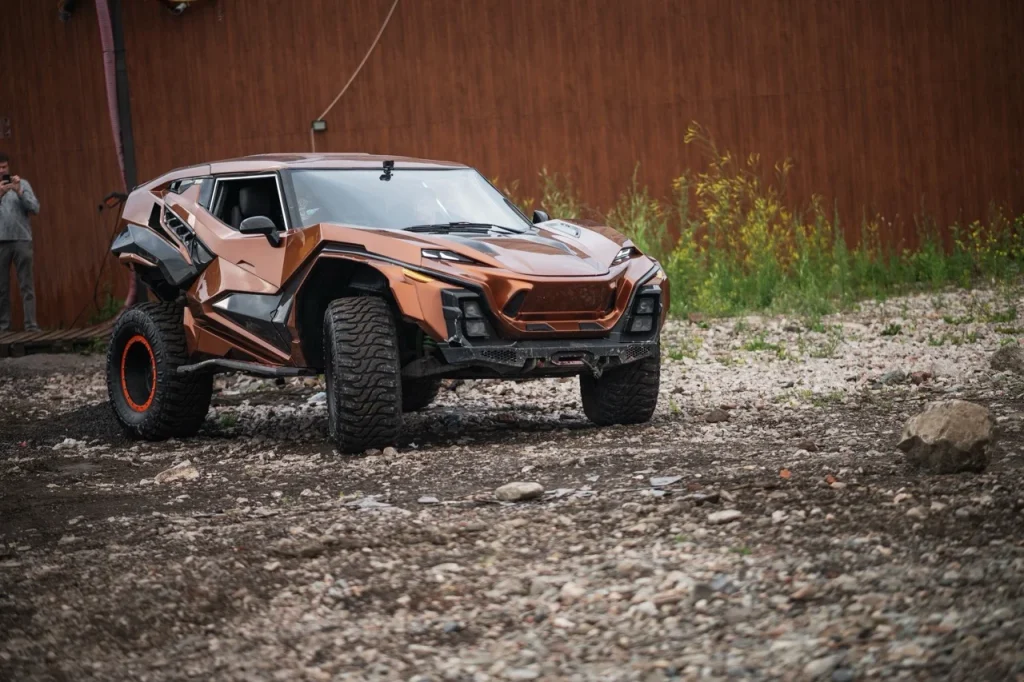
Enthusiasm for the styling does not erase the questions that follow every young manufacturer. A first production run of five machines is not mass production. Owners will care about more than jumps performed at a presentation.
They will need to know how long the components last, how consistent the build quality is, whether spare parts are available, and how quickly a broken vehicle can be repaired thousands of kilometers from Krasnoyarsk.
Claims about being the “fastest” or “most powerful” machine in its class are difficult to verify until the boundaries of that class are clearly defined and independent comparison tests become available.
VISUVA, however, is not attempting to replace Toyota, Mercedes-Benz, or a major manufacturer of industrial all-terrain vehicles. It has chosen a narrow space between an automobile, an expedition vehicle, and an expensive form of entertainment.
Success here does not require a million-unit production run. It requires a few dozen customers for whom an ordinary off-roader is no longer enough.
Perhaps VISUVA’s most important achievement can already be seen before full-scale production has begun. People who have never cared about ground pressure or suspension travel open the company’s social-media page and stay to watch a strange, angular machine charging through snow or climbing over rocks.
For the utilitarian world of all-terrain vehicles, that is already a small revolution: people have finally begun wanting the machine before they have found a reason to need it.
source https://visuva.ru/