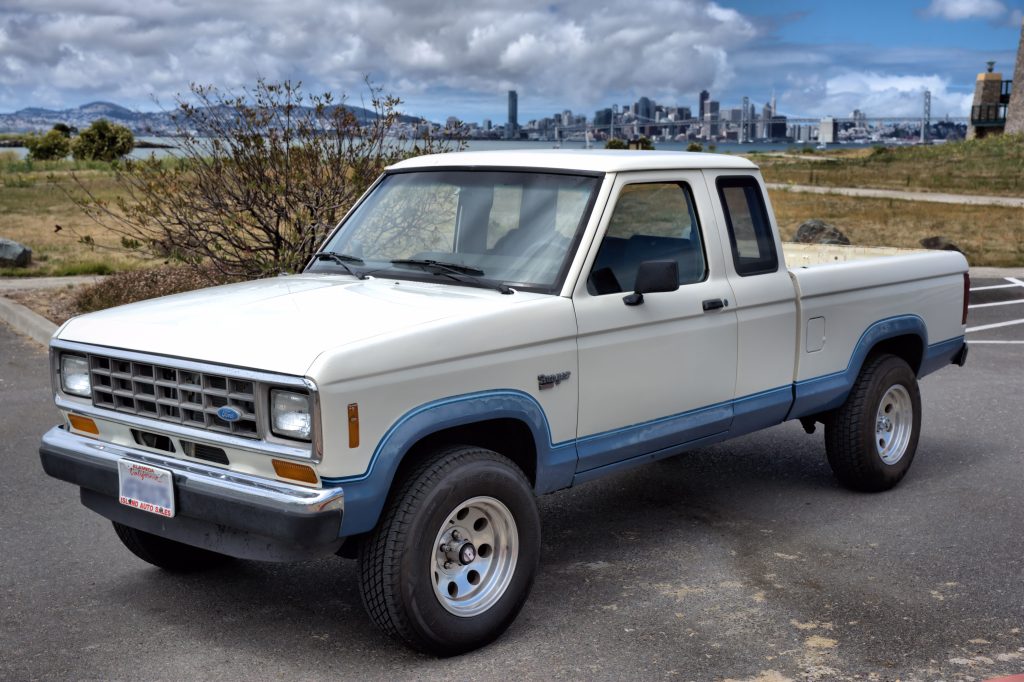
Today, the Ford Ranger name brings to mind a tall cab, a massive grille, and a body that barely fits into an ordinary European parking space. That is why the 1988 Ranger almost inevitably looks like a scale model by comparison. It has a narrow body, thin pillars, modest wheels, and a simple rectangular face. But it was no toy. The shortest version measured only 4.46 meters in length and around 1.70 meters in width, yet with the right equipment it could carry more than 700 kilograms. It was a genuine pickup truck—just from an era when practicality was not measured by the size of the grille.
The 1988 model year is particularly interesting. This was neither the beginning of the Ranger story nor the heavily updated version that followed. It was perhaps the most complete expression of the original design: available with several body configurations, four-wheel drive, the extended SuperCab, and even the flamboyant Ranger GT, while still retaining the angular appearance of the early 1980s. The following year, Ford would significantly modernize the truck, and the square face of the original Ranger would begin to give way to the smoother styling of the 1990s.
America Learns to Build a Small Pickup
During the 1970s, compact pickups sold in the United States almost always spoke with a Japanese accent. Ford offered the Courier, essentially a rebadged Mazda B-Series, while General Motors worked with Isuzu and Chrysler partnered with Mitsubishi. Buyers did not choose these small imported trucks for prestige. They bought them because they were cheaper, more economical, and much easier to use in town than traditional full-size models such as the Ford F-Series and Chevrolet C/K.
The oil crises and increasingly strict fuel economy requirements forced Detroit to take the compact truck market more seriously. In 1976, Ford launched Project Yuma, an effort to develop its own compact pickup as a replacement for the Courier. This was not simply an attempt to shrink the F-150. The new vehicle was designed as a separate product: light and economical enough for everyday driving, strong enough for real work, and comfortable enough that its owner would not see it purely as a piece of agricultural equipment.
The first production Ranger rolled off the Louisville assembly line in January 1982 and reached dealerships that spring as a 1983 model. It became Ford’s first compact pickup developed and manufactured in the United States. The Ranger name had previously been used for trim levels on full-size Ford trucks, but it now became a model of its own. Its timing was perfect: Chevrolet introduced the S-10 at almost the same moment, and America’s manufacturers finally had their own answer to the Japanese compact pickups.
Small Outside, Full-Size Engineering Underneath
The Ranger’s construction was refreshingly straightforward: a separate frame, a solid rear axle, and leaf springs. Rear-wheel-drive versions used Ford’s independent Twin I-Beam front suspension, while four-wheel-drive models received the related Twin Traction Beam system. It delivered a more comfortable ride over broken pavement than one might expect from a small truck, although the empty bed and rear leaf springs never allowed the driver to forget that this was not a passenger car.
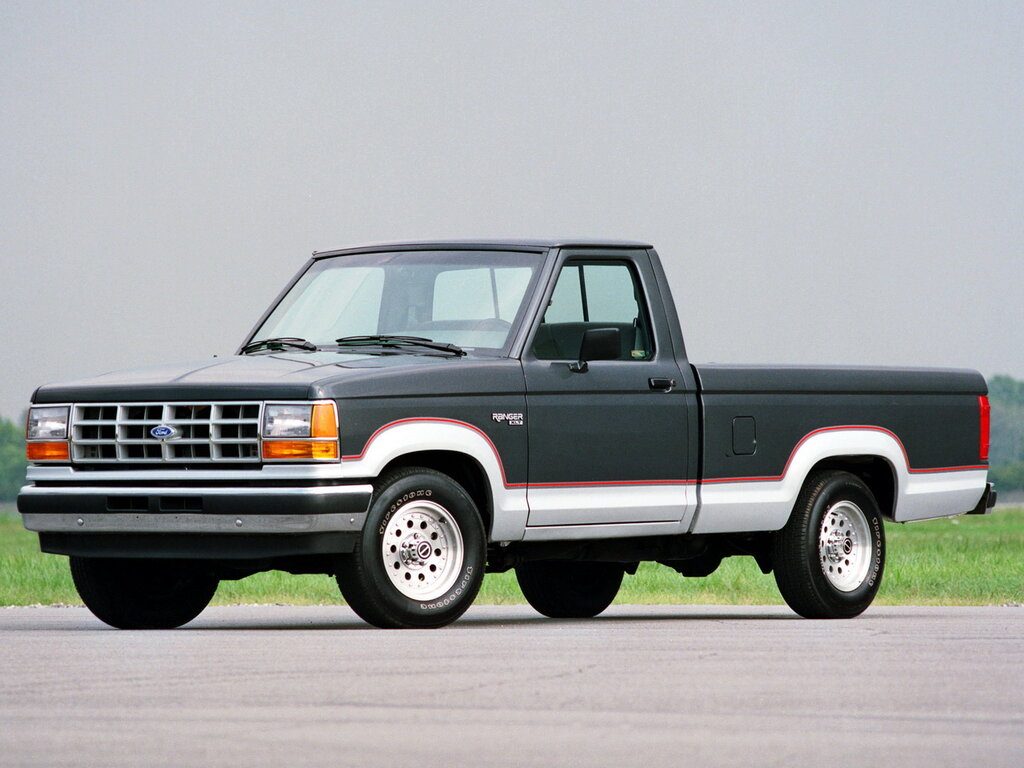
The 1988 Ranger could assume several very different personalities. The regular cab was available with either a six- or seven-foot bed, while the SuperCab, introduced in 1986, added storage space behind the front seats and two tiny folding jump seats. Calling them a proper second row would be optimistic. Adults had little room, but bags, tools, or children could be carried without putting everything in the exposed cargo bed. Depending on the configuration, overall length ranged from approximately 4.46 to 4.90 meters.
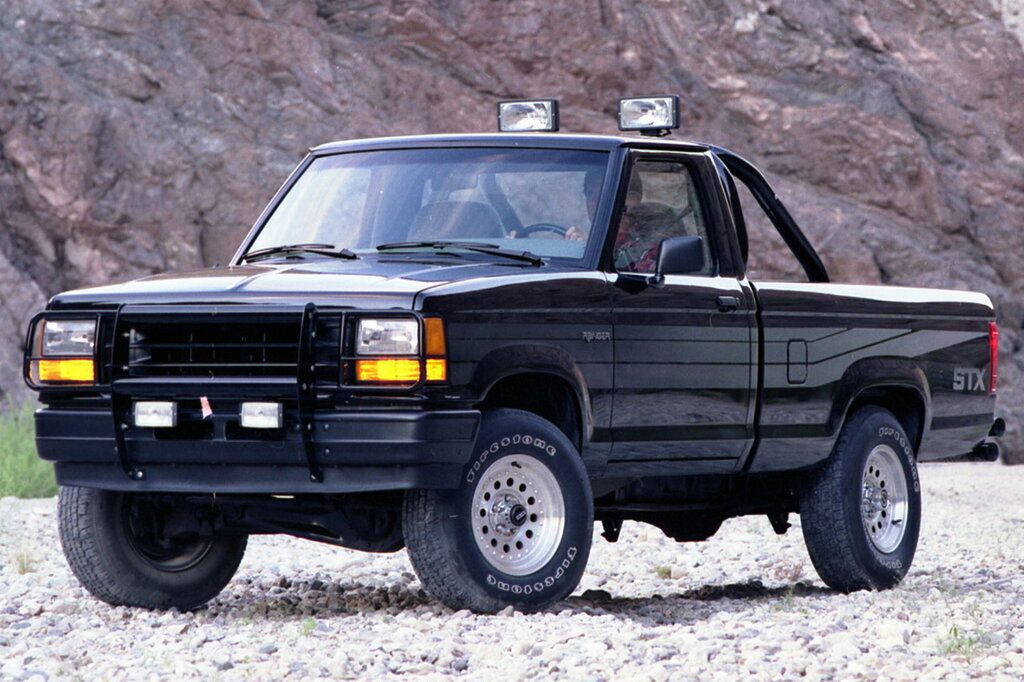
The four-wheel-drive Ranger did not merely pretend to be an off-roader. Low-range gearing, useful ground clearance, and compact dimensions made it genuinely capable on farms, forest trails, or snow-covered roads. Buyers who wanted something more serious could choose the STX High Rider, with raised suspension and a more purposeful off-road stance.
By 1988, the same Ranger could serve as an inexpensive rear-wheel-drive work truck, a more practical SuperCab, or a compact four-wheel-drive recreational vehicle—long before the word “lifestyle” became unavoidable in pickup truck advertising.
Three Engines and No Horsepower Arms Race
The entry-level 2.0-liter four-cylinder engine produced approximately 73 horsepower and made its final appearance in the Ranger lineup in 1988. Its carburetor already seemed old-fashioned beside the fuel-injected 2.3-liter engine, which developed around 90 horsepower. Both four-cylinder engines performed their duties honestly, but neither encouraged haste—especially when carrying a load or paired with an automatic transmission.
The main attraction was the fuel-injected 2.9-liter Cologne V6, producing 140 horsepower and approximately 230 Nm of torque. Those numbers appear modest today, but the Ranger weighed roughly 1.2 to 1.4 tonnes, so the V6 gave it respectable performance. Buyers could choose between a five-speed manual and a four-speed automatic transmission.
This was the philosophy of the period in its purest form. Ford was not trying to win an advertising war with spectacular horsepower figures. It offered exactly as much engine as a compact working truck required.
Payload capacity was far more revealing than engine output. Depending on wheelbase, drivetrain, and suspension package, the Ranger could carry approximately 545 to 737 kilograms. In other words, this neat little truck—roughly the length of a modern family crossover—could haul more than many current vehicles that look twice as aggressive. Compact did not mean decorative.
Ranger GT: A Sports Suit Under a Work Jacket
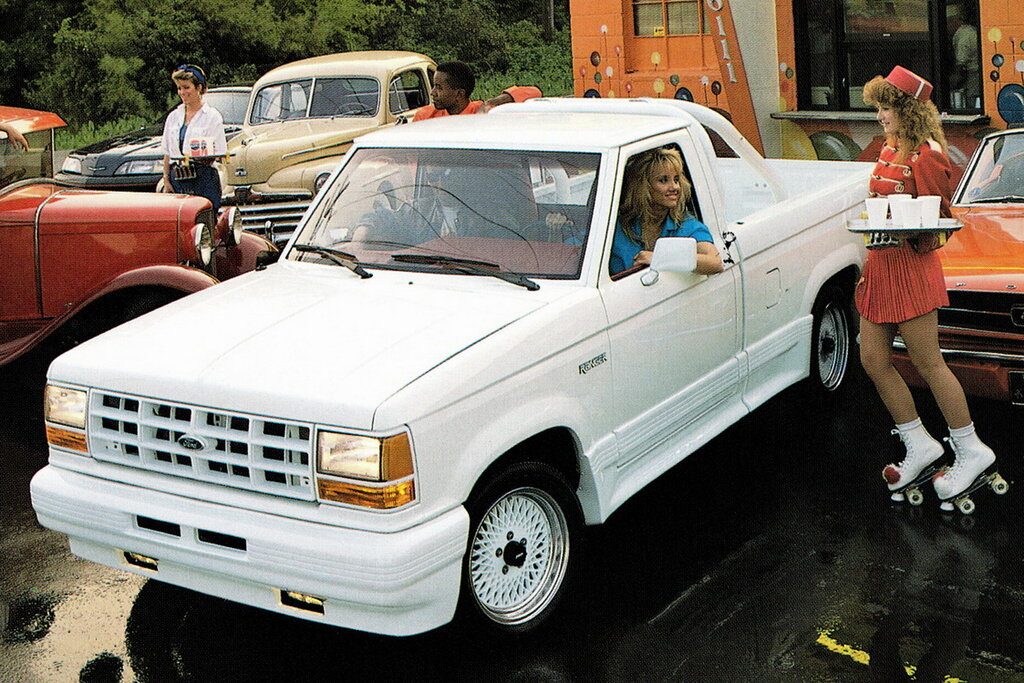
The most charming oddity in the lineup was the Ranger GT. Ford took a rear-wheel-drive regular-cab pickup, installed the 2.9-liter V6, added firmer suspension with front and rear anti-roll bars, a limited-slip differential, and wider performance tires, then finished it with bucket seats, a center console, fog lamps, a front spoiler, and ground-effect side skirts. Both manual and automatic transmissions were available.
The GT was not fast by modern standards. But it looked as though an ordinary delivery truck had suddenly discovered 1980s street fashion. Its appeal was not about acceleration times so much as the fact that it existed at all. Ford had already realized that people did not buy small pickups only because they needed to carry timber. The Ranger could be personal transportation, a young driver’s first new vehicle, or the basis for a custom project. The GT was aimed at buyers who wanted character just as much as they wanted a cargo bed.
At the opposite end of the range were the basic Ranger S and Custom, with the better-equipped XLT and STX positioned above them. This variety explains much of the truck’s success. According to historical brand and enthusiast archives, Ford sold approximately 367,000 Rangers in 1988, making it America’s best-selling compact pickup. A single model covered too many different needs to remain a niche product.
Imperfect—and All the More Appealing for It
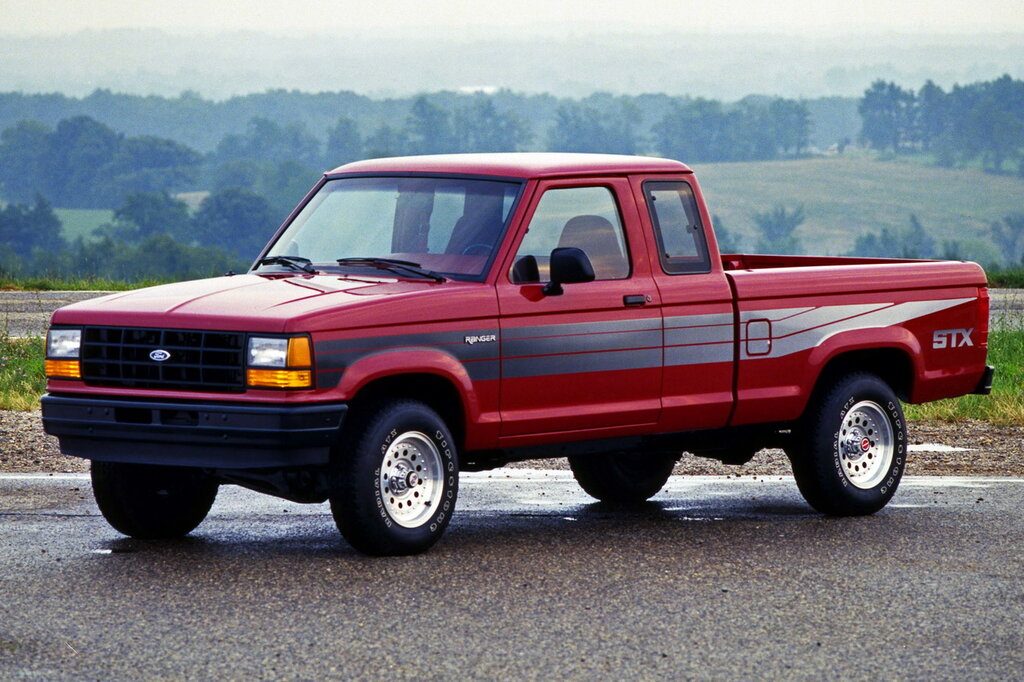
It is easy to romanticize the 1988 Ranger, but age does not erase its weaknesses. The entry-level engines are slow, an empty truck bounces over rough surfaces, the cabin is narrow, and the rear seats in the SuperCab are better considered emergency accommodations than genuine passenger space.
The early 2.9-liter V6 is particularly sensitive to overheating. A neglected cooling system could lead to cracked cylinder heads. Add corrosion and decades of hard work, and finding a genuinely well-preserved example becomes much more difficult than classified advertisements might suggest.
But simplicity also works in the Ranger’s favor. Its body-on-frame construction is easy to understand, the mechanical components are not hidden beneath layers of electronics, and North America still has a large supply of parts and accumulated knowledge about the model.
The Ranger does not demand to be treated like a museum exhibit. Even a carefully preserved example can still be used for its original purpose, which separates it from many collector vehicles that have become too expensive or too fragile for ordinary life.
The Final Year of Square-Jawed Honesty
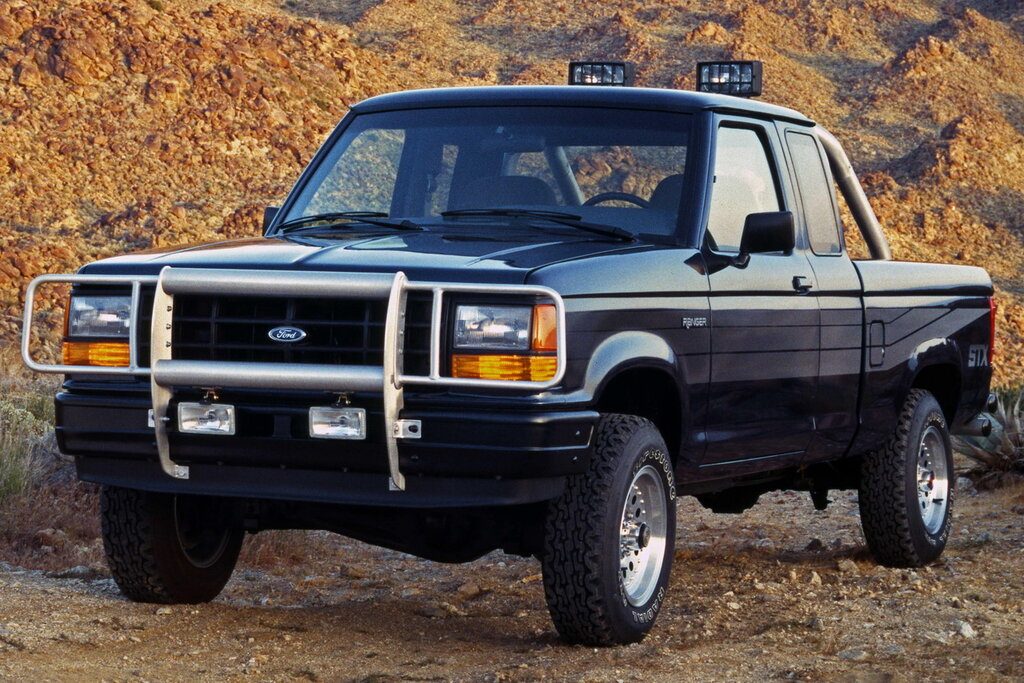
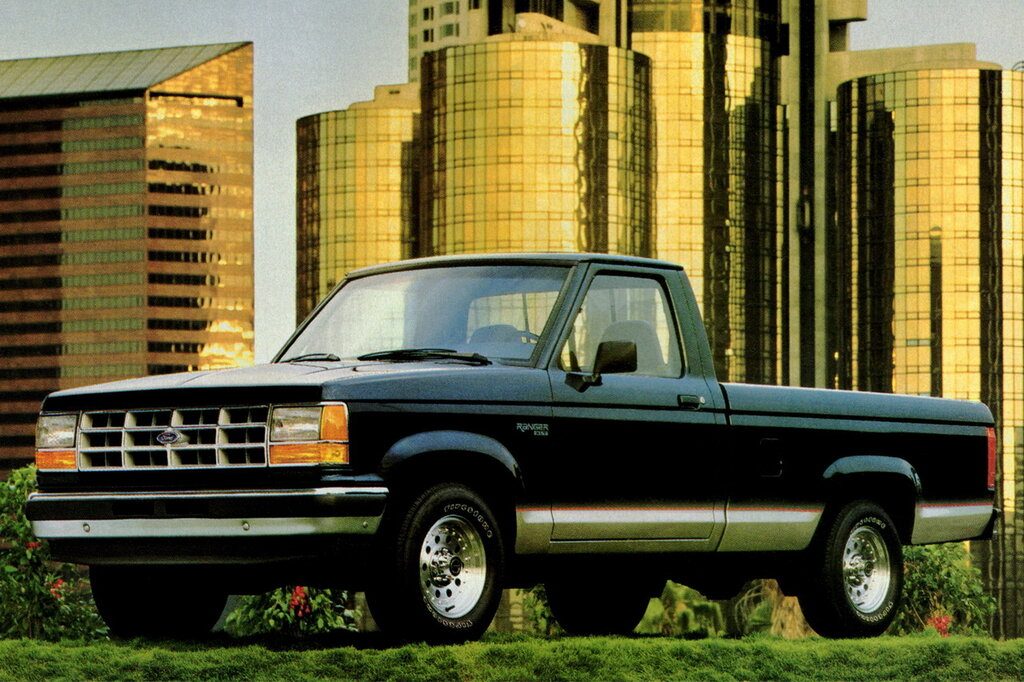
For 1989, the Ranger received a major update with a smoother front end, new fenders, a redesigned hood and grille, and flush-mounted headlights. Technically, the first generation remained in production until 1992, while its architecture also provided the foundation for the Bronco II and the original Ford Explorer.
Yet the 1988 model marked the end of the Ranger’s original identity: a simple, rectangular pickup created as America’s answer to the small Japanese trucks.
Today, the 1988 Ford Ranger is interesting for more than nostalgia. It represents an almost forgotten idea—that a pickup can be useful, durable, and desirable without occupying half the road or turning every journey into a display of status.
The Ranger fitted inside an ordinary garage, carried well over half a tonne, offered either economical four-cylinder power or a lively V6, and could even dress itself in a sporty body kit when the owner wanted something less sensible. It did not need to look enormous to perform real work.