Live Fast, Die Young: The Story of the F-16N—A Brief but Memorable Stint with the U.S. Navy

When it comes to fighter jets, the F-16 Fighting Falcon is one of the most recognizable aircraft in aviation history. However, among all the variants of this aircraft, there is one incredibly rare and unusual version that has left almost no mark on mainstream history but possesses a unique history and symbolism—the F-16N, developed for the U.S. Navy.
Why Did the F-16 End Up in the Navy?
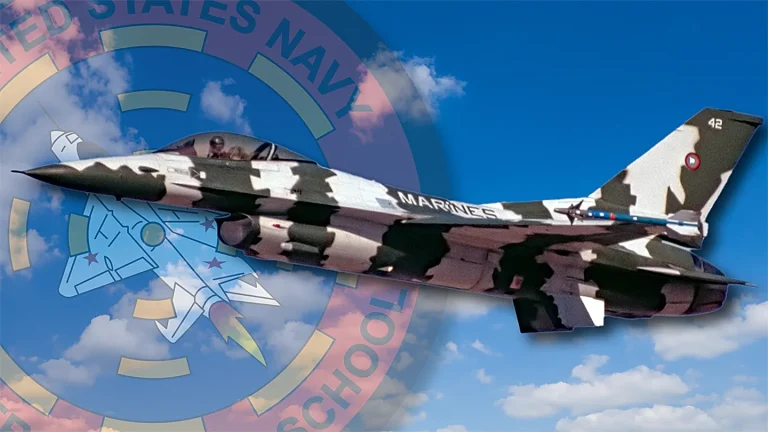
The F-16 fighter was originally developed as a lightweight, highly maneuverable, and inexpensive aircraft for the U.S. Air Force. But in the mid-1970s through the early 1980s, a need arose for a target aircraft to train the Navy’s carrier-based aviation: to simulate fast, agile “enemy” targets that pilots of carrier strike groups might encounter. What was needed was something capable of simulating highly maneuverable targets that rapidly changed course and speed—the nature of the threat that enemy fighters might pose.
Of the available platforms, the choice fell on a modified F-16. This aircraft was a fast, maneuverable, and affordable option for use as a flying target simulating an “enemy squadron.”
What Is the F-16N: The Little-Known Falcon Variant
The F-16N is a special version of the F-16A/B, modified to meet the needs of the U.S. Navy. The main feature of this version was that the aircraft was not intended to perform traditional combat missions—it was used as a flying target for carrier-based strike squadrons to practice on.
The main differences between the F-16N and the standard F-16 were as follows:
- Lack of A/G armament—the onboard bomb and missile arsenal has been removed to reduce weight;
- enhanced aerodynamic features and a braking system to enable the aircraft to safely enter and exit training zones;
- threat simulation system — sensors were installed on board to simulate enemy behavior;
- Enhanced maneuverability—the aircraft was capable of simulating the aggressive maneuvers typical of real combat operations;
- modifications to the fuel system, since the exercises involved short-duration maneuvering drills but did not require a long range.
Why did the Navy need an F-16 to serve as a “target”?
Although at first glance the idea seems strange—using a combat aircraft as a target!—it was precisely this that addressed important training objectives. In the midst of the Cold War and in the years that followed, the U.S. Navy realized that carrier-based fighter pilots needed to be able to counter fast, agile air threats posed by both current and future enemy fighters. This required “live” training that was as close to reality as possible.
The following tasks were assigned to carrier-based pilots:
- pursuit and tracking of high-speed targets;
- practicing attack maneuvers;
- evasion and interception maneuvers;
- Interaction with the missile defense systems of naval task forces.
This required not stationary simulators, but aircraft that could actually move, maneuver, and behave like a real enemy. The F-16, with its high maneuverability, proved to be the ideal choice.
Where and When Were the F-16Ns Deployed?
These aircraft were in service with several specialized “target” squadrons that operated in close coordination with naval aviation. They flew alongside carrier strike groups, simulating real-world air combat scenarios so that the pilots could practice their responses and tactics against a modern aerial adversary.
The F-16Ns were in service from around the late 1970s to the early 1990s, after which they were gradually phased out. The number of these aircraft was extremely small compared to the Air Force’s main F-16 fleet, and the missions they performed were specialized—not for just anyone.
Why hasn’t this modification been widely adopted?
The F-16N was an unusual aircraft, and it had its limitations:
- High Operating Costs
Although the F-16 was cheaper than some heavy fighters, maintaining the aircraft—even in a target role—remained a costly endeavor. - The
F-16N was not designed for combat missions and could not be deployed in full combat service if necessary. - Advances in Training Technology
: The emergence of ground-based trainers equipped with virtual reality technology and electronic simulators has reduced the reliance on live flights as targets. - Changes in Tactical Objectives
With the end of the Cold War and the shift to new air combat scenarios, the role of live targets has diminished, making the program less relevant.
The Legacy of the F-16N
Although the F-16N had a relatively short service life, its role in the history of flight training remains unique. This aircraft served as a bridge between the era when pilots learned “in combat” and the new era, when simulators and technology allow for the simulation of complex situations without the risk of an actual collision.
The F-16N has proven:
- Pilot training should be as realistic as possible;
- Role-playing flight training (in which an aircraft from one side plays the role of the “enemy”) can significantly improve skills;
- Specialized variants can play an important role in combat training, even if they are not intended for direct participation in combat operations.
Conclusion
The history of the F-16N is the story of an unusual application of one of the most famous combat aircraft of our time. This isn’t just another variant of the F-16—it’s a rare example of how a high-tech aircraft platform was used to train other pilots, helping them hone their skills under the most challenging conditions.
Although there were only a few of these aircraft and their service was relatively short-lived, the F-16N had a significant impact on tactical training and pilot instruction methods. It became a symbol of how aviation is evolving not only to fight, but also to prepare others for battle.
Based on material from https://www.twz.com/air/live-fast-die-young-the-story-of-the-navys-f-16n