The Trainer That Does Not Have to Land on an Aircraft Carrier: Why the M-346N Is Alone in the U.S. Navy Competition

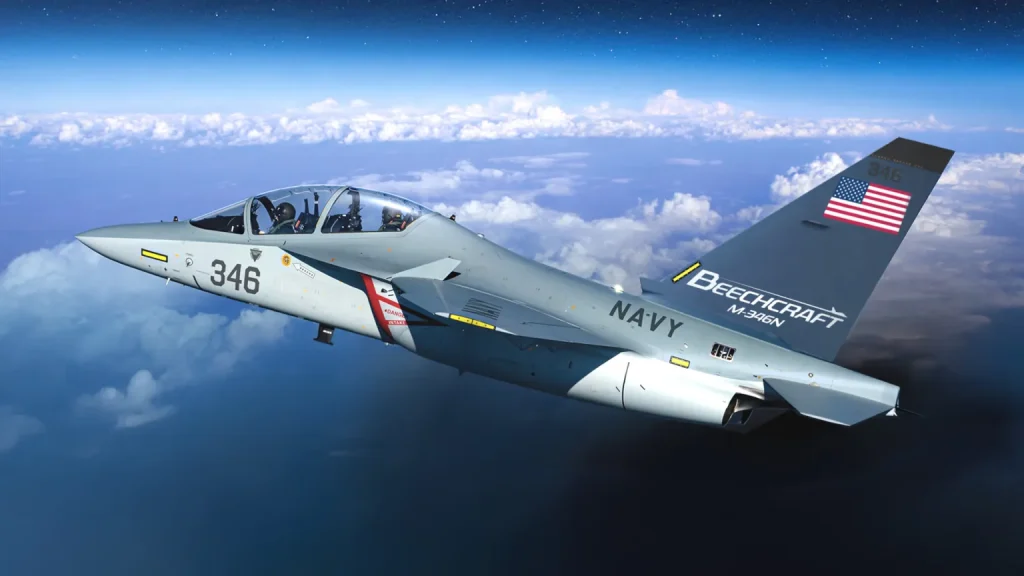
The U.S. Navy’s competition to replace the T-45 Goshawk began as a contest between four very different aircraft. Lockheed Martin planned to offer the supersonic TF-50N, Boeing proposed a version of the Air Force’s T-7A Red Hawk, Sierra Nevada Corporation was developing the new Freedom Jet, and Textron and Leonardo entered an Americanized M-346N.
By the proposal deadline, three major teams had withdrawn. This left the Beechcraft M-346N as the only publicly known contender backed by an operational production aircraft, an established supply chain, and a major aerospace manufacturer. Yet the most unusual aspect of the Navy’s future trainer is not its Italian origin. An aircraft intended to prepare carrier pilots will not actually be required to land on an aircraft carrier.
Why the T-45 Cannot Be Repaired Indefinitely
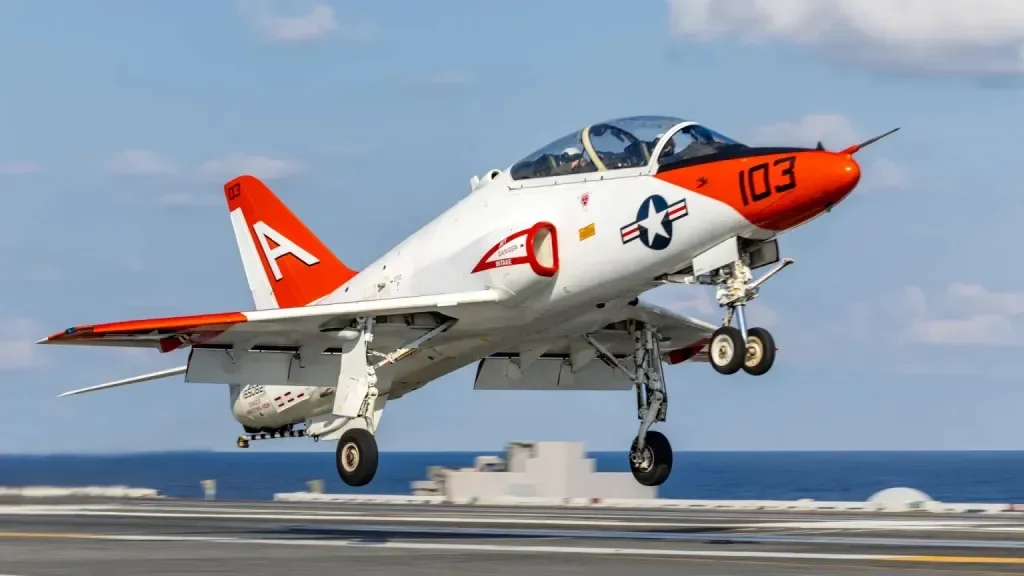
The T-45 Goshawk is a substantially modified carrier-capable version of the British Hawk trainer. To operate from aircraft carriers, the American aircraft received strengthened landing gear, an arresting hook, redesigned wing high-lift devices, and a structure capable of surviving arrested landings and catapult launches.
The first T-45s entered service in 1991. Later T-45Cs received digital cockpits, but the aircraft’s structure, engine, and overall architecture belong to an earlier generation. The Navy currently operates slightly fewer than 200 Goshawks.
The fleet’s age is already affecting readiness. Wings have to be replaced, fuselages repaired, and aircraft placed through a service-life extension program. A full overhaul of one T-45 involves 17 separate technical directives and can require approximately 24,000 labor hours. This work is expected to continue into the mid-2030s.
Another problem involved a series of hypoxia-like physiological episodes among pilots, leading to an upgrade of the onboard oxygen-generation system. Several Goshawks have also been lost in recent years, although the accidents had different causes.
The Undergraduate Jet Training System, or UJTS, program calls for the acquisition of 216 new aircraft, ground-based simulators, software, and supporting logistics infrastructure. Proposals were due by October 30, 2026, with a contract award expected in the fourth quarter of fiscal year 2027—between July and September 2027.
Why an Italian Aircraft Is Called Beechcraft
The M-346N is based on the M-346 Master developed by Italy’s Leonardo. The type is already used to train military pilots in Italy, Israel, Poland, Singapore, and several other countries. More than 100 aircraft from the M-346 family have been produced.
For the Navy competition, Leonardo partnered with the American company Textron Aviation Defense. Textron serves as the prime contractor and markets the aircraft under the historic Beechcraft name. Aircraft for the U.S. order are expected to be assembled in the United States, while the Honeywell F124 engine already has an American industrial base.
The Beechcraft M-346N is therefore neither a completely new aircraft nor simply a renamed Italian trainer. It is an adaptation of an existing airframe for the American requirement, incorporating a redesigned cockpit, software, training infrastructure, and a U.S.-based logistics system.
The letter N indicates that the aircraft has been tailored for naval aviation training, but it does not make it a genuine carrier-capable aircraft. The M-346N is not expected to receive landing gear reinforced for carrier impacts, a catapult-compatible nose strut, or the arresting hook required for routine flight-deck operations.
What Is the M-346N?
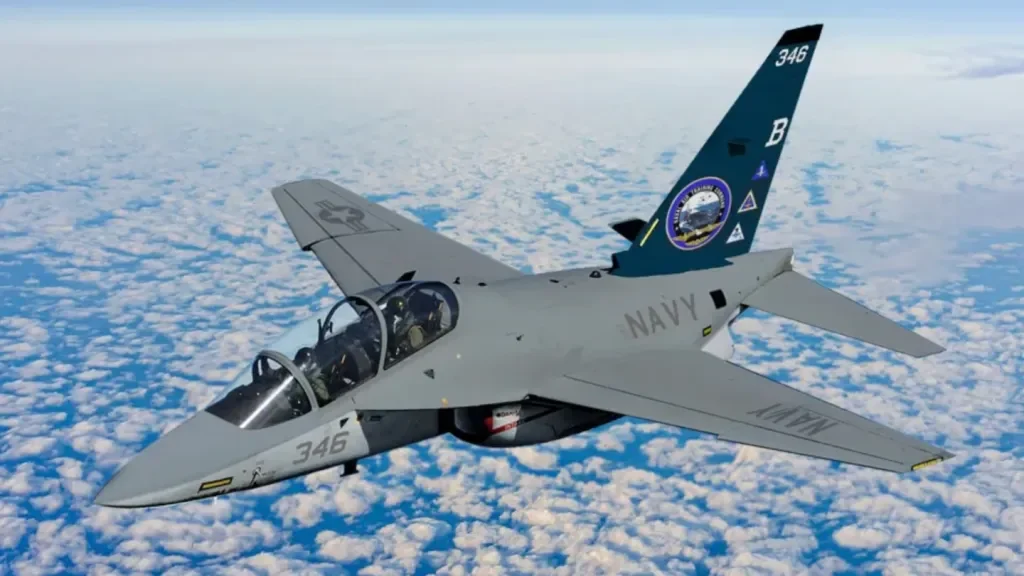
The M-346N is a twin-engine, tandem-seat advanced trainer. The instructor occupies the raised rear cockpit, providing better forward visibility and allowing close supervision of the student during landing approaches.
The airframe is designed for sustained training loads and makes extensive use of composite materials. A quadruplex digital fly-by-wire system prevents the aircraft from exceeding safe limits while still allowing energetic maneuvering at high angles of attack. Students can experience handling characteristics similar to those of a modern fighter without an ordinary control error immediately leading to a loss of control.
Two non-afterburning Honeywell F124-GA-200 turbofans each produce approximately 2,850 kilograms-force of thrust. The twin-engine arrangement is more complicated and potentially more expensive to maintain, but it offers an additional safety margin during flights over water: the failure of one engine does not necessarily result in the immediate loss of the aircraft.
| Length | 11.49 m |
| Wingspan | 9.72 m |
| Height | 4.76 m |
| Maximum ramp weight | 9,600 kg |
| Engines | 2 × Honeywell F124-GA-200 |
| Combined maximum thrust | Approximately 5,700 kgf |
| Maximum low-altitude speed | 590 knots / 1,090 km/h |
| Service ceiling | 13,715 m |
| Sea-level climb rate | Approximately 6,700 m/min |
| Permitted load factor | −3 to +8 g |
| Ferry range on internal fuel | Approximately 1,925 km |
| Ferry range with three external tanks | Approximately 2,550 km |
The M-346N is not a true supersonic aircraft. It has no afterburner, and most missions are conducted at subsonic speeds. For a trainer, this is a deliberate compromise: lower fuel consumption and operating costs are more valuable than sustained supersonic performance.
Its thrust-to-weight ratio, aerodynamic design, and controllability at high angles of attack nevertheless allow students to practice air combat, high-energy turns, weapon employment, and recovery from difficult situations. Five external stations can carry fuel tanks, training equipment, and weapons, while an aerial-refueling probe allows pilots to practice in-flight refueling.
Both cockpits are equipped with head-up displays, large-area multifunction screens, and hands-on-throttle-and-stick controls. The proposed configuration also includes a helmet-mounted display, night-vision compatibility, zero-zero ejection seats, an onboard oxygen-generation system, and an Automatic Ground Collision Avoidance System.
The Most Important System Is Not Mounted Under the Wing
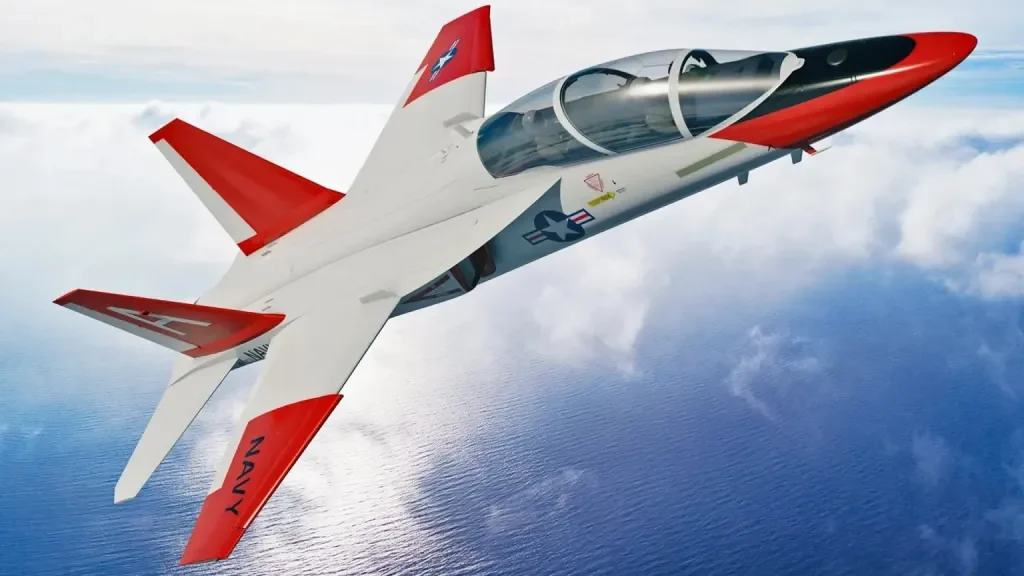
For the UJTS program, the aircraft is only one element of a much larger package. The Navy is not simply purchasing 216 jets, but a training system that includes simulators, classrooms, software, mission-planning tools, and management of the entire training process.
The Embedded Tactical Training System can simulate radar, electronic warfare, missiles, and other equipment without physically installing those systems aboard the aircraft. The student sees virtual targets on the cockpit displays, receives simulated threat warnings, and can employ computer-generated weapons.
Live, Virtual, and Constructive technology connects three levels of training. A real M-346N flies in the air, another participant may operate from a ground-based simulator, and computers add virtual aircraft, ships, radars, and missiles. To the pilot, all of them appear as parts of one complex tactical environment.
This makes it possible to conduct a large exercise without launching dozens of real aircraft or expending actual weapons. It also teaches more than basic flying. Students learn to process information, evaluate threats, assign targets, and employ simulated weapons—the skills required before transitioning to the F-35C, F/A-18E/F, or EA-18G.
Textron also promises to use artificial intelligence to analyze student performance and build individualized training programs. For now, this remains primarily a manufacturer’s claim, but the M-346 can collect and compare considerably more flight data than the T-45.
Why a Carrier Pilot Will Train Without an Aircraft Carrier
The T-45 was designed as a genuine naval aircraft. It can land on an aircraft carrier, catch an arresting wire, and launch from a catapult. The new UJTS trainer does not require any of these capabilities.
In fact, the future aircraft will not even be required to perform full runway touchdowns during Field Carrier Landing Practice, the shore-based training used to simulate carrier approaches. It must support approaches and wave-offs, while much of the remaining carrier-landing instruction will be transferred to simulators.
The decision appears paradoxical, but the Navy has a technical explanation. Modern carrier aircraft are receiving automated approach-control capabilities, including the family of Precision Landing Mode technologies commonly known as Magic Carpet. The system connects control-stick inputs more directly to the aircraft’s flight path and reduces the number of constant corrections required during a traditional carrier approach.
Naval Aviation officials argue that the training hours saved can instead be devoted to information processing, tactics, and the employment of complex onboard systems. The Navy explicitly describes UJTS not as a simple airframe replacement but as a complete transformation of undergraduate jet training, with a much greater role for virtual reality and simulation.
Removing carrier requirements also makes the aircraft lighter and cheaper. Reinforced landing gear, corrosion protection, an arresting hook, catapult equipment, and a strengthened airframe all increase weight and maintenance costs, even when the aircraft spends most of its service life operating from shore bases.
The decision remains controversial. A simulator can reproduce the appearance of a flight deck, ship movement, and instrument indications, but it cannot fully recreate the physical and psychological experience of approaching a moving carrier. Critics fear that the most difficult skill in naval aviation is being postponed until a later stage, when mistakes will be more expensive.
What Happened to the Other Aircraft?
Lockheed Martin and Korea Aerospace Industries planned to offer the TF-50N, a naval training version of the T-50 family. It would have been the most fighter-like contender: single-engined, supersonic, and closely related to a light combat aircraft. Lockheed Martin withdrew in April 2026 without providing a detailed explanation.
Boeing intended to enter a version of the T-7A Red Hawk, currently being developed for the U.S. Air Force. It withdrew in June, citing Navy requirements concerning qualification of the General Electric F404 engine. For a program already affected by delays and losses under the Air Force’s fixed-price contract, further redesign work may have presented too much financial risk.
This left Sierra Nevada Corporation’s Freedom Jet as the M-346N’s main competitor. It was a new twin-engine design intended to retain the ability to perform simulated carrier touchdowns ashore and potentially support actual carrier qualification.
However, a Freedom Jet prototype has yet to fly. The competition’s contractual structure required the manufacturer to accept a firm fixed price even though the aircraft’s final design had not matured. Sierra Nevada concluded that it could not accept that level of risk and declined to submit a proposal. Northrop Grumman had previously withdrawn from the team.
Stavatti Aerospace says it submitted its SM-31A Stiletto supersonic trainer proposal. That aircraft also exists only as a project, however, and Stavatti has no experience with the serial production of modern jet trainers. The M-346N therefore remains the only known entrant based on an operational aircraft and supported by an established manufacturer.
Why Maturity Became the M-346N’s Most Important Weapon
The M-346N is currently beating its competitors not through superior speed or maneuverability, but through readiness. The underlying aircraft has been in service for more than a decade, and its aerodynamics, engines, and core systems are already proven. Simulators, maintenance procedures, and an international supply chain already exist.
That is particularly important under a fixed-price contract. The manufacturer of a clean-sheet aircraft would have to estimate the cost of incomplete development and future design changes in advance. Textron and Leonardo can rely on actual M-346 operational data, although the American version will still require certification and integration work.
Two engines provide an additional safety margin, while the raised rear cockpit is well suited to an instructor’s needs. The quadruplex fly-by-wire system can shape the aircraft’s handling and prevent excursions beyond safe limits. Its electronics can imitate the systems of more expensive combat aircraft, reducing the need to consume F-35 and Super Hornet flight hours.
The aircraft may also take on secondary missions. With five external stations, a refueling probe, and an advanced virtual-training suite, it could serve as an adversary aircraft, a continuation trainer for operational pilots, or a lower-cost support platform during exercises.
Why the Only Major Contender Has Not Yet Won
The absence of serious competitors appears advantageous for Textron and Leonardo, but it presents a problem for the Navy. The competition was supposed to determine which company could offer the best price, service life, and delivery schedule. If there is no credible alternative, the service loses leverage in negotiations.
The Navy has not officially disclosed the bidders, so the M-346N is technically the only known major contender, not necessarily the only proposal received. The service could continue the evaluation, demand changes, restructure the contract, or reopen the competition.
Technical risks also remain. The American version will receive a different cockpit, software, communications equipment, and cybersecurity requirements. Production will have to be localized, maintenance infrastructure established, and the aircraft’s ability to withstand the Navy’s intense training tempo demonstrated.
Finally, the Navy must prove that the training concept itself is sound. If transferring much of carrier-landing preparation to simulators fails to produce the expected results, the capability cannot simply be restored through a minor M-346N upgrade. Creating a genuinely carrier-capable version would require new landing gear, structural reinforcement, an arresting hook, and an extensive test program.
Did the M-346N Win Before the Official Decision?
Formally, no. Source selection remains underway, no contract has been signed, and the Navy has not confirmed how many proposals it received. Yet the M-346N is already in a unique position: every major rival has withdrawn, while replacement of the T-45 is becoming increasingly urgent.
Its advantage is not that it is the fastest aircraft or the design most closely resembling a fighter. The M-346N offers the Navy lower technical risk: a production airframe, two established engines, a digital cockpit, and a mature training ecosystem.
At the same time, it embodies a controversial transformation of the entire American carrier-aviation training system. Future pilots will learn to manage complex tactical information, interact with virtual adversaries, and process enormous amounts of data—but for the first time, they may earn their Wings of Gold without completing a training landing on an aircraft carrier.
That is why the M-346N story is more important than an ordinary trainer competition. The U.S. Navy is not merely selecting a successor to the T-45. It is deciding whether a carrier pilot can be trained by replacing part of the real flight deck with computer code.