Memoirs of an Old Knight of Acre. Chapter VIII. The Last Peaceful Autumn

“Memory is remarkably selective. I can no longer remember how many times I sharpened my axe in those years, yet until my dying day I will remember the smell of the autumn forest during that hunt. Perhaps because none of us knew then that it was the last autumn of the world we had known.”
From the writings of Ansel de Nantes.
Human memory is a strange thing. It can preserve a single evening in every detail while erasing entire years. If someone asked me to recount everything that happened between my arrival in Caen and the autumn of 1095, I doubt I could do it. What returns to me is not a succession of separate days, but one endless, drawn-out day smelling of horse sweat, coal smoke from the smithy, fresh straw, and linseed oil with which we rubbed down our mail after every training session.
I grew almost without noticing it myself. My arms became stronger, my shoulders broader, my movements more certain. The axe that had once seemed heavy now felt like an extension of my own hand. Clavier no longer watched my every step, while Geoffroi and Drogo increasingly entrusted me with tasks they had once done themselves. Then came the day when Clavier unexpectedly ordered me to show a new boy how to clean mail properly and prepare a saddle. Only then did I realize that I was no longer the novice among them.
The autumn that year was unusually warm. October painted the Norman forests in gold and crimson, the air turned clear, and the morning mists rose slowly from the river valleys, as though reluctant to leave the earth. It was then that Duke Robert announced a great hunt.
To someone who had never lived among the nobility, such an occasion might have seemed no more than entertainment. In truth, a great hunt was almost as important to the life of the duchy as a council of war or an assembly of barons. It brought together people who rarely saw one another during the year, giving them the chance to discuss the affairs of their estates, make new agreements, arrange marriages, settle old disputes, and remind everyone who ruled these lands. And so, by the appointed day, barons, knights, abbots, bishops, their families, squires, falconers, huntsmen, dog handlers, and servants began arriving in Caen. The castle itself seemed too small to hold them all.
Never before had I seen so many noble ladies gathered in one place.
They were nothing like the peasant women and townswomen we encountered in Caen. Their gowns were made of fine wool and costly fabrics, richly embroidered, while light veils worked with silver thread covered their hair. Yet what surprised me most was something else: almost all of them sat a horse with complete confidence. Only later did I understand that among the Norman nobility, riding was as natural a skill as reciting the Psalms was to a monk.
Among those who arrived was the duke’s younger sister, Lady Agatha.
By then she was about thirty years old and had long been married, yet age had only added to her dignity. Looking back upon that day, I realize that she was the first truly noble woman I had ever seen. Not some minstrel’s beauty from a song, but a woman raised at the court of William the Conqueror. She spoke calmly, laughed rarely but sincerely, handled her horse with confidence, and carried herself in such a way that people seemed to make room for her without even thinking about it.
The hunt began before noon.
The hounds were released, the huntsmen rode ahead in search of tracks, and the long procession of riders slowly made its way deeper into the autumn forest. The air smelled of damp leaves, wet earth, and rotting acorns. Somewhere in the distance came the barking of hounds and the answering calls of the beaters’ horns, while sunlight broke through the yellowing canopy in broad shafts of gold.
Toward evening, the hounds finally put up a great boar.
The beast burst from a dense thicket of hazel like a stone from a siege engine, snapping young saplings as it came. Horses shied, the hounds raced after it, and in an instant the entire hunt dissolved into a chaotic chase.
That was when something happened that no one had expected.
Lady Agatha’s horse panicked at the sudden appearance of the boar, reared violently, and bolted. Several riders tried to catch its reins, but they were already too late. The terrified animal plunged through the forest, smashing through undergrowth with no regard for the path ahead.
“After her!” Robert ordered.
I did not even have time to think.
I drove my heels into my horse’s flanks and was the first to race after her.
Branches lashed my face, hooves slipped on the wet leaves, and only occasionally did I catch a glimpse of Agatha’s pale gown ahead. She was desperately trying to bring the animal under control, but the horse was no longer listening to its rider.
It ended without warning.
The ground ahead simply vanished.
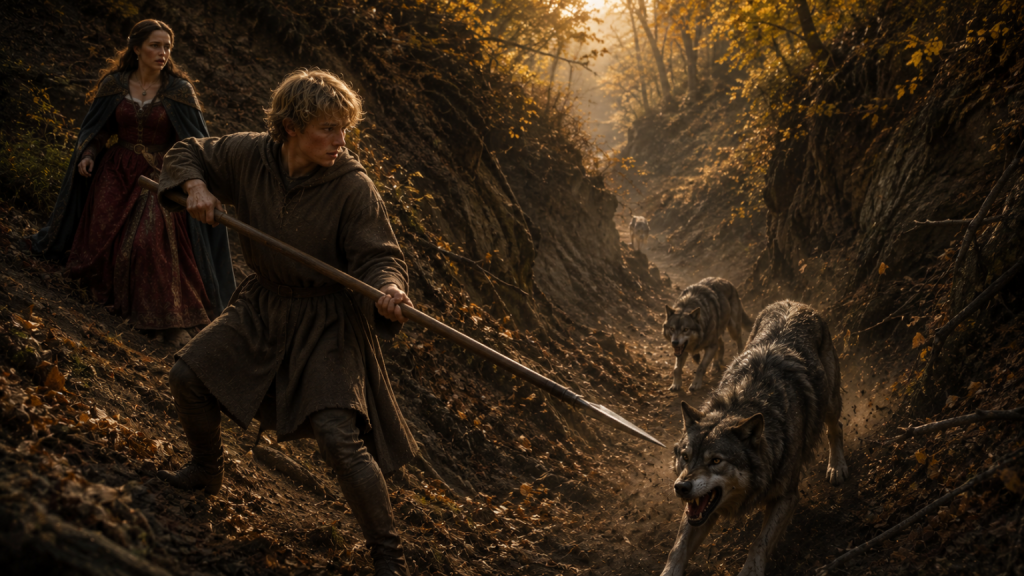
The terrified horse could not stop in time. It plunged into a shallow ravine and rolled down the slope with its rider. I hauled on my reins at the last possible moment, leapt from the saddle, and scrambled down after them.
Lady Agatha lay beside a fallen tree. Fortunately, the wet leaves had softened her fall, but she was unable to rise on her own.
That was when I heard the growling.
Five wolves appeared almost without a sound.
Perhaps the noise of the fall had drawn them. Perhaps it was the smell of blood from the injured horse. They did not rush to attack. Instead, they slowly spread into a half-circle, watching us.
In later years I would see Saracen charges, assaults upon fortresses, and more battles than I care to remember.
Yet the most frightening moments of my life belonged to none of them.
They were those few heartbeats while the wolves were still deciding whether to attack.
I barely remember taking hold of the boar spear.
I must have done it without thinking.
I stepped between the animals and Agatha and leveled the shaft before me, just as Clavier had taught us. The wolves were not afraid of me. They merely watched, waiting for the man before them to make a mistake.
It seemed to last an eternity.
In truth, it was only a few beats of the heart.
Then, somewhere above us, came the thunder of many horses.
Men shouted.
Hunting horns sounded.
The wolves raised their heads as one, listened, and almost silently vanished among the trees.
Moments later Robert, Geoffroi, Drogo, and the others were making their way down into the ravine.
Only then did I realize how badly my hands were shaking.
That evening, after the hunt had ended and the boar was being butchered near the camp, Robert unexpectedly summoned me to his fire.
Almost everyone who had taken part in the hunt was gathered around it.
The duke regarded me silently for a while, then removed a small hunting knife from his own belt. It rested in a plain leather sheath.
No jewels.
No gold ornament.
Good steel.
A horn grip.
A tool made to be used.
He held it out to me.
“Take it.”
I looked at Robert uncertainly.
“My lord…”
“A good knife is something a man needs every day.”
He smiled.
“And a sword…”
He paused for a moment.
“God willing, as seldom as possible.”
I accepted the gift in both hands.
At that moment, Lady Agatha approached me.
She looked first at the knife, then at me.
The faintest smile appeared upon her lips.
“So now you will carry something that will always remind you of me, Sir Ansel.”
I felt my face grow hot at once.
I believe even my ears turned red.
Agatha laughed softly, inclined her head, and returned to the other ladies.
Geoffroi waited precisely as long as good manners required.
The moment she was far enough away, he leaned toward me and whispered with complete seriousness:
“That’s it.”
“Our little monk is lost.”
Drogo shook his head mournfully.
“The man has barely received his first knife, and already noble ladies are taking an interest in him.”
Good-natured laughter rolled around the fire.
I merely tightened my grip on Robert’s gift, having no idea where to look.
The celebration continued until almost dark.
Musicians played, servants carried platters of roasted meat and young wine, and everyone talked excitedly about the day’s successful hunt.
It was then that a rider entered the camp.
His horse was white with foam, and the messenger himself could barely remain in the saddle.
He immediately demanded to be taken to the duke.
The laughter gradually faded.
Robert carefully read the letter the man had brought.
His face remained calm, but something appeared in his eyes that I had never seen there before.
Slowly, he raised his head.
“From Clermont…”
He said nothing more that evening.
But now, after all these years, I know this much with certainty:
it was with that letter that our youth came to an end.
What awaited us was another story entirely.
A story that would change not only our lives, but the whole of Christendom forever.