“It seems strange to me now that we spent so long preparing for an expedition which most of us believed would be over within a few months. No one intended to found new kingdoms. No one dreamed of spending the rest of his life in the East. We were going to kneel before the Holy Sepulchre, help the Romans recover their lost lands, and then return home. Or so we believed.”
From the writings of Ansel de Nantes.
Robert was gone for almost a month.
During that time, Rouen lived in a state of expectation. Every day messengers, pilgrims, and merchants arrived in the city, each bringing his own version of what had happened at Clermont. Some claimed that the Lord Himself had shown the Pope a sign. Others said that after Urban’s speech thousands of knights had fallen to their knees at once and sewn crosses directly onto their cloaks. Still others insisted that the French were already gathering a vast army and would march east before winter. Rumors multiplied faster than they could be born, until no one could tell truth from a beautiful invention.
Robert himself remained silent.
It was not until a late November evening that his small party appeared at the gates of Rouen. We squires formed up in the inner courtyard to await the duke’s return. He seemed scarcely changed by his absence. The same assured seat in the saddle. The same calm gaze.
Only now, upon his right shoulder, there was a small red cross.
When Robert dismounted, no one dared to be the first to break the silence.
He removed his gloves, looked over the men gathered before him, and spoke a single sentence.
“I have taken the Cross.”
Nothing more needed to be said.
Everyone understood what those words meant.
The following morning, messengers began riding out across the duchy. The barons were summoned to Rouen. Knights received orders to prepare for the expedition. Monasteries were instructed to pray for the pilgrims who would soon depart, while town officials were told to draw up lists of those intending to travel east.
It seemed as though all Normandy had begun moving at once.
Never before had I seen so much work being done at the same time.
Smiths scarcely left their forges. From early morning until late at night they hammered out spearheads, repaired mail, put new edges on swords, and shod horses. Leatherworkers made new saddles, scabbards, and travelling bags. Carpenters built campaign chests and wagons. Merchants bought up oats, salted meat, flour, wax, and barrels for wine. Priests heard confessions almost without rest.
It seemed as though the entire duchy were preparing to set out upon a distant journey.
We soon discovered that raising an army was far more difficult than raising a banner.
The expedition required an enormous amount of money.
Men had to be armed. Spare horses had to be bought. Provisions had to be gathered. Ships and baggage trains had to be paid for. Money had to be left behind for the families of those who were going away. Many lesser knights sold portions of their estates, mortgaged vineyards, mills, and even ancestral homes. Some sought assistance from monasteries; others borrowed from wealthy merchants.
Gold and silver seemed to vanish like water poured into sand.
But no one risked more than Robert himself.
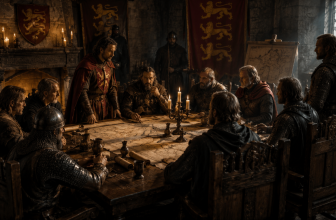
One morning, the duke once again summoned his closest advisers. As I had several months earlier, I stood behind his chair.
“There is not enough money,” he said calmly. “Even if every baron fulfils his obligation, it will not be enough.”
The treasurer merely spread his hands.
He had long since counted every source of revenue available to them.
Then Robert spoke the words that made his advisers exchange uneasy glances.
“I will mortgage Normandy to my brother, King William.”
Silence settled over the chamber.
Everyone understood what that meant.
For ten thousand marks of silver, the duchy would pass under the English king’s control until Robert returned from the expedition.
One of the barons could not restrain himself.
“My lord… what if you do not return?”
Robert looked at him calmly.
“Then I will hardly care who owns Normandy.”
Those words impressed me more deeply than any knightly oath. Only years later did I understand how much Robert was truly placing at stake. He was leaving behind not merely his estates, but his authority itself, entrusting the fate of his duchy to a man with whom his relations had never been simple.
The preparations continued throughout the winter.
Gradually, Rouen began to change. More and more armed men appeared in the streets. Some came from the duke’s distant lands, others volunteered for service, while still others hoped to find a place in the household of some wealthy baron. Among them were experienced knights, landless younger sons, ordinary sergeants, archers, craftsmen, priests, and even peasants who had decided to go as pilgrims.
They were very different men.
But now they all wore the same sign upon their clothing.
The red cross.
I often noticed Geoffroi sitting quietly in the evenings, staring toward a small house beyond the city wall.
“Thinking about the miller’s daughter?” Drogo asked him one day.
Geoffroi merely nodded.
“I wanted to marry her before we left.”
“And?”
Geoffroi gave a joyless smile.
“Now I’ll have to ask her to wait for me.”
Drogo was silent for a long time.
Then, unexpectedly, he said:
“Strange.”
“Only a month ago, I thought there could be nothing better than taking the road east.”
He paused.
“And now I find myself thinking about home more and more.”
No one laughed.
Everyone understood that he was saying what they all felt.
A few days later, Clavier summoned me to the armory.
Robert’s equipment lay upon a long table.
Mail.
Helmet.
Shield.
Sword belt.
Sword.
A spare lance.
Travelling bags.
Clavier looked at me carefully.
“Until now, you helped.”
He paused.
“Now you are responsible.”
At first, I did not understand what he meant.
Clavier placed his hand upon the sword’s scabbard.
“For all of this.”
He slowly gestured toward the equipment spread before us.
“If, before a battle, we discover that a strap has rotted, a girth has snapped, the sword has gone dull, or the horse has not been shod, it will not be our lord’s fault.”
He looked directly into my eyes.
“It will be yours.”
That was the first day I truly felt not like a boy attending upon a knight, but like a man who had been entrusted with another man’s life.
Spring approached quickly.
At last came the morning everyone had been waiting for—and fearing.
The bells of Rouen were ringing before dawn. The square before the cathedral was crowded with people. Priests blessed those who were leaving. Mothers wept. Children clung to their fathers’ cloaks. Wives hurriedly adjusted straps and travelling bags, as though by setting everything in its proper place they might somehow protect the men they loved from the dangers of the distant road.
I looked back.
Behind me stood the city that had become my home.
Ahead lay a road about which I knew almost nothing.
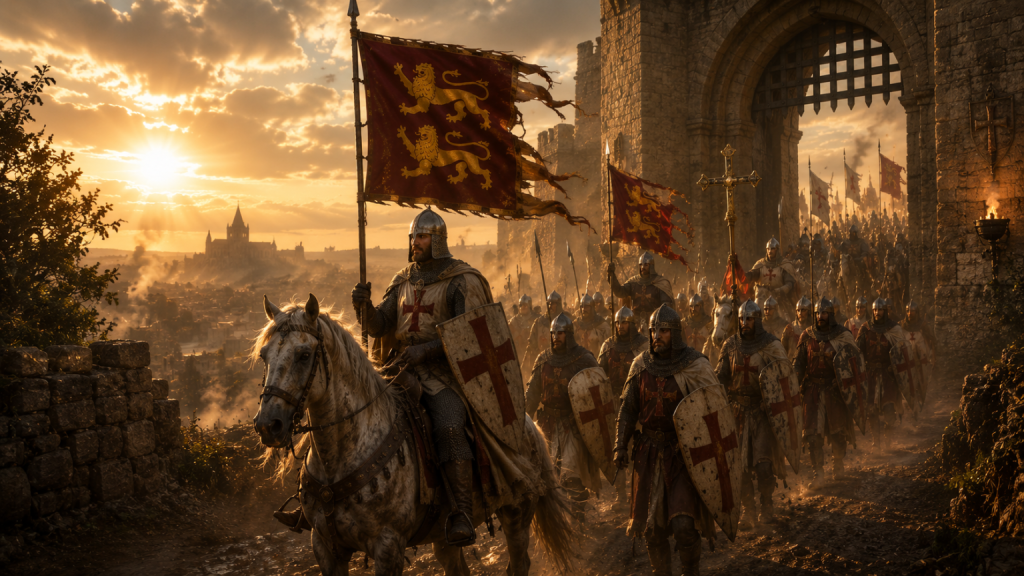
Robert slowly rode forward. Behind him flew Normandy’s red banner with its two golden lions. For a long moment he looked at his men, as though trying to commit every face to memory.
Then he raised his hand.
There was no grand speech.
Only the quiet command of a man who had already made his decision.
“Onward.”
The column slowly began to move.
I looked back only once.
The bells were still ringing over Rouen. Smoke rose above the city roofs, and people remained along the road for a long time, watching us go.
At the time, I believed that what lay ahead was a long pilgrimage from which we would all eventually return home.
I did not yet know that for many of us, the word home would soon change its meaning forever.
That was the day my youth ended and the road began—the road that would lead me first to the walls of Constantinople, then to Antioch, and, years later, to Acre, where I now sit writing these words.