While the B-17 Was Being Born, Boeing Was Designing a Bomber Without a Tail

In 1935, Boeing was working on an aircraft that would eventually define the image of the American heavy bomber for decades. On July 28, the Model 299 made its first flight — the aircraft that would later become the B-17 Flying Fortress. Four engines, a conventional fuselage, a large straight wing, and a traditional tail assembly made it look relatively conservative even by mid-1930s standards. Yet at almost exactly the same time, Boeing was exploring a completely different line of development. Its engineers were drawing enormous aircraft with swept wings, no conventional horizontal tail, and control surfaces mounted well behind the trailing edge. Under the general designation Model 306, Boeing studied a heavy bomber, a passenger aircraft, a flying boat, and even two fighter designs.
None of them was ever built.
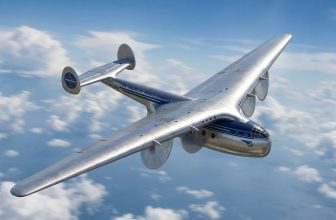
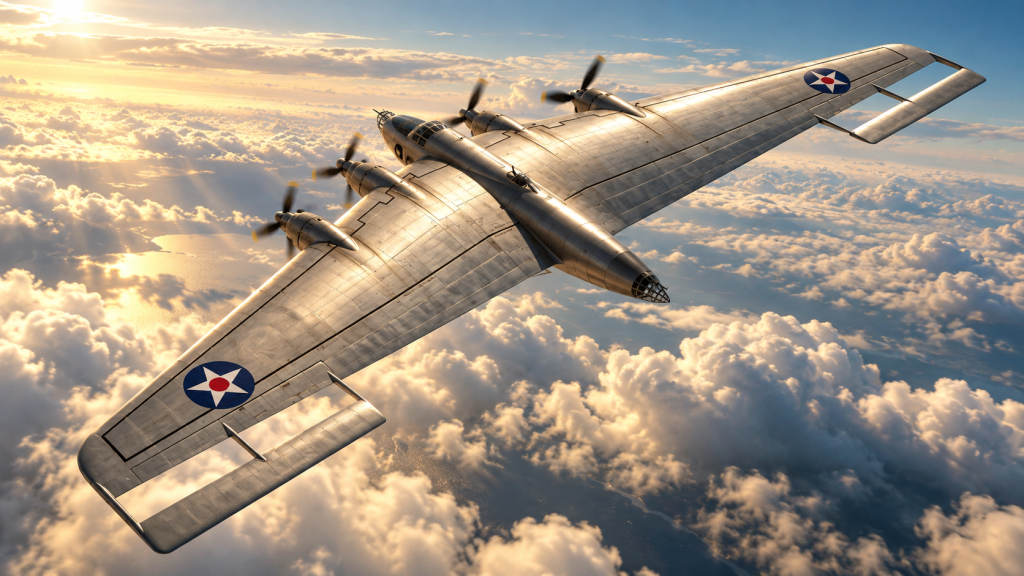
In fact, the Model 306 remained so obscure that many of the images circulating online today are modern artistic reconstructions rather than photographs of a prototype, wind-tunnel model, or completed aircraft. And that is precisely what makes the project so interesting. The Model 306 was not a forgotten “super bomber” that almost entered service. It was something more revealing: an engineering experiment by a major aircraft manufacturer trying to determine how far it could move away from the conventional airplane layout.
And Boeing was doing this at the very moment when the far more orthodox Model 299 was beginning its transformation into the B-17.
One Designation, Several Different Aircraft
The first point that needs clarification is also the source of much confusion: the Boeing Model 306 was not a single airplane. The designation covered a family of preliminary studies developed in 1935. The best-known member was a four-engine long-range bomber, but Boeing also considered the passenger Model 306A, the single-engine Model 306B fighter, the twin-engine Model 306C fighter, and a large flying-boat version.
All of them were based on the same broad aerodynamic idea: a swept wing, no conventional horizontal tail, and an unusual system of control surfaces.
Calling them “flying wings” requires some qualification. These were not pure flying wings in the modern B-2 sense, where almost the entire aircraft is integrated into the wing. The large Model 306 bomber clearly had a distinct central body, cockpit, and fuselage-like sections. It would be more precise to describe it as a tailless aircraft approaching the flying-wing concept. Nevertheless, the Model 306 is generally placed within the broader history of American flying-wing development.
Its most distinctive feature was the control system. Instead of conventional elevators, Boeing planned to use elevons — surfaces combining the functions of elevators and ailerons. But they were not simply attached to the trailing edge. The control surfaces were mounted behind the wing on extended supports.
The idea was that these surfaces would operate in cleaner airflow and could deflect without disturbing the main wing profile as severely as conventional trailing-edge controls. The concept was reportedly examined in wind-tunnel testing.
The result was an aircraft with an unmistakably unusual appearance. Its wing had a sweep of roughly 35 degrees — a considerable figure for the mid-1930s. Today, swept wings are usually associated with high subsonic or transonic flight, but that was not the main reason here. On a tailless aircraft, wing sweep helped place control surfaces farther behind the center of gravity, increasing their effective control arm.
In other words, the Model 306 did not look futuristic simply for the sake of looking futuristic. Boeing was trying to solve one of the fundamental problems of tailless aircraft: how to provide adequate stability and control without a conventional tail.
A Bomber Almost as Wide as the XB-15
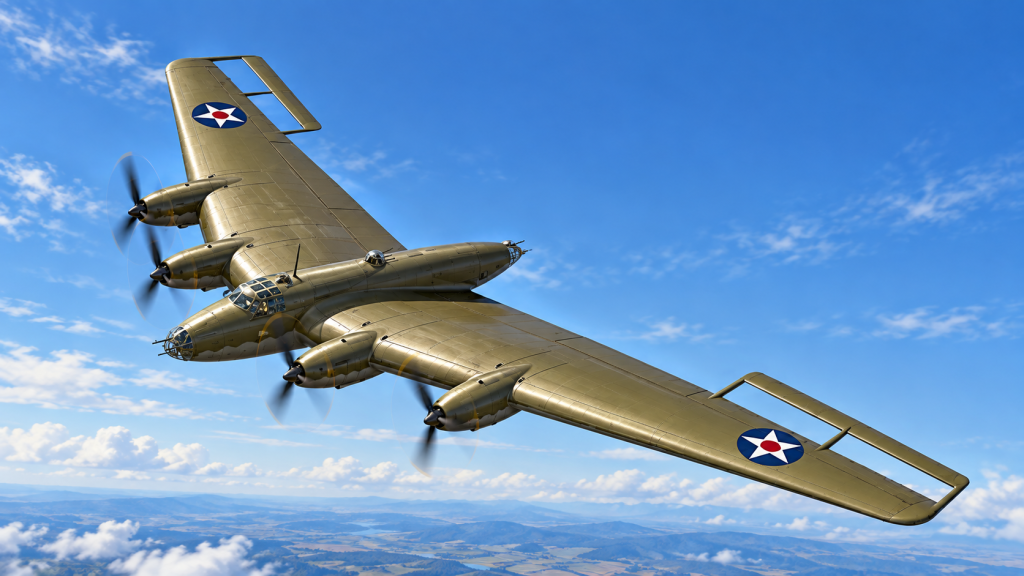
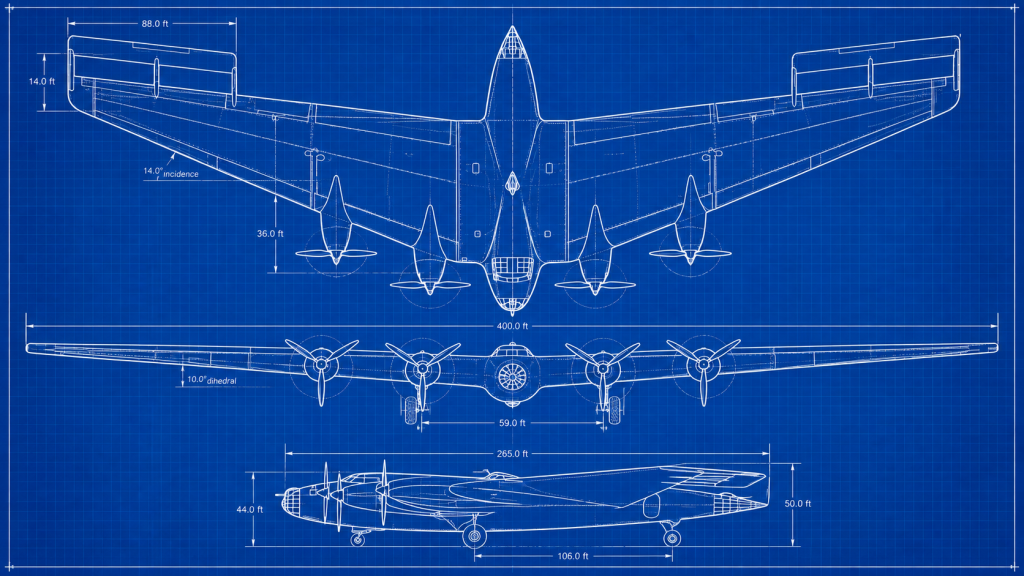
The principal member of the family was the heavy long-range Model 306 bomber. Its projected wingspan reached approximately 140 feet, or 42.6 meters, while its length was around 18.2 meters. The planned crew consisted of ten men.
For comparison, the prototype Model 299 that would become the B-17 had a wingspan of roughly 31.6 meters. The experimental tailless Boeing was therefore more than ten meters wider than the aircraft that ultimately evolved into the Flying Fortress.
Power was to come from four liquid-cooled Allison V-1710 engines producing approximately 850 horsepower each, driving tractor propellers. Sources commonly give a projected range of around 5,000 miles, or roughly 8,000 kilometers. The planned bomb load, however, was surprisingly modest: about 2,500 pounds, or 1,130 kilograms.
For such a large aircraft, that figure seems small, but it reveals the design priority. The Model 306 was conceived primarily as an aircraft of extreme range rather than as a bomber optimized to carry the heaviest possible load. Defensive armament was also projected, including two .50-caliber and two .30-caliber machine guns.
Another detail illustrates how easily the different Model 306 variants become mixed together in modern retellings. Some descriptions claim that the land-based versions used modern tricycle landing gear with a nose wheel. Yet the more detailed descriptions of the bomber itself indicate fully retractable conventional landing gear with a tail wheel. The passenger 306A, by contrast, really was designed with a tricycle arrangement.
This is important because the Model 306 did not exist in isolation. At almost the same time, Boeing was working on two other enormous aircraft programs.
The future XB-15 originated before the B-17, although the giant experimental bomber itself did not fly until October 1937. With a wingspan of approximately 45.4 meters, it was intended to explore the possibilities of an extremely long-range heavy bomber. But its performance was badly limited by the lack of sufficiently powerful engines. Aircraft had simply grown faster than available powerplants could keep up.
That leaves a fascinating picture of Boeing in the mid-1930s. The company was simultaneously pursuing several very different answers to the same question. One was the relatively compact and conventional Model 299. Another was the giant experimental XB-15. And the third was the radical tailless Model 306.
The future of the long-range bomber was not yet obvious.
An Airliner With Two Propellers Working Against Each Other
If the bomber Model 306 looked unusual, the passenger Model 306A was even stranger.
It was designed for 28 passengers and had a projected wingspan of around 32.3 meters. Power was to come from four Pratt & Whitney Hornet S1EG radial engines producing approximately 750 horsepower each. But Boeing proposed installing them in paired push-pull arrangements. One engine in each pair would drive a tractor propeller, while the other would sit behind it and drive a pusher propeller.
The projected cruising speed was approximately 200 mph, or about 320 km/h, while range was estimated at roughly 1,900 kilometers. The cockpit was intended to be closely integrated into the forward contours of the central structure, and the aircraft would have used fixed tricycle landing gear — an unusual feature for the period.
But the Model 306A also demonstrates just how preliminary these studies were. Boeing’s calculations suggested that airflow disturbed by the forward propeller would reduce the efficiency of the rear propeller by around ten percent. Development of the passenger version was subsequently abandoned.
That distinction matters. The Model 306A was not a lost competitor to the Douglas DC-3 that narrowly missed production. It was an engineering study. Boeing tested the idea on paper, calculated the disadvantages, and decided that the concept did not justify moving forward.
That is exactly what preliminary design work is supposed to do.
A flying-boat version was also considered, using a similar aerodynamic layout and the same Allison V-1710 engines. But the surviving drawings appear so preliminary that they do not even show fully developed provisions for lateral stability on the water, such as conventional wing floats or substantial side sponsons.
Treating this version as a nearly complete aircraft would therefore be especially misleading.
There is also a common chronological error associated with the project. Some modern accounts claim that the Model 306 incorporated experience from the Boeing 314 Clipper. Taken literally, that cannot be true. The Model 306 studies date from 1935, while Pan American did not order the Boeing 314 until 1936, and the first Clipper did not fly until June 7, 1938.
The technical relationship actually runs in the other direction. The Boeing 314 later benefited from experience and structural solutions associated with the giant XB-15 program. There was certainly an engineering relationship between Boeing’s large-aircraft projects of the period, but the Model 306 cannot accurately be described as a derivative of an aircraft that did not yet exist.
Boeing Even Considered Tailless Fighters
The smallest members of the Model 306 family were the 306B and 306C fighters. These designs reveal just how broad Boeing’s experiment really was. The company was not merely studying one unusual bomber. It was asking whether the same aerodynamic philosophy could be applied to aircraft of completely different sizes and missions.
The single-seat Model 306B had a wingspan of roughly 12 meters and a length of about seven meters. A single Allison V-1710 engine was installed at the rear and drove a three-bladed pusher propeller. Proposed armament appears to have included one or two .50-caliber machine guns in the nose, possibly supplemented by a heavier gun. Available descriptions mention an endurance of around three hours and a service ceiling of at least 4,500 meters, although reliable projected speed figures are difficult to establish.
The Model 306C developed the same concept further with two smaller Ranger V-770SG engines producing roughly 420 horsepower each. Wingspan decreased to about 11.5 meters. Once again, the design employed control surfaces mounted behind the main wing.
But the absence of comprehensive performance data tells us something important about the status of both fighters. These were not mature prototypes waiting for funding. They were exploratory configuration studies.
Boeing was effectively asking a series of questions.
Could this layout work as a heavy bomber?
Could it work as an airliner?
Could it work as a flying boat?
Could it work as a fighter?
The answer was never convincing enough to justify building one.
Why the Model 306 Lost to a Conventional Aircraft
There is no known single catastrophic flaw that suddenly killed the entire Model 306 program. Instead, several factors appear to have worked against it at the same time.
The first was stability.
A tailless aircraft creates a much more difficult problem in longitudinal and directional stability. Boeing was attempting to solve that problem through wing sweep and remote elevons, but every unconventional solution introduced additional aerodynamic uncertainty.
Decades later, former Boeing executive and engineer Jack Steiner recalled that such designs were considered problematic within the company because of stability concerns and large pitching moments. This was a retrospective recollection rather than a formal 1935 cancellation report, but it helps explain why Boeing may have remained cautious about the configuration.
The second problem was propulsion.
The engines available in the mid-1930s placed severe limits on very large aircraft. The real XB-15 later demonstrated the same issue in practice. Aircraft dimensions and weight were growing rapidly, while engine power was not increasing at the same pace.
The proposed Model 306 bomber had four Allison engines producing approximately 850 horsepower each — around 3,400 horsepower in total. For an aircraft with a wingspan approaching 43 meters, ten crew members, fuel for thousands of kilometers, defensive armament, and a bomb load, that did not leave an enormous performance margin.
The third and perhaps most important factor was simple: Boeing already had an aircraft that worked.
The Model 299 made its first flight on July 28, 1935. It was also four-engined, long-range, all-metal, and technically advanced, but it retained a conventional aerodynamic layout. Developing it into a military aircraft did not require Boeing to solve the problems of tailless stability, unusual elevon systems, and an entirely new structural and aerodynamic arrangement at the same time.
The comparison was therefore harsh.
The conventional aircraft may have looked less revolutionary on paper, but it could be built, flown, tested, and improved.
There is an important distinction here. There is no evidence that Boeing held a dramatic meeting in which engineers were forced to choose between “the B-17 or the flying wing,” deliberately killing the Model 306 in favor of the Model 299.
The two projects were at completely different levels of maturity.
The Model 299 was a real aircraft built in response to U.S. Army Air Corps requirements.
The Model 306 remained an exploration of what might be possible.
An Aircraft That Is More Interesting Because It Was Never Built
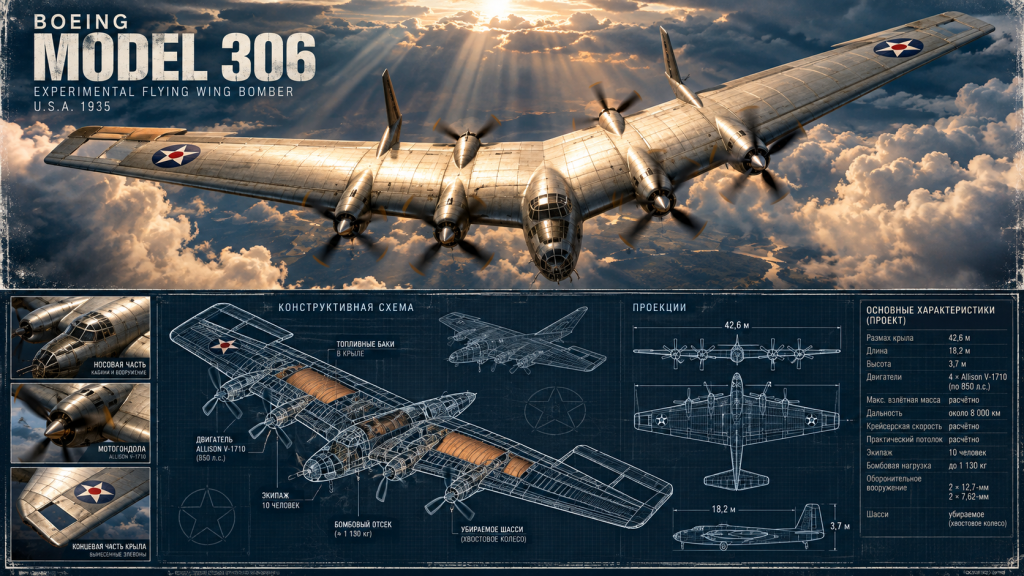
Modern images of the Boeing Model 306 can easily create the wrong impression. A high-quality 3D model, polished metal skin, American insignia, dramatic clouds beneath the wings — and suddenly the aircraft begins to look like a forgotten prototype that really flew.
It did not.
No Model 306 was ever constructed.
We do not know how fast it would actually have been. We do not know how it would have behaved during takeoff or landing, how difficult it would have been to control, what its real service ceiling would have been, or whether it could have achieved the projected range. Most of the surviving performance numbers are design estimates from an early stage of development.
Modern three-dimensional artwork should therefore be treated as reconstruction, not documentation.
But that does not make the Model 306 less interesting. It makes it more revealing.
In 1935, Boeing was building the aircraft that would become the B-17, developing the giant XB-15, and at the same time investigating a machine with a 35-degree swept wing, remote elevons, and almost no conventional tail. And it did not stop with one aircraft. The same basic idea was tested on paper as a passenger aircraft, a flying boat, and several fighters.
The Model 306 was not an “American B-2 fifty years early,” nor was it a lost superweapon whose potential was mysteriously ignored. That interpretation gives the project too much technical maturity and too little historical context.
Its real significance is more interesting.
It shows just how uncertain aircraft development still was in the mid-1930s. It was not yet obvious that a large long-range aircraft should look like a B-17, Lancaster, or B-24. Designers were still testing nearly every possibility available to them: enormous straight wings, pusher propellers, tandem engine arrangements, tailless aircraft, and true flying wings.
Boeing ultimately moved forward with the far more conventional Model 299. Within a few years, it evolved into one of the defining American aircraft of the Second World War.
The Model 306 remained a collection of drawings.
Yet those drawings reveal another version of Boeing — a company that, in the same year the future B-17 first took to the air, was seriously asking whether a heavy bomber needed a tail at all.