An article from Nikolai Kolyadko’s channel in the VKontakte community.
If there’s anything more interesting than reports on actual combat operations, it’s the documents detailing their planning. For starters, there are far fewer of them. Simply because operational planning takes place primarily through verbal discussions, which are rarely recorded, and we learn about them, at best, from memoirs—with, of course, limited reliability. The situation is slightly less disheartening when it comes to the related radio or telegraph communications. But even of these, far fewer have survived than we’d like. And it’s fascinating to compare what was planned with what actually happened in the harsh reality.
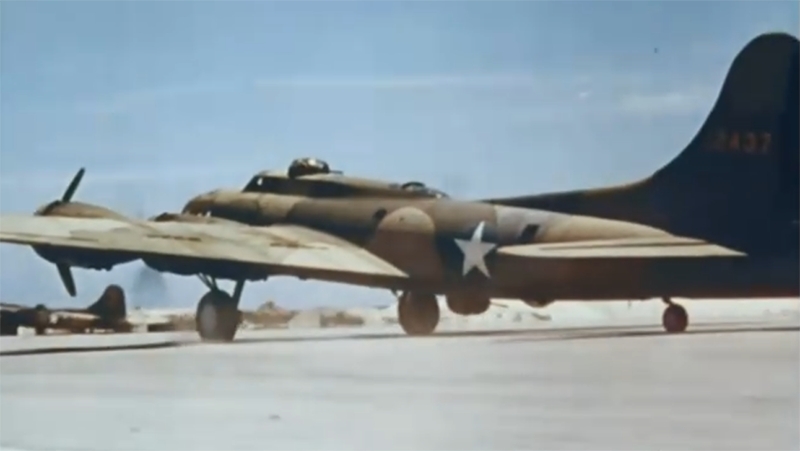
And it’s even more interesting to find out why they planned it that way. In this case, many people interested in the Battle of Midway invariably ask: Why on earth did the Americans send a bunch of “Flying Fortresses” to Midway, which were just pointlessly burning up fuel there? Or why they also sent over four Army B-26 “Marauders,” which were to serve for the first time as long-range torpedo bombers—a role for which their crews had received absolutely no training. It would seem much more logical to have sent more truly useful aircraft there instead—specialized naval dive bombers and torpedo bombers. Especially since there were some of them—albeit not many—in reserve.
I hope this document will shed some light on the reasoning behind this decision. As well as the reasons for organizing aerial reconnaissance in this particular way. And, I’ll say it again, it’s very interesting to go through it point by point—with a pencil in hand, so to speak—to see what they guessed correctly and anticipated, and what went completely wrong.
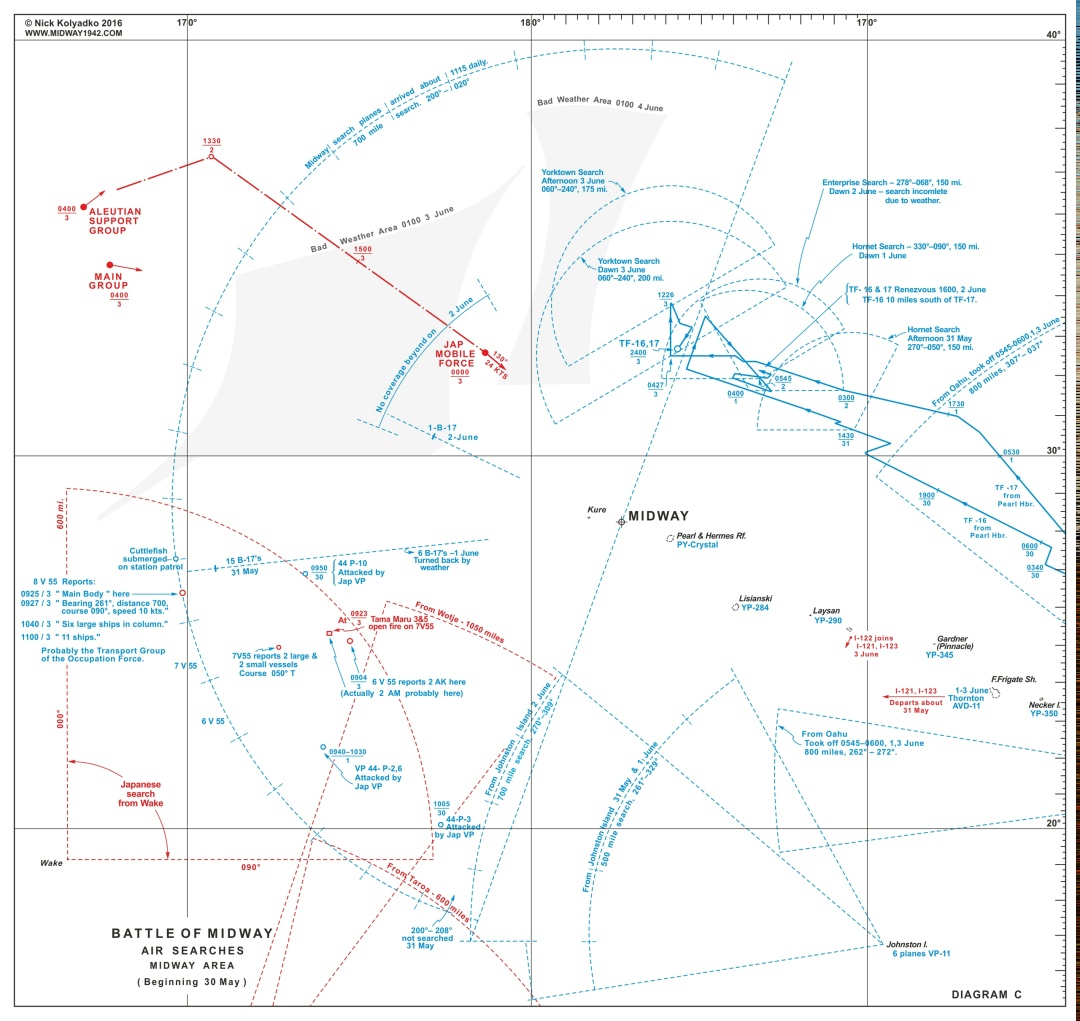
Diagram of the Air Reconnaissance Operation Prior to the Battle of Midway (really clickable)
SECOND PATROL AVIATION WING
PW2/A16-3/A4-3/VZ/(020)
TOP SECRET
May 23, 1942.
MEMORANDUM
From:
Commander, Second Patrol Air Wing.
To:
Commander-in-Chief, U.S. Pacific Fleet.
Subject:
Use of Aviation in Connection with the Enemy Attack on Midway.
Attachments:
Diagram (A).
[The copy of the document in the archive does not include a diagram. However, in general, it should correspond to the diagram of the actual organization of patrol flights shown in the illustration above. The following notes are by the translator.]
1. The following plan is submitted for consideration as a means of utilizing the [coastal-based] aircraft available in the Hawaiian area to provide assistance to Midway in the event of an attack on it.
2. Situation
Analysis
: The problem with Midway is that it must strike before it is struck. The greatest danger is the sudden destruction of our aircraft on the ground and the disabling of runways by bombs before the planes can inflict any damage on the enemy. To prevent this, two key conditions are necessary: effective reconnaissance and long-range strike aircraft.
3. Let’s consider the requirements for reconnaissance. In this case, ideal reconnaissance is that which guarantees detection before the enemy launches its carrier-based aircraft for an attack. In other words, daily reconnaissance must cover the enemy’s movements at a distance that allows the next day’s reconnaissance to reach the probable takeoff radius of aircraft from the enemy’s aircraft carriers before the enemy can reach it. Assuming that the enemy will not take off from a distance greater than 200 miles [370 km], that it will not exceed a speed of 27 knots [50 km/h], and that PBY reconnaissance seaplanes [Consolidated PBY-5/5A “Catalina” flying boats] will take off at dawn each day, reconnaissance at a range of 700 miles [1,296 km] will accomplish this task, as shown in the diagram in Appendix (A).
4. Reconnaissance aircraft take off daily at dawn, fly toward the target at a speed of 100 knots [185 km/h], and return at a speed of 111 knots [206 km/h] to arrive before dark. With effective coverage, the enemy will be detected at a distance of more than 200 miles [370 km]; the actual distance depends on the time of the attack and the enemy’s speed. Assuming the enemy intends to attack Midway at dawn, it would have to launch its aircraft approximately two hours before dawn from a distance of about 300 miles [556 km] to avoid detection during the day and before takeoff.
5. Given that visibility of 25 miles [46 km] can reasonably be expected in the Midway area at this time of year, especially for such large strike groups or any ship traveling at a speed that leaves a clearly visible wake in its wake. With 25-mile visibility, each PBY can cover an 8° sector. It is desirable to cover at least a 180° arc. This would require about 23 aircraft (assuming that our carrier groups will cover the flanks of the eastern sector).
6. Even if the enemy were detected a day before the attack, there are no long-range strike aircraft at Midway capable of striking it. PBYs are ineffective against fighter opposition and cannot attack during the day. They can be used effectively as torpedo bombers at night, especially in bright moonlight. [The PBY-5/5A “Catalina” flying boats were equipped with systems for carrying two aerial torpedoes.] However, the chances of making contact at long range after dark are slim.
7. Recommendations
(a) Immediately increase the number of PBY aircraft at Midway by 8 PBY-5 seaplanes, bringing the total to 24, 12 of which will operate from the water. [The PBY-5 was a “pure” flying boat; the PBY-5A had retractable wheeled landing gear and could also take off from land.]
(b) Use these PBYs to conduct reconnaissance of a 180° sector with a radius of 700 miles [1,296 km]; begin reconnaissance daily at dawn, fly toward the target at an average speed of 100 knots [185 km/h], and return at a speed of 111 knots [206 km/h] or higher in order to return before dark.
(c) Deploy our own aircraft carrier strike groups so that they cover the flanks of the Midway reconnaissance mission—or at least one flank; the other flank can be covered by PBY-5s operating from Johnston [Atoll].[Located 1,330 km southeast of Midway]
(d) Deploy a floating base (AVD) [a seaplane base on an obsolete “flash-deck” destroyer] to patrol the area or the lagoon of the French Frigate Reefs [an atoll in the Hawaiian Archipelago, roughly midway between Pearl Harbor and Midway] (if the minefield allows it to enter) [the entrance to the lagoon had been mined to prevent its use as a refueling point for Japanese long-range flying boats from submarine “tankers”], so that it could serve as a refueling point for PBYs or as a rescue ship along their retreat route toward Oahu.
(e) After detecting the enemy and carrying out (if possible) night attacks, withdraw the PBYs to Pearl Harbor—if necessary, via the French Frigate Shoals—before an attack on Midway becomes inevitable. These aircraft may conduct a shortened follow-up reconnaissance, taking off before dawn if the enemy was detected the previous day, and, after determining the enemy’s disposition, also withdraw to the French Frigate Shoals, without returning to Midway.
(f) Deploy at least six B-26s [Army medium bomber “Marauder”] and six B-17s [Army Heavy Bomber “Flying Fortress”] to Midway by May 29 as a long-range strike force; The B-26s are to operate as torpedo bombers (with a range of 525 miles [972 km] carrying a torpedo), and the B-17s as long-range bombers. These aircraft are to carry out long-range strikes day and night, if practically feasible, but must withdraw before the enemy enters the area of operations, when an air strike on Midway becomes inevitable.
(g) Deliver 12 aerial torpedoes to Midway via patrol aircraft (modified for high-speed release) [That is, equipped with both additional aerodynamic stabilizers and a nose shock absorber] for use with the B-26.
(h) Maintain at least six B-17s on standby at Barking Sands Airfield, equipped with auxiliary fuel tanks and ½ of a standard bomb load (4 × 600-fn [270-kg]). These aircraft will be able to deliver a similar bomb load within a radius of 1,200 miles [2,222 km] and return to base; or, if the airfield at Midway remains undamaged, they may land there, rearm, refuel, and carry out several attacks before returning to Oahu.
(i) Retrofit as many additional B-17s as possible for such long-range bombing missions.
(j) If the airfield at Midway remains undamaged, additional B-17s carrying a full bomb load (8 × 600-fn [270 kg]) could fly to Midway from the Hawaiian area, refuel, carry out a strike, and return to base.
(k) Work out the procedures for loading and servicing Army aircraft at Midway; send a small Army liaison detachment to Midway to assist with this work.
(l) All Army and Navy aircraft landing at Midway for combat missions must report to the commander of the Midway Naval Air Station to confirm their readiness to carry out missions and to receive mission assignments and coordination. The Commander of Midway Naval Air Station shall, to the extent possible, inform all aircraft landing at Midway of the location of our forces.
(l) All long-range air strikes should be directed primarily against enemy aircraft carriers. [As in the original, two consecutive items labeled (l)]
(m) Given that our submarines will be operating in this area and their positions will be difficult to determine, do not launch air strikes against submarines unless they are positively identified as enemy vessels and pose a threat to our surface forces. This restriction shall also apply to torpedo boats.
(n) Conduct horizontal-flight bombing from relatively low altitudes to ensure hits.
(o) During torpedo attacks, close in to the minimum range—every torpedo launch must result in a hit.
(p) The commander of the Midway Naval Air Station and the commander of the naval base’s air defense forces must, before dispatching aircraft to strike surface forces in an area where our own surface forces may be present, broadcast information about the area where the target is located so that our forces, if mistakenly identified as targets, can signal their presence and prevent an attack on them by our aircraft.
(q) All pilots must review and thoroughly learn the silhouettes of the ships (especially their own), as well as the procedures and identification signals used during close approaches.
(r) All of our aircraft must exercise extreme caution so as not to reveal the presence or location of our aircraft carriers. This requires a thorough study of the ships’ silhouettes, an understanding of the situation, and precise navigation.
(s) All intelligence, combat, and enemy-tracking information must be relayed to our aircraft carriers.
(t) Cancel all scheduled torpedo training drops in the Hawaiian area, effective May 29, for both carrier-based aircraft and the patrol wing, as this could reduce the number of combat-ready torpedoes in that area during a critical period.
The above recommendations have been approved by the commander of the Seventh Air Army. [What the army’s bombers must ensure.]
/signature/
8. P. N. L. Bellinger
Source: https://vk.com/@664805017-nemnozhko-planirovaniya