One BT-34 Instead of the T-34 and KV. What Could Have Become the Soviet Union’s Main Tank of World War II?

As we know, by the beginning of the Great Patriotic War, the Soviet Union possessed two fundamentally new tanks: the T-34 medium tank and the KV-1 heavy tank. The former became a true symbol of Soviet armored forces, while the latter remained one of the best-protected tanks in the world during the early years of the war. However, maintaining two entirely different families of vehicles created certain problems. They required separate production facilities, spare parts, repair bases, and specialist training. But what if Soviet designers had managed to create an almost universal chassis that could serve as the basis for both medium and heavy tanks?
That is precisely the alternative we will explore today. In our timeline, the famous KV family of tanks never appeared, and the development of heavy armored vehicles followed an entirely different path. Designer Joseph Kotin, having grown frustrated with attempts to perfect the numerous successors to the T-28 and T-35, unexpectedly turned his attention to the BT-9 fast tank. Its design became the starting point for an entirely new vehicle designated the BT-34. This eventually evolved into an entire family of armored fighting vehicles, culminating in the 45-ton T-34-122, armed with a powerful 122 mm gun. But let us start at the beginning.
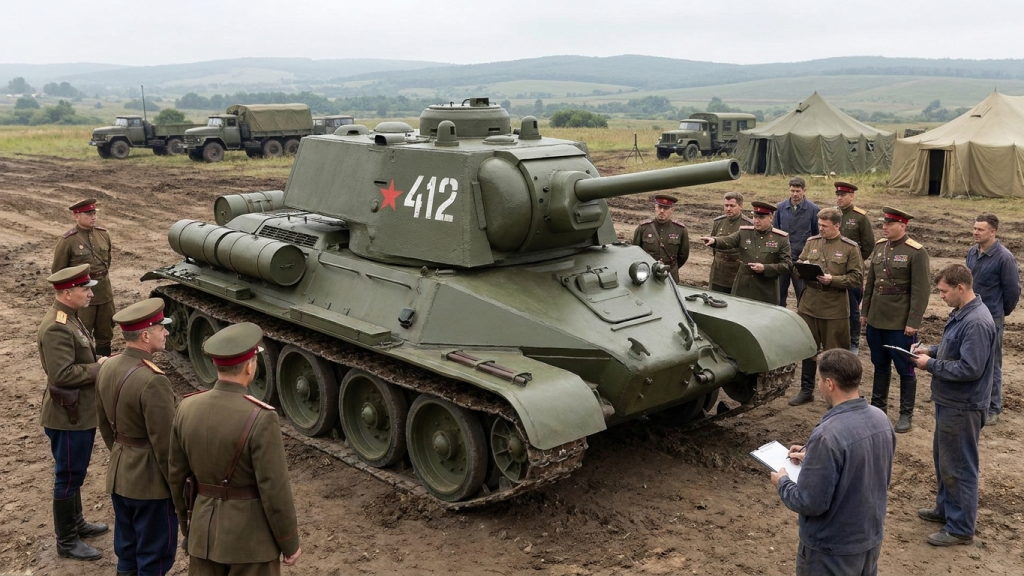
The first BT-34 with a 76 mm gun
Instead of the KV — Endless Successors to the T-28 and T-35
The main historical point of divergence occurs in the second half of the 1930s. Unlike in our reality, where Soviet specialists gradually abandoned the multi-turret concept and developed the single-turret KV heavy tank, events here followed a much more complicated course.
In Leningrad, designers continued improving the T-28 and T-35, attempting to eliminate their numerous shortcomings. The military demanded stronger armor, higher speed, new guns, and improved cross-country mobility. At the same time, the belief persisted that a heavy tank should have several independent firing positions, providing all-around protection.
The result was an entire series of experimental vehicles. Some received stronger armor and new turrets, others more powerful engines, and still others redesigned running gear. Certain projects even proposed removing some of the turrets in favor of thicker armor.
However, the results of testing repeatedly disappointed the military. The vehicles were heavy, complicated to manufacture, and extremely temperamental in service. Increasing their weight caused failures in the transmission and running gear, while attempts to reinforce individual components made the designs even heavier.
Reliability was an especially serious problem. Heavy tanks could demonstrate impressive specifications on paper, but they frequently broke down during long marches. Repairing them required skilled specialists, while spare parts had to be manufactured in small batches.
By the beginning of 1939, it had become clear that the numerous attempts to modernize existing vehicles had reached a dead end. The military demanded a new heavy tank, preferably one that was considerably simpler and more reliable.
It was then that Joseph Kotin proposed a solution that initially struck many observers as almost reckless.
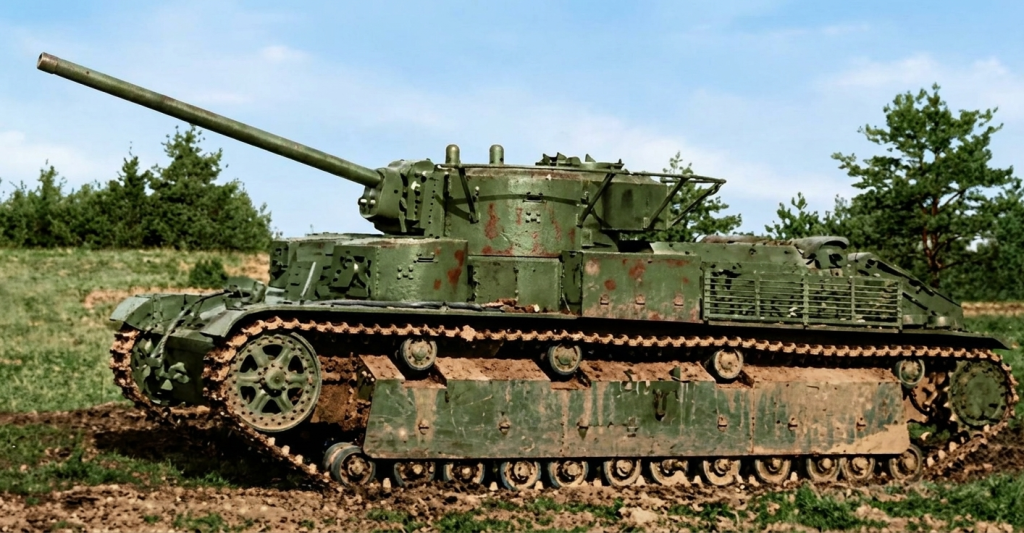
Colorized photograph of an experimental T-28 armed with the 95 mm F-39 gun
Kotin’s Unexpected Choice
In early 1939, the designer’s attention was drawn to the latest BT-9 fast tank. No such production vehicle existed in our history, but in this alternative timeline, it represented a further development of the famous BT family.
The BT-9 was already a fairly advanced tank, featuring well-angled armor, a powerful diesel engine, and improved suspension. Its design had much in common with the promising T-34 medium tank, which was also under development at the time.
However, Kotin was not particularly interested in the vehicle’s armament or armor protection. What caught his attention was its overall layout and the potential for further development of its running gear.
The designer reasoned that creating an entirely new heavy tank was unnecessary. It would be far more sensible to take an already proven design and systematically recalculate it for a substantially greater weight.
Moreover, Kotin decided not to limit himself to the military’s current requirements. Instead of designing a vehicle weighing 40–45 tons, he ordered that its major components be engineered from the outset for a weight of 50 tons.
This decision became the defining factor in the project’s subsequent development.
The intention was not to immediately build a 50-ton tank. Kotin wanted to create running gear, a transmission, and structural hull components with a considerable reserve of strength. This would subsequently make it possible to increase armor protection, install new turrets, and mount heavier guns without having to redesign practically the entire vehicle each time.
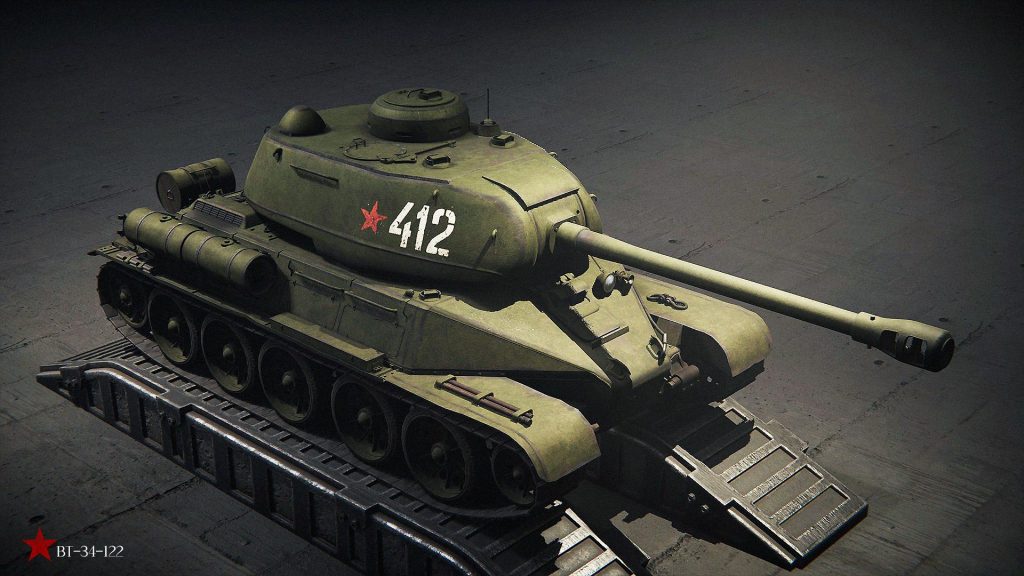
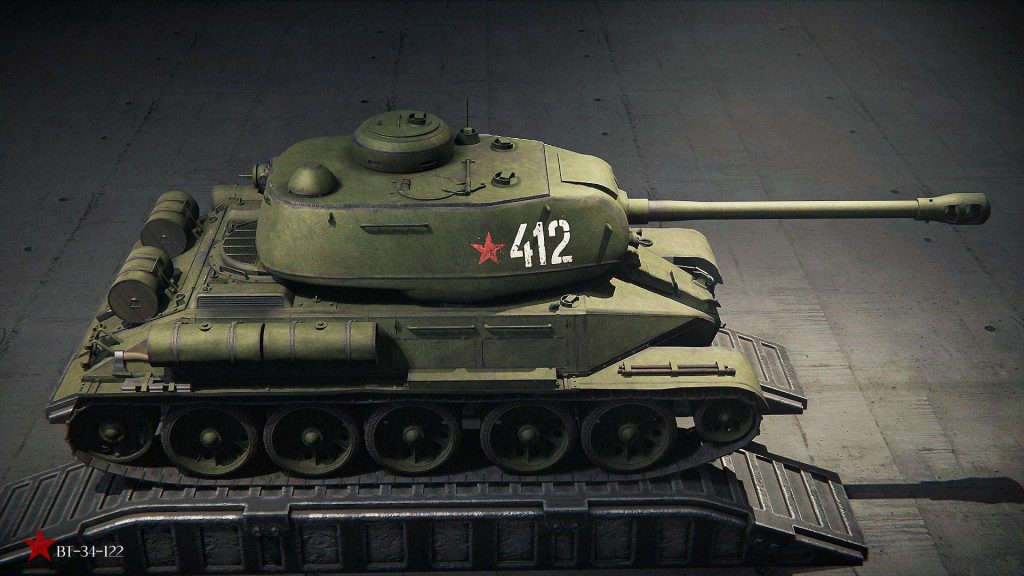
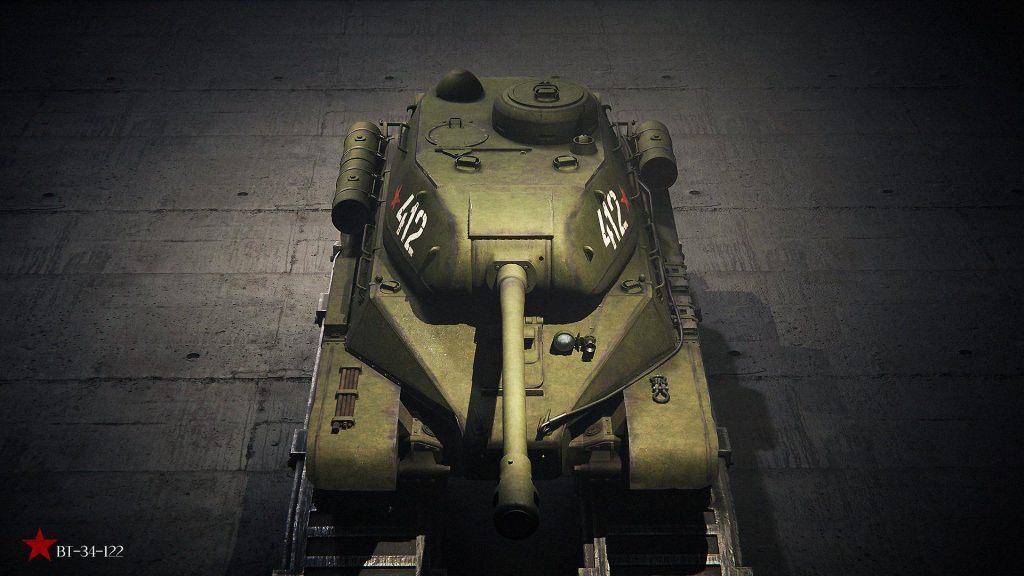
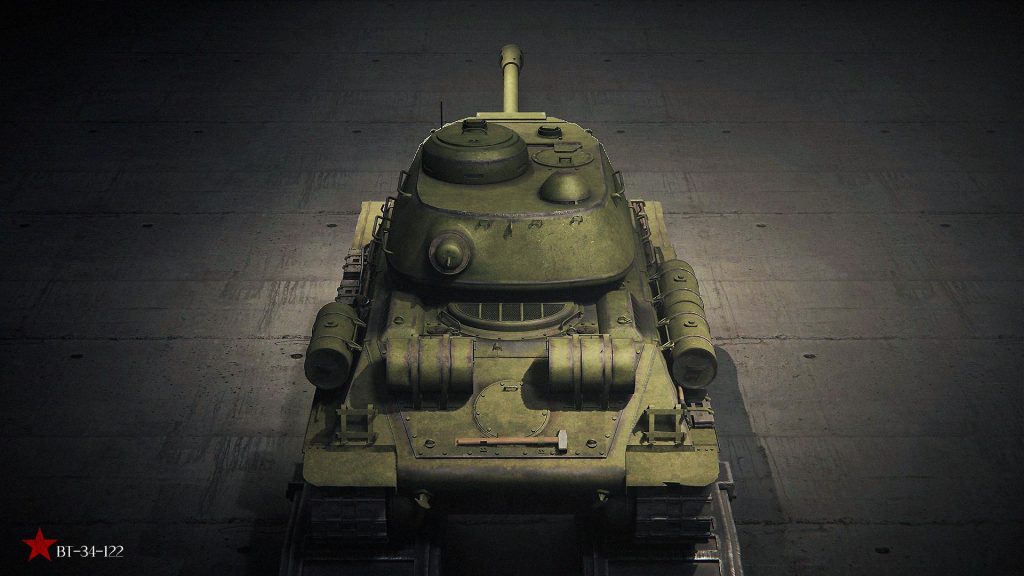
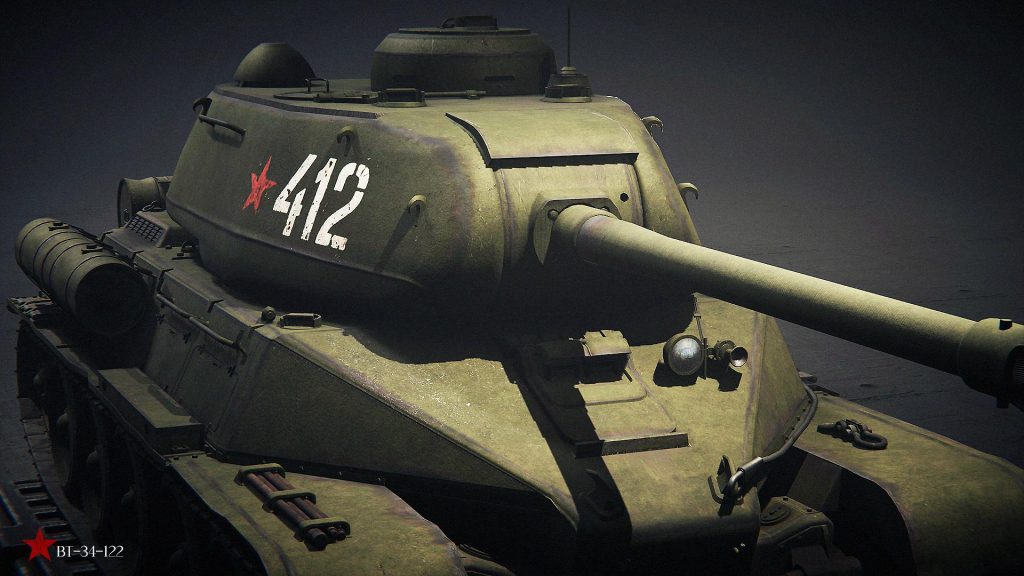
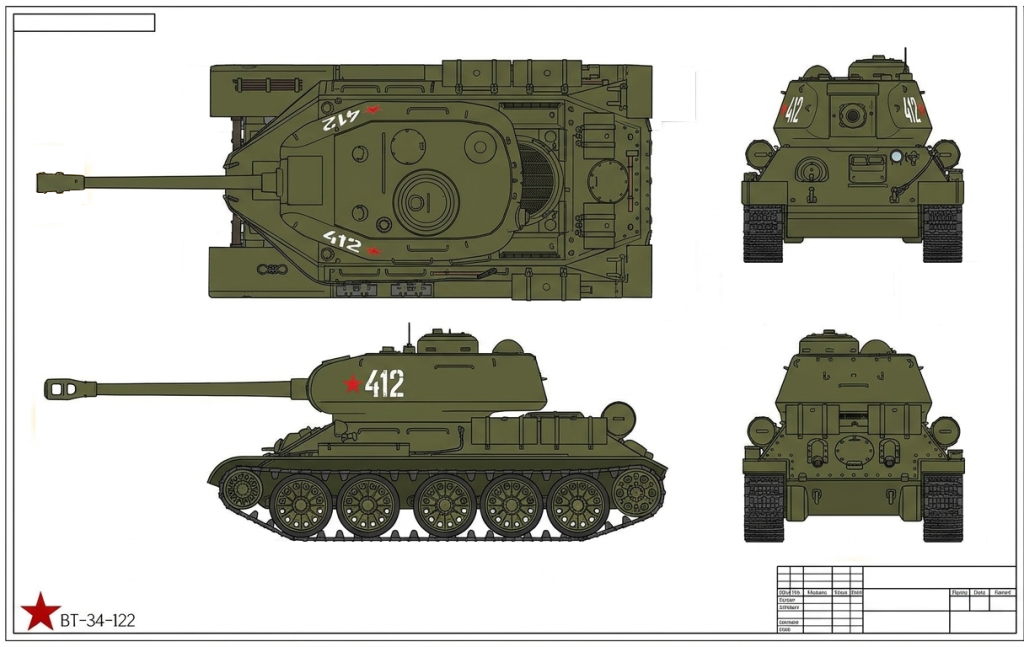
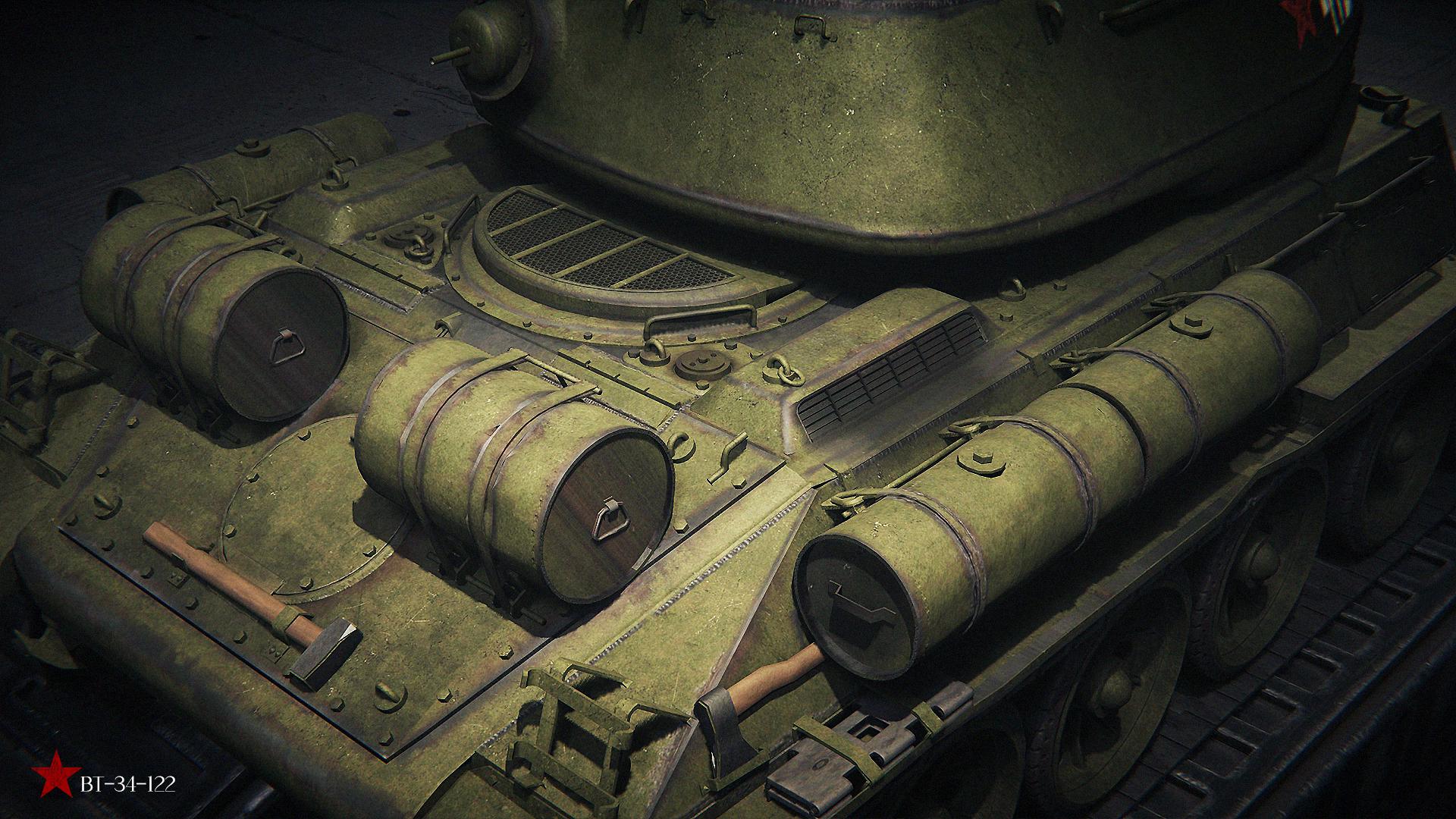
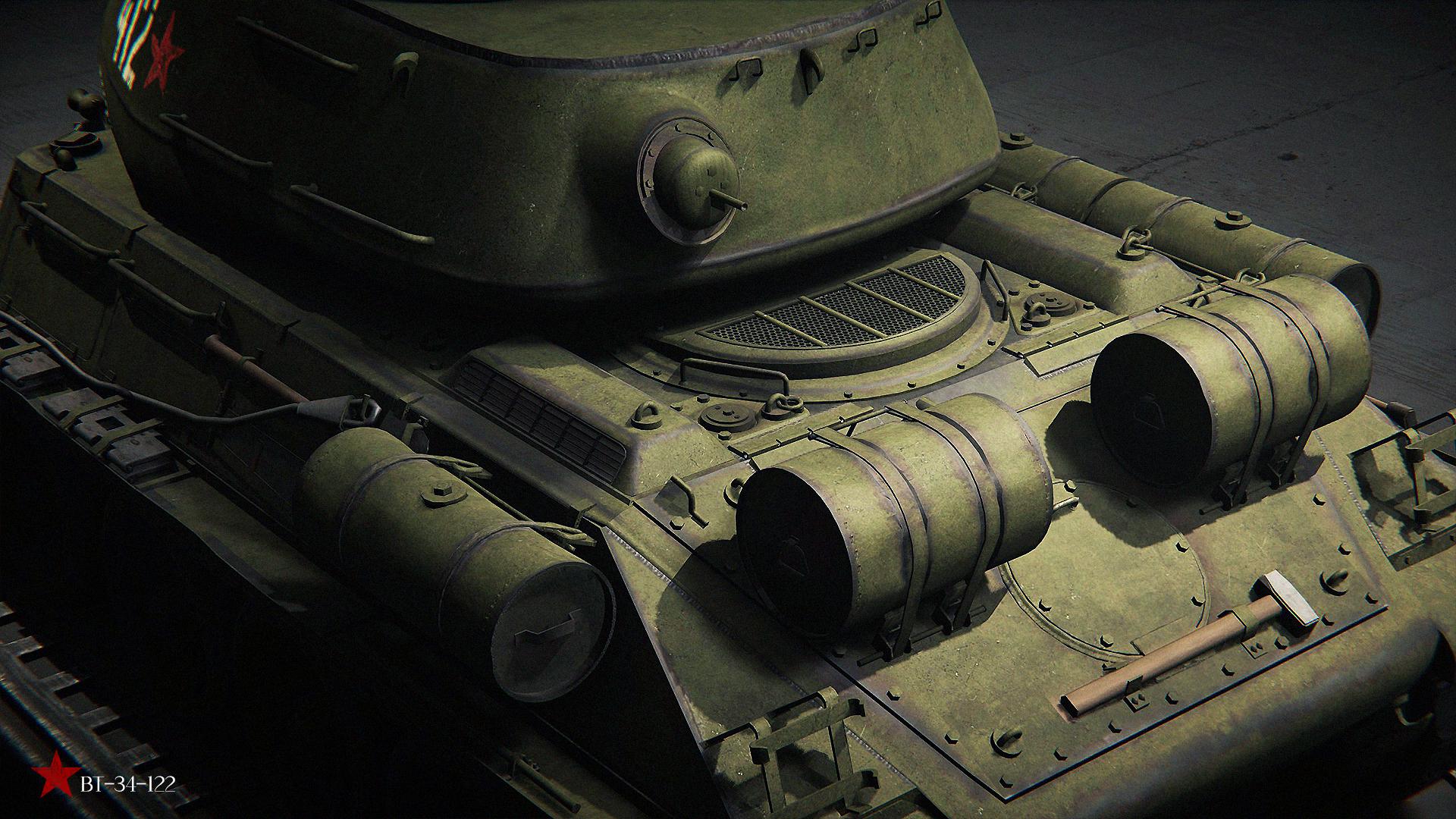
BT-34-122
How a Fast Tank Was Turned into a Heavy Tank
Naturally, simply enlarging the BT-9 to the required dimensions was impossible. Practically every major component had to be recalculated.
First of all, the designers completely redesigned the running gear. The reinforced road wheels received new axles and bearings, the suspension arms were modified, and the strength reserve of the suspension springs was increased. The drive sprockets, idler wheels, and track chains were also redesigned.
Particular attention was paid to the transmission. Experience operating earlier heavy tanks had shown that gearboxes and final drives were frequently responsible for serious breakdowns. Therefore, the new components were designed from the outset to withstand substantially greater torque and impact loads.
The hull also had to be designed almost entirely from scratch. To obtain sufficient internal space, it was widened and lengthened while retaining a rational layout and sloped armor plates.
The convertible wheeled-and-tracked running gear of the earlier BT tanks was abandoned altogether. For a vehicle of this weight, it offered no practical advantage. The new tank was designed from the very beginning as a fully tracked vehicle.
As a result, relatively little of the original BT-9 remained in the new design. Nevertheless, the general engineering philosophy was preserved: a relatively simple layout, a diesel engine, spring suspension, and an emphasis on maintaining high mobility.
The new vehicle received the designation BT-34.
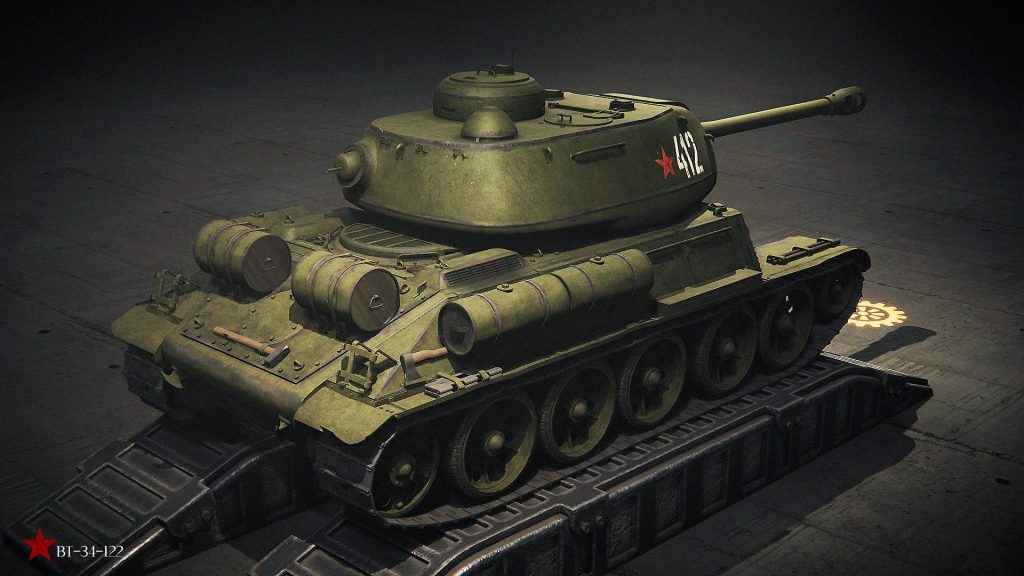
Why Was It Called the BT-34?
Unlike the familiar designations of Soviet tanks, the name of the new vehicle was somewhat unusual. Formally, it no longer belonged to the BT class of fast tanks, since it was now a full-fledged heavy tank.
However, Kotin deliberately retained the letter designation to emphasize the design’s origins. The number 34, in turn, was intended to indicate maximum standardization with the promising T-34 medium tank.
Initially, it was assumed that both vehicles would share a large number of components: engines, transmission elements, observation devices, electrical equipment, and some of the armament and fighting-compartment equipment.
But as development progressed, it became clear that the requirements for a heavy tank differed significantly from those for a medium tank. The increased weight required many components to be reinforced, while the larger hull demanded entirely different structural solutions.
Ultimately, the degree of actual component commonality amounted to only about 20%.
At first glance, this result seemed disappointing. However, even that 20% was significant. Common instruments, individual equipment components, and certain manufacturing solutions simplified production and crew training.
More importantly, unlike previous experimental heavy tanks, the BT-34 was designed from the outset with future modernization in mind.
Summer 1939: Trials That Surprised the Military
The first experimental BT-34 was ready by the end of the summer of 1939. The vehicle received a 76 mm gun, substantial anti-shell armor protection, and a diesel engine belonging to the V-2 family.
In terms of its principal characteristics, the new tank was roughly comparable to the future historical KV-1. Its combat weight was approximately 45 tons, its maximum armor thickness reached 75 mm, and its road speed was around 34–35 km/h.
However, the greatest surprise was neither its firepower nor its armor protection, but its reliability.
The experimental tank confidently traversed rough terrain, overcame obstacles, and completed extended test runs. Some breakdowns naturally occurred, but they were nowhere near as catastrophic as those experienced by previous experimental heavy tanks.
The reinforced running gear performed particularly well. Despite the considerable weight, the suspension provided acceptable ride quality and did not require constant replacement of its most heavily stressed components.
The transmission’s performance also proved unexpectedly successful. The reserve of strength built into the design allowed its components to operate without being subjected to their maximum loads.
Test crews noted that the vehicle remained controllable even on difficult terrain and was considerably easier to maintain than the numerous experimental successors to the T-28 and T-35.
Following the trials, the military demanded that preparations for an initial production batch be accelerated.
Twelve BT-34s Are Sent to Finland
By December 1939, Leningrad factories had manufactured twelve tanks belonging to the initial production batch. These vehicles received a somewhat simplified turret design and improved cooling and lubrication systems.
All twelve BT-34s were sent for operational trials during the recently begun Soviet-Finnish War.
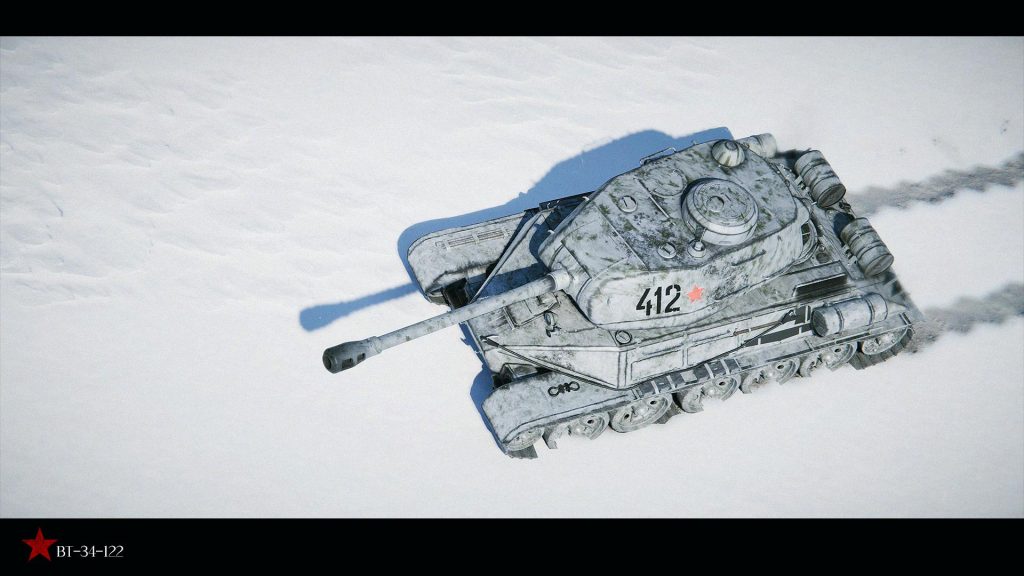
Here, the new equipment faced genuine combat conditions for the first time. Snowdrifts, wooded terrain, anti-tank obstacles, and severe frost created exceptionally difficult operating conditions.
However, it was precisely in Finland that the main advantages of Kotin’s design became apparent.
The thick armor provided reliable protection against most Finnish anti-tank guns of common calibers, while the wide tracks allowed the tanks to move across snow-covered terrain. Particularly important was their ability to continue moving after the running gear had been subjected to repeated impact loads.
Of course, the BT-34 was not invulnerable. Anti-tank mines, heavy artillery shells, and hits on vulnerable areas posed serious dangers. Furthermore, the 76 mm gun was not always capable of quickly destroying the reinforced-concrete fortifications of the Mannerheim Line.
Nevertheless, the overall results were highly convincing. Unlike earlier heavy tanks, the BT-34 could not only enter combat but also undertake lengthy marches without constant assistance from maintenance units.
After the campaign ended, the evaluation commission recommended that the vehicle be accepted into service.
BT-34-76 — the First Heavy Tank of a New Family
In the spring of 1940, the new tank officially received the designation BT-34-76. The final digits indicated the caliber of its main armament.
It was decided to organize serial production at the Kirov Plant in Leningrad, gradually winding down work on earlier experimental heavy tanks.
The production BT-34-76 retained the main features of the prototype. The vehicle received a welded armored hull, reinforced spring suspension, a diesel engine, and a turret armed with a 76 mm gun.
Its armament was subsequently improved. The original guns were replaced by more modern weapons with better ballistic characteristics.
Most importantly, factory specialists gained the ability to quickly correct identified shortcomings without fundamentally altering the tank’s basic design.
Technical Specifications of the BT-34-76
Estimated specifications for this alternative-history scenario.
- Classification — heavy tank.
- Year accepted into service — 1940.
- Combat weight — approximately 45 tons.
- Crew — 5.
- Armament — 76.2 mm tank gun and DT machine guns.
- Maximum armor thickness — 75 mm.
- Engine — V-2 family diesel.
- Power output — approximately 600 hp.
- Maximum road speed — 34–35 km/h.
- Suspension — reinforced individual spring suspension.
- Maximum design weight of the basic chassis — up to 50 tons.
The resulting vehicle was very close to the real KV-1 in combat capabilities, but it featured a more rational running gear design and considerable potential for future modernization.
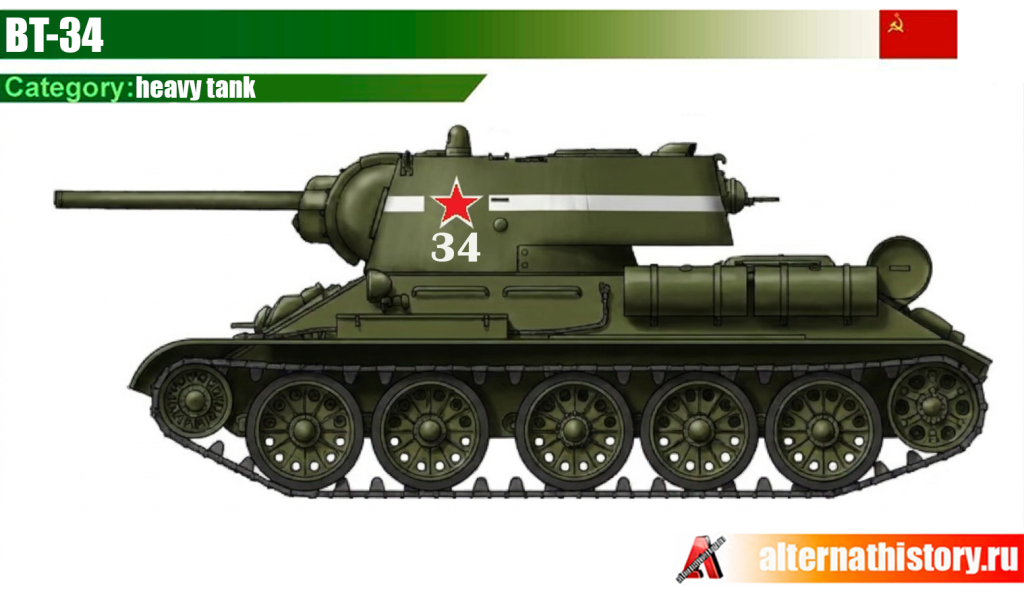
BT-34-76
Summer 1941: The BT-34 Encounters German Tanks
By the beginning of the Great Patriotic War, the Red Army already possessed several hundred BT-34-76 tanks. The new vehicles were primarily assigned to heavy tank units within the mechanized corps of the western military districts.
In their first battles, they demonstrated capabilities that closely resembled those of the historical KV-1. German 37 mm anti-tank guns posed practically no threat to their frontal armor, while early 50 mm guns were far from always capable of penetrating the tank at normal combat ranges.
However, the main difference from actual history became apparent during the retreat.
The historical KV tanks suffered from inadequate transmission reliability, while their considerable weight complicated the recovery of damaged vehicles. The BT-34 remained a heavy tank as well, but its components, having been reinforced from the outset, were less prone to failures caused by excessive loads on the running gear.
This did not mean that losses could be substantially reduced. Fuel shortages, German air superiority, communication problems, and inadequate training among some crews remained unchanged.
Nevertheless, a number of vehicles that would have had to be abandoned in our history because of mechanical failures managed to retreat alongside their units in this alternative timeline.
By the autumn of 1941, the BT-34 had acquired a reputation as a reliable and well-protected heavy tank.
However, it had already become clear that its armament needed to be strengthened.
Kotin Remembers the Five-Ton Reserve
Even before the war, Kotin had repeatedly returned to the original concept underlying the BT-34’s design.
The tank weighed approximately 45 tons, but its major components had been engineered for 50 tons. Consequently, there was a reserve of roughly five additional tons that could be used to improve its combat characteristics.
Initially, variants armed with more powerful 85 mm guns were considered. However, as new German tanks began appearing on the battlefield, it became increasingly apparent that even these weapons would have limitations.
By the autumn of 1942, Soviet designers already possessed experience developing powerful 122 mm artillery systems, including the famous A-19 corps gun.
In actual history, the D-25T tank gun appeared later, in 1943. In our alternative timeline, however, work on its tank-mounted variant begins earlier. Abandoning numerous heavy tank development programs allows additional engineering resources to be concentrated on creating a powerful weapon for an already existing chassis.
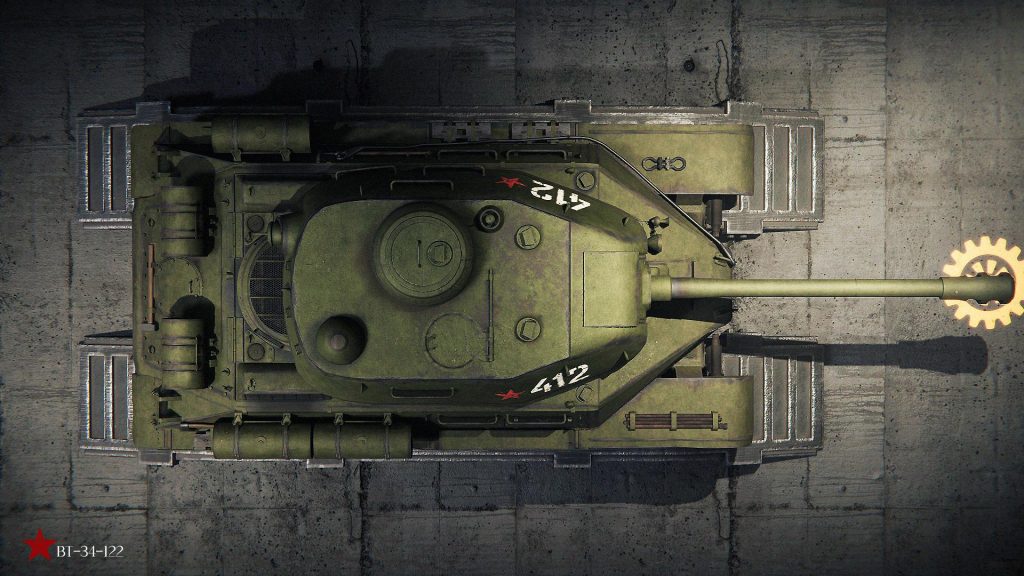
As a result, an experimental 122 mm tank gun, designated the D-25T, appears by the end of 1942.
Installing it requires an entirely new turret with a larger turret ring, stronger laying mechanisms and recoil systems, and a redesigned ammunition arrangement.
Most importantly, however, the BT-34’s running gear can be retained without fundamental modification.
T-34-122: The Red Army’s New Heavy Tank
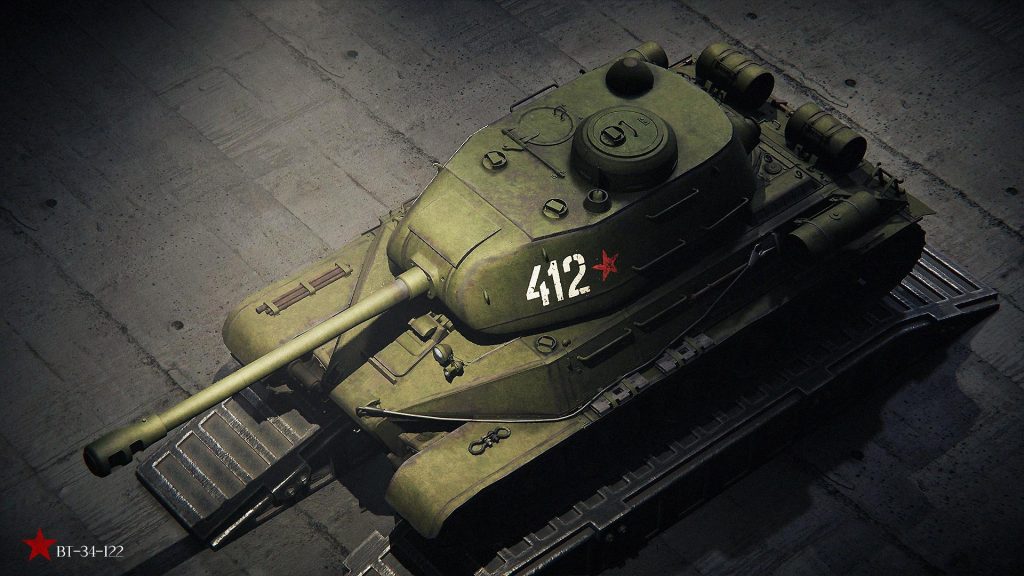
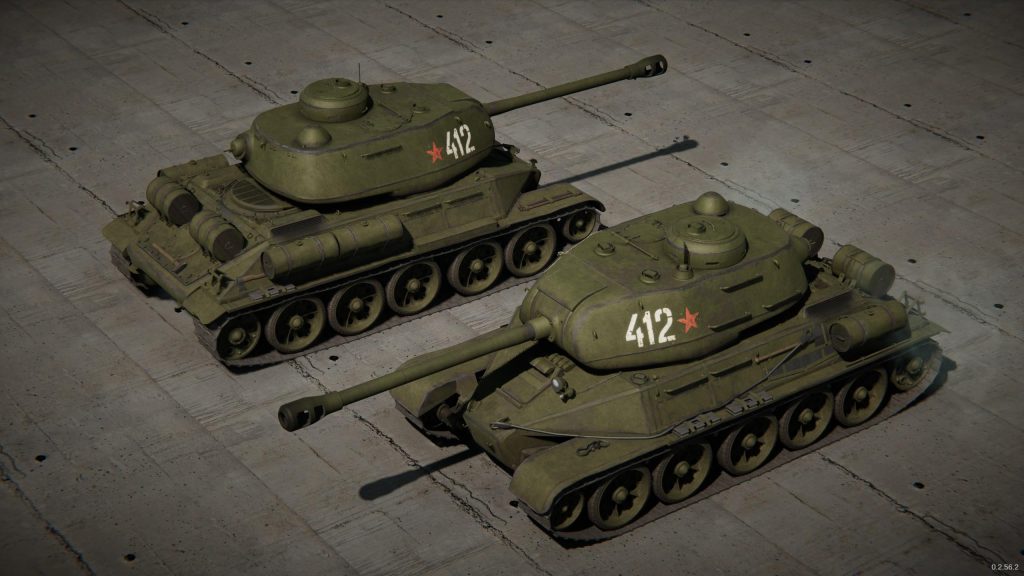
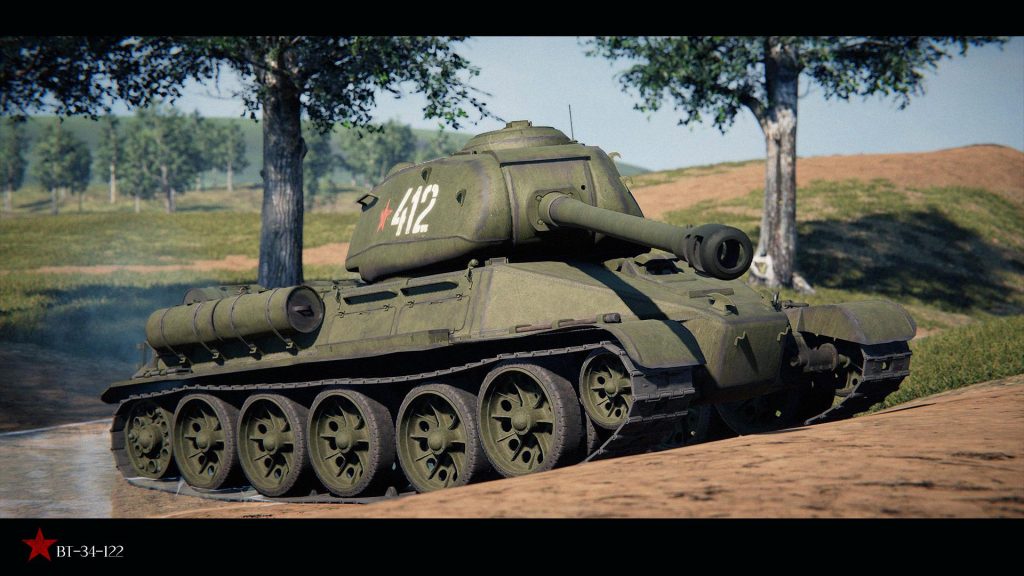
At the end of 1942, an entirely new tank, designated the T-34-122, arrives at the testing ground.
Formally, it is derived from the BT-34, but the design has changed so extensively that the military decides to abandon the previous letter designation. The designation T-34-122 emphasizes the vehicle’s membership in the new standardized family, although direct component commonality with the conventional T-34 medium tank remains limited.
The tank’s combat weight is approximately 45 tons. Despite the installation of significantly heavier armament, the designers manage to maintain this figure by redesigning the hull, adopting a more rational armor arrangement, and reducing the weight of certain components.
Nevertheless, the available weight reserve is now practically exhausted.
The vehicle’s defining feature is its extremely powerful 122 mm D-25T gun. Its armor-piercing shell possesses tremendous destructive power and allows it to engage even the heaviest German tanks.
In terms of combat capabilities, the new T-34-122 is close to the real IS-2, which never appears in this alternative timeline.
At the same time, the use of a long-established chassis provides a significant advantage. Factories do not need to completely reorganize production, while maintenance units already have experience servicing the main components.
Naturally, the transition to the new armament creates certain problems. The ammunition capacity becomes considerably smaller, while the use of separate-loading ammunition limits the rate of fire. However, the military considers these disadvantages an acceptable price for the dramatic increase in firepower.
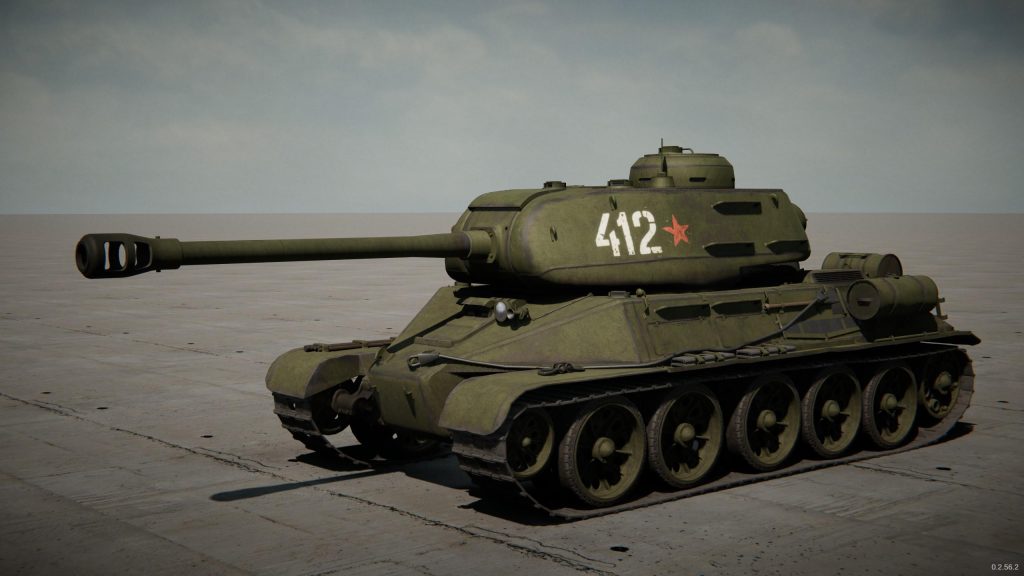
Technical Specifications of the T-34-122
Specifications of the alternative design, based on the capabilities of the historical IS-2.
- Classification — heavy tank.
- Year prototype completed — 1942.
- Start of serial production — 1943.
- Combat weight — approximately 45 tons.
- Crew — 4.
- Main armament — 122 mm D-25T gun.
- Secondary armament — DT machine guns.
- Maximum armor thickness — up to 120 mm in the frontal aspect.
- Engine — modernized V-2 family diesel.
- Power output — approximately 520–600 hp, depending on the variant.
- Maximum road speed — approximately 35–37 km/h.
- Running gear — a development of the BT-34 design with reinforced components.
- Combat role — engaging heavily armored vehicles, breaking through fortified positions, and supporting offensives.
Why Did the T-34-122 Appear Earlier Than the Real IS-2?
At first glance, an obvious question arises: how did Soviet designers manage to create a heavy tank armed with a 122 mm gun almost a year earlier than in actual history?
The answer lies in the particular circumstances of this alternative timeline.
In our world, the development of heavy tanks proceeded through several successive stages. First came the KV-1 and KV-2, followed by various experimental vehicles, the KV-1S, the KV-85, and finally the IS family of tanks.
Each new design required testing, the elimination of shortcomings, and the establishment of production.
In the alternative reality, a significant part of this process had already been completed in 1939 with the creation of the BT-34, which possessed a considerable reserve of structural strength.
Soviet engineers no longer needed to design a fundamentally new chassis for each successive heavy tank. Their main efforts could instead be directed toward armament, armor protection, and improving existing components.
Admittedly, such acceleration had its limits. Developing a 122 mm tank gun, creating a new turret, and establishing production of powerful artillery systems remained extremely difficult tasks.
Therefore, the end of 1942 should be regarded as a highly optimistic but acceptable date for completing the experimental vehicle in this alternative scenario. Several more months would still be required before such tanks could appear at the front in large numbers.
From Kursk to Berlin
Serial production of the T-34-122 began in the spring of 1943. Initially, output remained limited because factories experienced difficulties manufacturing the new turrets and artillery systems.
Nevertheless, by the summer, the first heavy tank units had received the new vehicles.
During the Battle of Kursk, T-34-122s did not yet form the backbone of Soviet heavy tank formations, although individual units had already managed to take part in the fighting.
The advantage of the 122 mm gun was particularly evident when engaging heavy German tanks. With a successful hit, its powerful shell could disable even a well-protected vehicle.
However, there were problems here as well. The limited rate of fire made it difficult to engage several opponents simultaneously, while the relatively small ammunition supply required crews to select their targets carefully.
By 1944, production had expanded considerably. The T-34-122 gradually replaced the earlier BT-34-76 in heavy tank units, although the older vehicles continued to be used for infantry support and auxiliary combat tasks.
The new tanks participated in offensives in Right-Bank Ukraine, Belarus, Poland, and East Prussia. Their powerful guns proved particularly useful for destroying fortified firing positions.
In urban combat, 122 mm shells could demolish brick walls, barricades, and field fortifications, considerably easing the advance of assault units.
In the spring of 1945, T-34-122 tanks entered Berlin alongside other Red Army formations.
Thus, this vehicle became the Soviet Union’s principal heavy tank during the final stage of the war.
One Hull — Many Combat Vehicles
However, Kotin’s greatest achievement was not even the creation of a single successful tank, but the emergence of a promising family of armored fighting vehicles.
After the BT-34-76 and T-34-122 had been put into production, engineers began developing self-propelled artillery systems based on the same chassis.
Vehicles armed with 152 mm guns, intended to destroy fortifications and support heavy tank formations, appeared particularly promising.
Later, projects for armored recovery tractors, engineering vehicles, and armored mobile repair workshops also emerged.
A significant proportion of their parts and components remained common. Such standardization simplified production, reduced the range of spare parts required, and made maintenance easier for frontline units.
Naturally, creating an absolutely universal platform proved impossible. Different combat vehicles imposed different requirements concerning weight distribution, weapon placement, and internal hull volume.
Nevertheless, the BT-34 family became one of the most successful examples of using a common engineering foundation for several classes of heavy armored vehicles.
And What Happened to the Regular T-34?
An important clarification is needed here. Initially, the creation of the BT-34 did not imply the immediate abandonment of the T-34 medium tank project.
On the contrary, it was precisely with this promising Kharkov-designed tank that engineers attempted to maximize standardization of the new heavy vehicle.
However, the successful trials of the BT-34 forced the military to reconsider its plans. The Red Army leadership faced a question: was it worth simultaneously establishing production of two different tanks if one offered considerably stronger protection and sufficient mobility?
In our alternative timeline, the decision was made to concentrate the main effort on the heavy BT-34 family.
Work on the T-34 medium tank continued for some time but was eventually discontinued. Individual technical solutions and components were used to improve the BT-34, but the medium tank never entered production as a separate vehicle.
This choice had both advantages and serious disadvantages.
On the one hand, the army received well-protected tanks capable of resisting most German anti-tank weapons during the early stages of the war.
On the other hand, the heavy BT-34 required considerably more metal, fuel, and labor than the historical T-34.
Even with a rational design, its production could not match the mass production of actual Soviet medium tanks.
As a result, the Red Army received fewer modern tanks than it did in our history.
And this became the greatest weakness of the entire concept.
Instead of an Afterword: One Good Tank Instead of Two Different Ones — Was It Worth It?
The history of the alternative BT-34 family demonstrates just how important choosing the right basic design can be in the development of military technology.
By abandoning the endless refinement of complicated multi-turret vehicles, Kotin managed to create a heavy tank with a considerable reserve of structural strength. This subsequently made it possible to accelerate the development of more powerful armored vehicles.
The BT-34-76 proved a worthy alternative to the historical KV-1, while the T-34-122 developed from it approached the combat capabilities of the famous IS-2.
However, this is precisely where the main contradiction of the entire program became apparent.
In actual history, Soviet armored forces received two different tools. The mass-produced T-34 became the backbone of armored formations, while the heavy KV tanks, and later the IS series, were used to accomplish the most difficult missions.
In our alternative timeline, the attempt to combine these functions produced a genuinely successful heavy tank, but at the same time deprived Soviet industry of the opportunity to manufacture equally large numbers of medium vehicles.
Therefore, the overall outcome would have been far from straightforward. Individual tank units would have received better-protected and more powerful equipment, but the Red Army might have possessed considerably fewer tanks.
Nevertheless, if Soviet engineers had managed to reduce the labor required to manufacture the BT-34 and establish its mass production, the concept could have proved highly promising. Perhaps the USSR would have approached the idea of a universal main battle tank during World War II itself, decades before this concept became widespread.
Source — https://www.reddit.com/r/SprocketTankDesign/comments/1xsi6ca/bt34122/