Poland is bringing the “Borsuk” to the global market: the new Borsuk infantry fighting vehicle is being developed not for Europe, but for Asia

The Polish defense industry is gradually beginning to play in a completely different league. Until recently, Warsaw mainly purchased foreign equipment and modernized its Soviet legacy, but now Poland is striving to become a full-fledged exporter of modern combat vehicles. That is precisely why the export version of the new Polish Borsuk infantry fighting vehicle was unveiled for the first time at the IDEB 2026 exhibition in Bratislava—a vehicle that is already being called, even in Poland itself, the leading contender to become the local defense industry’s next export hit.
But the most interesting thing isn’t even the car itself, but rather who they actually plan to sell it to.
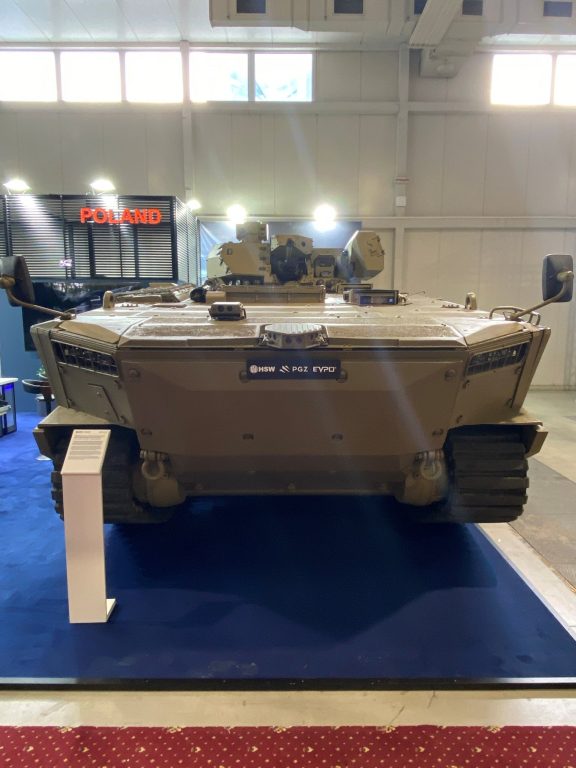
Formally, the presentation took place in Slovakia and appeared to be an attempt to interest Bratislava in the new Polish IFV. In reality, however, almost no one believes that the Slovaks will actually back out of the contract they’ve already signed for the Swedish CV90s. It is much more likely that Poland and Slovakia are using the exhibition as a platform to promote their joint product in the Asian and Middle Eastern markets. Even the vehicle’s camouflage pattern—clearly designed with markets outside Europe in mind—directly hints at this.
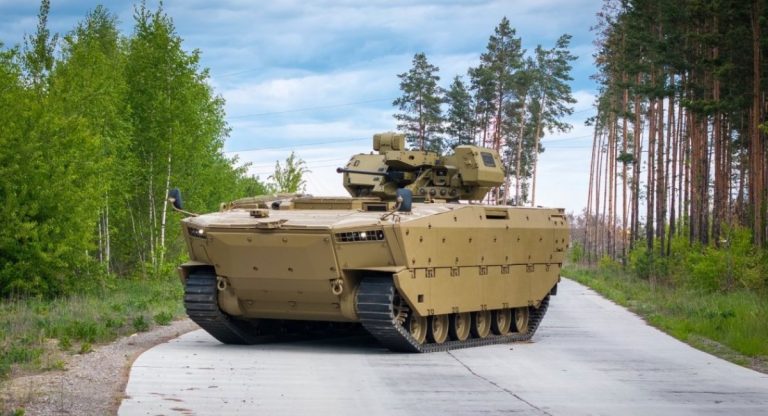
Polish Next-Generation Infantry Fighting Vehicle
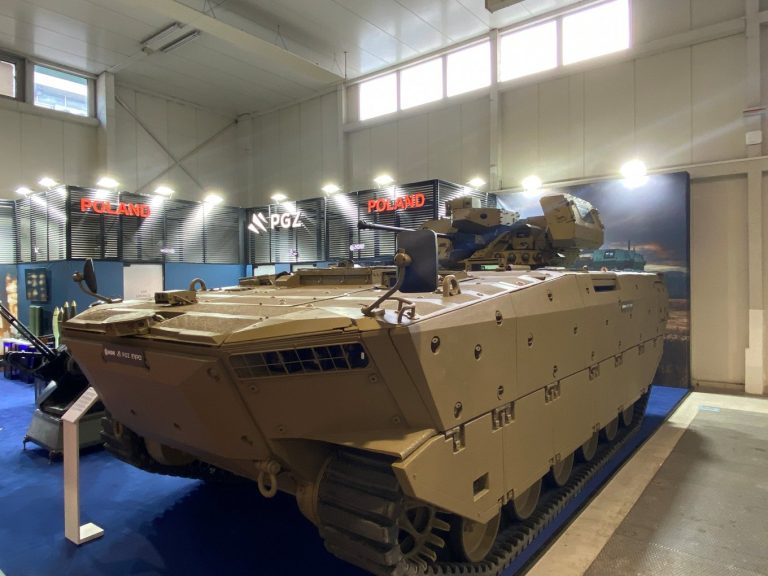
The Borsuk itself is an extremely important vehicle for Poland. It is the first fully modern Polish tracked infantry fighting vehicle developed in-house, intended to replace the old Soviet BMP-1s, known in Poland as the BWP-1.
Work on the project began back in the 2010s, and the vehicle was first unveiled to the public in 2017. The lead developer was Huta Stalowa Wola—a company that in recent years has become one of the symbols of Poland’s new defense industry. It is there that the Krab self-propelled howitzers are manufactured, and now the Borsuk as well.
The vehicle was designed to meet the rather specific requirements of the Polish Army. Poland wanted a modern IFV with good protection, powerful armament, and the ability to float without additional preparation. The last point seems almost anachronistic today—many modern heavy IFVs have long since sacrificed amphibious capability in favor of thicker armor. But the Polish military still considers the ability to quickly cross the numerous rivers of Eastern Europe an important advantage.
The result was a relatively lightweight IFV weighing about 28 metric tons, equipped with a hydropneumatic suspension, a modern MTU engine, and a remotely controlled ZSSW-30 combat module. The vehicle is armed with a 30-mm Bushmaster II automatic cannon, a machine gun, and Spike LR anti-tank missiles.
The export version turned out to be completely different
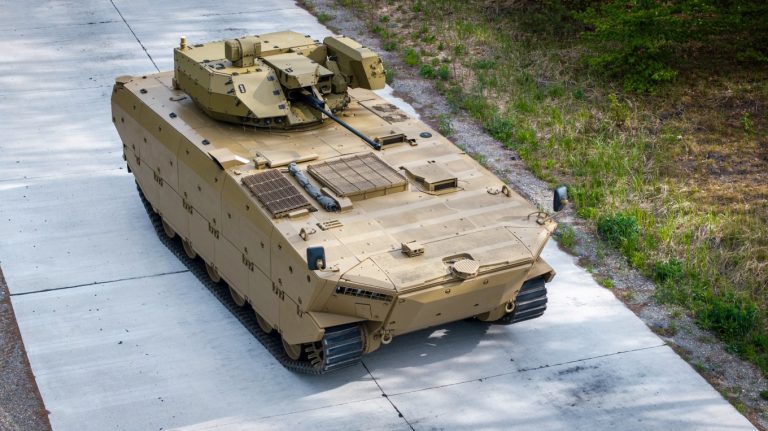
However, the export model presented in Slovakia differs significantly from the Polish military version.
The main change is the installation of the Slovak-made Turra-30 unmanned turret from EVPU. It can be equipped with either a Slovak-made cannon or one manufactured by the American company Northrop Grumman, as well as Spike LR/LR2 missiles. In fact, this is no longer simply a Polish vehicle, but a joint Polish-Slovak product.
That’s exactly what makes the whole story so interesting.
In recent years, Eastern Europe has gradually been transforming into a new industrial hub for NATO. Poland, the Czech Republic, Slovakia, and Romania are rapidly ramping up their defense production. Moreover, the focus is no longer just on licensing or repairing equipment, but on efforts to develop their own export platforms.
Poland is particularly aggressive in this regard. After the war in Ukraine began, Warsaw started pouring enormous amounts of money into its military and defense industry. The production of the Krab, Rosomak, Piorun, and now the Borsuk is viewed not only as a matter of national security, but also as a future export business.
Why Asia Appears to Be the Main Focus
That said, it seems rather unlikely that Slovakia will actually buy Borsuk.
Back in 2022, Bratislava signed a contract to purchase 152 Swedish CV90 MkIVs for nearly 1.7 billion euros. Moreover, the first vehicles for the Slovak Army have already been officially unveiled. Against this backdrop, the idea of suddenly abandoning the Swedish platform seems almost far-fetched.
That is precisely why analysts are increasingly discussing another scenario: Poland and Slovakia are simply using the joint project to promote the car in third countries.
The markets in Asia and the Middle East are currently the subject of particularly active discussion. A few months ago, Defence24 reported that Warsaw and Bratislava were already discussing the joint promotion of military equipment in Saudi Arabia and Vietnam.
For these markets, the Borsuk could prove to be a very attractive option. The vehicle is relatively light, amphibious, equipped with Western weaponry, and could potentially cost less than many of its Western European competitors.
In addition, many Asian countries still operate the old Soviet BMP-1 and BMP-2 infantry fighting vehicles. For them, the Polish vehicle appears to be a logical replacement, but one based on modern NATO technology.
But the competition will be fierce
The only problem is that the market for infantry fighting vehicles is currently absolutely saturated.
Turkish, South Korean, Swedish, German, and American companies are actively competing for export contracts. Moreover, many of their vehicles have already seen action in actual wars.
The Borsuk does not yet have this advantage. Moreover, the Polish Army itself has only just begun receiving production-model vehicles. The first 15 IFVs were delivered to the troops only at the end of 2025, and a full-scale ramp-up of production is still ahead.
Nevertheless, Poland’s very attempt to enter the global armored vehicle market is highly significant. Just ten years ago, few people viewed the Polish defense industry as a serious player in the export market. Now Warsaw is already trying to sell its own infantry fighting vehicles, artillery, and air defense systems far beyond Europe.
And if Borsuk does indeed establish a foothold in Asian markets, it will mark one of the most significant breakthroughs for the Polish defense industry since the end of the Cold War.