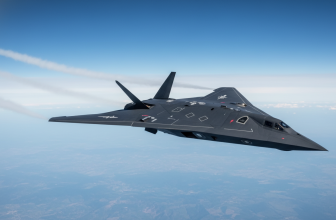
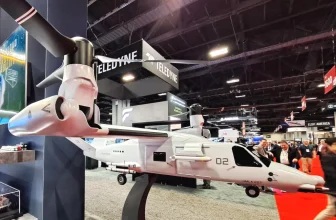
In recent years, the U.S. military’s need for long-range, cost-effective strike systems has become one of the key priorities in developing the combat capabilities of the U.S. Army, Navy, and Air Force. One solution to this challenge is a new missile called the Red Wolf, which is positioned as a long-range cruise missile capable of delivering a precision-guided warhead against well-protected ground and sea targets.
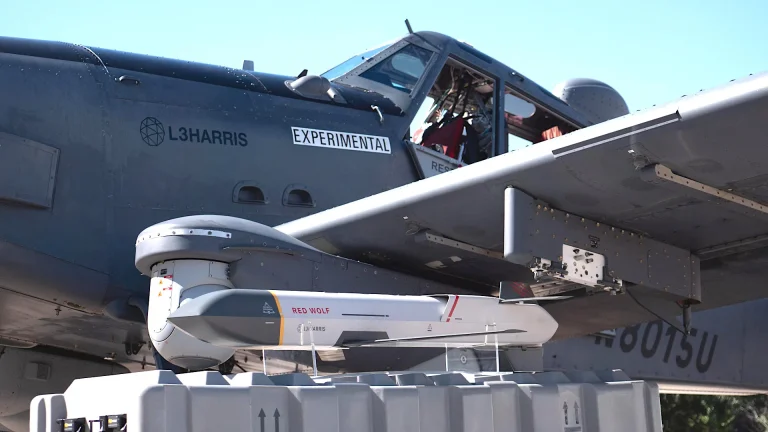
Unlike traditional heavy cruise missiles, the Red Wolf—part of the so-called Wolf Pack family—is a collection of modular launch platforms designed for flexible deployment from various platforms: airborne, ground-based, or naval.
Contents:
Why the Red Wolf Isn’t Just “Another Missile”
Red Wolf is being developed by L3Harris Technologies at the intersection of two trends that are becoming increasingly prominent in modern weaponry:
- an increase in the proportion of inexpensive but accurate strike munitions;
- the blurring of the line between aviation munitions, autonomous reconnaissance drones, and long-range cruise missiles.
Such systems are designed to enable the military to strike key targets from a safe distance—outside the range of enemy air defenses—while being lightweight and modular enough to be launched from a wide variety of platforms.
According to official data, the Red Wolf can strike targets at ranges of up to about 200 nautical miles (approximately 370 km), which significantly exceeds the capabilities of older missiles designed for light platforms and helicopters.
Where Red Wolf Can Be Used
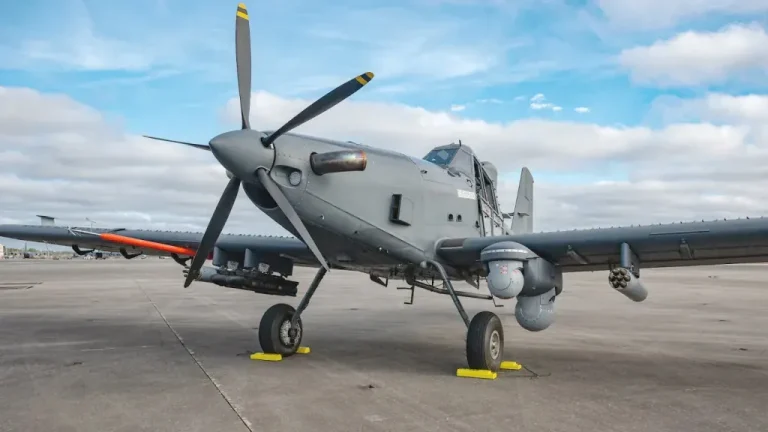
One of the most interesting applications for the Red Wolf is its use in combination with new light attack aircraft and support platforms, such as the OA-1K Skyraider II.
The OA-1K Skyraider II is a light, multi-purpose turboprop aircraft that the U.S. Air Force describes as the result of the Armed Overwatch program and which is named after the legendary A-1 Skyraider of the 20th century.
The Skyraider II was originally designed for close air support, surveillance, and reconnaissance missions, but there is discussion about equipping it with strategic strike capabilities, specifically through missiles such as the Red Wolf.
This could give a light aircraft what it clearly lacks at present: the ability to strike distant targets without entering the enemy’s danger zone.
Red Wolf in the broader context of armaments
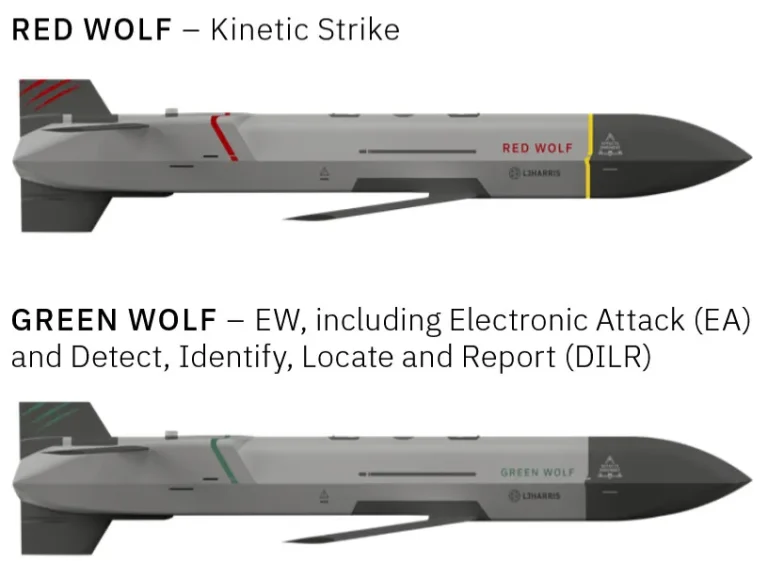
Red Wolf is not the only system of its kind, but it stands out specifically for its combination of range, modularity, and relatively moderate cost. It is being developed as part of a broader product line that also includes other “Wolf” systems, such as Green Wolf—a version equipped with radio or electronic jamming capabilities, designed to jam air defense or reconnaissance systems on the battlefield.
This approach reflects a strategic vision of future conflicts: Instead of relying on expensive, heavy missiles, the military aims to have large quantities of precise, long-range munitions that can be launched from a variety of platforms—from helicopters to light aircraft.
Red Wolf has already undergone numerous test runs as part of its development since the early 2020s, and the concept behind it stems in part from experiments and projects carried out through the Pentagon’s Strategic Capabilities Office (SCO).
What are the advantages and limitations?
Pros of Red Wolf:
- Long range—up to ~200 nautical miles—allowing it to engage targets outside the carrier’s immediate danger zone.
- Modularity—the missile is suitable for integration onto various platforms: aircraft, helicopters, and land- and sea-based systems.
- Its low cost compared to heavy cruise missiles makes it suitable for widespread use.
Limitations and Questions:
- Although the missile offers range, it still cannot compete with the heaviest strategic cruise missiles in this regard.
- Its effectiveness depends heavily on the delivery vehicle and the platform’s ability to operate safely at the maximum standoff range.
- Integration with new types of media (such as Skyraider II) is still under discussion and requires technical testing.
Why Is This Important Today?
Red Wolf reflects the current trend in military technology: long-range, affordable, and adaptable weapons are becoming increasingly sought after in the strategies of technologically forward-thinking nations. The United States, as it rethinks its objectives in the context of high-intensity conflict, is seeking ways to provide strike capabilities not only to heavy and expensive platforms but also to lightweight, mobile, and mass-produced systems.
If such a missile becomes standard equipment for light attack aircraft or helicopters, it could shift the balance on the battlefield, making it possible to engage targets at long ranges without deploying fifth-generation aircraft or heavy bombers.
Conclusion

The Red Wolf is not just a new missile: it is a symbol of a shift in approaches to 21st-century strike capabilities. It combines:
- a range comparable to that of traditional cruise missiles,
- its relative affordability,
- and the ability to run it on a variety of platforms.
And although its role on specific platforms, such as the OA-1K Skyraider II, is still under discussion, the concept itself shows the direction in which modern weapons are heading—toward versatile, scalable, and accessible firepower.