An article by Roman Ponomarenko from the WARSPOT website, dated February 11, 2022.
Even experienced soldiers can make mistakes. On the evening of March 31, 1863, the legendary Confederate ranger Major John Mosby set up camp at the large Miskell Farm, hoping to obtain fodder for his horses. Confident of his safety, he didn’t even bother to post a guard, and in the morning, the farm was attacked by a superior force of Union cavalry. The “Gray Ghost’s” brilliant career could have come to an end at its peak, but Mosby and his men were saved by a stroke of luck that turned the entire course of events on its head.
The spring of 1863 was a very successful one for Major John Mosby and his 43rd Virginia Cavalry Battalion. In early March, during a lightning-fast raid on Fairfax, the Confederates captured Brigadier General Edwin Stauton, as well as a lieutenant, a telegraph operator, 30 privates, and 58 horses, all without firing a single shot or suffering any casualties.
Despite this impressive success, Mosby had no intention of resting on his laurels. His rangers constantly attacked the enemy, and he himself fully lived up to his nickname, “The Gray Ghost.”
In late March, Mosby planned another raid into Northern Virginia, which was occupied by federal troops. At noon on March 31, 1863, despite the snow and rain, Mosby set out from Rector Town with a detachment of 70 rangers toward Fairfax County. His target was the town of Dranesville, located on the border of Fairfax and Loudoun counties, where a federal garrison was stationed — a detachment of the 1st Vermont Cavalry Regiment, part of the U.S. Army’s cavalry division tasked with defending Washington.
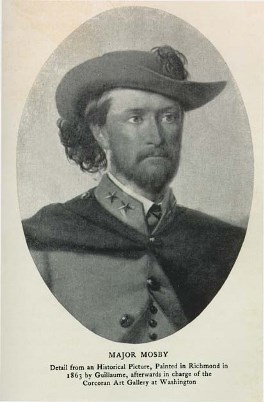
The legendary ranger John Mosby. pinterest.com
The people of Vermont had already dealt with Mosby’s Rangers on numerous occasions. Lieutenant Joshua Groat wrote in his memoirs:
“In late winter of 1863, part of our regiment was stationed in Drainsville. There, we were harassed by the rebel guerrilla Mosby. For several weeks, he went about his business, capturing and killing sentries and raiding our outposts.”
Unnoticed by the enemy, the Ranger detachment reached Drainsville by the end of the day. There, Mosby was in for a disappointment: the town was unguarded, as the garrison had left it on March 30, heading east across the Difficult Run River, and was now about 13 km away. Given the exhaustion of the men and horses after the long march, Mosby turned west as twilight fell.
Around 10:00 p.m., the rangers stopped for the night at Miskel Farm—the farm owned by Thomas and Lydia Miskel. This farm was located a few miles north of the town of Lisberg on the east bank of the Broad Run River, near its confluence with the Potomac River. Mosby and his officers took up quarters in the main house, while the rank-and-file occupied a barn in the yard, where they settled down on bales of hay.
The farm itself, surrounded on all sides by a high fence, had only one entrance gate. The house and barn were located deep within the yard, about 600–700 meters from the gate. The farm was bordered on two sides by rivers—the Potomac to the north and the Broad Run to the west. Federal army camps were visible on the opposite banks of the rivers, but since there were no fords, they posed no threat.
The decision to spend the night at this farm was based on just one factor—it was the only place for many kilometers around where the Southerners could obtain enough fodder for their horses.
By this point, Mosby and his Rangers had traveled over 65 km through snow and mud, so both men and horses were severely exhausted. At the same time, the commander of the Rangers felt safe, as he believed there were no enemy forces within 30 km of his position. Therefore, Mosby did not post a guard—the soldiers simply unsaddled their horses, ate, and went to sleep.
Vermonters are on the trail
Under different circumstances, Miskel-Farm would have been a perfectly safe place to spend the night, were it not for one detail. News of the arrival of the Confederate cavalry spread quickly among the locals. Unfortunately for Mosby, some of them did not sympathize with the Confederacy or feared reprisals from the Union forces for aiding the Confederates. Upon seeing Mosby’s men, a woman from Drainsville went to Union Church, where the Union garrison was stationed. Late that evening, she told Major Charles Taggart that Mosby and “about 65 of his men” were in Drainsville. Taggart immediately recognized the importance of this information and ordered Captain Henry Flint to take five companies of the 1st Vermont Cavalry Regiment to locate and destroy the rangers. Flint’s detachment set out around midnight.
When the federal troops reached Drainsville, they discovered that there were no rangers left there. However, the riders’ tracks were clearly visible in the snow, and Flint decided to continue the pursuit at the head of a ragtag group of volunteers numbering about 150 cavalrymen. Along the way, a local resident reported that Mosby and his band were at Miskell’s farm.
Opponents are drawing closer together
At sunrise on April 1, Captain Flint and his Vermont cavalry were on the road between Drainsville and Miskel Farm, heading toward the Broad Run River. Along the way, he made a brief stop at the home of a farmer named Green to ask for directions. By a stroke of luck, Ranger Dick Moran was at that house; he had not spent the night with the others at Miskell’s farm but had gone to visit his old friend Green. As soon as the federal troops left, Moran jumped on his horse and galloped across the fields to the farm to warn Mosby. The Northerners did not notice him and continued on their way along the road.
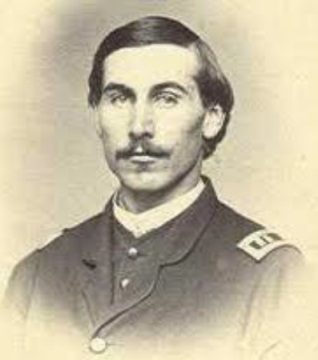
Lieutenant Joshua Groat. pinterest.com
On the approach to the farm, Flint divided his forces into two groups—an assault force and a reserve force. He personally led the assault vanguard, while he entrusted the 50-man reserve detachment to Captain George Bean (commander of Company G). Bean was tasked with surrounding the farm and, once Flint’s cavalry entered the gate, blocking it so that none of the Rangers could escape. Flint ordered Lieutenant Groat to lead the advance detachment of riflemen, who were to fire the first volley from their carbines during the assault. This was to be followed by a charge on horseback with sabers drawn.
While Flint was preparing for the attack, the rangers were just waking up. One of them, wandering around the yard, noticed that the enemy in the federal camp on the opposite side of the river was sending some kind of signals. He reported this to Mosby, who came out into the yard. At that moment, the Rangers’ commander saw Dick Moran racing toward him at breakneck speed, waving his hat and shouting, “Saddle up! The Yankees are coming!”
Under different circumstances, the rangers would have simply left the farm without engaging in battle against a numerically superior enemy, but now they no longer had time for that. They had just begun feeding the horses, and almost all of them were unsaddled, when a column of cavalry in the blue uniforms of the federal army appeared galloping several hundred meters from the farm. Half of Mosby’s men were completely unprepared for battle—the sleepy rangers had only just begun to crawl out of the hay where they had been sleeping. Mosby and his officers, revolvers in hand, ran toward the barn to organize a defense there. The situation looked critical for the “Gray Ghost.” “When Captain Flint charged forward at the head of his squadron, their sabers glinted in the morning sun, and I felt that my last hour had come,” Mosby recalled after the war.
The Attack on and Defeat of the Vermonters
However, things did not go at all as expected. The cavalry burst through the outer gates and fired a volley from their carbines. The volley was scattered, since not all the riders were able to enter the courtyard in time to fire due to the narrow gates. Flint then ordered a charge on horseback with sabers, rather than using carbines (presumably hoping to capitalize on his numerical advantage). But the Vermonters were unable to form a battle line and charged toward the barn in columns of two, trying to form ranks on the move. As they approached the barn, they ran into a small fence surrounding the cattle yard and hesitated. That sealed their fate. The experienced rangers took full advantage of their enemy’s mistake: the Union cavalrymen came under heavy revolver fire. Captain Flint was among the first to be killed; six bullets were later found in his body. Finding themselves under concentrated fire, the Federals panicked and rushed backward. Since the rear ranks were pressing forward while the front ranks wanted to turn back, a stampede ensued. Moreover, the only way back was through the very same gate through which the federal agents had entered the farm. This gate had been blocked with planks and various equipment, in accordance with Flint’s orders. A stampede and panic broke out at the closed gate.
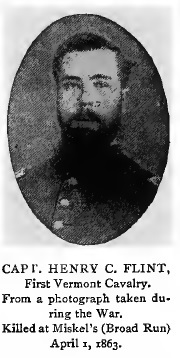
Captain Henry Flint, who commanded the federal troops. He was killed at the very start of the skirmish at Miskel Farm. pinterest.com
Seeing the enemy’s disorderly retreat, Mosby gathered about 20 rangers (apparently, their number depended on the availability of saddled horses) and launched a counterattack “with gunfire and shouts.” He himself mounted Private Harry Hatch’s horse; Hatch soon found himself a captured horse and joined the attackers. One of the first to join the attack was Lieutenant Samuel Chapman, who threw down his unloaded revolvers and drew his saber—a highly unusual move for Mosby’s men (they did not usually carry sabers, considering them an anachronism; it is also possible that Chapman did not have his own saber but took a captured one). The beating of the panicked Vermont cavalrymen began. The overwhelming majority of the Union troops dropped their weapons and surrendered right there in the courtyard. Captain Bean and his men took to their heels. The Southerners pursued the enemy for about 12 km and captured several more prisoners. Only a few Vermonters managed to escape.
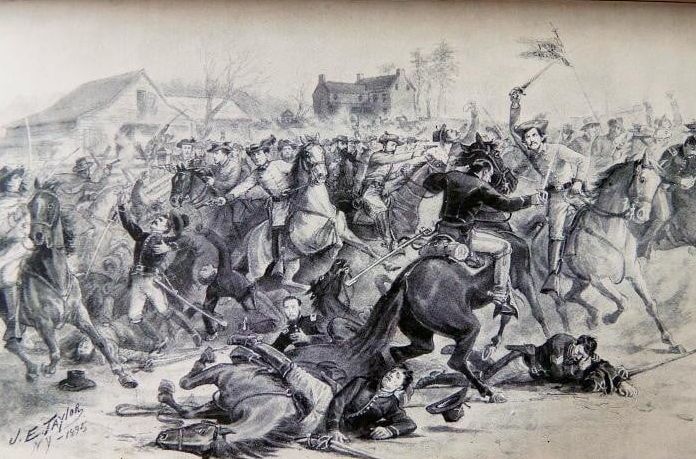
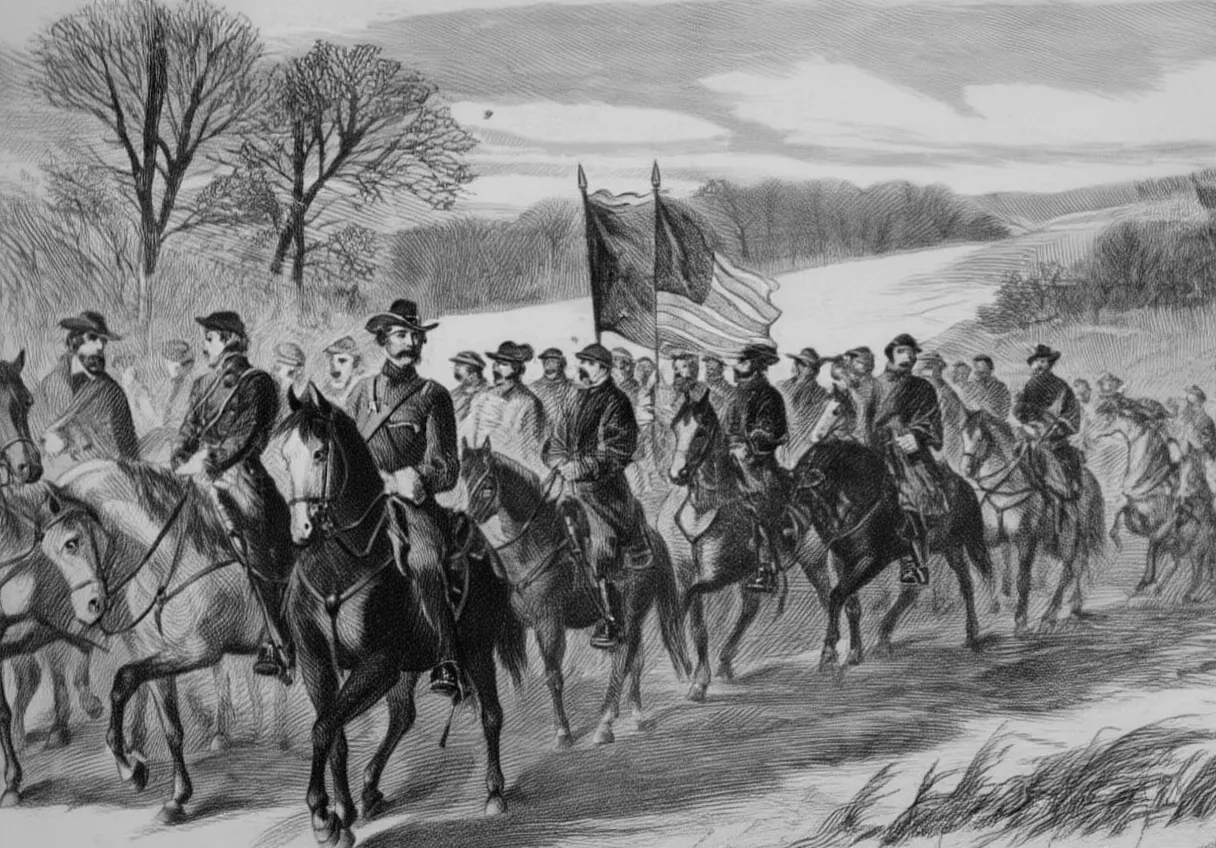
Mosby and his men in the battle at Miskel Farm. pinterest.com
Among those who distinguished themselves, Mosby singled out Lieutenant Chapman. After the war, he described Chapman’s role in that battle as follows:
“That day, I was accompanied by a young artillery officer named Samuel F. Chapman, a young artillery officer, who, at his country’s first call, had abandoned his theological studies and, like Stonewall Jackson, had become a sort of military Calvin, singing the psalms of David as he went into battle. I must admit that his character as a soldier bore a closer resemblance to the Jewish prophets than to the apostles or Baptists in whom he so devoutly believed. Before Sam reached the gate, he had already emptied both his pistols and drawn his saber. No matter which direction the Covenanters chose, the enemy’s ranks thinned wherever he went. He was right in front of me—usually leading the charge in the fray at the gate. It wasn’t the Union cavalry’s fault that they hadn’t passed through the gate faster, but Sam seemed to think it was. Even at that most critical moment of my life, when I was on the brink of death and had barely escaped, I couldn’t help but laugh. Sam was striking out while standing straight in his stirrups, slashing left and right with all the theological fervor of Balfour of Berli. I doubt he prayed that day for the souls of those he sent across the River Styx. For that, I made him captain.”
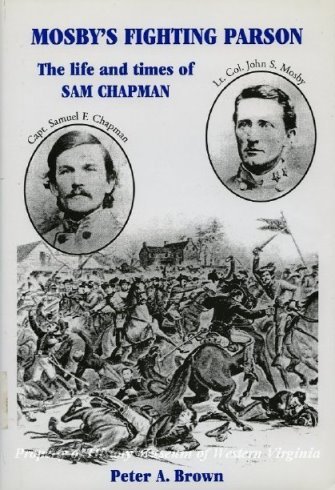
The cover of the book by Peter Brown, who researched the biography of Samuel Chapman
Mosby also singled out Sergeant Hunter and Privates Harry Hatcher, Wellington, Turner, Wild, Sowers, Ames, and Siebert for their outstanding service.
Results
Mosby’s losses totaled just four men—one killed (Private Davis of Kentucky) and three wounded (Privates Hart, Hurst, and Case). The Union cavalry lost 106 men—9 killed (including 2 officers, one of whom was Captain Flint), 15 seriously wounded (including 2 lieutenants, one of whom was the aforementioned Joshua Groat), and 82 captured (some of whom were also wounded). Mosby’s spoils included 95 horses, as well as weapons and equipment abandoned by the enemy on the battlefield.
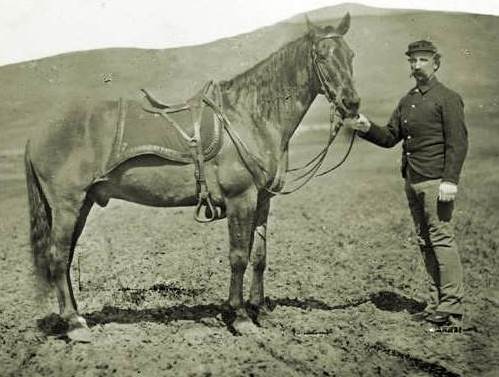
The Vermont cavalry rode Morgan horses. After the battle at Miskell Farm, 95 of these horses were added to the Confederacy’s horse herd. pinterest.com
Mosby left the severely wounded enemy cavalrymen where they were, as there was no way to transport them to the rear. Local farmers provided whatever assistance they could to the wounded, taking some of them to Miskell’s house, while a local doctor treated the injured right in the field. Mosby rode up to him to pay his respects and get an update. “The doctor who was treating them told me that many of those who had fled were wounded,” Mosby noted in his report.
One of the captured Vermonters, Sergeant Horace Eady, escaped from captivity the next day. During a stop near Rector’s Town, he noticed that many Rangers were wearing the same blue jackets, pants, and boots as he did (due to a severe shortage of uniforms, Southerners often wore pieces of captured clothing, especially in cold weather). Idi reasoned that since he himself did not know all the men in his company by sight, the same was likely true of Mosby’s men. Therefore, seizing the opportunity, he simply slipped out of the camp. Avoiding the roads, Idi made his way back to his own lines over the course of two days until he reached the positions of the 25th Maine Regiment.
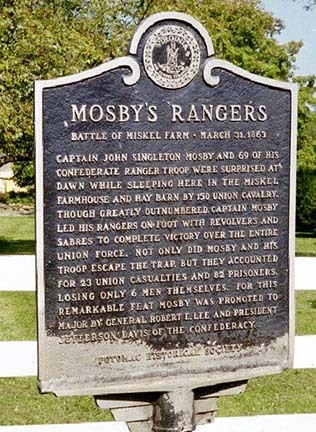
A commemorative plaque installed at the site of the event. pinterest.com
As soon as Major Taggart received a report of the incident, he dispatched Major Hall’s detachment to the scene to pursue Mosby, recover the bodies of the fallen, and assist the wounded. News of Flint’s defeat also reached the headquarters of the cavalry division responsible for the defense of Washington. Its commander, Major General Julius Stachel, immediately dispatched Colonel Prive with three cavalry regiments (the 6th and 7th Michigan and the 1st Virginia) to track down Mosby. Prieve returned without finding any trace of Mosby and his men—the “Gray Ghost” had retreated to his own territory in time, taking all the prisoners and captured horses with him.
Consequences
The rout of a detachment from the 1st Vermont Cavalry Regiment at Miskel Farm was the most dramatic clash between small units of the entire war. By the start of the operation, the Federals held all the advantages: a two-to-one numerical superiority, rapid-fire carbines, and their opponent was trapped on a farm surrounded on two sides with only one exit. Moreover, Mosby had not posted any sentries. Yes, Moran managed to warn the Rangers, but they no longer had time to prepare their defense.
The promising operation ended in disaster. Flint’s main mistake was ordering a cavalry saber charge—in the confined space of the courtyard, the crowded cavalrymen made an excellent target for enemy revolvers. If Flint had dismounted his men and ordered them to use cavalry carbines, things might have turned out differently: the Federals’ numerical superiority and advantage in weaponry left the Rangers with virtually no chance.
The situation was exacerbated by Flint’s sudden death. The second-in-command, Captain Bean, was in charge of the reserve and was outside the farm. He was unable to restore order and regroup his men, even though, at the very moment of Flint’s death, the Northerners still held all their advantages—numerical superiority and combined firepower. Subsequently, Bean was made a scapegoat, accused of cowardice and incompetence, and discharged from the army.
On April 2, 1863, Flint’s immediate superior, Major General Stachell, reported to headquarters:
“They came upon Mosby, who was completely taken by surprise and utterly unprepared for an attack by our troops. If our troops had been properly prepared… I regret to inform the command that the detachment sent by Major Taggart missed such a good opportunity to capture the insurgents. This can only be explained by the incompetence of the officers and the cowardice of the enlisted men. I have ordered Colonel Price to conduct a thorough investigation into all the circumstances and recommend that all officers found at fault be dismissed.”
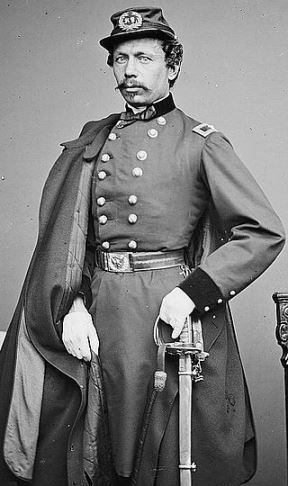
Major General Julius Stachel, a Hungarian by nationality, participated in the Hungarian Revolution of 1848. In 1864, he was awarded the United States’ highest honor—the Congressional Medal of Honor. wikipedia.org
The feds could only take comfort in the claim that Mosby had allegedly been struck in the face with a saber, a detail that Stachel also mentioned in his report. This claim did not correspond to reality. For Mosby, the battle at Miskell Farm was yet another success that cemented his legendary reputation. On April 4, General Robert E. Lee, commander of the Army of Northern Virginia, reported on this engagement to Jeff Davis, President of the Confederate States. However, there is no denying that Mosby was extremely lucky. Had circumstances been even slightly different, his detachment would have been routed, and he himself would have ended up either in captivity or in a grave. To be fair, it should be noted that Mosby was fully aware of his mistake. He understood that he had, in effect, led his men into a trap and had failed to post sentries. In a report dated April 7, he sincerely stated: “I admit that in this instance I did not take sufficient precautions against a surprise attack.” Mosby learned his lesson, drawing several important conclusions: he never again allowed himself to occupy a vulnerable position, and he never left his camp unguarded.
Sources and References
-
-
- Ashdown, Paul and Edward Caudill. The Mosby Myth; A Confederate Hero in Life and Legend. SR Books; Wilmington, Delaware, 2002
- Gray Ghost: The Memoirs of Col. John S. Mosby, by John S. Mosby. New York: Bantam Books, 1992
- Official Records of the Union and Confederate Armies in the War of the Rebellion. Vol. 25, Chap. 37 — Operations in Northern Virginia, West Virginia, Maryland, and Pennsylvania. January 26-June 3, 1863
- Williamson J. Mosby’s rangers. — Sturgis-Walton Company, 1909
-
Source: https://warspot.ru/21272-neozhidannyy-triumf-dzhona-mosbi