As part of our series on the Balkan Hub, it makes sense to touch on Romania’s history during World War I. This member of the hub played a twisted role in the events, contributing to the prolongation of the Balkan crisis and its unfavorable development for Russia.
Starting in 1913–14, Russian representatives in Romania noted that attitudes toward them had changed. Previously, those attitudes had been unfriendly, driven by the Russophobia prevalent in Romania. Now, however, the attitude toward Russia and its representatives had become markedly friendly. Previously, Bucharest had aligned itself with Austria-Hungary and Germany—with whom it had concluded an alliance treaty in 1883. But by 1913, Romania’s orientation had shifted somewhat, and a sentiment had spread that the country should not consider itself bound by the treaty with the Austro-Germans.
By this time, Bucharest had decided that it would be better to join a different coalition—one hostile to neighboring Austria-Hungary. Victory as part of this coalition promised a share in the partition of Austria-Hungary. Romania hoped to secure, among other things, Transylvania and other regions with a Romanian ethnic majority. Bucharest had in mind more than just the national goal of reuniting Romanians with the territories they inhabited. Transylvania was wealthier than Romania itself; there was plenty to get one’s hands on there. Furthermore, the Romanians were eager to seize the property of Austro-German investors in their country.
This is what brought about a shift in Romania’s attitude toward Russia. Russophobia gave way to a desire to use Russia for its own ends. After all, gaining Transylvania was possible only over the dead body of Austria-Hungary—and that required Russian support. However, the Romanians remained silent for the time being regarding Austria-Hungary and its provinces, making no public display of their ambitions toward it. In 1913, they asserted territorial claims against another neighboring country—Bulgaria. And to pursue these claims, Bucharest turned to St. Petersburg for support, promising to shift its alignment from the Austro-German bloc to one friendly toward Russia. More details on this were provided in previous publications.
Contents:
1914 — 1916
In August 1914, the long-brewing world war found a pretext and broke out. Berlin and Vienna demanded that Bucharest take their side, but Bucharest refused, believing that siding with the Austro-German alliance—especially at the very outset of the war—was not in Romania’s best interests.
The Great War sparked mixed feelings in Bucharest—both fears and hopes. The war offered a chance to gain territory by siding with the winning side. But who would win, and when? The Romanian leadership was very afraid of making a miscalculation—of taking a stand at the wrong moment and on the wrong side, ultimately losing along with that side. Bucharest found itself at a crossroads. If the Entente were to win—by siding with it, Romania could gain Transylvania. But what if the Austro-German bloc were to win? Then it would be necessary to side with them and take Russian Bessarabia. But it was essential to side with one side or the other—and specifically at the moment when it became absolutely clear that that side was the victor.
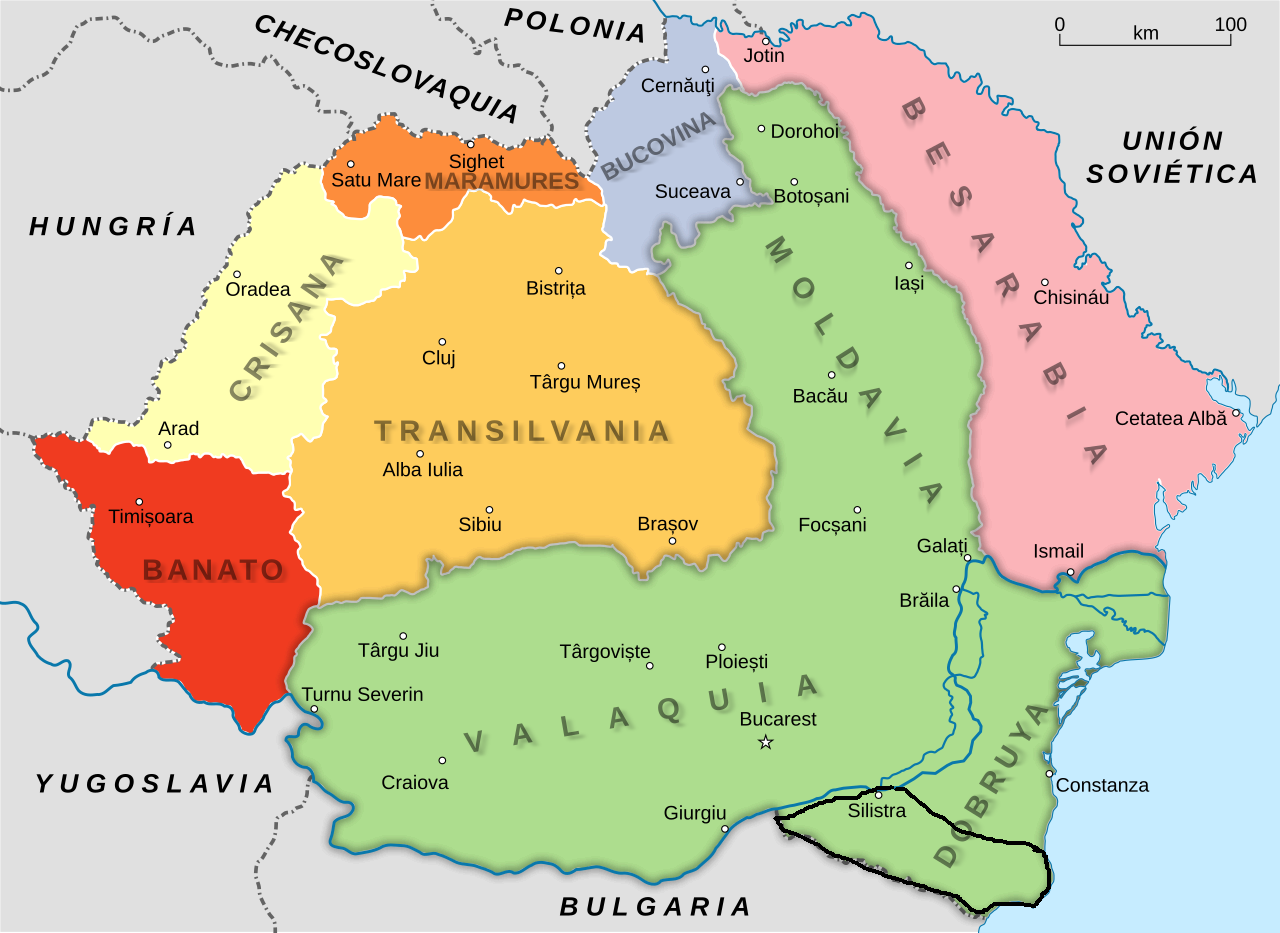
Romania before the war (in green) and the territories it sought to capture—Russian Bessarabia on the right and the provinces of Austria-Hungary on the left. The territory seized from Bulgaria in 1913 is highlighted below.
The reasoning of the Romanian leadership was simple: if they entered the war long before it ended, they would have to fight for a long time (with all the costs involved and bearing the full brunt of the war), and it was still unclear how the war would turn out in the end. If, on the other hand, they entered at the end, when the victors were already clearly established, they would have to fight only briefly, at little cost, and achieve a quick result.
The majority of Romanians wanted the Entente to emerge victorious. The idea of siding with the Entente drew large demonstrations, attracted a great many activists, and enjoyed administrative support. There were also supporters of joining the Austro-German side, but they were few in number and had little influence. One example was the Romanian king (of the House of Hohenzollern), who could not even influence his own wife—an Entente supporter—or their son, the heir to the throne.
In the fall of 1914, news arrived of the Entente’s victories in the Battles of the Marne and Galicia. The defeated Austro-Hungarian army retreated. Russian troops occupied Bukovina. This further stirred up Bucharest, which had been counting on Bukovina itself, the southern part of which was inhabited predominantly by Romanians. Romanian newspapers cried out: “Let’s cross the Carpathians! The hour has come! Let’s liberate our brothers!” In the spring of 1915, the idea of entering the war on the side of the Entente began to take hold among the Romanian leadership.
The situation was quite favorable for the Romanian campaign: Bulgaria had not yet entered the war against the Entente, the Russian front ran through the Carpathians, the Serbian front was holding, and Italy was set to enter the war on the side of the Entente in the spring of 1915. Moreover, Transylvania was very poorly defended by Romania.
Had Romania intervened at that moment, it could have thwarted the Austro-German offensive on the Russian front planned for the spring of 1915. Instead of launching the offensive, the Austro-Germans would have been forced to divert the troops they were concentrating for it to Transylvania to repel the Romanian offensive.
The Romanians began negotiations with representatives of the Entente regarding their entry into the war. They sought to sell their support for the Entente at the highest possible price and haggled with Gypsy-like fervor. The Romanians wanted all of Bukovina, as well as Transylvania, Hungary up to the Tisza River, the Serbian part of the Banat—and that wasn’t all. And they wanted all this not for entering the war on the Entente’s side, but for neutrality—simply for not taking action against the Entente. However, the Entente powers responded irritably: Romania could hope for territorial gains only by entering the war against the Central Powers.
The negotiations dragged on. Even as they secured concession after concession, the Romanians refused to agree to any concrete terms. At the same time, they continued to maintain contact with the Austro-Germans. The Romanian representatives listened eagerly to the promises—what they would receive in return for siding with the Austro-German side (starting with Bessarabia). Romania allowed military supplies destined for Turkey to transit through its territory.
However, there were also objective reasons that prevented Bucharest from immediately siding with the Entente and instead led it down the path of duplicity, bargaining, and opportunism. One of those reasons was Bulgaria. In 1913, the Romanians stabbed the Bulgarians in the back, taking advantage of the fact that the Bulgarian army was tied down by its enemies in the Second Balkan War. As a result of the attack, part of Bulgarian territory—Southern Dobruja—was seized. After that, the Romanians feared that the Bulgarians would do the same to them—strike from behind when the Romanians were focused on fighting Austria-Hungary.
During the negotiations, the Romanians insistently demanded that their border with the Bulgarians be secured. Specifically, this meant that if the Bulgarians took action against the Romanians, Russia would have to take action on behalf of the Romanians against Bulgaria. Of course, no one in Russia was eager to go to war over Romanian territorial gains.
Another problem facing Romania was the poor equipment of its army. The country’s domestic defense industry was in its infancy. On top of that, there was corruption—not all of the budget allocated to the army actually reached it.
Another “sticking point” for the Romanians was the issue of the Black Sea straits. Romanian trade was conducted primarily by sea—through the straits. If Russia established a foothold in the straits, Romanian imports and exports would fall under Russian control. Therefore, the prospect of Russia establishing a foothold in the straits alarmed Bucharest no less than it did London. But in the spring of 1915, Anglo-French operations began in the straits, and Bucharest was somewhat reassured.
Month after month passed, and negotiations continued. Meanwhile, the balance of the war shifted. The Serbs repelled the Austro-Hungarians with a counterattack. Reports came from Italy that this “Latin sister of the Romanians” was also leaning toward taking action against Austria-Hungary. Romanian supporters of entering the war on the side of the Entente launched a vigorous campaign. But the ruling faction, led by Prime Minister I. Brătianu, decided to wait a little longer. Then, on May 2, 1915, the Austro-German offensive on the Eastern Front began. The Russian army was forced to retreat. The Anglo-French operation in the Dardanelles ended in failure. Bulgaria entered the war on the Austro-German side; Serbia was defeated. Romanian pro-Entente enthusiasts fell silent, and attitudes toward Austro-German representatives became markedly friendly.
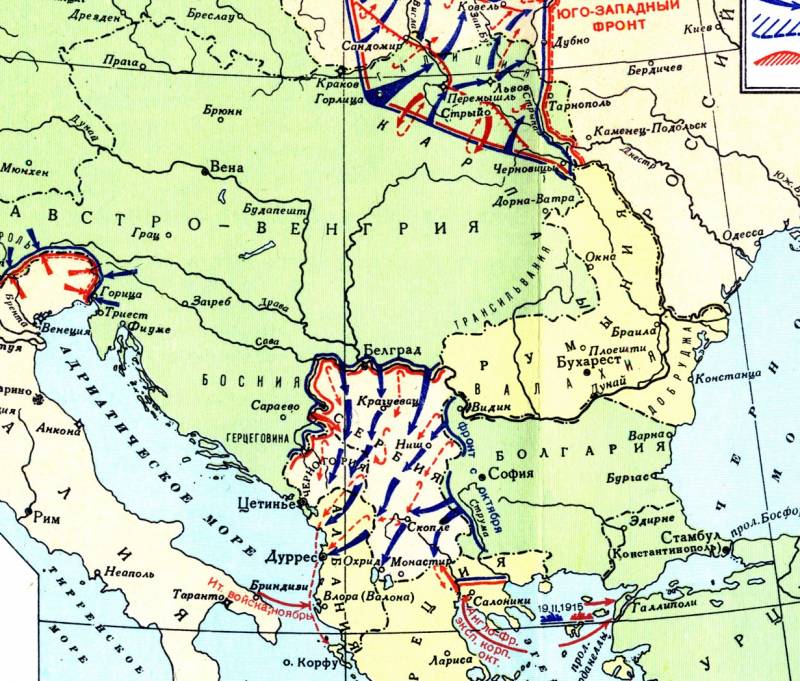
The Battles Around Romania in 1915
The Romanian leadership decided to maintain neutrality for the time being. Instead of marching through the Carpathians, Bucharest turned to trade. The war drove up prices for grain and livestock, which, along with oil, were Romania’s main exports. The Austro-Germans were buying up everything. Romania became a country like Denmark—a neutral nation profiting from trade with warring nations in desperate need of supplies. However, it wasn’t exactly Denmark that profited from Danish shipments to Germany. Specifically, a handful of so-called “goulash barons” grew rich, while the people suffered only hardships from someone else’s war. After all, food prices skyrocketed not only for German importers but also domestically. In Romania, these contrasts were even more pronounced; only an oligarchic clique profited from Austro-German imports.
Entry into the War and Defeat
The year 1916 arrived; in May and June, Russian troops carried out the Brusilov Offensive. Austria-Hungary’s defeat was spectacular. And then, in Bucharest, people began to fear they might be too late to join the war. After all, Austria-Hungary (or even just Hungary) could conclude a separate peace with the Entente—and then who would need the Romanians?
Negotiations with the Entente regarding Romania’s entry into the war intensified. The Russian General Staff opposed this—they believed it would be more advantageous for Romania to remain neutral. But the Western allies, especially the French, insisted on involving the Romanians at any cost. All the more so since they would not be the ones footing the bill. France’s manpower was nearly exhausted, and a new front in the Balkans was expected to divert at least some enemy forces. The Romanians secured agreement on all their conditions for entering the war. But then Brătianu began demanding further concessions, and it took another two months to reach an agreement on them. Meanwhile, the Brusilov Offensive had run out of steam, and the Austro-Germans had stabilized the front. On August 4, 1916, Romania finally joined the Entente. On August 14, Bucharest declared war on Austria-Hungary, hoping that would be the extent of it. But on August 19, Germany—and then Bulgaria—declared war on Romania.
The Romanian command divided its forces: 370,000 men and 185 batteries to the north against Austria-Hungary; 140,000 troops and 80 batteries to the south, against Bulgaria; 50,000 formed a reserve in the center. A total of 1,200,000 men were mobilized during the war.
“Generals prepare for the last war” (W. Churchill). For the Romanian general staff, the “last war” was the invasion of Bulgaria in 1913. At that time, the Bulgarian army was firmly tied down on other fronts; there was no one to field against the Romanians, and they encountered virtually no resistance. In 1916, the Romanians were counting on something similar—not battles, but a triumphant march, while the Austro-Hungarians were tied down on other fronts, especially the Russian one. At first, that’s exactly what happened. But then complications quickly began to mount, eventually turning into a catastrophe.
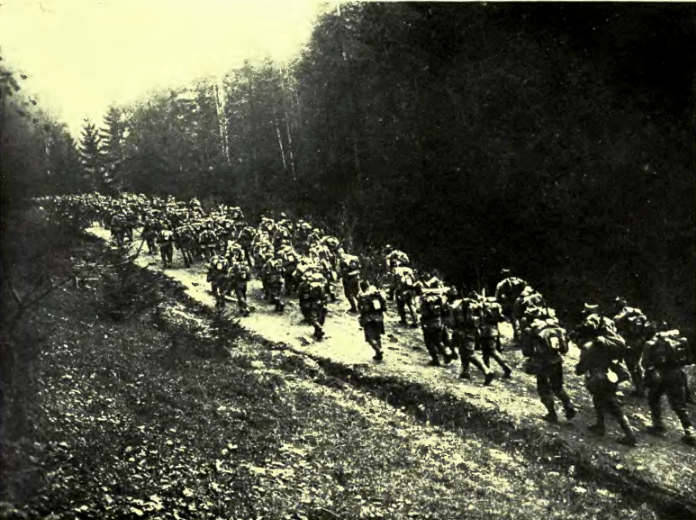
Romanians Enter Transylvania
Bulgaria remembered 1913 all too well. The Bulgarian forces were not numerically superior to the opposing Romanian troops. However, the Bulgarians concentrated their forces on a few key points—and their attacks on those targets proved successful. The Romanian high command panicked, and the offensive in Transylvania was halted. This gave the Central Powers time to redeploy reserves to the Romanian front. Their counteroffensive began in October.
The Romanians were caught in a pincer movement from the north, from Transylvania, and from the south, from Bulgaria. In November, Central Powers forces launched an offensive on Bucharest. The Russian command recommended that the Romanians preserve their army, which meant retreating and surrendering Bucharest without a fight. The Romanian generals hesitated, but ultimately decided to fight and were once again routed. On December 6, 1916, the Germans entered Bucharest. The Romanian army fell apart; by December 17, only 70,000 men remained on the front.
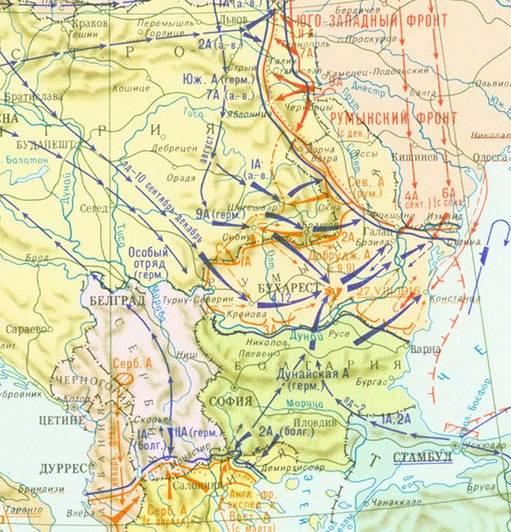
The Defeat of Romania by Attacks from Bulgaria and Austria-Hungary
The remnants of the Romanian army retreated northeast, toward Moldova. Masses of civilian refugees also flocked there. The exodus began during the muddy autumn season, and then the winter frosts set in. Most of the food supplies fell into the hands of the advancing enemy, leading to famine. Famine and cold were followed by epidemics.
All in all, the Romanians kept trying to figure it out, but they still misjudged the timing of their entry into the war. Had they entered the war in June 1916, they would have helped consolidate Brusilov’s success. But they waited too long; by entering the war in August—when Brusilov’s breakthrough had already stalled—the Romanians faced swift retaliation from the Central Powers.
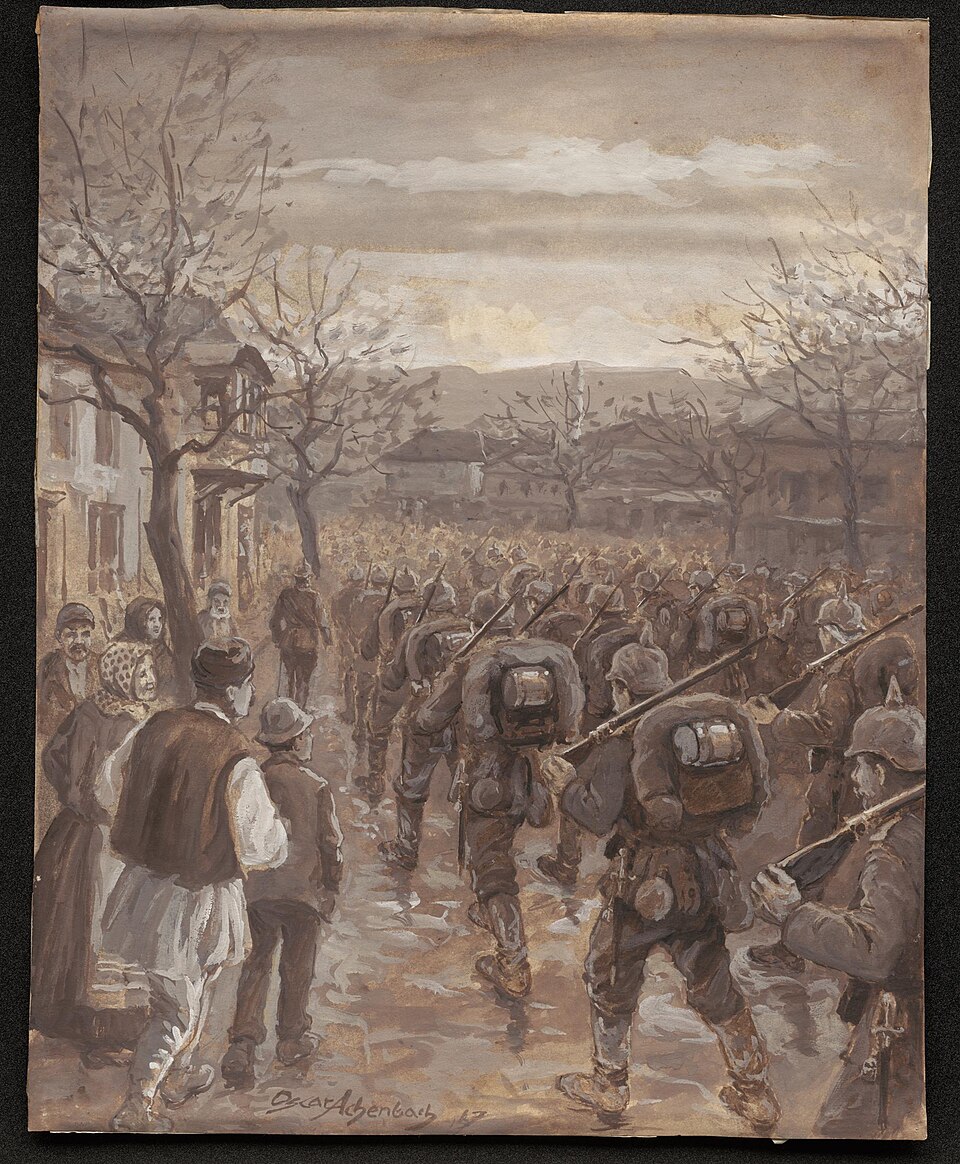
German Troops in Romania
Although Romania entered the war two years later than the other countries, it suffered just as much as they did. Its population numbered more than 7 million at the start of the war; the exact number of casualties is unknown, but by the lowest estimate, 220,000 military personnel died (120,000 killed in action or from wounds, 30,000 from disease, 70,000 died in captivity), as well as 270,000 civilians (120,000 due to military operations, 150,000 from famine and epidemics). According to other estimates, more than 300,000 military personnel and more than 400,000 civilians died—roughly one in ten Romanians.
To be continued