"Sarmat" Returns Once Again: Russia Promises to Put Today's Heaviest Nuclear Missile on Combat Duty

Russian authorities have once again announced the imminent deployment of the RS-28 “Sarmat” intercontinental ballistic missile—a system the West has long dubbed “Satan-2.” According to Vladimir Putin, the first regiment equipped with the new missiles is scheduled to begin combat duty by the end of 2026. The announcement came after another test launch from the Plesetsk Cosmodrome, which Moscow described as a complete success.
For Russia, the “Sarmat” project has long since become more than just another rearmament program; it has turned into a matter of political and military prestige. This missile was featured in presentations as far back as 2018, and it was this missile that Putin showcased alongside other “wonder weapons” of the new generation—the “Avangard” hypersonic glide vehicles, the “Poseidon” nuclear-powered drone, and the “Burevestnik” cruise missile. At the time, the impression was that this new generation of Russian strategic systems was on the verge of completely changing the global balance of power. But the reality turned out to be far more complicated.
The Heir to “Voevoda”
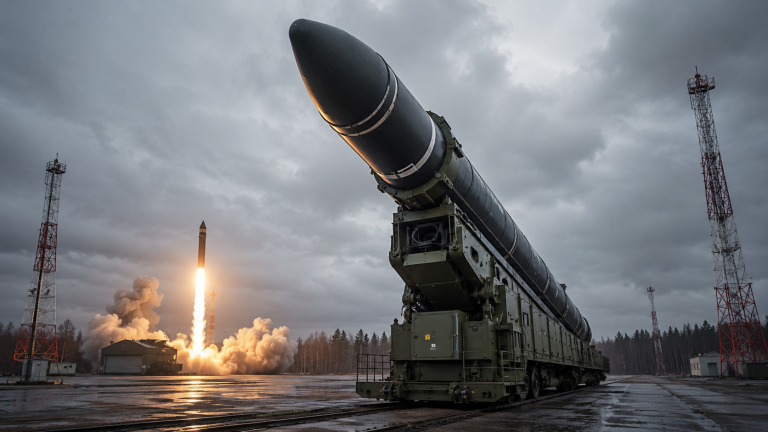
The “Sarmat” was intended to replace the Soviet R-36M2 “Voevoda”—giant, heavy liquid-fueled missiles that NATO designated the SS-18 Satan. For decades, these missiles were the symbol of the Soviet, and later the Russian, nuclear deterrent. Their enormous mass, colossal range, and ability to carry a large number of multiple independently targetable reentry vehicles (MIRVs) made them among the most dangerous strategic systems of the Cold War era.
The new “Sarmat” was conceived as a direct successor to this concept, but incorporating modern technologies. It is a super-heavy liquid-fueled intercontinental ballistic missile weighing over 200 metric tons. According to Russian statements, it is capable of carrying both conventional multiple independently targetable reentry vehicles (MIRVs) and “Avangard” hypersonic glide vehicles. Various estimates suggest it could carry up to 10–15 nuclear warheads or a combination of different means of overcoming missile defense systems.
The Russian side places particular emphasis on the missile’s range and its flight paths. Putin reiterated that the “Sarmat” is capable of striking targets via virtually any route, including a southern route through the South Pole—an area traditionally less well-covered by U.S. early-warning systems. It is also claimed that the missile can follow a partially orbital trajectory, which makes it more difficult to intercept. Western analysts, however, view these claims with caution, considering some of the specifications to be clearly exaggerated.
The rocket that is constantly being moved
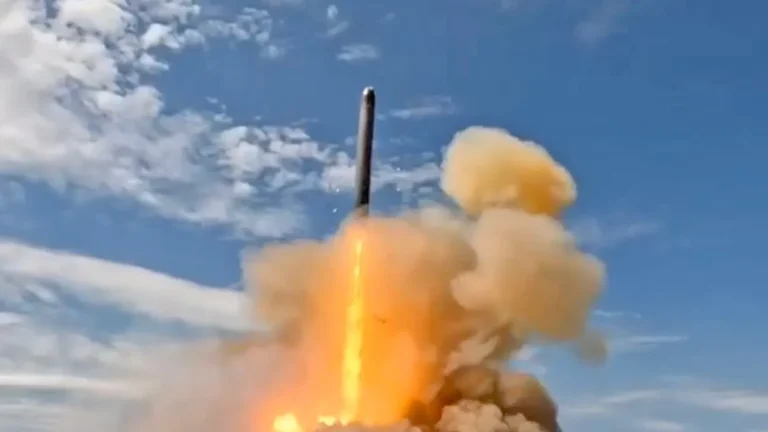
The main problem with the program is that the “Sarmat” has been plagued by constant delays. Initially, the system was supposed to enter service around 2020, but the tests were postponed repeatedly. The first successful launch did not take place until 2022, after which a series of failures followed.
The failure of the 2024 test was particularly high-profile; according to Western observers, the missile effectively destroyed the test shaft at Plesetsk, leaving a massive crater. This incident dealt a serious blow to the reputation of the program, which Russian authorities have been promoting for several years as a key component of the country’s future strategic forces.
The reasons for the project’s delays remain unclear. Most likely, several factors are at play. A super-heavy liquid-fueled ICBM is an extremely complex system, even by the standards of nuclear powers. At the same time, Russian industry is under serious pressure from sanctions, component shortages, and the overall strain on the defense sector due to the war in Ukraine. Furthermore, the very concept of heavy liquid-fueled missiles is considered controversial today. Many countries are opting for more mobile and cheaper solid-fuel systems.
A New Nuclear Arms Race
But for Moscow, the “Sarmat” remains a matter of prestige. It is not just a missile, but a symbol that Russia is still capable of developing systems on par with those of the late Soviet era. That is why every successful launch is accompanied by the most grandiose claims about “the most powerful weapon in the world.”
Another interesting point is that the deployment of the “Sarmat” is taking place after the de facto collapse of the strategic treaty framework between Russia and the United States. Following the expiration of START III, restrictions on the number of deployed heavy launch vehicles and warheads have been lifted. Theoretically, this gives Moscow the opportunity not only to replace the old “Voevoda” missiles with new ones on a one-to-one basis, but also to retain part of its previous arsenal alongside the new systems.
Against this backdrop, the “Sarmat” becomes part of a much larger picture—a new strategic arms race. The U.S. is modernizing the Minuteman as part of the Sentinel program, China is rapidly increasing the number of silo-based launchers, and Russia is attempting to simultaneously preserve its Soviet legacy and introduce a new generation of systems.
The only problem is that, to this day, “Sarmat” remains more of a missile of promises than a system that has actually been deployed on a large scale. For several years now, Russia has been announcing that it will soon be put on combat duty. The current target date is the end of 2026. But given the project’s history, it is by no means certain that this particular date will turn out to be the final one.
источник https://www.twz.com/nuclear/russia-plans-to-deploy-sarmat-icbm-operationally-later-this-year