The Destroyer That Carries Its Own Fleet: Why Naval Group Designed the SCX26 With 100 Missiles and a Swarm of Drones

At first glance, France’s SCX26 looks like a typical exhibition “warship of the future”: a low-observable hull, more than 100 missiles, a laser weapon, and an electromagnetic gun. Yet behind this impressive collection of technologies lies a far more interesting idea. Naval Group wants to transform the destroyer from a single combat platform into a command center, arsenal, and floating base for its own unmanned fleet.
Not a New Destroyer, but a Ship-Sized Laboratory
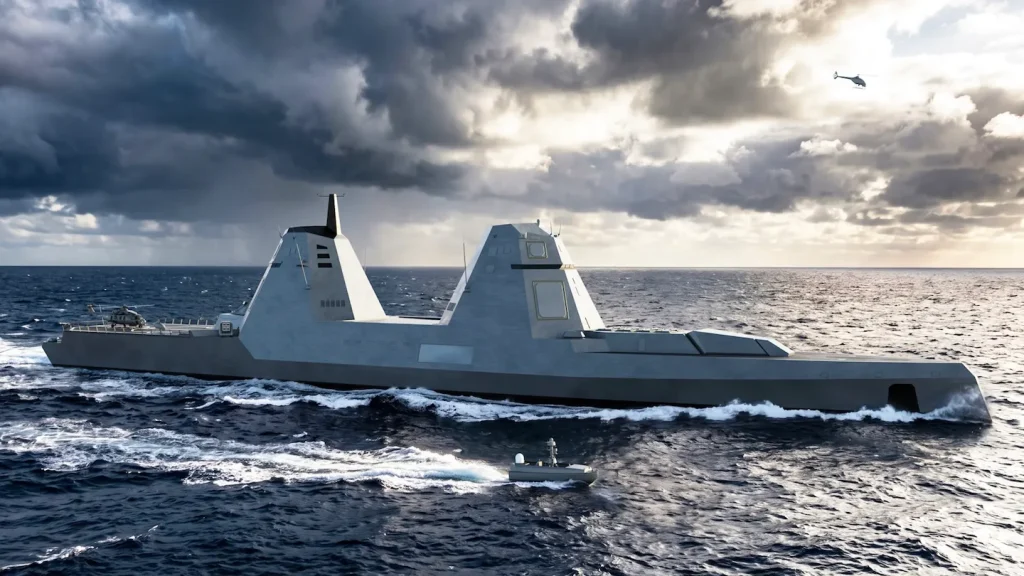
Naval Group unveiled the SCX26 concept at Euronaval 2026. The ship is approximately 170 meters long and 24 meters wide, with a projected displacement of around 8,000 tonnes, potentially approaching 10,000 tonnes depending on its configuration. This places it firmly in the destroyer category and makes it considerably larger than France’s modern FDI frigates.
The proposed CODLAG propulsion system, combining diesel-electric machinery with a gas turbine, is intended to provide a maximum speed of 30 knots. Its range would exceed 8,000 nautical miles, or approximately 14,800 kilometers. The core crew is projected to consist of about 150 sailors, with accommodation for another 100 personnel, including command staff, drone operators, and mission specialists.
However, the SCX26 is not yet a design for a new French Navy warship. There is no approved procurement program, customer, construction schedule, or announced cost. Naval Group describes it as a concept study—a way to combine emerging requirements, naval architecture, and future technologies before discussing the results with naval personnel and equipment suppliers.
The railgun, laser, and some of the ship’s other systems should therefore be regarded as potential capabilities rather than ready-to-install weapons. Naval Group is effectively asking what kind of ship should be designed today so that, 15 or 20 years from now, it can accommodate systems that do not yet exist in operational form.
Why Does the Ship Have Two Superstructures?
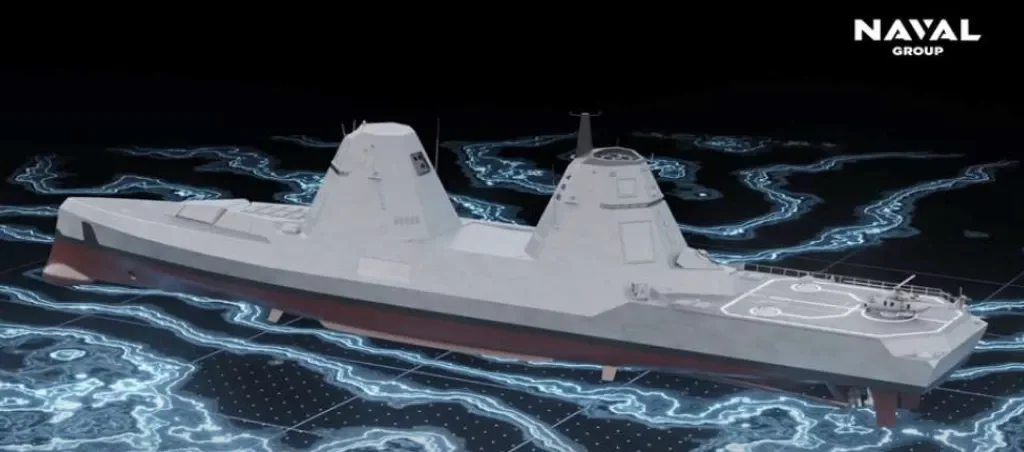
The most distinctive feature of the SCX26 is its pair of widely separated superstructures. Between them is an open central area intended for interchangeable equipment, additional launchers, unmanned systems, and other modular payloads.
The forward superstructure is broad and massive, with large radar arrays integrated into its angled surfaces. The sensor suite is expected to include a new UHF-band radar for detecting difficult long-range targets, as well as a multifunction active electronically scanned array derived from the Sea Fire radar family.
The aft superstructure is taller and narrower. Separating the sensor installations should reduce blind spots and improve survivability: damage to one section of the ship would not necessarily eliminate all of its surveillance and communications systems. Missile launchers and other critical equipment are similarly distributed between the bow and stern.
Naval Group treats the central space between the two structures as a “growth zone.” During the ship’s service life, it could receive new containerized systems, missile launchers, electronic warfare equipment, or drone-control hardware. This distinguishes it from warships whose internal layout leaves little space for technology added after construction.
The SCX26 has smooth hull sides, few exposed fittings, and a distinctive wave-piercing bow. Its angled surfaces are intended to reduce its radar signature, but the designers are not concerned solely with radars aboard ships and aircraft. The upper surfaces of the superstructures have also been shaped with overhead detection in mind, including surveillance by radar-equipped satellites.
This does not make the SCX26 an “invisible destroyer.” A 170-meter warship cannot be completely concealed. Instead, signature reduction is intended to shorten the distance at which the ship can be confidently detected, complicate its identification, and make it a more difficult target for anti-ship missile seekers.
Almost 100 Full-Size Missiles—and Several More Defensive Layers
The exhibition model appears to carry 12 Sylver vertical-launch modules: eight forward and four aft. In the standard eight-cell configuration, this would provide 96 full-size launch positions.
These cells could theoretically accommodate Aster 30 surface-to-air missiles, MdCN land-attack cruise missiles, and other compatible weapons. Quad-packing smaller CAMM missiles or using future Sylver NG launchers could raise the total missile load beyond 100.
Such a large magazine is not intended solely for offensive strikes. Modern warships may have to repel saturation attacks involving anti-ship missiles, drones, and decoys arriving simultaneously. Vertical-launch magazines cannot be replenished quickly at sea, meaning that even a powerful destroyer could exhaust its interceptors after several attack waves.
The inner defensive layer would include two modular Rampart launchers. Depending on their configuration, they could fire small missiles, guided rockets, decoys, and other effectors. Unlike traditional systems designed around a single munition, Rampart is intended as a universal launcher using interchangeable weapon modules.
A 100-kilowatt laser is proposed for installation high on the forward superstructure. Its likely targets would include small drones, boats, and vulnerable components of more sophisticated systems. The laser’s primary advantage is the absence of a conventional ammunition magazine: as long as the ship can generate electricity and remove waste heat, it can theoretically continue firing.
The laser would not replace surface-to-air missiles, however. Fog, rain, sea spray, atmospheric turbulence, range, and the need to keep the beam focused on one point of the target all restrict its effectiveness. On the SCX26, it is therefore presented as a supplementary defensive system rather than the ship’s primary weapon.
The Railgun Is a Bet on the Distant Future

The SCX26’s forward weapon is described as a large-caliber electromagnetic gun capable of firing rapid salvos. A more conventional 57mm gun would be mounted behind it. Both are enclosed within angular housings that preserve the ship’s low-observable profile.
An electromagnetic railgun accelerates its projectile using magnetic fields rather than propellant gases. In theory, it could provide high velocity and long range while using relatively inexpensive ammunition. Such a weapon might engage ships, land targets, and some aerial threats without consuming valuable missiles.
In practice, the railgun remains one of the most speculative elements of the concept. Sustained firing requires powerful pulsed-energy systems, extensive cooling, and a barrel capable of surviving extreme wear. No navy has yet deployed an electromagnetic gun as standard armament aboard an operational warship.
The railgun aboard the SCX26 therefore indicates the ship’s projected energy requirements more than its actual weapon fit. If a future destroyer is expected to operate a railgun, a more powerful laser, advanced radars, and a large drone fleet, its electrical system must be designed with considerable reserve capacity from the outset.
The Real Heart of the SCX26 Is in the Stern
The ship’s most important compartment is hidden beneath the flight deck. This large mission bay would accommodate helicopters, unmanned aircraft, uncrewed surface vessels, and underwater vehicles. A heavy elevator would move aircraft and drones between the internal hangar and the flight deck.
The flight deck is designed to support one NH90-sized helicopter and two vertical-takeoff drones. The embarked force could be changed before deployment and might include reconnaissance UAVs, electronic warfare platforms, anti-submarine systems, communications relays, strike drones, or mine-countermeasure vehicles.
The ship would also carry workshops, spare parts, and equipment for maintaining its unmanned systems. Naval Group has mentioned the possibility of additive manufacturing, although the description of the SCX26 as a “floating drone factory” should be treated cautiously. It would more likely be able to print certain components, repair damaged vehicles, and change their payloads—not manufacture sophisticated drones from scratch while at sea.
This is what separates the SCX26 from a conventional destroyer carrying a few drones. Unmanned systems have not been added to an otherwise complete warship. A significant portion of the vessel’s architecture has been designed around their storage, movement, repair, launch, and recovery.
An aerial drone could lift a radar beyond the ship’s horizon. An uncrewed surface vessel could investigate a suspicious area or carry sensors dozens of kilometers ahead. An underwater vehicle could search for mines or submarines. Other platforms could jam enemy sensors, serve as decoys, relay communications, or deliver weapons.
A single SCX26 could therefore create a distributed network of sensors and effectors around itself. The ship would remain a protected command center and carrier of heavy missiles, while unmanned vehicles performed the most dangerous tasks farther away.
The Crew Would Have to Manage an Entire Network

The SCX26 is intended to serve as the central node of a hybrid naval force incorporating crewed ships, aircraft, and unmanned platforms operating in the air, on the surface, and underwater. Its combat-management system would combine information from onboard radars and sonars with data supplied by remote vehicles.
Artificial intelligence would not necessarily be used to initiate attacks independently. Its more immediate purpose would be to process enormous amounts of information, correlate sensor tracks, assign tasks to unmanned vehicles, identify anomalies, and present recommendations to the crew.
Automation helps explain the relatively small permanent crew, but the additional accommodation for 100 personnel reveals the other side of the concept. The more unmanned systems the ship carries, the more operators, technicians, communications specialists, and mission planners it may require. Drones reduce the risks to personnel conducting reconnaissance or approaching a threat, but they do not eliminate the need for people aboard the mothership.
The Most Difficult Questions Remain Unanswered
The railgun and laser attract attention, but the success of the SCX26 would depend on far less spectacular technologies. Its crew would need to recover drones safely onto a moving ship in poor weather, transfer them rapidly between the deck and hangar, recharge batteries, refuel engines, and repair aircraft after repeated missions.
Operations involving uncrewed surface and underwater vehicles would be particularly challenging. Launching them is comparatively straightforward, but recovering them in rough seas requires precise positioning, specialized handling systems, and protected openings in the hull.
Communications would represent another vulnerability. If an adversary jammed control links or disrupted satellite navigation, the ship would still need to maintain control over its distributed unmanned force. This would require autonomous operating modes, several independent data links, and predetermined instructions for vehicles that lose contact with the mothership.
Finally, all these capabilities compete for the same internal volume. Additional missiles, drone fuel, spare vehicles, electrical equipment, workshops, and maintenance personnel increase displacement and consume valuable space. Any real design would inevitably become a compromise between an air-defense destroyer, an arsenal ship, a command vessel, and a drone carrier.
Not a Ship With Drones, but Drones Built Around a Ship
The SCX26 is unlikely to be constructed exactly as displayed at Euronaval. By the time a real vessel appears, the superstructures, weapons, number of missile cells, and even the propulsion system could all be different.
Nevertheless, the concept’s central idea is far more realistic than some of its futuristic weapons. A destroyer of the future will no longer be defined solely by the number of missiles it carries or the range of its own radar. Its value will also depend on how many remote platforms it can deploy, how far it can extend its sensors, and how quickly it can restore its unmanned force after suffering losses.
The French concept proposes an unusual formula: approximately 100 heavy missiles remain available for a major engagement, Rampart launchers and a laser protect the inner defensive zone, while a constantly changing fleet of unmanned vehicles performs most of the everyday work.
The SCX26 is not simply a warship carrying several drones. It is an attempt to create a warship that carries its own fleet.