In the spring of 1743, the Spanish galleon Nuestra Señora de Covadonga departed Acapulco and headed for the Philippines. Aboard were 530 people and a cargo of silver that today would be worth tens of millions of pounds. On paper, she was a floating fortress: a thousand-ton ship designed to carry fifty guns. Yet when George Anson’s British warship Centurion appeared off the island of Samar, only thirteen of those guns were ready to fire.
The others had been removed to make room for passengers and cargo.
That detail contains almost the entire story of the Spanish and English galleons. One was built to carry as much wealth as possible across an ocean. The other was built to catch it and take that wealth away. One was a floating warehouse, passenger vessel, military transport, and postal service combined. The other was a specialised maritime predator.
But does this mean that the enormous Spanish galleons were slow and obsolete, while lighter English ships consistently outclassed them in battle?

The Ship That Connected Three Continents
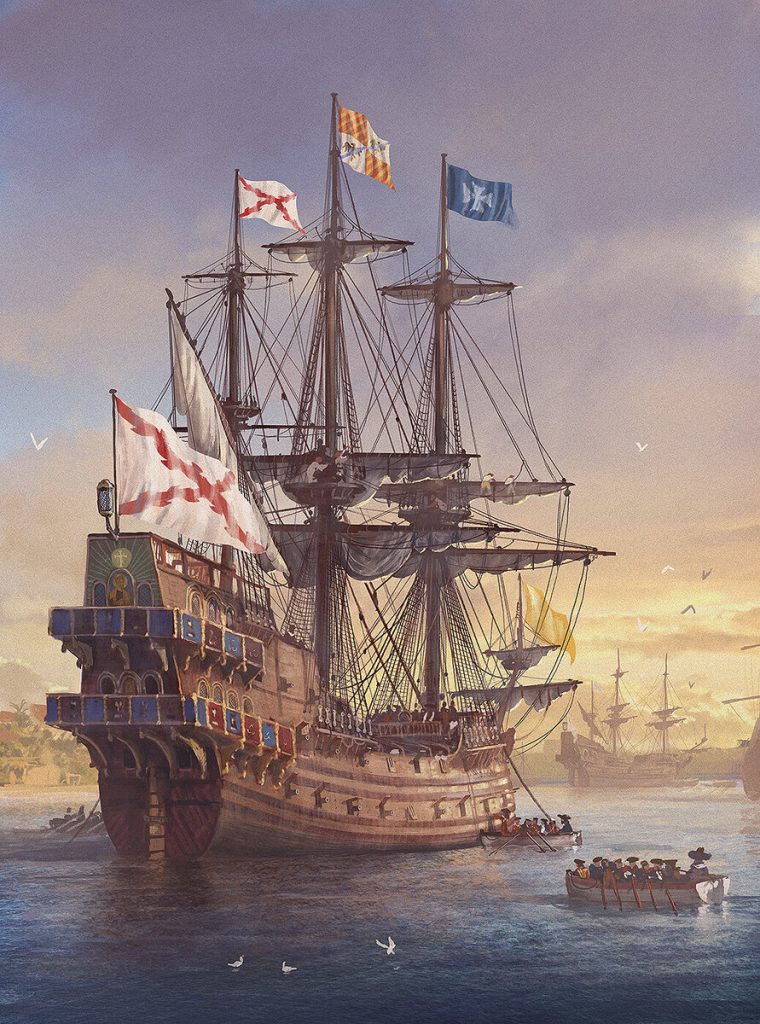
The term Manila galleon refers to the Spanish ships that sailed between Manila in the Philippines and Acapulco in New Spain—modern Mexico. The route began operating in 1565, when the expedition of Miguel López de Legazpi reached the Philippines and navigator Andrés de Urdaneta discovered a reliable return passage across the northern Pacific.
From Acapulco, the ships carried primarily American silver. In Manila, it was exchanged for Chinese silk and porcelain, cotton textiles, spices, ivory, lacquered furniture, and many other Asian goods. The cargo was then shipped back to Mexico, transported overland to Veracruz, and partly carried across the Atlantic to Europe.
This created one of the first genuinely global trading systems, connecting China, the Philippines, the Americas, and Spain. Manila became the gateway through which American silver entered Asian markets and Chinese goods reached the New World. The trade was so profitable that the authorities repeatedly—and unsuccessfully—attempted to restrict both the value of cargoes and the size of the ships.
There was never a single standard design known as the Manila galleon. The route operated for two and a half centuries, and its ships constantly evolved. The earliest vessels of the late 16th century displaced approximately 400–500 tons. By the beginning of the 17th century, ships of around 1,000 tons had appeared, while the largest examples of the 18th century exceeded 2,000 tons.
In practice, almost any large Spanish ship serving the route could be called a Manila galleon. By the 18th century, some were no longer closely related to the classic galleons of the Spanish Armada, resembling later ocean-going merchantmen and warships instead.
Why Spain Needed Giants
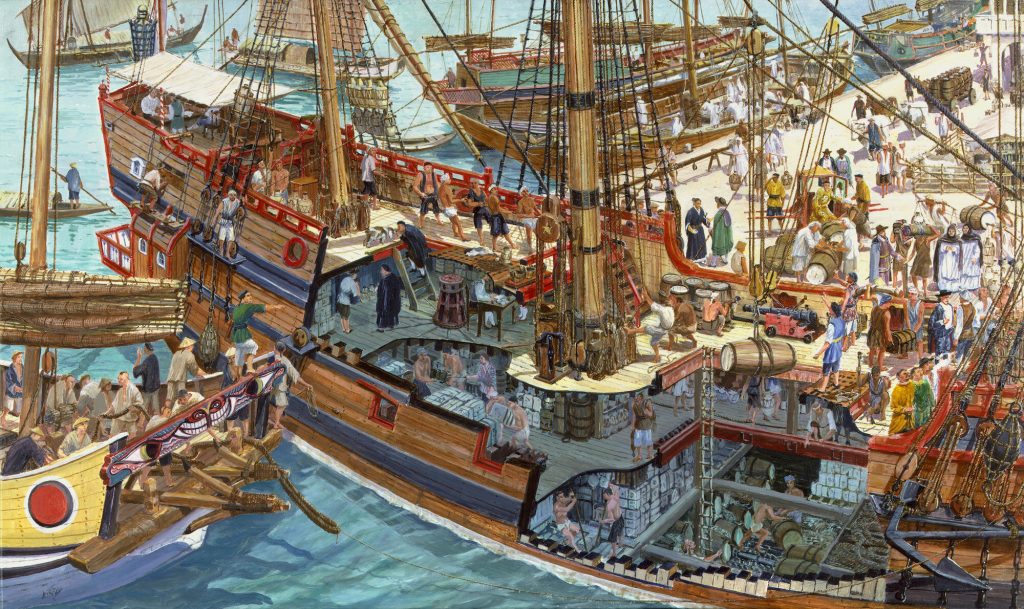
The voyage from Manila to Acapulco could last from four to eight months. After leaving the Philippines, a galleon sailed far north in search of the westerly winds, crossed the Pacific, reached the Californian coast, and then headed south towards Mexico. For most of the journey, there was nowhere to replenish supplies or carry out major repairs.
The ship therefore had to carry vast quantities of water and food, a large crew, soldiers, passengers, official correspondence, and an immensely valuable cargo. The loss of a single vessel could mean the loss of almost an entire trading season. For Manila, which depended upon money and supplies from New Spain, such a disaster could have consequences lasting for years.
The Spanish solution was perfectly rational: build the largest, strongest ship capable of surviving the ocean crossing.
Most Manila galleons were constructed in the Philippines. The islands possessed extensive supplies of durable hardwoods such as molave, narra, yakal, and apitong. Local labourers, Chinese craftsmen, and Spanish shipwrights all participated in their construction. Building a vessel of more than 2,000 tons required timber to be cut and transported from a vast surrounding area.
Manila galleons were also free from some of the restrictions affecting Spain’s Atlantic vessels. Ships departing from Seville had to cross the shallow bar at Sanlúcar, which limited their draught and size. Manila and Acapulco had no equivalent obstacle, allowing Pacific vessels to be built considerably wider and deeper.
The Spanish Crown attempted to restrain this growth. In 1593, regulations allowed only two 300-ton galleons to sail each year. Merchants, however, wanted more cargo space, and official restrictions could be circumvented or ignored. By 1614, ships of roughly 1,000 tons were already serving the route.
Commercial logic repeatedly defeated royal regulation.
England Builds a Maritime Predator

In late 16th-century England, shipbuilders were solving a different problem. The country needed vessels capable of intercepting an enemy, securing the weather gauge, and attacking with artillery without becoming trapped in a dangerous boarding action.
The result was the English race-built galleon—a vessel literally built for speed. Its hull was longer and narrower, while the towering forecastles and stern structures of earlier ships were greatly reduced. The lower profile created less wind resistance, the finer hull lines reduced drag, and an improved sail plan allowed the ship to sail closer to the wind.
Ships associated with this approach included Francis Drake’s Golden Hind, the famous Revenge, and the larger Ark Royal, which served as the English flagship during the Spanish Armada campaign. After 1578, most new English warships were constructed according to these principles.
The English favoured a relatively small number of heavy guns positioned low in the hull. A ship could approach, fire a broadside, withdraw to reload, and then return. The objective was to damage the enemy’s hull, rigging, and steering system, depriving it of the ability to manoeuvre.
Spanish tactics continued to place greater emphasis on soldiers and close combat. High superstructures allowed troops to fire down onto an enemy’s deck before the ships grappled and infantry settled the matter by boarding. Spanish soldiers were considered among the finest in Europe, so the concept was not irrational. The problem was that a faster English ship could simply refuse to close the distance.
Speed, however, came at a price. An English galleon carried fewer provisions, people, and goods. Conditions aboard were cramped, and during a long oceanic expedition a smaller ship exhausted its water and food supplies more quickly.
The Spanish ship was designed to endure the ocean. The English ship was designed to use it as a hunting ground.
Did Pirates Really Fear the Manila Galleons?
During the 250 years in which the route operated, only four Manila galleons were captured at sea: Santa Ana in 1587, Nuestra Señora de la Encarnación y Desengaño in 1709, Nuestra Señora de Covadonga in 1743, and Santísima Trinidad in 1762. Around two dozen more were lost to storms, reefs, fires, and navigational errors.
It would be misleading, however, to explain this record simply by claiming that pirates were afraid of them.
The galleons’ greatest defence was the Pacific Ocean itself. To intercept one, an English raider had to sail around South America, survive either the dangerous Strait of Magellan or Cape Horn, preserve his crew through months at sea, locate places to repair and resupply, and correctly predict when the Spanish ship would appear.
Even after finding a galleon, the attacker could not be certain of victory. Its massive wooden hull might absorb numerous hits, its large crew could repair damage, and the soldiers carried aboard made any boarding attempt extremely dangerous.
In 1709, the English privateer Woodes Rogers captured the Encarnación. Several days later, however, he attempted to stop another Spanish galleon, the Begoña. Four English ships fired more than 500 cannonballs at her, yet the Spanish vessel endured the bombardment and escaped.
Furthermore, the famous captures were not the work of random pirates. Thomas Cavendish and Woodes Rogers were privateers operating with government permission and financial backing from wealthy investors. George Anson commanded a British military expedition. The Santísima Trinidad was taken by Royal Navy warships during the Seven Years’ War.
The Manila galleons were not invulnerable. Hunting them simply required something approaching the resources of a state.
When Cargo Became More Dangerous Than Enemy Guns
The greatest weakness of a Spanish galleon was often not its lack of speed, but the value of the merchandise aboard. Every free corner of the hold promised additional profit, encouraging merchants to load as many bales, crates, and chests as possible.
Guns interfered with trade. They occupied valuable space, required ammunition and trained crews, increased the weight of the upper decks, and reduced useful cargo capacity. Some were therefore removed, lowered into the hold, or buried behind merchandise until they became impossible to use during a sudden attack.
This was what doomed the Covadonga. The ship was designed to carry fifty guns, but in 1743 she put to sea with only thirteen mounted. The rest had been removed to make room for silver and passengers. Near the Philippines, the galleon encountered the British Centurion, which was smaller, more manoeuvrable, and retained its full fighting armament.
The Spanish resisted, but the Covadonga could not match the firepower of a dedicated British warship. After a fierce battle, the galleon surrendered, and Anson secured one of the richest prizes in British naval history. Along with the silver, the British captured letters, official dispatches, and passengers’ personal belongings that are now held by the UK National Archives.
Spain had built an armed fortress and then turned it into an overloaded warehouse.
The Santísima Trinidad: Spain’s Ultimate Giant

The most extreme expression of the Spanish concept was the galleon Santísima Trinidad y Nuestra Señora del Buen Fin, built in the Philippines around 1750.
She measured more than 51 metres in length and approximately 15 metres across the beam, displacing over 2,000 tons. The vessel could carry more than four hundred crew members, hundreds of passengers, and an enormous cargo. Depending on the source, she was designed for between 60 and 70 guns. By the standards of her age, she was a true maritime giant.
Yet her size did not make her invincible.
In 1762, after Spain entered the Seven Years’ War, the Santísima Trinidad departed Manila for Acapulco. The vessel was struck by a storm, lost her masts, and was forced to turn back. Near the Philippines, she was intercepted by the British ships Panther and Argo.
Of approximately sixty guns, the galleon could employ only ten. The others were either stored in the hold or obstructed by cargo. Despite the damage, the Spanish endured several hours of British fire, but they could neither manoeuvre effectively nor deliver a full response.
The giant surrendered.
The British brought her to Portsmouth, where the immense Spanish vessel caused a sensation. Her defeat, however, was not proof that heavy galleons were inherently useless. It resulted from a disastrous combination of storm damage, overloading, partial disarmament, and an encounter with two prepared warships.
Who Built the Better Galleon?
Judged purely by effectiveness in an artillery engagement, the English concept was more advanced. A low, fast, and manoeuvrable galleon could select the range, retain the weather gauge, and bombard a heavier opponent without allowing it to board.
But Spain was not trying to build the perfect duelling ship.
A Manila galleon had to cross the world’s largest ocean, transport hundreds of people, and carry a cargo valuable enough to justify the entire enterprise. Its immense size, capacious hull, and robust construction were suited to that mission. Only four captures in two and a half centuries suggest that the system worked remarkably well.
The greatest enemy of the Manila galleons was neither pirates nor English cannon, but the ocean itself. Storms, typhoons, disease, water shortages, navigational errors, and overloading destroyed far more of them than every enemy squadron combined.
The English vessel was better suited to hunting. The Spanish vessel was better suited to carrying treasure. Both performed their intended roles effectively—until circumstances forced one to fight according to the other’s rules.
That was when it became clear that a floating warehouse should not duel a dedicated warship, just as a light maritime predator was poorly suited to carrying hundreds of passengers and an immense cargo across the Pacific.
Spain built ships capable of holding an empire together. England built ships capable of plundering it. In the end, both maritime powers received exactly the galleons they needed.