From a Marine Armored Personnel Carrier to a Miniature Warship: What Saab Has Turned the Famous CB90 Into

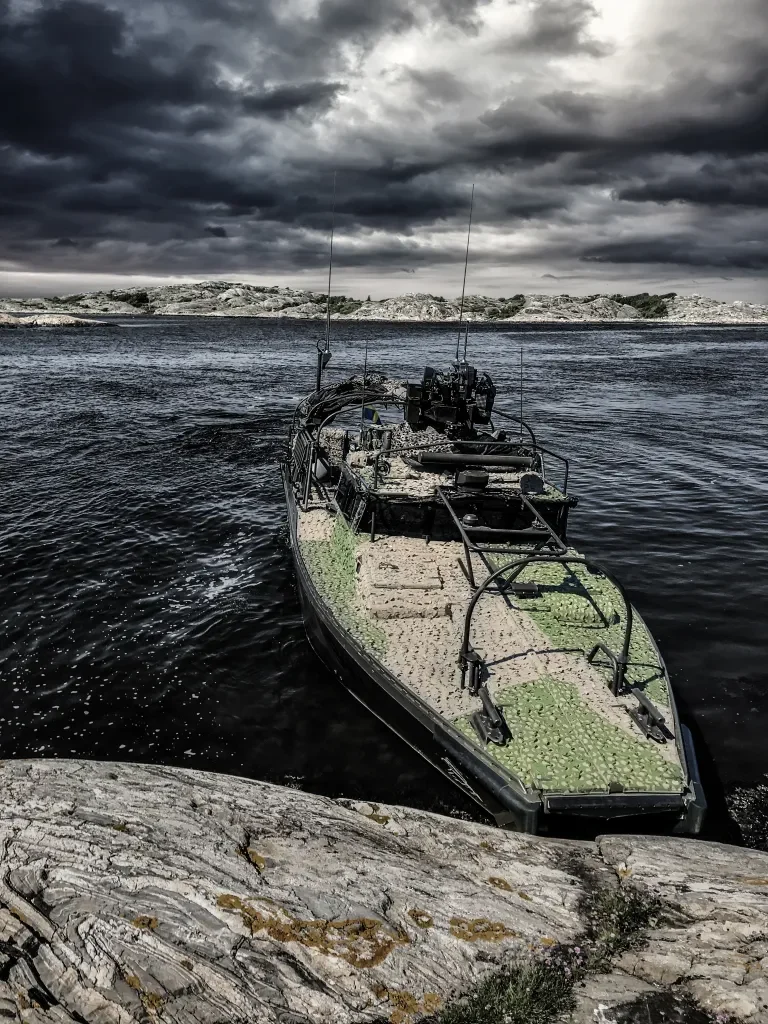
The Swedish CB90 has always been an unusual assault craft. It can exceed 40 knots, operate among islands and in shallow coastal waters, and use its bow ramp to land troops directly on the shore. Now Saab has decided that simply carrying soldiers is no longer enough. The new CB90 CX is intended to detect targets, launch anti-ship missiles, protect a naval group from drones—and, when necessary, perform these missions without anyone aboard.
The result is no longer merely a larger assault boat. It is a compact modular combat platform. One configuration carries a radar, another anti-ship missiles, and a third a rapid-firing air-defense gun. Operating together, several such boats could perform some of the missions that previously required a much larger warship.
However, Saab is currently presenting both a real new hull and several proposed future mission packages. It is therefore important to distinguish what already exists from what remains a concept.
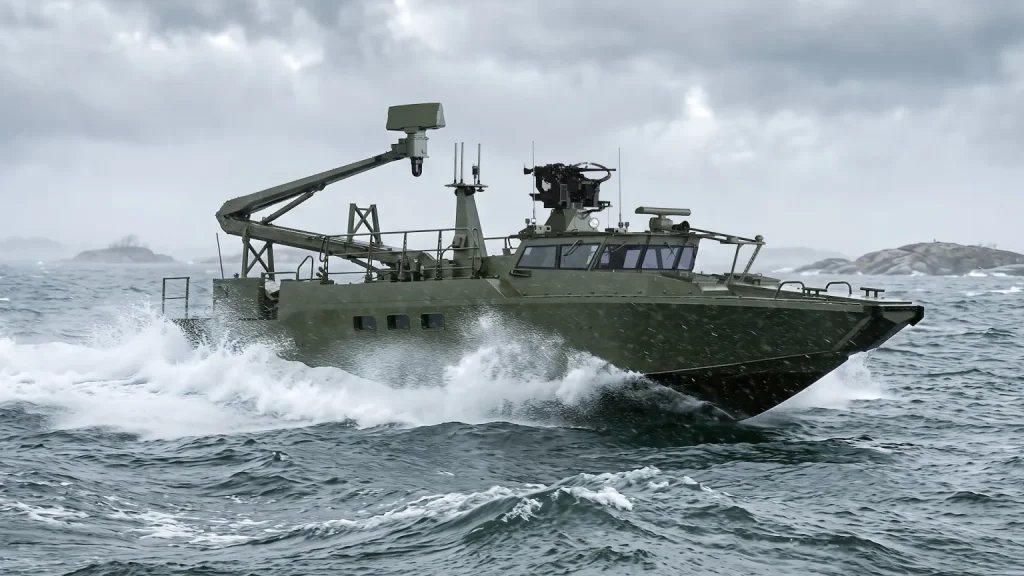
A Boat Originally Designed for the Archipelago
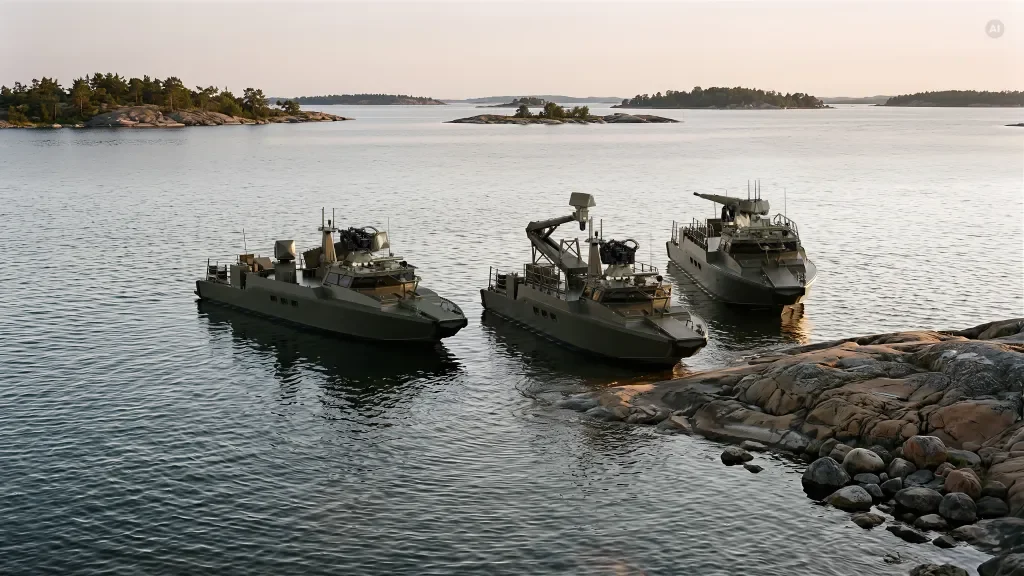
The history of the CB90 began in the late 1980s, when the Swedish Navy needed a fast transport for operations in the Baltic Sea. A conventional landing craft was poorly suited to a region filled with thousands of islands, rocky shores, and narrow channels. Sweden needed a small and exceptionally maneuverable vessel.
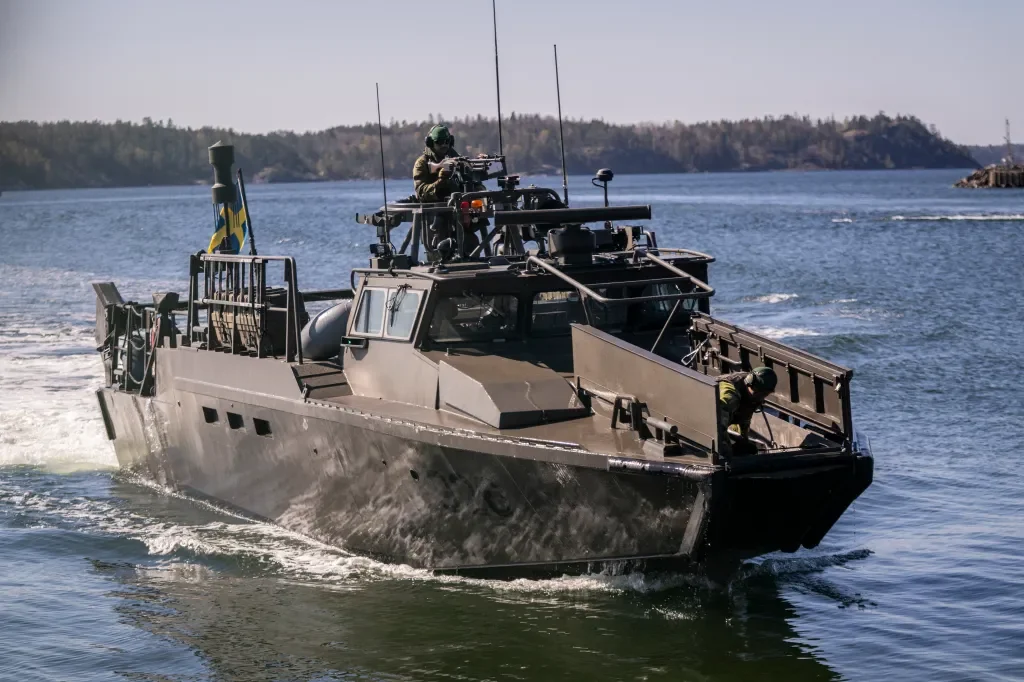
The result was the Combat Boat 90—an aluminum craft powered by two waterjets, with the wheelhouse positioned forward and a passage running through the hull. Troops could leave through the bow ramp without first moving across an exposed deck. The boat could drive directly onto a beach, unload its passengers, and quickly reverse into deeper water.
Its combination of speed, shallow draft, and ability to stop abruptly made the CB90 one of the world’s most recognizable combat boats. More than 250 examples of different variants have been built, and the basic design has entered service with around ten countries. In the U.S. Navy, Swedish-built examples are known as Riverine Command Boats, while Russia developed its Project 03160 Raptor around the same general concept.
The latest major development was the CB90 Next Generation. At 16.3 meters long, it can exceed 40 knots, is powered by two 900-horsepower engines, and carries up to 18–21 troops in addition to its three-person crew. Its maximum displacement is approximately 25 tons, while its range is up to 300 nautical miles.
The CB90 CX retains the basic layout of its predecessor, but internally it is a very different machine.
What Has Changed in the CB90 CX?
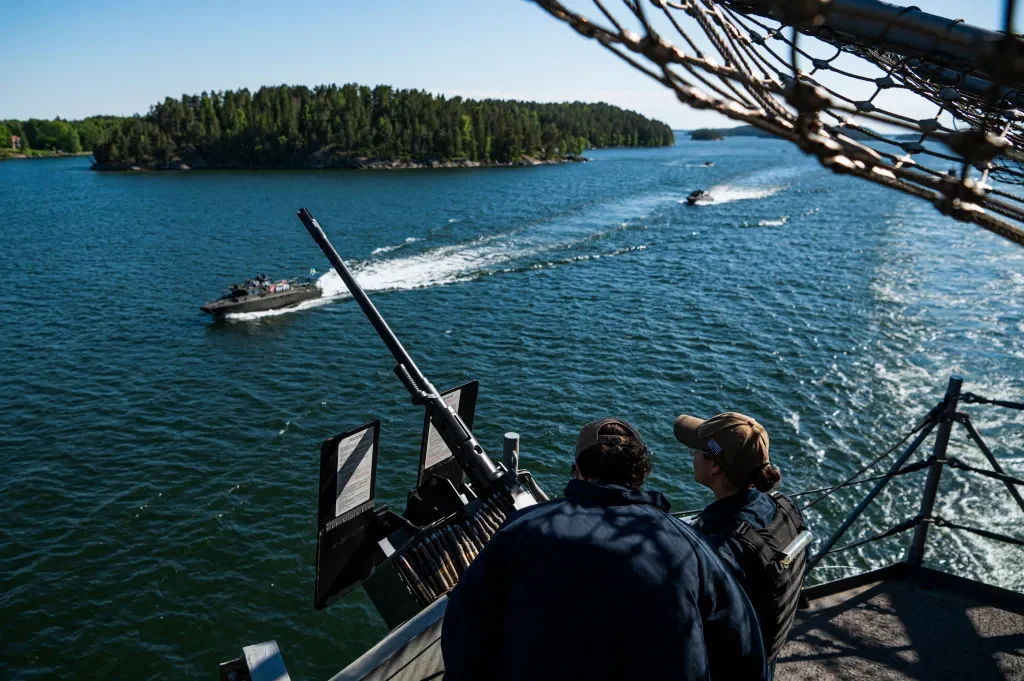
The new boat has grown to 18 meters—almost two meters longer than the CB90 NG. It is four meters wide and has a draft of 1.1 meters. The output of each engine has increased from 900 to 1,100 horsepower, although maximum speed remains above 40 knots.
At first, this may seem odd: the hull is larger and the engines are more powerful, but the boat is no faster. The additional power, however, is not intended to set speed records. It compensates for the greater size and weight of radars, launchers, remote weapon stations, communications equipment, and onboard computers.
| Length | 16.3 m | 18 m |
| Engines | 2 × 900 hp | 2 × 1,100 hp |
| Maximum speed | Over 40 knots | Over 40 knots |
| Crew and troops | 3 crew + up to 18–21 troops | 0–10 personnel |
| Primary mission | Troop transport and amphibious assault | Reconnaissance, strike, and short-range air defense |
| Autonomous operation | Not stated | Included |
The reduced number of personnel aboard is particularly revealing. The extra internal volume has not been used to enlarge the troop compartment, but to accommodate electronics, weapons, and mission equipment. If the original CB90 can be described as a marine armored personnel carrier, the CX is closer to a compact warship.
Saab also says the new boat will operate in a wider range of sea conditions than earlier models. However, the company has not yet disclosed its displacement, payload capacity, fuel load, or precise seakeeping limitations.
The First Variant: A Combat Boat with a Large Radar
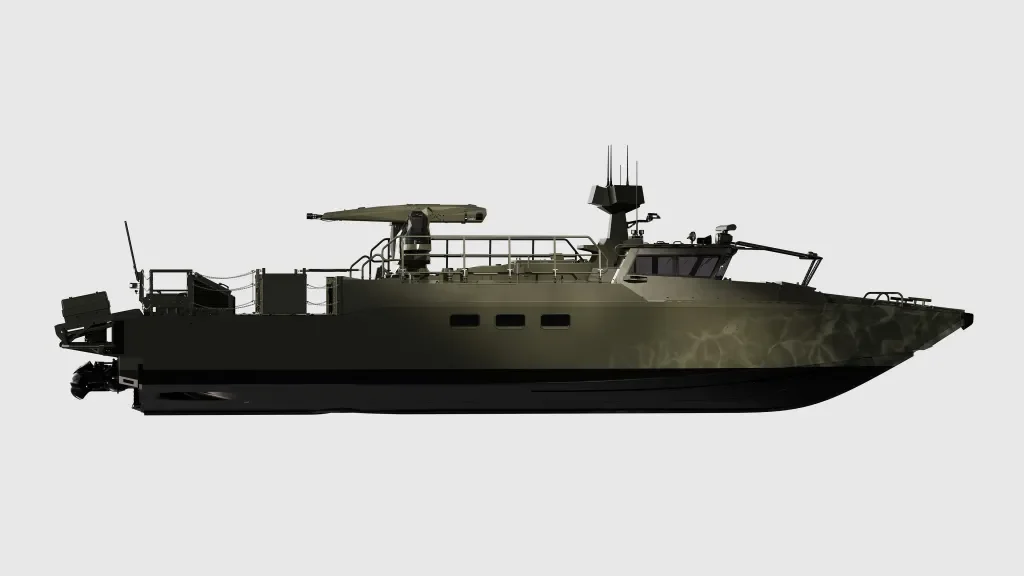
The intelligence, surveillance, and reconnaissance version of the CB90 CX carries the Sea Giraffe 1X three-dimensional radar. This compact X-band active electronically scanned array can monitor air and surface activity simultaneously.
The complete system weighs less than 150 kilograms, with approximately 100 kilograms installed above deck. Its low weight allows it to be mounted on vehicles, buildings, and small vessels without turning them into floating radar towers.
On the CB90 CX, the antenna is mounted on a telescopic mast extending to approximately 11 meters. The radar has a stated instrumented range of more than 100 kilometers. This does not mean the boat will detect another small craft at that distance. The radar horizon still applies: the lower the target is above the water, the sooner it disappears behind the curvature of the Earth.
Against aircraft, helicopters, and drones, however, the elevated antenna offers a serious advantage. The boat could hide among islands with only its mast visible above the coastline or move ahead of a naval group as a radar picket. Its data could then be passed to other boats, coastal units, or larger warships.
The ISR version also carries a Trackfire remote weapon station armed with either a 12.7mm machine gun or a 30mm cannon. Its role is not limited to self-defense. The weapon station’s electro-optical sensors supplement the radar and help identify detected contacts.
The Second Variant: Two Missiles Against a Warship
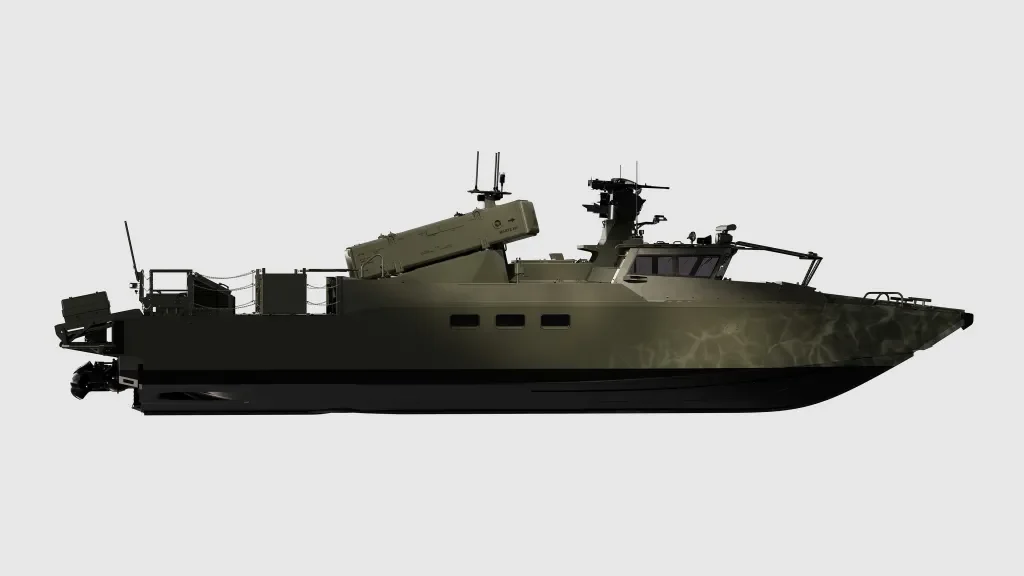
The strike configuration turns the CB90 CX into a small missile boat. Saab’s published renderings show it carrying two angled launch canisters for MBDA Marte ER anti-ship missiles.
The Marte ER has a range of more than 100 kilometers, travels at high subsonic speed, and approaches its target at very low altitude over the sea. During the terminal phase, its active radar seeker takes over, allowing the missile to operate on a fire-and-forget basis.
A small boat’s own radar cannot detect a low-profile surface target at a distance of 100 kilometers. To exploit the full range of the Marte ER, the CB90 CX would need external targeting data from another radar-equipped boat, an unmanned aircraft, a patrol aircraft, or a coastal surveillance station.
This is where the logic behind the entire project becomes clear. Saab is not trying to place a large radar, anti-ship missiles, and a complete air-defense system on a single 18-meter hull. Instead, these capabilities are distributed among several boats. One finds the target; another receives the coordinates and launches its missiles without activating its own emitting sensors.
The Marte ER should currently be regarded as one proposed armament option. Saab has confirmed that Sweden intends to equip its boats with a different, still-undisclosed missile. It also remains unclear whether the strike configuration is included in the initial order or will appear at a later stage.
The Third Variant: A Floating Anti-Aircraft Gun
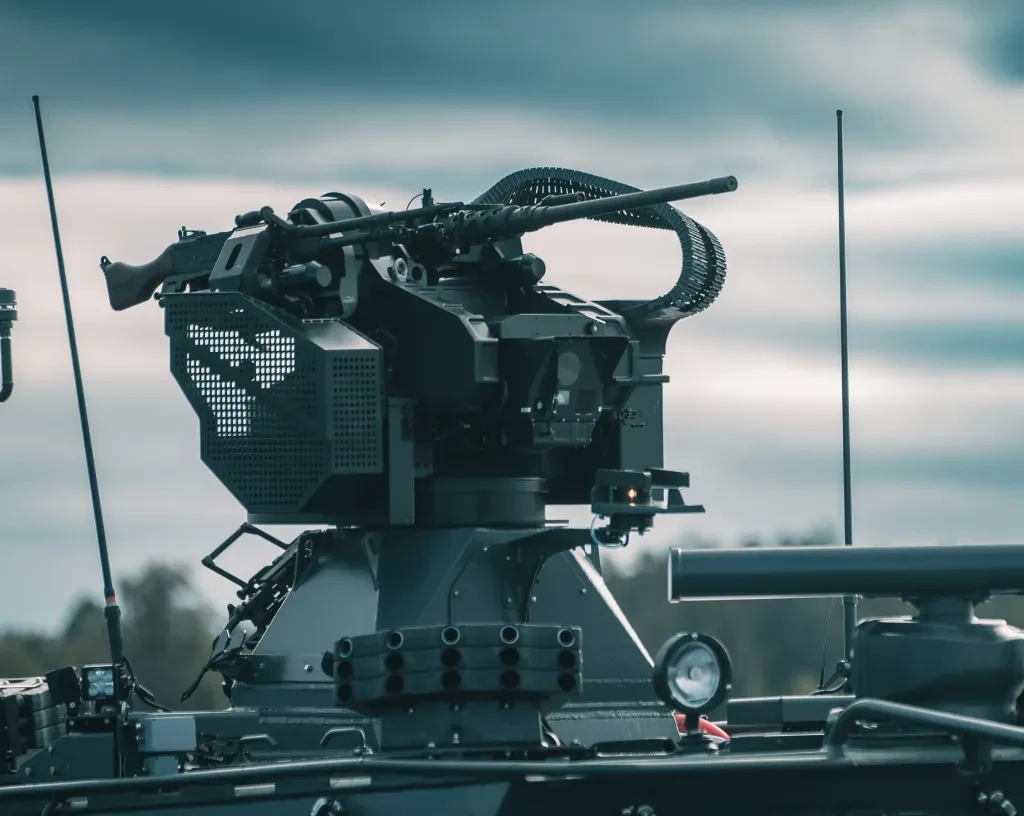
The short-range air-defense version carries Rheinmetall’s remotely operated SeaSnake 30 weapon station. It uses a 30mm revolver cannon with a nominal maximum rate of fire of up to 1,100 rounds per minute.
Its most important feature is programmable airburst ammunition. The shell does not need to strike a small drone directly. Instead, it detonates at a calculated point in its flight and creates a cloud of fragments in front of the target.
The 30mm cannon has an effective range of around three kilometers. This is not enough to replace a surface-to-air missile system, but it provides a useful final layer of defense against drones, helicopters, loitering munitions, and small uncrewed surface vessels. The SeaSnake can also engage light boats and targets on shore.
The advertised rate of 1,100 rounds per minute does not mean the cannon can sustain such fire continuously. It is a maximum mechanical rate used for short bursts. The size of the ammunition supply aboard the CB90 CX has not been disclosed, even though this will determine how many attacks the craft can repel before it must reload.
Nevertheless, the SeaSnake turns the CB90 CX into a mobile defensive position. Several such craft could be distributed among islands, ports, and naval anchorages. An adversary would then have to locate a group of small, fast-moving boats, each capable of changing position after being detected.
A Boat Without a Crew—but Not an Autonomous Hunter
Every CB90 CX is expected to receive Saab’s Autonomous Ocean Core. This is an open software and hardware architecture designed for integration into different types of surface and underwater vessels.
It controls the vessel’s movement, uses navigation sensors, plans routes, and interacts with onboard systems. As a result, the CB90 CX can operate with a conventional crew, under remote control, or in a partially autonomous mode.
It is still too early, however, to describe it as a fully independent combat robot. Saab has not revealed whether the boat can independently recognize obstacles in a complicated environment, continue its mission after losing communications, select hiding places, or coordinate with other unmanned craft. The company stresses that a human will remain within the decision-making loop, especially when weapons are used.
In practice, an optionally crewed arrangement may be more useful than full autonomy. During routine missions, personnel operate the boat normally. When the mission becomes particularly dangerous, it can be sent forward under remote control—for reconnaissance, radar picket duty, or inspection of a suspicious object. Losing the vessel would still be expensive, but no personnel would be placed at risk.
Removing the crew also frees internal space and allows the craft to remain at sea without fatigue becoming a limiting factor. Human support cannot be eliminated entirely, however. The boat still requires refueling, engine maintenance, weapon reloading, and repairs.
Why a Small Combat Boat Cannot Replace a Corvette
Its equipment may make the CB90 CX resemble a warship, but physics cannot be ignored. An 18-meter hull cannot provide the survivability, seakeeping, and endurance of a corvette or frigate.
There is no room for a layered air-defense system, large missile magazines, extensive damage-control equipment, or a substantial crew. Two anti-ship missiles provide a single salvo, after which the boat must return to reload. The radar version offers valuable air surveillance, but its tall mast and active radar also reveal its position. The gun-equipped model can defeat individual threats, but it would struggle against a prolonged mass attack.
In open water, the CB90 CX will remain too small and too dependent on sea conditions. Its natural environment is the coast—straits, islands, and archipelagos where large warships are restricted by depth and limited maneuvering room, while a small craft can hide behind islands and rapidly change position.
Saab is therefore not proposing that the new CB90 replace larger ships. Its role is to push their sensors and weapons forward, multiply the number of targets an opponent must track, and force the enemy to hunt for numerous small platforms rather than one obvious center of combat power.
One Warship Divided Among Several Hulls
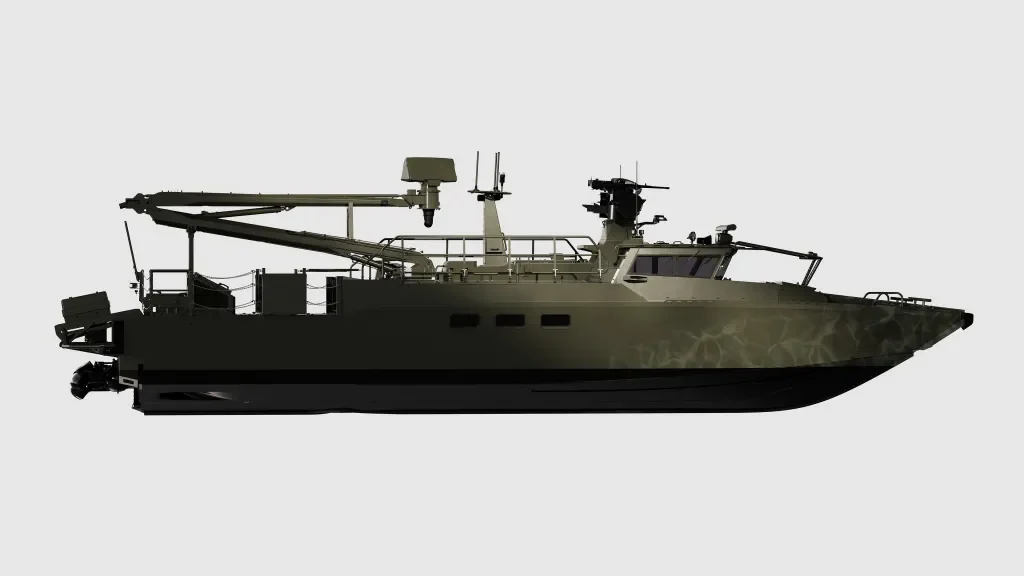
Sweden will be the launch customer for the CB90 CX. The new craft will operate alongside the smaller CB90 NG rather than immediately replacing it. Existing boats will continue carrying troops and conducting raids, while CX variants take on reconnaissance, strike, and short-range air-defense missions. The first boat is already undergoing final acceptance trials, although delivery dates and the final production armament have not yet been disclosed.
Saab is also considering the launch of quadcopters and tube-launched unmanned aircraft from the CB90 CX. Lightweight torpedoes have been mentioned as another possible option. These proposals, however, appear to be at an earlier stage than the three initial mission configurations.
The CB90 CX is interesting not because of any single missile or radar, but because of the way Saab intends to use it. One boat becomes the eyes, another the long-range weapon, and a third the shield. They can be scattered among islands, connected through a shared information network, and sent into the most dangerous areas without crews.
Saab has not managed to fit a corvette into an 18-meter hull—that would be impossible. Instead, it has divided some of a corvette’s capabilities among several small combat boats. The result is not one miniature warship capable of doing everything, but a group of platforms that begins to behave like a single, much larger combat organism.