The Government Was Being Overthrown While People Went to the Theater: How Petrograd Failed to Notice the Revolution

On the evening of October 25, 1917, according to the old Russian calendar, armed detachments were already occupying central Petrograd when Nina Krivosheina boarded a tram on Liteyny Prospekt and headed to the People’s House to see Don Carlos. She later could not remember anything unusual about the journey. The passengers behaved normally, there was no agitation outside the theater, and the opera began as scheduled.
By that time, Alexander Kerensky, head of the Provisional Government, had already left the capital. The Bolsheviks controlled the bridges, railway stations, post office, telegraph, telephone exchange, power station and State Bank. Inside the Winter Palace, government ministers were trying to determine whether any loyal troops were coming to their rescue. The cruiser Aurora stood on the Neva, while preparations were being made at the Smolny Institute to declare the transfer of power to the soviets.
Most residents, however, had not yet realized what had happened. The following day, Krivosheina’s acquaintances learned that the government had fallen and reacted almost indifferently: the Bolsheviks, they assumed, would not remain in power for long.
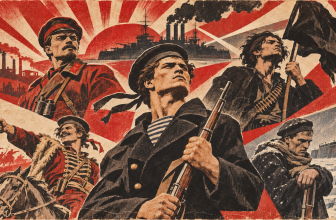
The October Revolution is now represented by a sequence of instantly recognizable images: the shot from the Aurora, Red Guards running across Palace Square, the gates of the Winter Palace and a crowd flooding its grand staircase. Yet a person in Petrograd on November 7, 1917, would probably have seen nothing of the sort. The revolution that transformed the history of an enormous country began almost routinely for the capital itself.

A City Accustomed to Disorder
By the autumn of 1917, Petrograd had already spent several months in a state of political fever. During a single year, the city had witnessed the fall of the monarchy, mass demonstrations, street shootings, the July unrest and General Kornilov’s attempted advance on the capital. Soldiers, protesting workers and armed patrols appeared constantly in the streets. Shortages of bread, electricity and transport had become part of everyday life.
Rumors of another uprising therefore surprised few people. A new political crisis was seen not as the beginning of a new era but as another episode in the continuing collapse of authority.
The decisive events began on October 24, when the Provisional Government attempted to close Bolshevik newspapers and raise the bridges across the Neva. The Military Revolutionary Committee of the Petrograd Soviet declared these actions an attack on the revolution and began deploying the units under its control.
But this was not a mass uprising in the familiar sense. No barricades were constructed, enormous columns did not march along Nevsky Prospekt, and no battles were fought for every city block. Small groups of Red Guards, soldiers and sailors received specific addresses, arrived at their destinations and replaced the existing guards.
Contemporary observer Nikolai Sukhanov compared the operations to changing the guard. Most cadets and government employees had no desire to open fire and preferred to obey armed detachments believed to have much of the Petrograd garrison behind them.
The Revolution Began with Bridges and Telephones
The Bolsheviks understood that power in a modern city did not exist only inside government offices. It depended on the ability to issue orders, move troops and control information.
During the night of October 24–25, detachments of the Military Revolutionary Committee occupied the main post office, telephone exchange, power station, railway terminals and principal bridges. The Petrograd Telegraph Agency and State Bank were also brought under control. The cruiser Aurora approached the Nikolayevsky Bridge, which government forces had attempted to raise in order to isolate the working-class districts from the city center.
Resistance was minimal. Government institutions passed into rebel hands faster than the ministers could receive information about what was happening.
The telephone network was particularly important. Calls to Moscow and other cities were restricted, leaving Petrograd filled with rumors that could not be verified. Some people claimed that loyal government troops were approaching. Others reported that the ministers had fled or that yet another cabinet was being formed.
The Bolsheviks, meanwhile, were already circulating their own version of events. At ten o’clock in the morning, the Military Revolutionary Committee issued its appeal “To the Citizens of Russia,” declaring the Provisional Government deposed and state power transferred to the Petrograd Soviet.
This created an important paradox: when the proclamation was published, the ministers remained inside the Winter Palace and formally continued to meet. The government was declared overthrown approximately sixteen hours before its members were actually arrested.
But the announcement mattered more than legal precision. Whoever controlled the telegraph and could speak in the name of the state already possessed a substantial part of state power.
Kerensky Left, but the City Hardly Noticed
Kerensky departed Petrograd on the morning of October 25. Soviet films frequently depicted him fleeing the Winter Palace disguised as a woman. The story was invented. The head of government openly left the city in a car belonging to the American diplomatic mission, hoping to find loyal military units at the front and return to the capital.
His departure was another sign of the regime’s weakness. The government remained inside the Winter Palace without its chairman, lacking reliable communications with the army and barely knowing who still obeyed its orders.
For most residents, none of this changed everyday life. Trams continued along their routes, shops opened, and cinemas and some theaters remained in operation. Electrical failures caused certain performances to be canceled, but theatrical life did not stop.
Only in the evening did armed checkpoints begin seriously disrupting movement through the city center. A person could travel several blocks along ordinary streets before suddenly encountering sailors with rifles inspecting passersby near a bridge or government building.
This scene bore little resemblance to the later image of a revolutionary capital. Most residents did not pour into the streets to support the Bolsheviks, but neither did they attempt to defend the Provisional Government. They watched, waited and tried to continue with their daily lives.
That indifference was more dangerous to the government than open revolt.
The Provisional Government’s Last Refuge
By the middle of the day, the Bolsheviks controlled almost all of Petrograd. The Provisional Government retained only Palace Square and the Winter Palace.
Cadets from several officer schools, artillery cadets, a small group of Cossacks, disabled war veterans and two companies of the 1st Petrograd Women’s Battalion—approximately 137 women—arrived to defend the palace. Later legend transformed them into a united garrison prepared to protect the ministers to the end. In reality, the defenders did not know who was commanding them or what they were expected to do.
No reinforcements arrived. Some of the Cossacks decided to leave, unwilling to fight without infantry support. Some cadets also abandoned the palace. The Women’s Battalion occupied positions unsuited to serious defense. Ammunition, provisions and a clear plan were all lacking.
The ministers continued meeting in the Malachite Room, receiving reports and sending orders to people who increasingly failed to respond. From time to time, envoys arrived demanding surrender. They were detained, then released, after which negotiations began again.
Pyotr Palchinsky, one of the organizers of the palace’s defense, later made a telling observation: the Winter Palace had been taken not so much because of the strength of the attackers as because of the weakness of its defenders.
The Shot That Did Not Begin a Bombardment
At approximately 9:40 p.m., a shot rang out from the Aurora’s forward six-inch gun. In the Soviet version of history, it became the signal for the immediate storming of the Winter Palace.
In reality, the cruiser fired a single blank round. It did not bombard the palace and could not have damaged it. Even the intended meaning of the signal has been interpreted differently. According to one account, it called the naval vessels on the Neva to combat readiness; according to another, it was intended to increase pressure on the Provisional Government. Президентская библиотека имени Б.Н. Ельцина
An attempt was also made to fire on the Winter Palace from the Peter and Paul Fortress, but it proved ineffective. Some of the guns had not been prepared, several shells missed their target, and the resulting damage was minor.
No cinematic artillery preparation followed. The Bolsheviks’ main weapon was not naval gunfire, but their understanding that the palace defenders were demoralized and gradually slipping away.
An Assault That Resembled Wandering Through a Museum
Late in the evening, Red Guards, soldiers and sailors arriving from Kronstadt gathered around the Winter Palace. There was no single moment when the entire mass of men simultaneously charged the gates.
Small groups entered through poorly guarded doors, windows and service passages. Some were detained and disarmed, then later released. Elsewhere, defenders surrendered their weapons without resistance. The attackers became lost inside the enormous building, wandered through its corridors and halls, searched for the ministers and tried to determine who was actually directing the operation.
There were isolated exchanges of gunfire and brief clashes, but the fighting did not resemble the enormous attack later shown on screen. The Russian State Archive describes it as a prolonged and confused siege involving negotiations, ultimatums and the gradual infiltration of armed men into the palace.
At approximately two o’clock in the morning, Red Guards reached the room where the ministers were meeting. The Provisional Government was arrested, led out of the palace and sent to the Peter and Paul Fortress. Kerensky was not among them.
The Winter Palace had been taken. For most of Petrograd, however, it happened while the city was asleep.
Morning in a New State
The following day, residents lined up at newspaper kiosks, trying to discover who now governed the country. Telephone service remained restricted, information from Moscow and the front arrived only in fragments, and different newspapers offered radically different descriptions of events.
Some shops and restaurants closed. People began stocking up on kerosene because of electrical shortages. Rumors spread that government troops were approaching and that the Bolsheviks would soon flee.
The trams, however, continued running.
Many people regarded the new authority as just another temporary government that would be replaced within a few days. During the eight months since the fall of the monarchy, cabinets had repeatedly changed, ministers had come and gone, while promises to resolve the questions of war, land and food remained unfulfilled.
Few understood that this time power had been seized by people who did not intend to surrender it through another political compromise.
How a Quiet Takeover Became a Great Assault
The actual events of October 25 were poorly suited to the creation of a heroic epic. Small detachments occupied government buildings, ministers sat inside an almost empty palace, and the city’s inhabitants rode trams and attended theaters. The revolution needed a more expressive scene for its own birth.
Such a scene appeared three years later.
On November 8, 1920, director Nikolai Evreinov staged an enormous public performance titled The Storming of the Winter Palace on Palace Square. Depending on the estimate, between 6,000 and 8,000 people participated. Vast “Red” and “White” stages were constructed, dozens of searchlights were employed, artillery thundered, armored vehicles moved across the square, and silhouette battles were performed in the palace windows.
There were far more participants than during the actual seizure of the palace. The gunfire was more intense, the action better organized and the confrontation far more dramatic. One eyewitness to the events of 1917 joked that fewer bullets had been fired during the real revolution than during its reenactment.
The performance was filmed, and its visual imagery influenced Sergei Eisenstein when he made October for the revolution’s tenth anniversary. The enormous crowd charging the palace, the large-scale battle and the tense montage of the assault emerged in cinema.
The film was so convincing that its staged scenes were subsequently used on numerous occasions as documentary footage. The artistic image gradually displaced eyewitness testimony.
What we remember is not the revolution of 1917, but its theatrical reconstruction of 1920 and cinematic version of 1927.
A Revolution That Did Not Need a Grand Assault
The Bolsheviks did not triumph in Petrograd because of a heroic attack on a fortified palace. The Provisional Government had lost power before its ministers were arrested.
It did not control the garrison, could not ensure that its orders were obeyed and failed to persuade the city’s residents to come to its defense. The Bolsheviks merely had to occupy the communication hubs, isolate their opponents and declare victory. The Winter Palace was an important symbol, but by nightfall it had become an island of the old authority inside a city already controlled by another force.
That was why residents could travel to the theater while the fate of the country was being decided. No enormous battle was taking place in the streets. Over the course of one rainy day, the orders issued by one group of people simply ceased to be obeyed, while the orders of another began to be carried out.
Sometimes a state does not disappear beneath the thunder of artillery. Sometimes it disappears between two tram stops.