On 6 December 1273, one of the most prolific authors of the Middle Ages suddenly stopped writing. Thomas Aquinas was working on the Summa Theologiae, an enormous work in which he intended to explain the structure of the world, human nature, the existence of God, the origins of good and evil, the meaning of law, the organisation of society and the path to salvation.
The book remained unfinished. His secretaries waited for him to resume dictation, but Thomas never gave them another line.
His friend and assistant, Reginald of Piperno, tried to persuade him to return to work. According to Thomas’s early biographers, he replied that after what he had experienced during Mass, everything he had written seemed like straw.
Three months later, he died before reaching the age of fifty.
The story seems almost like an act of mockery by fate. Thomas had spent his life arguing that the world could be explained rationally and systematically, yet in the end he refused to complete his greatest work. This paradox, however, helps us understand him. Aquinas was more than a monk who wrote about religion or a medieval thinker who devised proofs for the existence of God. He attempted to construct a single intellectual system in which faith, logic, nature, human passions and social laws did not contradict one another.
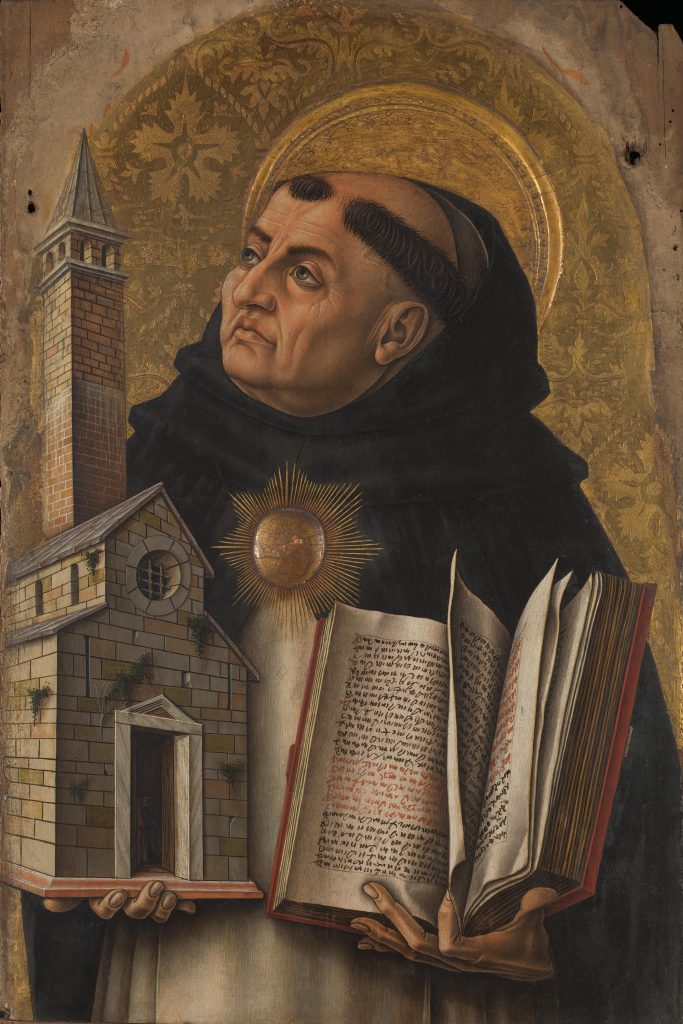
The Younger Son Who Ruined the Family Plan
Thomas was born around 1225 at the castle of Roccasecca, near the town of Aquino, midway between Rome and Naples. The name by which he became known — Aquinas — came from this area. His family belonged to the Italian nobility, and the boy’s future appeared to be settled. At the age of five, he was sent to study at the famous Benedictine abbey of Monte Cassino. His relatives probably expected him eventually to obtain a senior position there, perhaps even becoming abbot.
It would have been an excellent career for the younger son of an aristocratic family. The abbot of a wealthy monastery controlled estates, revenues and dependants, and dealt with popes, kings and princes. Thomas chose a very different path.
While studying in Naples, he encountered the Dominicans, a recently established mendicant order whose members renounced personal property, depended upon alms, preached in towns and devoted themselves to education. To the Aquinas family, their son’s decision to join the Dominicans looked almost like a loss of social status. Instead of taking an honourable position in a rich abbey, he intended to become an itinerant friar in a white habit.
His relatives intercepted Thomas during his journey and held him at the family castle for about a year, hoping to force him to abandon his decision. Later biographies decorated this episode with numerous legends, but the confinement itself is considered reasonably well attested. Eventually, his family relented, and Thomas left to continue his education, first in Paris and then in Cologne.
There his teacher was Albert the Great, one of the most learned men of the age. Thomas was physically large, reserved and uninterested in idle conversation. According to his early biographers, the other students nicknamed him “the Dumb Ox”, assuming that his silence concealed a slow mind. Albert is said to have given a prophetic response: one day the bellowing of this ox would be heard throughout the world.
The story may have been embellished by Thomas’s followers, but it captures his character rather well. He revealed almost nothing about his personal life, avoided brilliant performances for their own sake and preferred to examine a question until no uncertainty remained.
Dangerous Aristotle Returns to Europe
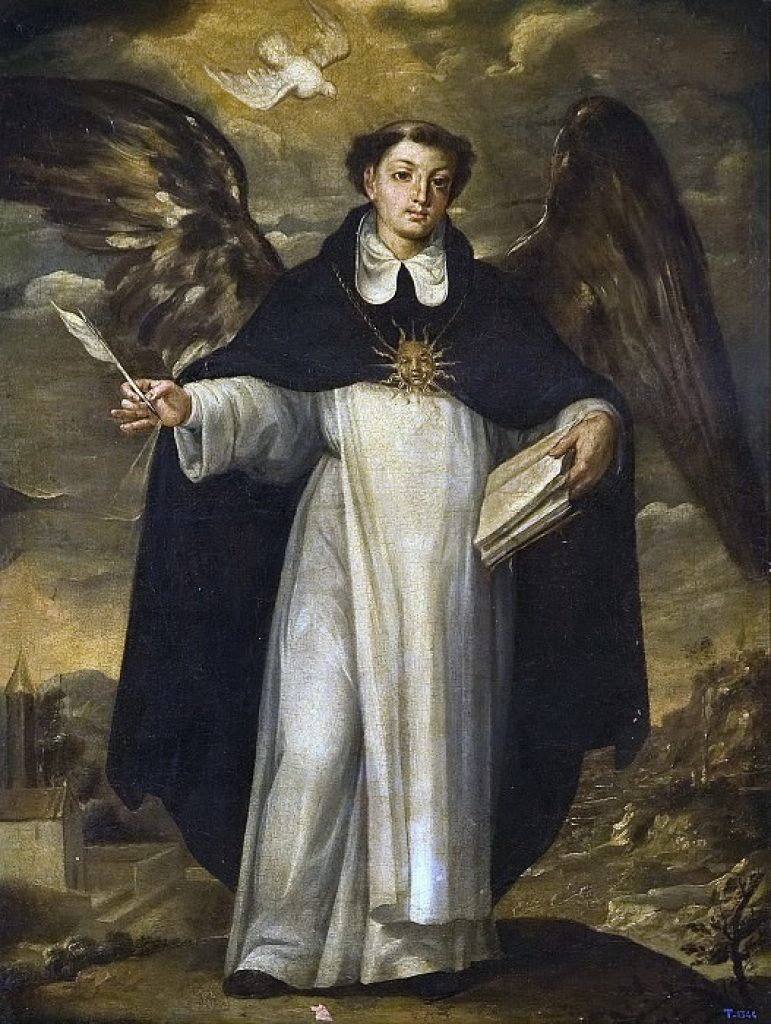
Thomas arrived at university during a genuine intellectual revolution. Western Europe was rediscovering the works of Aristotle. Some of his writings had been almost unknown to the Latin world, but they were now becoming available through translations from Greek and Arabic, often accompanied by the commentaries of Muslim thinkers such as Avicenna and Averroes.
European scholars suddenly encountered an almost complete account of the world created by a pagan philosopher centuries before Christianity. Aristotle had written about nature, motion, matter, the soul, logic, government, virtue and happiness. He explained phenomena through observable causes and structured arguments without appealing to the Bible.
Some theologians regarded these books as a threat. If a pagan philosopher could explain the world through reason alone, what place remained for faith? Other teachers became so enthusiastic about Aristotle and his Arabic commentators that they appeared ready to accept even propositions that conflicted with Christianity, including the eternity of the world or the existence of one universal intellect instead of individual human souls.
Thomas joined neither camp. He believed that reason possessed its own powers and could discover truth without constantly appealing to revelation. Human beings could study nature, reason about morality and even arrive at the conclusion that God exists. Certain truths, however — including the Trinity, the Incarnation and the path to salvation — could not be derived from observation and chains of logic. They became known through faith.
In Thomas’s view, properly functioning reason and genuine faith could never truly contradict one another because both ultimately came from God. When a contradiction appeared, someone had either made a mistake in reasoning or misunderstood the content of faith.
Aquinas therefore transformed Aristotle from a dangerous pagan into one of the principal conversation partners of Christian theology. He did not retrospectively turn the ancient philosopher into a Christian, nor did he accept everything Aristotle had written. Thomas used the ideas he considered sound, corrected those he found doubtful and rejected those he believed incompatible with Christianity.
From this project emerged Thomism, the philosophical and theological tradition named after Thomas himself.
How the Summa Theologiae Works
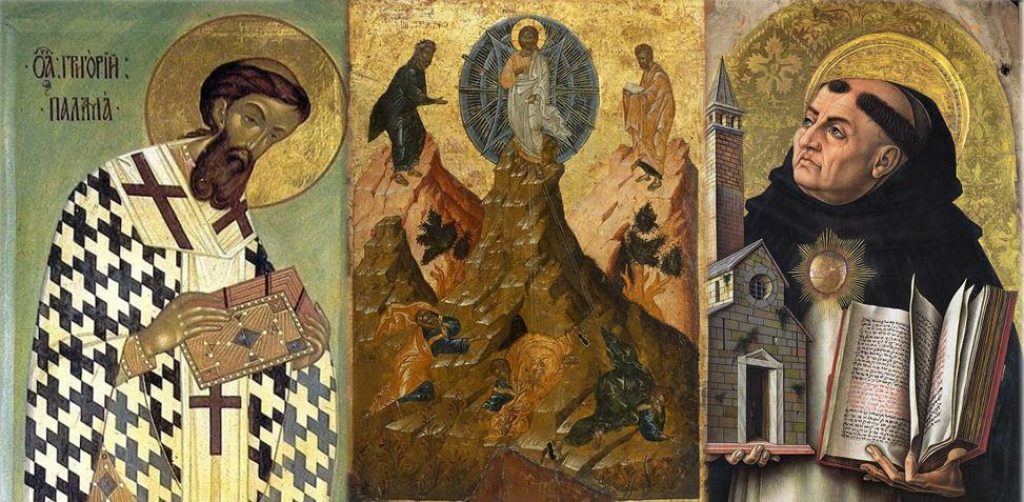
Thomas’s most famous work was the Summa Theologiae. He began writing it around 1265 and intended it for beginning students. That description may frighten anyone who has seen a modern edition: the unfinished work contains more than five hundred questions and nearly 2,700 individual articles.
By “beginners”, however, Thomas did not mean casual readers. He meant students who had already begun the serious study of theology. He was frustrated that they had to search through dozens of books, confront endless repetition and encounter subjects in an accidental order. Thomas decided to arrange the entire system logically: beginning with God and the creation of the world, then proceeding to humanity, morality, Christ and the sacraments.
Every article of the Summa resembles a small university debate. It begins with a question: Does God exist? Do human beings possess free will? Is every law just? Is killing ever permissible in war?
Thomas then presents arguments against the answer he is eventually going to defend. These objections can be so powerful that readers may suspect he has already lost the debate. Only then does he introduce the opposing authority, give his own solution and answer each of the original objections in turn.
This method is one reason why the Summa has survived for so long. Thomas never pretended that difficult questions did not exist. He first allowed his opponent to speak and only then began to reply. The reader was shown not merely the finished conclusion but the entire structure of the argument.
The work addressed almost everything that might have interested an educated person in the thirteenth century: God and angels, the human soul, memory, love, fear, pleasure, virtue, law, property, trade, war, political authority and happiness. In Thomas’s hands, medieval theology was not a narrow discussion of religious ceremonies. It was an attempt to describe the whole of reality.
Five Ways to God
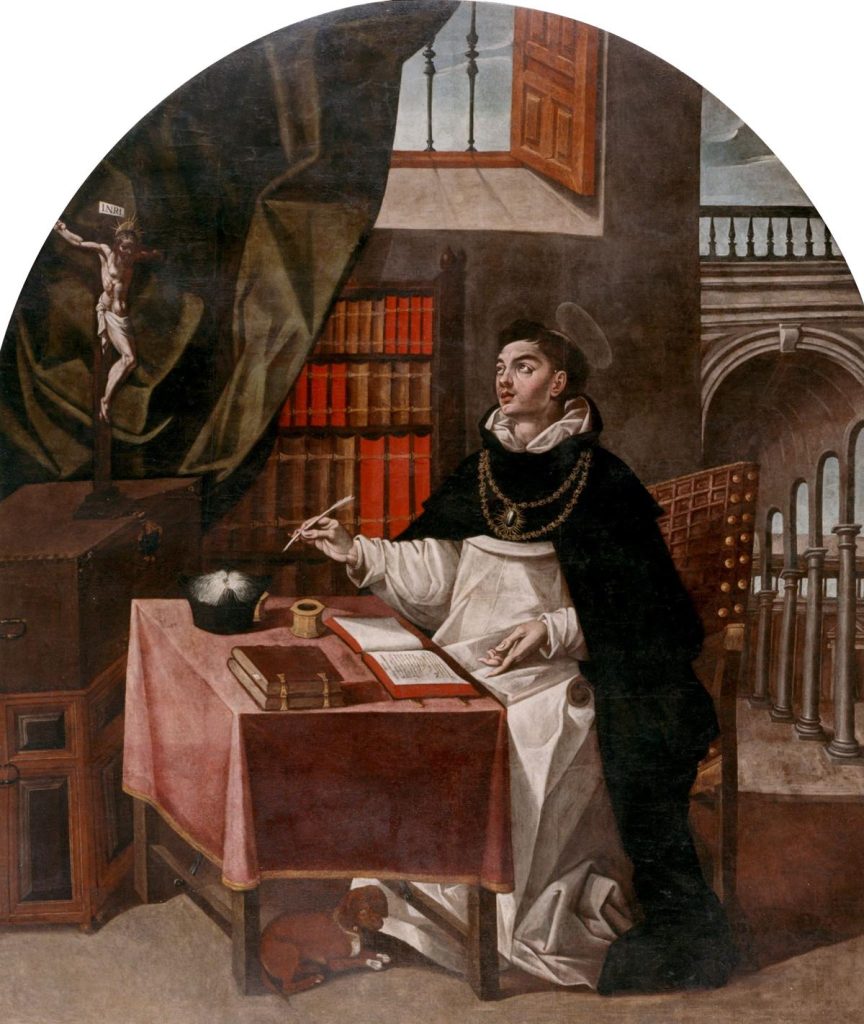
Outside the Church, Thomas is best known for his “Five Ways” — short arguments concerning the existence of God. They are frequently called five proofs, although Aquinas presented them as different routes leading from the observable world towards its ultimate foundation.
The first began with motion and change. Whatever passes from one state to another receives the possibility of change from something already actual. The second examined chains of efficient causes. The third began with things that come into existence and disappear: if everything that exists could once have failed to exist, there must be some foundation that does not exist merely by chance. The fourth considered different degrees of perfection, while the fifth examined the ordered behaviour of natural things, which act towards particular results despite possessing no intelligence of their own.
Popular retellings often reduce these arguments to the statement: “Everything has a cause, therefore God created the universe.” Thomas’s reasoning was more complicated. He did not claim that God was simply the first event in a long chronological sequence. He wanted to explain what sustains the existence of a changing and dependent world at every moment. Within his system, God was not a craftsman who started a mechanism and then walked away, but the ultimate source of existence itself.
The Five Ways were never intended to replace faith or establish every Christian doctrine. They could not demonstrate the Trinity, the Resurrection or the teachings of the Gospels. Thomas was arguing only that human reason could independently reach certain truths about God. Beyond that point lay the territory of revelation.
Debate over these arguments continues today. Some philosophers consider them historically important but obsolete after the development of modern science. Others reply that Thomas was discussing metaphysics rather than physical mechanisms, and that discoveries in astronomy or biology do not in themselves disprove his reasoning.
More than seven centuries after Aquinas’s death, his questions are still being debated, although the participants no longer wear medieval academic robes.
Why His Ideas Reached Beyond Theology

Thomas believed that the world had been created rationally and was therefore accessible to human understanding. Studying nature did not distract people from God; it allowed them to discover the order of creation. Matter was not inherently base or evil. A human being was a unity of body and soul, rather than a soul temporarily imprisoned inside an unnecessary shell.
He took the human desire for happiness just as seriously. Every person acts for the sake of some perceived good, although people can be mistaken about what that good is. A good life required more than a single correct decision. It depended on stable qualities such as courage, justice, temperance and prudence. Virtue gradually trained a person to desire what was right, rather than merely obeying rules through fear of punishment.
From this view emerged Thomas’s theory of natural law. He believed that the basic distinction between good and evil was accessible to human reason. A person did not have to be Christian, or even religious, to understand it. Human beings naturally sought to preserve life, form families, educate children, discover truth and live in society. By reflecting on these common goods, reason could derive moral principles.
Human laws were supposed to apply those principles to particular circumstances and serve the common good. If a government issued a command contrary to justice, that law lost some of its moral authority. Thomas did not encourage people to break every rule they disliked: resistance might cause an even greater evil. Yet he established an important distinction — a state command and justice were not necessarily the same thing.
This is why Aquinas remained important in the history of law and political philosophy. His theory of natural law survived the Middle Ages, influenced later Catholic, Protestant and secular authors, and still appears in debates about human rights, the common good and the limits of state authority.
More Than a Man with an Enormous Book
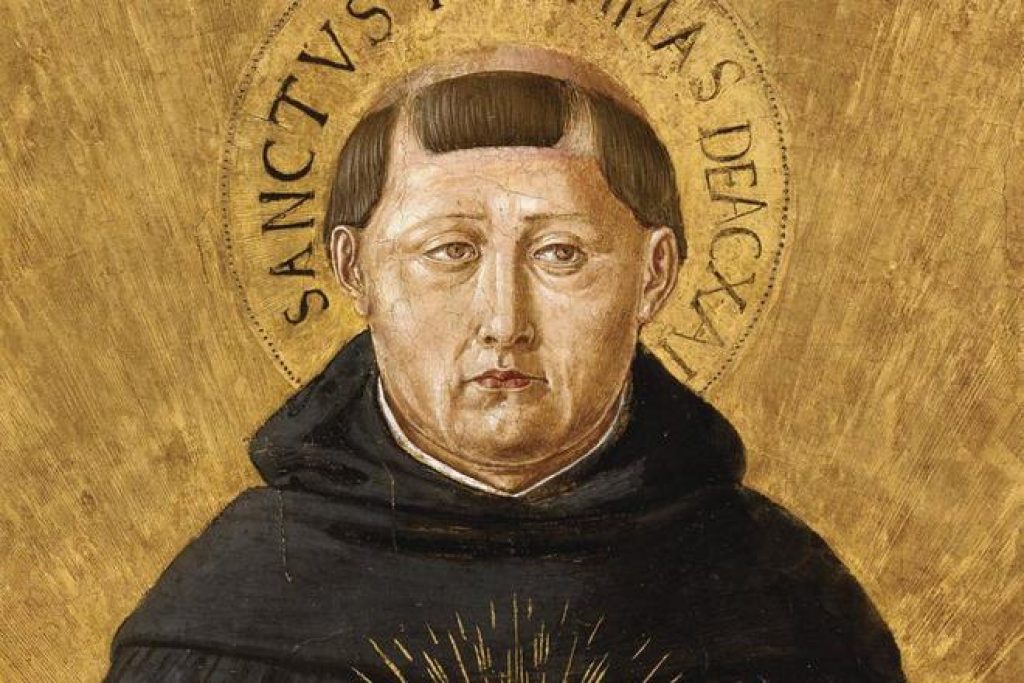
It is easy to turn Thomas into a caricature: a motionless, heavy-set friar surrounded by manuscripts and discussing matters far removed from ordinary life. In reality, he travelled constantly, taught students, participated in university conflicts, preached and carried out assignments for both his order and the papal court. He worked in Paris, Cologne, Orvieto, Rome and Naples, dictating texts to secretaries while continuing to lecture.
At the request of Pope Urban IV, Thomas helped to compose liturgical texts for the Feast of Corpus Christi. He is traditionally credited with hymns that Catholics continue to sing, including Pange lingua, whose final verses are known as Tantum ergo. The man famous for strict logical constructions could express the same ideas in poetry intended not for university debate but for worship.
His views did not immediately become undisputed Catholic orthodoxy. After Thomas’s death, several positions close to his teaching were included in the Paris condemnations of 1277. Other theological schools continued to argue with the Dominicans and accused them of relying too heavily on Aristotle. Aquinas’s transformation into the central philosopher of Catholicism took decades and, in some respects, centuries.
He was canonised in 1323 and proclaimed a Doctor of the Church in 1567. During the nineteenth century, Pope Leo XIII placed Thomism at the heart of a revival in Catholic philosophy.
Today, Thomas is studied by more than theologians. Historians of philosophy examine his theories of being and causation; legal scholars study natural law; ethicists debate his ideas about virtue, happiness and human action.
Everything He Had Written Seemed Like Straw
In the autumn of 1273, Thomas continued working on the Summa Theologiae in Naples. He had reached the section on penance, but on 6 December, after celebrating Mass, something happened. Thomas himself left no account of it. According to the story preserved by his companions, he experienced a religious revelation and afterwards refused to continue writing.
“I can write no more. All that I have written seems like straw to me,” he reportedly told Reginald.
The remark did not necessarily mean that Thomas had lost confidence in reason or decided that his work was mistaken. More likely, the thinker who had spent his life describing God in human language suddenly felt the distance between the description and the reality he had attempted to describe. His system had reached a limit that he himself had always acknowledged: reason could rise very high, but it could not contain everything.
Early in 1274, Thomas was summoned to the Second Council of Lyon. He became ill during the journey and stopped at the Cistercian abbey of Fossanova, where he died on 7 March. The Summa Theologiae remained unfinished. His students later assembled a supplement from his earlier writings.
Thomas Aquinas is not remembered because he found final answers to every question. His greatest achievement lay in the ambition of the project itself. He lived at a time when a new philosophy could appear to threaten Christianity, and he chose not to close the dangerous books but to read them carefully. He believed that truth could withstand an honest question, a powerful objection and rigorous examination.
That is why every section of his greatest work begins not with an established truth, but with a doubt.