Editor choice

The Roman Empire of Flavius Theodoric Augustus: What if Theodoric the Great Had Accepted the Title of Roman Emperor?
History loves dates that later generations turn into symbols. One such date is 476 AD—the traditional boundary between Antiquity and the Middle Ages, when the Germanic commander Odoacer deposed the young Romulus Augustulus. However, contemporaries hardly perceived this event as the “fall of the Roman Empire.” The Senate continued to convene, consuls assumed office, officials collected taxes, and laws were still written in Latin.
Moreover, less than twenty years after the deposition of the last Western emperor, a man arrived in Italy who, in many respects, turned out to be an emperor without the imperial title.
His name was Theodoric.
And if just one of the decisions he made were changed, the history of 6th-century Europe could have looked roughly like the map presented here: a restored Western Roman Empire stretching from the Atlantic to Pannonia, having once again subjugated Italy, most of Spain, and Southern Gaul, and turning the Germanic kingdoms into dependent states.
Remarkably, this alternate history begins surprisingly well with events that actually occurred in our reality.
The Goth Raised by the Roman Empire
Theodoric the Great was born around 454 into the family of the Ostrogothic king Theodemir of the Amal dynasty. His origins seemed to preclude any future role as the guardian of the Roman state. He was a Germanic king, belonged to the Gothic military aristocracy, and professed Arian Christianity.
But Theodoric’s childhood was spent in a completely different environment.
At about eight years old, he was sent as a hostage to Constantinople—a common guarantee for treaty compliance at the time. The future king spent about ten years in the capital of the Eastern Roman Empire. It was there that he became acquainted with the Roman state apparatus, court ceremonial, and the concept that power should rely not only on the sword of his retinue but also on laws, taxes, bureaucracy, and ancient state traditions.
Therefore, Theodoric turned out to be a rather unusual barbarian ruler. He could wage war against emperors, ravage Roman provinces, and blackmail Constantinople, but he by no means sought to destroy the Empire itself.
He wanted to take his rightful place within it.
Emperor Zeno tried to simultaneously use and control the dangerous Gothic leader. Theodoric received high Roman offices: in 483 he became magister militum (Master of Soldiers), and in 484 he was appointed consul. Thus, the future conqueror of Italy was already formally part of the highest elite of the Roman Empire.
Finally, Zeno found a way to simultaneously get rid of the restless Ostrogoths and regain control over Italy.
Theodoric was offered to go west and overthrow Odoacer.
In 489, the Ostrogoths invaded Italy. After several years of grueling war, Theodoric trapped his opponent in Ravenna. In 493, the parties agreed to jointly rule Italy.
The agreement did not last long.
At a banquet, Theodoric personally killed Odoacer.
And this is where the most interesting part begins.
A King Who Ruled Like an Emperor
Theodoric became the master of Italy, but he did not declare himself emperor.
Formally, he remained a rex (king), and even the title “King of Italy,” often found in modern literature, was not his usual official title. At the same time, his actual position was much more complex. In relations with the Goths, Theodoric was their king, while in relations with the Roman population, he carefully portrayed himself as the continuator of the former state system.
The Roman Senate was preserved. The old administration continued to function. Roman aristocrats held state offices. The consular tradition continued to exist.
Theodoric himself demonstratively emulated the best Roman rulers of the past. It is no coincidence that the Anonymus Valesianus reports that Romans compared him to Trajan and Valentinian.
An astonishing state emerged.
The army consisted largely of Goths.
The state apparatus was managed predominantly by Romans.
And above them stood a Germanic king who effectively performed the functions of a Western emperor.
The later Byzantine historian Procopius even characterized Theodoric as a ruler who, lacking the imperial title, essentially possessed the dignity of a true emperor. Contemporaries also used the traditional Roman term princeps in reference to him.
The result was paradoxical: the Western Roman Empire had disappeared from the political map, but a significant part of its state institutions continued to exist in Italy.
Only the Augustus was missing.
Why Didn’t Theodoric Become Emperor?
Today, it might seem that after defeating Odoacer, all Theodoric had to do was don the diadem and declare himself the new Western emperor.
But for a man of the 5th century, everything looked much more complicated.
In Roman political tradition, imperial power was not reduced to mere territorial control. Theodoric could conquer Italy, but proclaiming himself Augustus would automatically mean a claim to supreme Roman authority and an extremely dangerous conflict with Constantinople.
After 476, the official version was not that the Western Empire had ceased to exist as Roman territory. Odoacer had sent the imperial insignia to Constantinople, and the Western Senate reported that a separate Western emperor was no longer needed: one Augustus was sufficient for both parts of the state.
Therefore, the Eastern emperor considered himself the supreme sovereign of Italy as well.
Theodoric understood this perfectly.
He could be a practically independent ruler while maintaining the legal fiction of Constantinople’s imperial supremacy. This ambiguity suited both sides. The emperor saved face and retained theoretical rights over the West, while Theodoric gained the opportunity to do almost whatever he wanted in Italy.
There was also a second problem: religion.
Theodoric was an Arian, while the majority of the Roman population in Italy adhered to Nicene Christianity. As long as he was a Germanic king and the secular ruler of Italy, this compromise worked. But a Roman Augustus was perceived not just as a military sovereign. The emperor was traditionally the defender of the Church and a central figure in the Christian world.
An Arian on the Roman imperial throne would inevitably create a problem of legitimacy.
Finally, there were the Ostrogoths themselves.
A too-rapid transformation of their king into a Roman emperor could provoke discontent among the Gothic military aristocracy. Theodoric spent his entire life balancing between two societies—Gothic and Roman. The necessity of maintaining this balance was one of the fundamental contradictions of his state. Participants in discussions of the original alternate history map rightly draw attention to this.
Therefore, the real Theodoric chose an extremely cautious formula:
To be an emperor in everything but name.
But there was a moment when everything could truly have changed.
497 AD: The Return of the Purple
In our reality, after long negotiations, Emperor Anastasius recognized Theodoric’s position in Italy. Around 497–498, the imperial insignia, which Odoacer had sent to Constantinople after the deposition of Romulus Augustulus, were returned to Italy.
Why exactly Anastasius returned them is still debated by historians.
But for alternate history, this is almost the perfect point of divergence.
Let us imagine that the negotiations end differently.
By this time, Constantinople is preoccupied with its own problems, and Theodoric has clearly proven that he is the only person capable of ensuring order in Italy. The Senate, for its part, understands: here is the rarest opportunity to finally legitimize the established regime.
And then the senators do what they did not do in our history.
They offer Theodoric the purple.
Not just the crown of the Gothic king.
The imperial diadem.
Theodoric hesitates.
To accept it without Constantinople’s consent would mean civil war. But Anastasius also desperately wants to avoid a war over Italy.
As a result, a compromise emerges.
Theodoric recognizes Anastasius as the senior Augustus and renounces any claims to Eastern territories. Constantinople, in turn, recognizes the restoration of the Western imperial throne.
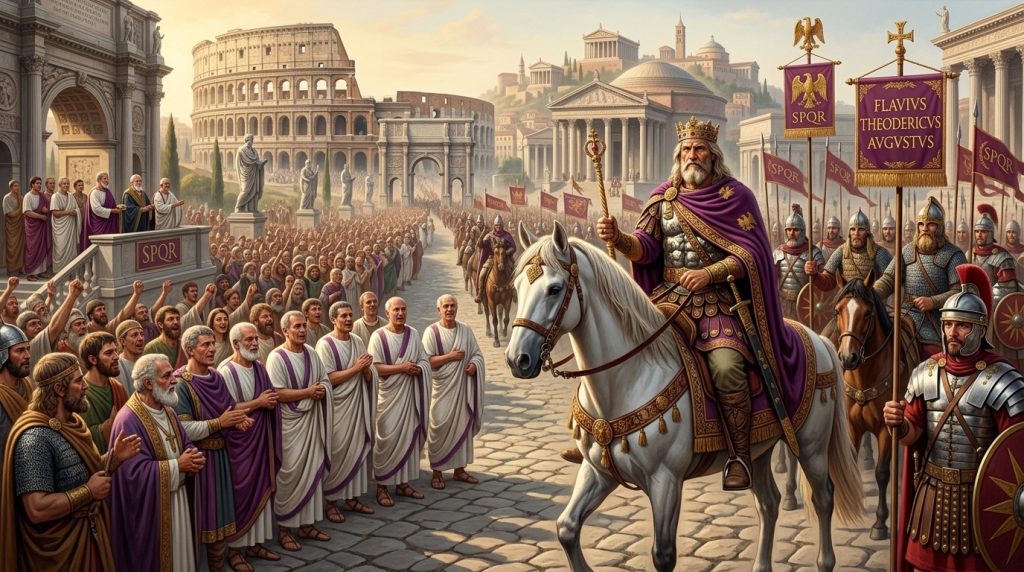
In Rome, a ceremony takes place that the West has not seen in over twenty years.
The Senate proclaims:
Flavius Theodericus Augustus.
The Western Roman Empire is officially reborn.
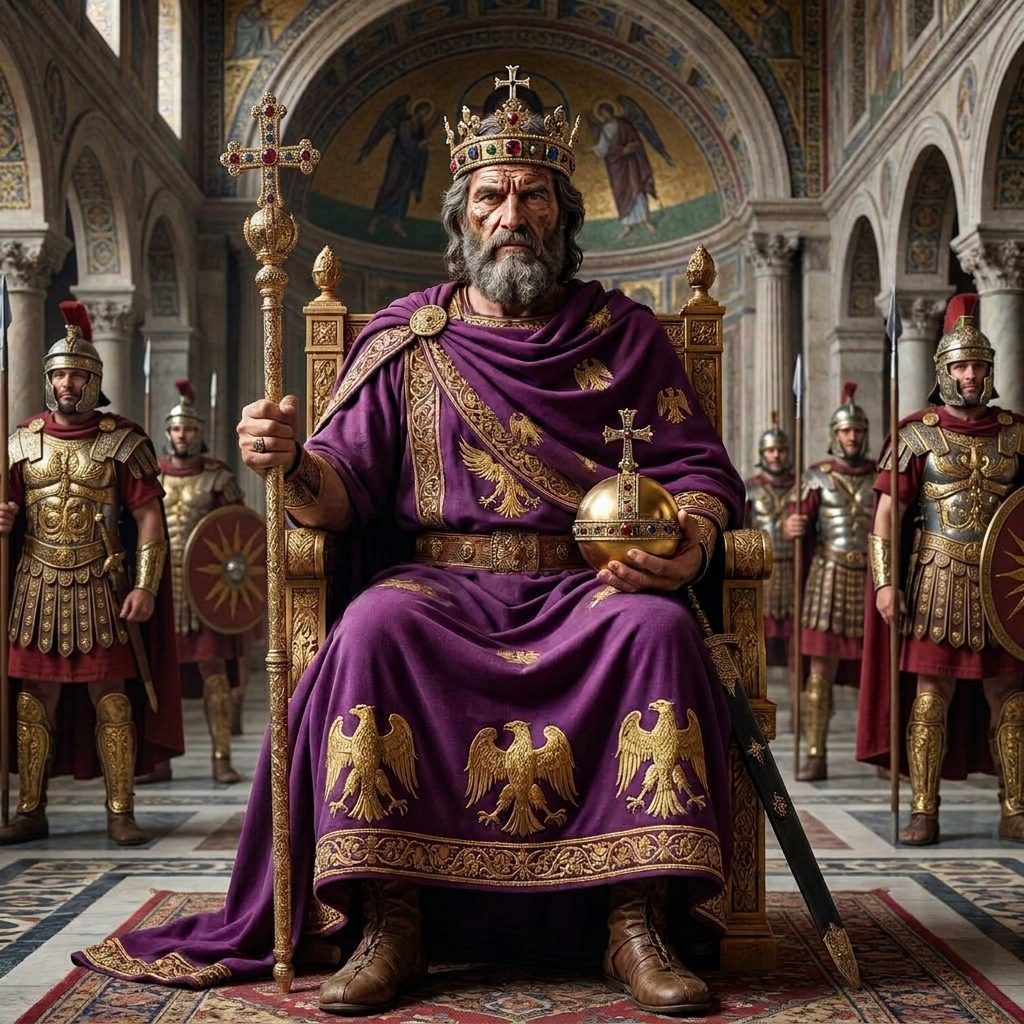
Emperor Flavius Theodoric Augustus
Not an Ostrogothic Kingdom, but a Roman Empire
This decision may seem symbolic, but it completely changes the subsequent course of history.
In our reality, Theodoric remained primarily a king of the Ostrogoths ruling over Italy. Therefore, his numerous diplomatic projects were perceived as relations between Germanic kingdoms.
Now, everything is different.
If Theodoric is the legitimate Roman emperor, his foreign policy gains an entirely new ideological foundation.
He is no longer conquering foreign states.
He is restoring Roman provinces.
For the Senate, this is restitutio imperii—the restoration of the Empire.
For the Roman aristocracy of Gaul and Spain, Theodoric is not a foreign conqueror, but an Augustus.
For the Germanic kings, he is a highly unpleasant reminder that their states arose on territory that Rome had never formally relinquished.
Most importantly, Theodoric gains the ability to offer the barbarian elites an extremely attractive compromise:
Serve the Empire—and retain your lands.
508 AD: The Return of Gaul
The first opportunity to test this new imperial ideology comes with the war between the Franks and the Visigoths.
In real history, the Frankish king Clovis defeated the Visigoths at the Battle of Vouillé in 507. King Alaric II was killed, and most of Visigothic Gaul was lost.
Theodoric intervened and preserved Septimania for the Visigoths.
But in our version, his intervention is on a much larger scale.
Now, it is not the army of an Ostrogothic king marching south into Gaul.
It is the army of the Western Augustus that is sent there.
In 508, the imperial army occupies Provence and restores direct Roman administration over a significant portion of the Mediterranean coast of Gaul.
The Franks are forced to halt.
On the map, this territory is marked as the first major expansion of Theodoric’s state after Italy.
And unexpectedly, it becomes clear that the name of Rome still possesses immense political power.
Gallo-Roman landowners have no desire to become Goths. But no one is asking them to.
They are offered the chance to be Romans of the Empire once again.
The difference is enormous.
510 AD: Spain Returns Under the Eagles
The next gift to Theodoric comes in the form of a dynastic crisis in the Visigothic state.
After the death of Alaric II, his heir is the young Amalaric—Theodoric’s own grandson. In our history, Theodoric effectively established control over the Visigothic state as regent.
Here, he goes further.
The Senate passes a decree whereby the lands of the Visigoths are once again incorporated into the Western Roman Empire.
However, Theodoric does not make the mistake of trying to destroy the Visigothic nobility.
On the contrary.
Visigothic aristocrats receive Roman titles and offices. Their retinues are transformed into federate units of the imperial army. Their landholdings are confirmed by imperial charters.
The result is an almost perfect deal.
The Visigothic elite retains its wealth and status.
The Hispano-Roman population gets its familiar administration.
Theodoric gains most of the Iberian Peninsula practically without a large-scale war of conquest.
Thus, in 510 AD, a vast Spanish portion of the restored Empire appears on the map.
From Italy, the Augustus’s domains now stretch almost to the Atlantic Ocean.
The Last Gothic Frontier
One problem remains.
The northwest of the Iberian Peninsula belongs to the Suebi.
In our reality, their kingdom would survive for several more decades, only to be destroyed by the Visigoths in 585.
In Theodoric’s world, this does not happen.
The emperor initially offers the Suebic king the same treaty accepted by other Germanic elites: acknowledge the authority of the Augustus, receive a Roman title, and retain internal autonomy.
The Suebi refuse.
In 515 AD, war begins.
The Roman army advances through Lusitania and northern Spain. The military power of the Suebi is completely incomparable to the resources of a state that now controls Italy, Spain, and a significant part of Mediterranean Gaul.
The campaign ends quickly.
Gallaecia is annexed to the Empire.
In Rome, people begin to speak seriously for the first time that the events of 476 were merely a short interregnum.
517 AD: The Emperor Returns Beyond the Alps
The next target is not the west, but the northeast.
The Alpine provinces held immense strategic importance for Italy. Without control over Raetia, Noricum, and Pannonia, Italy itself remained open to new invasions.
Therefore, Theodoric begins to gradually restore the Roman presence in the Alps and along the middle Danube.
But the situation here is more complex.
The Empire is no longer capable of simply restoring the administrative map of the 4th century. The population has mixed, old cities have fallen into decline, and Germanic and local military principalities exist in many territories.
Theodoric acts pragmatically.
Where possible, full Roman administration is restored.
Where it is not, dependent federates are established.
On the map, therefore, Raetia, Noricum, and Pannonia appear as a mosaic of direct and indirect control. This is exactly how the author of the original map explains such shading: in these areas, Roman power remains fragmented.
By 517 AD, the Roman border once again reaches the Danube.
It is then that the Senate first grants Theodoric the honorific epithet:
Restitutor Occidentis — Restorer of the West.
But the greatest successes are yet to come.
519 AD: The Burgundian Question
The Kingdom of the Burgundians occupies a highly inconvenient position between the domains of the Franks and the Empire.
Theodoric has no intention of destroying it.
By this time, it has become obvious that the restored Western Empire is not obliged to annex every province directly. The old system of federates can be turned into an effective instrument of the new Roman order.
After military pressure and diplomatic negotiations, Burgundy recognizes the supremacy of Rome.
The southeastern districts of Gaul come under the direct administration of the Empire, while the Kingdom of Burgundy itself is preserved.
Formally, a king exists.
In reality, the decisions of Lugdunum increasingly depend on Rome.
On the map, therefore, Burgundy is shown not as an ordinary imperial province, but as a state under strong Roman influence. This is precisely the status envisioned by the author of the original alternate history scenario.
The result is a system astonishingly reminiscent of the Roman Empire’s structure several centuries earlier: around the core provinces, a belt of dependent states emerges once again.
520 AD: The Treaty of Carthage
One last great adversary remained: the Vandals.
And here, Theodoric proves himself more a diplomat than a conqueror.
The Vandal Kingdom controls North Africa, Carthage, Sardinia, Corsica, and the most important maritime routes of the western Mediterranean. A full-scale war would require a massive fleet and could drag on for years.
Therefore, Rome chooses pressure.
After several years of diplomatic conflicts, naval demonstrations, and the threat of invasion into Africa, the Treaty of Carthage in 520 AD is concluded.
Corsica, Sardinia, and the Balearic Islands are returned to the Empire.
Rome gains a number of strategic points and maritime rights.
The Vandal king retains Africa but acknowledges the political primacy of the Western Augustus.
On the map, Vandal territories, like Burgundy, are therefore shown as being under strong Roman influence.
The Mediterranean Sea once again begins to become a Roman lake.
At least, its western half for now.
The Last War of the Old Emperor
By the early 520s, Theodoric is already around seventy years old.
Before him lies a state whose existence would have seemed impossible just a quarter of a century earlier.
Italy. Sicily. Dalmatia. Spain. Southern Gaul. The Alpine lands. Part of Pannonia. Sardinia. Corsica. The Balearic Islands.
The Burgundians and Vandals acknowledge Roman supremacy.
But in the northwest of the Iberian Peninsula and along the foothills of the Pyrenees, there remain lands where imperial power is nominal or entirely absent.
Theodoric’s final campaigns are directed against the Vascones (Basques).
These are no longer the great wars of his youth.
There are no decisive battles determining the fate of the continent. Roman columns build roads, occupy fortresses, conclude treaties with local chieftains, and slowly push the imperial border toward the Bay of Biscay.
The last territories come under Roman rule.
The Senate decides that the previous title is no longer sufficient.
Restitutor Orbis
In 526 AD, the eighty-year-old Theodoric arrives in Rome.
He enters the city that was once the capital of the world and which, under his rule, has once again become the true capital of a Western power.
The Senate gathers in the Forum.
Behind the old emperor stands an almost unbelievable culmination of thirty years of rule.
When Theodoric first entered Italy, the Western world was a mosaic of Germanic kingdoms.
Now, Rome once again controls the vast majority of lands from the Atlantic to the Adriatic and the Danube.
The author of the original map brings this alternate chronology to precisely such a finale: the annexation of the Visigothic state, the subjugation of the Suebi, the dependence of the Vandals and Burgundians, the return of Vasconia, and the Treaty of Carthage in 520 complete the restoration of the Western power. The capital is simultaneously moved from Ravenna back to Rome.
Before the senators stands an old Goth.
But now, few see him merely as a Goth.
The herald recites the titles.
Flavius Theodericus Pius Felix Invictus Augustus.
And finally, the new one is pronounced:
Restitutor Orbis.
Restorer of the World.
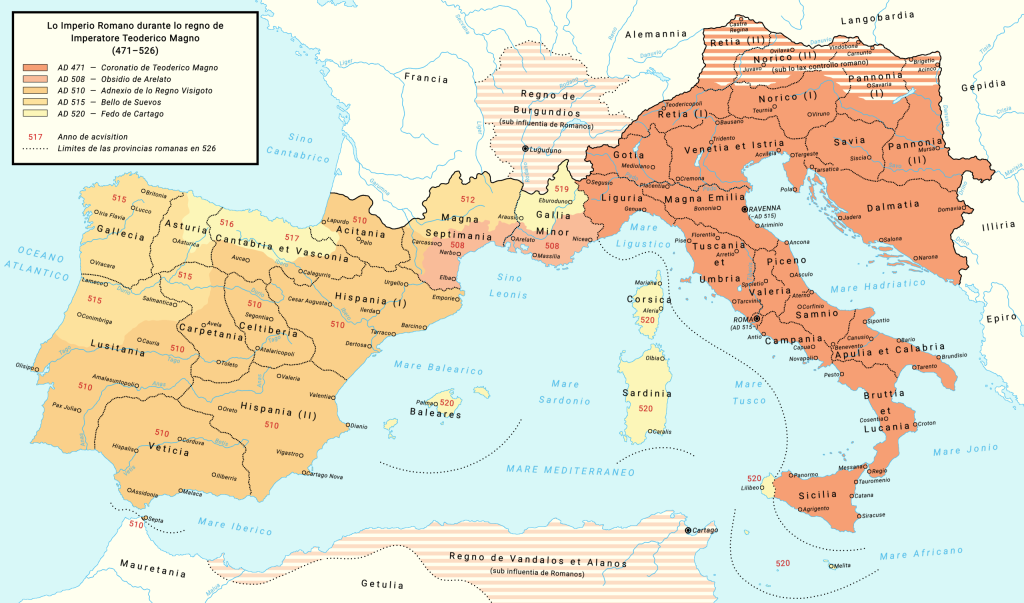
A Roman Empire That Should Not Have Existed
Thus, by the death of Theodoric the Great in 526 AD, the state depicted on the map comes into being.
But the most interesting part is that this is not at all a restored empire of the times of Trajan or Constantine.
This is already a different Rome.
The Germanic kings have not disappeared. Burgundy and Africa retain their own rulers. Along the Danube, Roman administration is intertwined with the power of local military chieftains. Gothic nobility occupies the highest army positions, while the old senatorial aristocracy manages the civil administration.
Even the concept of “Roman” is gradually changing.
It denotes ethnic origin less and less, and allegiance to the state more and more.
A Goth can be a Roman general.
A Visigoth, an imperial official.
A Burgundian king, a vassal of the Augustus.
A Hispano-Roman, a senator.
Before us is no longer the Late Antique Roman Empire.
This is a Romano-Germanic empire of the Early Middle Ages, emerging three centuries before the state of Charlemagne.
And it is precisely here that the main consequence of this alternate history lies.
In our history, Theodoric died as a king of the Ostrogoths, and the system he created proved too dependent on the personality of its creator. Within a few decades, Italy was ravaged by Justinian’s Gothic Wars.
Here, however, Theodoric leaves his successors an entirely different kind of political capital.
Not a Regnum Gothorum.
But an Imperium Romanum.
The next ruler no longer needs to explain to the Romans why they should obey a barbarian king. He merely needs to ascend the throne of the Augustus.
And therefore, in the textbooks of this world, the year 476 will never become the date of the fall of the Western Roman Empire.
Historians will call it something else:
The beginning of the Great Interregnum of 476–497 AD.
And Theodoric, the son of an Ostrogothic king who spent his childhood as a hostage in Constantinople, will be remembered by posterity not as the last great barbarian sovereign of Antiquity.
On the marble pedestal of his statue in Rome, the words will remain:
FLAVIVS THEODERICVS AVGVSTVS
RESTITVTOR ORBIS
Flavius Theodoric Augustus.
Restorer of the World.