U.S. CV-22B Ospreys Deployed to Puerto Rico: History, Capabilities, and Role of the Tiltrotor Aircraft

Currently, in December 2025, a large-scale deployment of U.S. CV-22B Osprey tiltrotors, along with MC-130J Commando II aircraft, is taking place in Puerto Rico, marking a significant development for the aviation community in the Caribbean region. These aircraft, stationed at Rafael Hernández International Airport, enhance the capabilities of the U.S. Air Force Special Operations Command in the region, expand the operational range of special operations, and increase the flexibility and responsiveness of aviation support in the South Atlantic and the Caribbean.
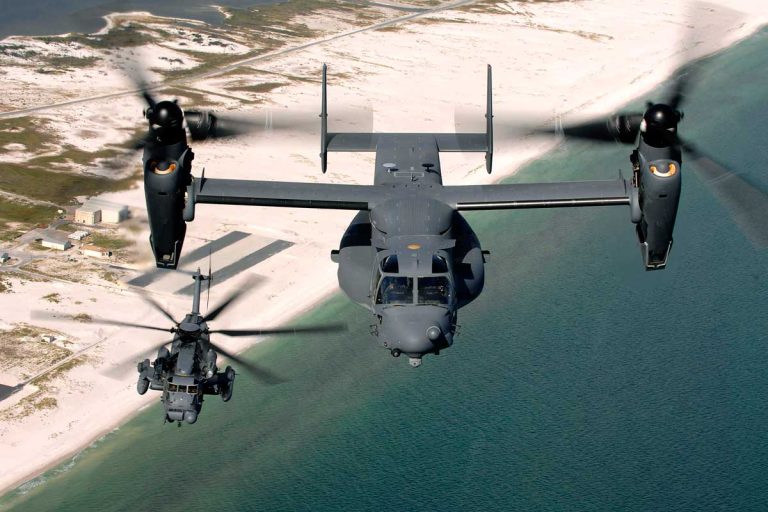
Where did Osprey come from, and what is it used for?
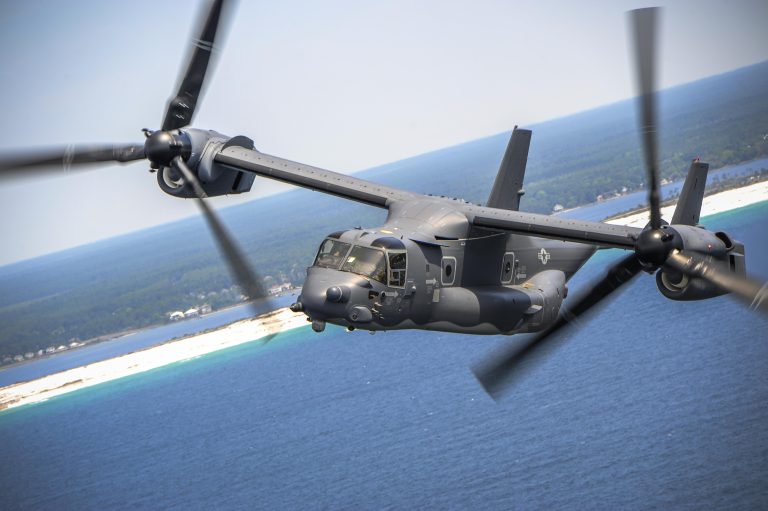
The CV-22B is a specialized version of the V-22 Osprey tiltrotor aircraft, developed for tactical missions by special operations forces. The V-22 family itself arose from the need to create an aircraft that combines a vertical takeoff and landing (VTOL) helicopter (VTOL) with a high-speed, long-range aircraft, enabling it to effectively carry out complex infiltration, evacuation, and logistics missions.
The original concept was developed as early as the late 20th century, and prototypes began to appear in the 1980s and 1990s. It was the CV-22—a specialized version for the Air Force Special Operations Command—that became the solution the U.S. uses for rapid force deployment, deep raids, and tactical support.
How It Flies: Design Features
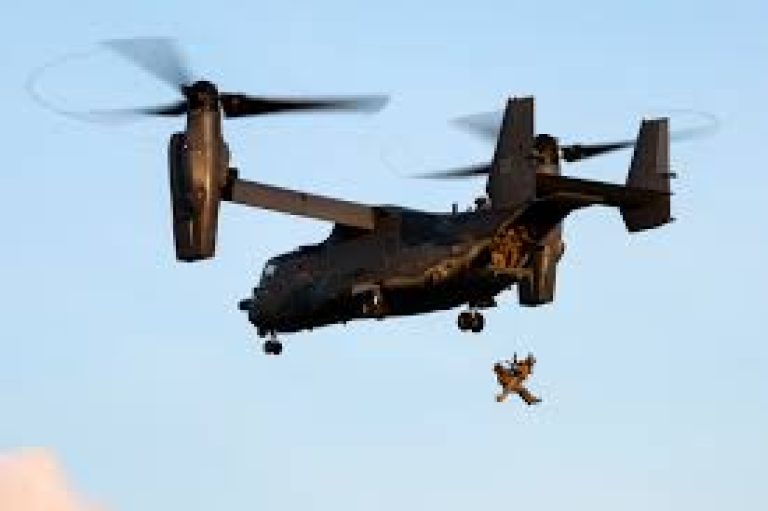
The main feature of the CV-22B is its convertible wing configuration. This means that during takeoff and landing, the rotors and engines are in a vertical position, like a helicopter, and in a horizontal position, like an airplane. This design gives it unique advantages:
- vertical takeoff and landing without the need for airfield infrastructure;
- speed and range comparable to those of conventional aircraft;
- adaptability in challenging environments—from jungles to mountainous regions;
- the ability to operate in bad weather and at night thanks to state-of-the-art navigation systems and sensors.
Tactical and Technical Specifications of the CV-22B

The CV-22B tiltrotor combines transport and operational capabilities, including:
Dimensions and Powertrain:
- Length approximately 17.4 m, rotor span approximately 25.8 m, height approximately 6.7 m;
- Engines: two Rolls-Royce-Allison AE1107C turboshaft engines, each with a power output of more than 6,200 liters of force. 352sow.af.mil
Flight Characteristics:
- Cruising speed — up to 277 mph (approximately 445 km/h);
- Practical ceiling—up to 25,000 feet;
- Operational range—approximately 500 nautical miles without refueling; with in-flight refueling, the range can be significantly extended;
- Operational range—over 2,100 miles with in-flight refueling, enabling long-range missions.
Capacity and Payload:
- Crew: four people (two pilots and two flight engineers/specialists);
- Transportation of up to 24 soldiers in seats, up to 32 people on the floor, or approximately 4,500 kg of cargo;
- Capable of transporting up to 10,000 pounds (approximately 4,500 kg) internally, or cargo on an external sling. 352sow.af.mil
Weapons and Systems:
- There is usually one large-caliber machine gun installed for self-defense;
- It is equipped with state-of-the-art navigation systems, including radar with terrain-following capability, infrared sensors, and secure communication systems.
Operational History and Combat Use
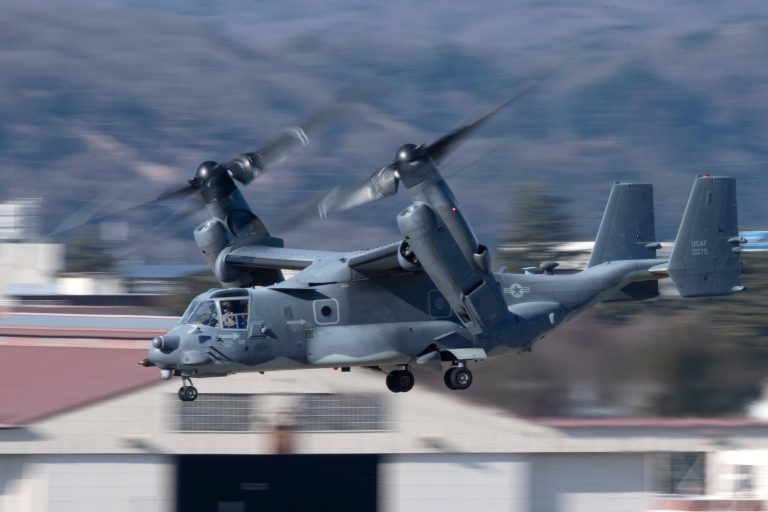
The CV-22B tiltrotors began entering service in the mid-2000s and were deployed for the first time in actual operations as early as 2008–2009, including in Africa and Iraq. Over the years of service, they have proven their value for special operations missions, especially where covert, rapid movement of forces over long distances or operations from concealed locations are required.
Despite its merits, the Osprey’s operation was not without problems—over the years, the aircraft were temporarily grounded to conduct a detailed review of safety issues. This reflected the complex nature of the tiltrotor design and led to stricter requirements for maintenance and upgrades.
The Park and Its Current Use
As of the end of 2025, the CV-22B program includes approximately 50–56 aircraft assigned to the U.S. Air Force Special Operations Command that regularly participate in training, regional deployments, exercises, and actual operations.
The deployment to Puerto Rico—involving at least nine CV-22Bs, as evidenced by satellite data and air traffic patterns—underscores the importance of this region for rapid deployment, rescue, tactical support, or covert operations.
Conclusion
The CV-22B Osprey has become one of the key aircraft in modern U.S. aviation, combining transport and tactical capabilities. Its tiltrotor configuration provides unique capabilities for vertical takeoff and rapid long-range flights, which are particularly valuable for special operations forces. The deployment of these aircraft to Puerto Rico in 2025 reflects the strategic importance of tiltrotors in the global aviation architecture of the 21st century—from flexible logistics to covert operations.