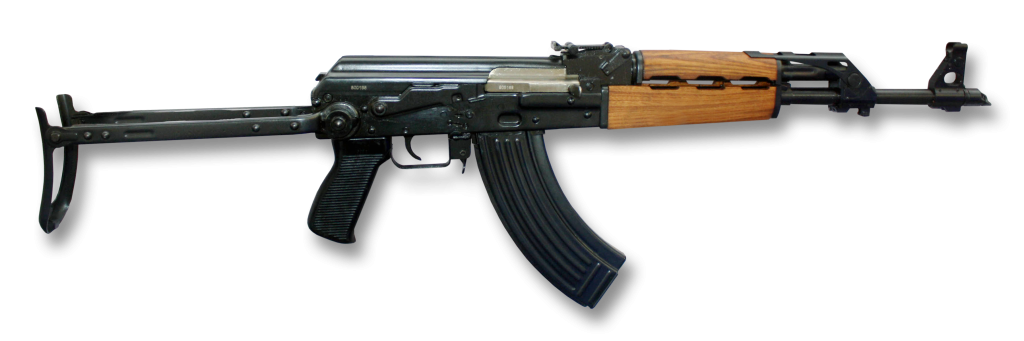
Place a Soviet AKM next to a late-production Yugoslav Zastava M70 and the ancestry of the latter is immediately obvious. The same long-stroke gas-piston system, the same rotating bolt, the same 7.62×39 mm cartridge, and the unmistakable silhouette of a Kalashnikov rifle. Even today, Zastava openly describes later weapons from this family as being based on the Kalashnikov operating system.
But pick up both rifles and the similarities become less complete. The Soviet AKM was the result of years of effort to reduce weight, manufacturing complexity, and production costs. The AK’s heavy milled receiver was replaced with a lighter stamped one, numerous components were simplified, and the unloaded rifle eventually came down to roughly 3.1 kilograms.
The Yugoslavs followed essentially the same path toward a stamped receiver — and then made it thicker. Late M70B1 and M70AB2 rifles used a 1.5 mm stamped receiver and a reinforced front trunnion resembling the arrangement used on the Soviet RPK light machine gun. The standard AKM receiver was approximately 1 mm thick. As a result, the Yugoslav rifle ended up heavier than the Soviet weapon on which it was based.
It seems like a strange reversal. Soviet designers had spent years making the Kalashnikov lighter, only for Yugoslav engineers to start moving in the opposite direction.
But this was not an attempt to “fix” the AKM. Yugoslavia was developing a rifle for a somewhat different infantry weapons system. Once the M70 is examined component by component, something interesting becomes clear: this was not merely a Balkan copy of the Kalashnikov, but an independent branch of its evolution.
A Kalashnikov Built Without Kalashnikov
The story begins with a circumstance that had a major influence on the weapon’s development. Yugoslavia did not receive a complete Soviet technical package and production license for the AK. Relations between Moscow and Belgrade eventually recovered after the Soviet-Yugoslav split of the late 1940s, but under Josip Broz Tito, Yugoslavia continued to pursue an independent military policy.
The concept behind the new Soviet assault rifle nevertheless attracted considerable Yugoslav interest.
Work on a domestic Kalashnikov-pattern weapon began in the late 1950s. Instead of simply establishing a licensed production line, engineers at the Kragujevac factory had to reproduce and adapt the design themselves. Forgotten Weapons dates the beginning of the Yugoslav program to 1959 and notes that the country did not receive a Soviet technical data package.
One of the early results was the M64. Even at this stage, it was clear that Yugoslav engineers were not interested in producing the most exact copy of the Soviet rifle possible.
The design included a true bolt hold-open mechanism that locked the action to the rear after the last round had been fired. This was highly unusual for a Kalashnikov. A standard Soviet AK closes its bolt after the final shot, meaning the shooter receives no immediate indication from the bolt carrier that the magazine is empty.
On early Yugoslav prototypes, the bolt remained open. The convenience came at a price, however: the mechanism interacted with a special cut in the magazine. It was eventually abandoned because compatibility with standard AK magazines was considered more important. The Yugoslavs retained a simpler solution — a special magazine follower that held the bolt open after the final round. Remove the magazine, and the bolt closed again.
It was a small detail, but it revealed something important about the designers’ attitude toward the original weapon.
For them, the Kalashnikov was a foundation, not an untouchable blueprint.
The real divergence, however, came from a weapon that today can seem almost forgotten.
The Rifle Was Also Expected to Launch Grenades
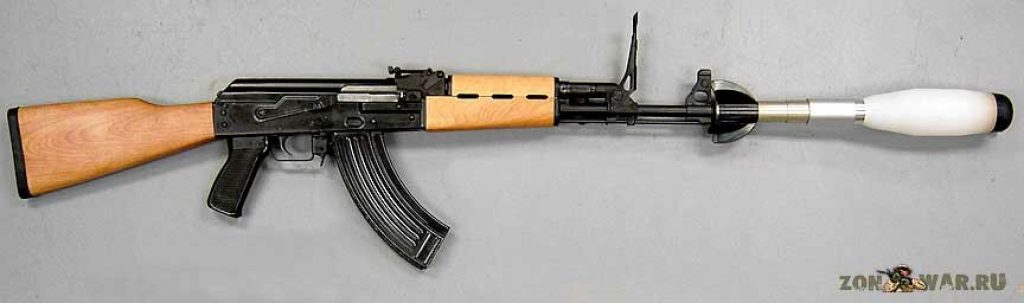
In postwar armies, rifle grenades were for a time regarded as a highly practical way to dramatically increase the firepower of an ordinary infantryman. No separate grenade launcher was required: a grenade could be fitted to the muzzle of a standard rifle, a special blank cartridge loaded, and the soldier suddenly had a weapon capable of delivering far more explosive power than an ordinary bullet.
The Yugoslav People’s Army took this capability very seriously.
That is why the M70 received one of the most recognizable features of the Yugoslav Kalashnikov — a folding ladder sight for launching rifle grenades.
And it was not merely an additional sight.
Raising it shut off the gas system. Propellant gases no longer flowed to the gas piston and were instead used to propel the grenade. The rifle’s self-loading action therefore ceased to operate: after firing, the weapon effectively became a manually operated single-shot rifle until the next cartridge was chambered.
The sight had separate scales for the M60P1 fragmentation grenade and the M60 anti-tank grenade. Small Arms Review gives maximum ranges of up to 240 meters for the former and 150 meters for the latter.
This is where many of the differences between the M70 and AKM begin to make sense.
Launching a rifle grenade places very different stresses on a weapon than firing an ordinary cartridge. The rifle had to withstand a powerful impulse and do so repeatedly under military conditions.
The Yugoslavs therefore began reinforcing the design.
The characteristic button at the rear of the M70 receiver locked the recoil-spring guide in place and helped secure the receiver cover. A standard AKM has no equivalent feature. On a rifle regularly used to launch rifle grenades, this additional safeguard had a practical purpose.
And eventually the reinforcement went even further.
Why the M70 Ended Up With an RPK-Like Receiver
The history of the M70 is complicated by the fact that the designation covered numerous significantly different variants. There were rifles with milled and stamped receivers, fixed and folding stocks, different barrel-mounting methods, and even different stamped-receiver thicknesses.
In simplified form, the development went something like this: early M70 and M70A rifles used milled receivers; these were followed by the M70B and M70AB; production later shifted to stamped M70B1 and M70AB2 variants. There were also transitional configurations, such as the M70AB1 with a lighter receiver. Therefore, the claim that “all M70s have 1.5 mm receivers” is incorrect.
But the later configuration became what most people now recognize as the classic Yugoslav M70.
And here the designers adopted a rather unusual solution for a standard infantry rifle.
The stamped receiver was made from 1.5 mm steel, compared with approximately 1 mm on the Soviet AKM. The front trunnion was also substantially reinforced. Its greater dimensions produced the easily recognizable rectangular bulges on the sides of the receiver.
Anyone familiar with the Soviet RPK will recognize the arrangement.
For a light machine gun, reinforcement makes perfect sense. The RPK was intended for more sustained fire, so its receiver and front trunnion incorporated a greater structural margin than those of a standard assault rifle.
The Yugoslavs effectively applied a similar philosophy of durability to an ordinary infantry weapon.
Small Arms Review describes the result succinctly: the M70 received something approaching RPK-level strength in the dimensions of a standard rifle.
The price was weight.
And this is where the original paradox begins to disappear.
Yugoslav engineers had not forgotten why the Soviet Union developed the AKM. They were simply optimizing their rifle around different requirements. For the Soviet Army, one of the main goals was a lighter, more economical, highly manufacturable mass-production rifle. For the Yugoslav People’s Army, rifle grenades remained an important part of the infantry squad’s firepower.
The same basic mechanism was therefore being developed in two different directions.
The M70 Differs From the AKM in More Than Just Thicker Steel
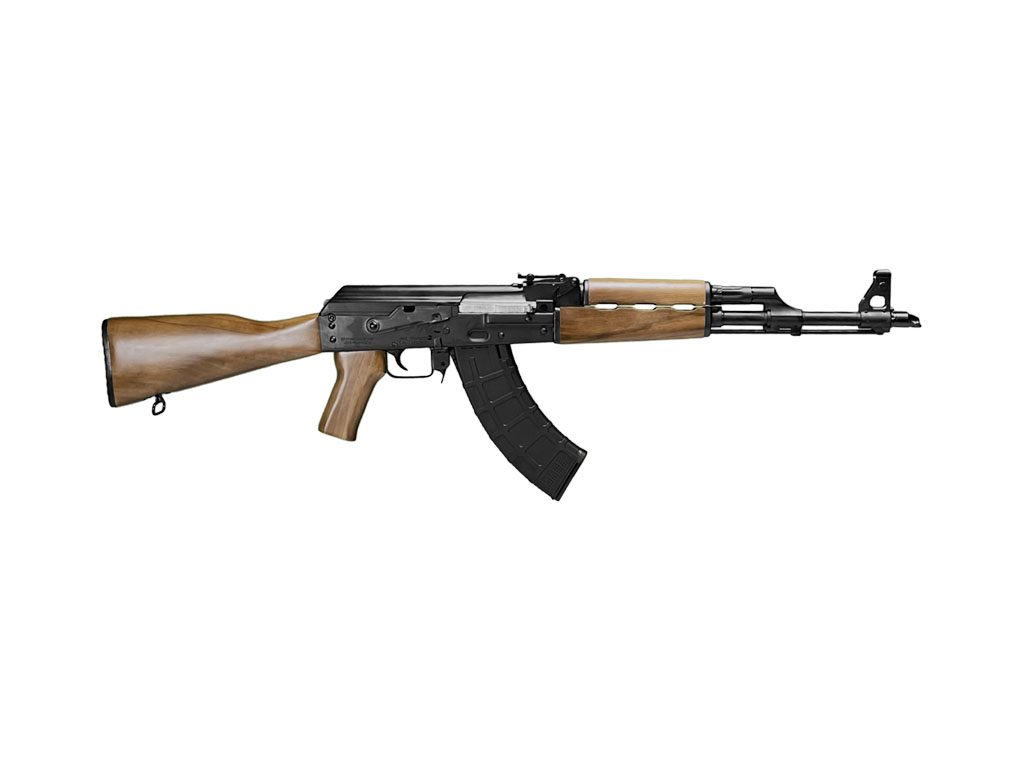
Place the two rifles side by side and an experienced observer can quickly learn to identify the Yugoslav weapon.
The M70 has a distinctive longer wooden handguard with three cooling slots rather than the two commonly seen on Soviet AKMs. The gas block carries the grenade sight. On later variants, the receiver displays the characteristic bulges associated with the reinforced front trunnion. There is also the previously mentioned locking mechanism for the recoil-spring guide.
Some differences are less obvious.
One of the best known is the absence of a chrome-lined bore on classic Yugoslav M70 rifles. Soviet AKMs used chrome-lined bores and chambers, improving corrosion resistance and simplifying maintenance when military ammunition was used under less-than-ideal conditions.
The Yugoslav approach was different. This did not automatically make the barrel poor or short-lived, but it did place greater demands on cleaning and corrosion prevention.
At the same time, many M70 features cannot simply be divided into “better” and “worse.”
A reinforced receiver increases structural strength — but adds weight.
A rifle-grenade system gives an infantryman additional firepower — but requires extra components.
A bolt hold-open feature is convenient for the shooter — but the original mechanism interfered with full compatibility with standard AK magazines, so it was abandoned.
A heavier rifle can feel more stable when firing — but the soldier still has to carry it together with ammunition and the rest of his equipment.
That is why comparing the M70 with the AKM becomes far more interesting than simply trying to identify the “better Kalashnikov.”
They represent two different sets of compromises.
Key Differences
| Cartridge | 7.62×39 mm | 7.62×39 mm |
| Operating system | Gas-operated, rotating bolt | Gas-operated, rotating bolt |
| Receiver | Stamped | Stamped |
| Receiver thickness | Approx. 1 mm | 1.5 mm |
| Front trunnion | Standard AKM | Reinforced, RPK-style |
| Rifle grenades | Not central to AKM design | Standard capability |
| Gas shutoff | No | Yes |
| Grenade sight | No | Yes |
| Receiver cover/recoil assembly retention | Standard AK arrangement | Additional locking system |
| Bolt hold-open | No | True mechanism on early designs; later magazine-follower system |
| Chrome-lined barrel | Yes | Generally absent on classic M70s |
| Magazine capacity | 30 rounds | 30 rounds |
What matters most is not any individual row in the table, but the pattern they create.
Almost every significant difference in the M70 can be traced either to Yugoslav doctrine and weapon requirements or to the country’s independent manufacturing evolution.
Why Didn’t Yugoslavia Simply Copy the AKM?
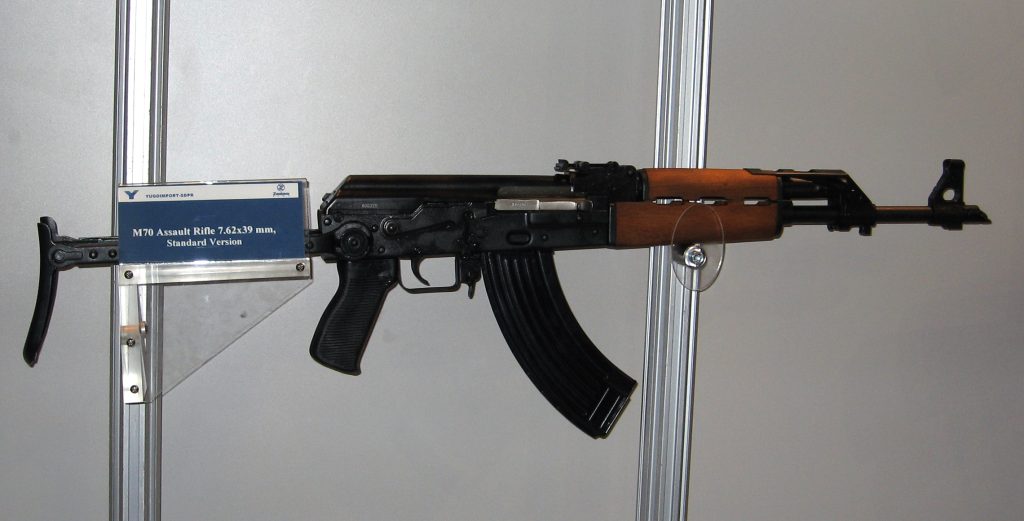
At first glance, that would seem to have been the most rational solution.
By the early 1960s, the Soviet Union had already gone through the difficult evolution from the early AK and its unsuccessful attempt at a stamped receiver, to the heavier milled-receiver AK, and finally to the far more production-efficient AKM. A huge country with enormous experience in mass-producing small arms had already solved many of the difficult engineering problems.
Why not simply copy the finished solution?
Because military equipment rarely exists independently of the army expected to use it.
Yugoslavia was building its armed forces for a highly specific strategic situation. The country stood between two military blocs, belonged to neither NATO nor the Warsaw Pact, and prepared for the possibility of a major war against a more powerful adversary. This encouraged a large army, an extensive territorial-defense structure, a domestic defense industry, and a strong emphasis on producing weapons independently.
Within that system, the M70 was expected to be more than merely a cheap mass-produced assault rifle.
It became one of the basic weapons of Yugoslav infantry.
Rifle grenades allowed a squad to deploy fragmentation and anti-armor munitions without issuing a separate dedicated grenade launcher to every unit. The later spread of under-barrel grenade launchers would change how many armies approached this problem, but when the M70 was developed, the Yugoslav solution was entirely rational.
And if the rifle was expected to perform this additional job regularly, the extra mass of its reinforced construction no longer looks pointless.
It becomes the price of versatility.
The Most Interesting Part Came Later
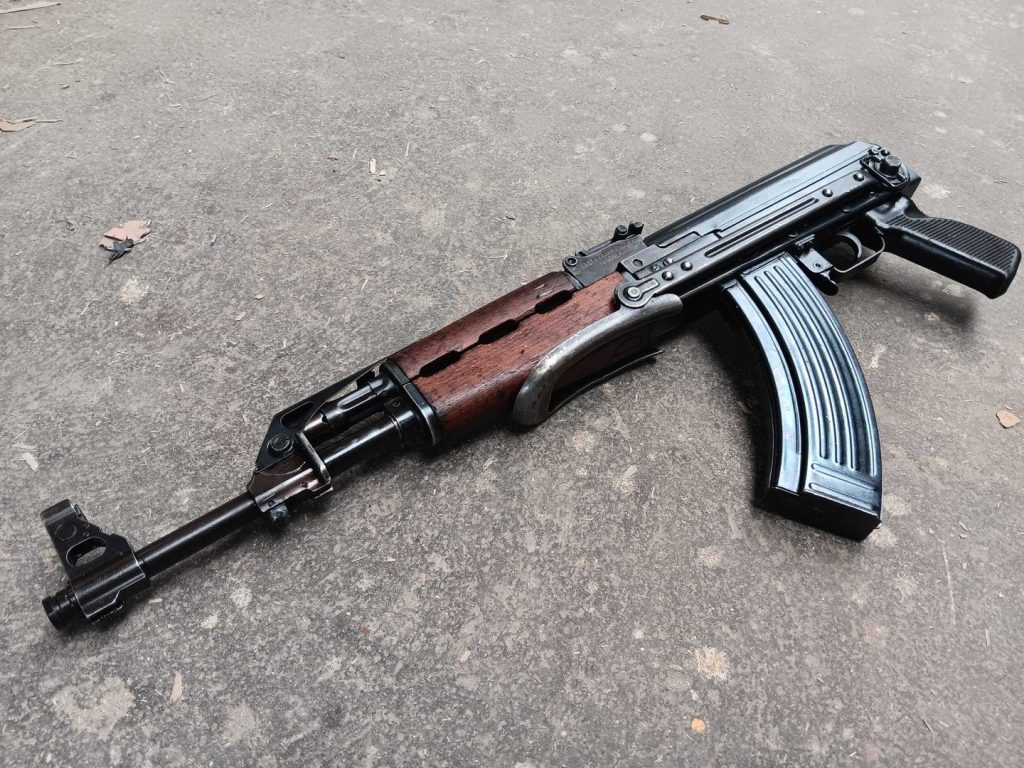
One might expect this separate branch of Kalashnikov development to have disappeared after the breakup of Yugoslavia.
Instead, it continued.
Zastava kept developing the family. The modern Serbian M05 in 7.62×39 mm is officially described by the manufacturer as an upgraded version of the M70. The basic Kalashnikov operating principle remains, but polymer furniture, accessory rails, modern sights, and other features required by a very different military environment have been added.
The result is an engineering lineage extending across more than half a century.
The Soviet AK provided the starting point.
The Yugoslavs independently reproduced its operating principle.
They then began adapting the weapon to their own requirements.
The M64 introduced indigenous solutions.
The M70 evolved into a full production family.
Its reinforced stamped construction became one of its most recognizable characteristics.
And later Serbian rifles grew out of the M70.
Calling the Zastava M70 simply a “Yugoslav copy of the AKM” is therefore convenient, but not entirely accurate.
Copying was only the beginning of the story.
So Why Did Yugoslavia Make the Kalashnikov Heavier?
We can now return to the question we started with.
The Soviet Union steadily reduced the weight of the Kalashnikov and ultimately produced the AKM. Yugoslavia adopted the same basic operating system, moved toward stamped receivers — and then, in the best-known late M70 variants, increased the thickness of the steel and installed a heavier front trunnion.
At first glance, it really does look like a step backward.
But only if we assume that designers in both countries were solving exactly the same problem.
The Yugoslavs needed a weapon that could perform the normal duties of an assault rifle while fitting into their own infantry weapons system, in which rifle grenades played a significant role. At the same time, they were developing their own production base for a Kalashnikov-pattern weapon and had no reason to reproduce every Soviet engineering decision exactly.
That is how the M70 emerged.
Not an improved AKM.
Not an inferior AKM.
And not simply a copy.
It was the same engineering principle reshaped by the requirements of a different army.
That is perhaps why the Zastava M70 remains so interesting decades later. It demonstrates how misleading superficial similarities between small arms can be. Change the requirements imposed on the same basic weapon, and two countries can begin developing almost identical mechanisms in very different directions.
The Soviet designer looked at the AK and asked where more unnecessary metal could be removed.
The Yugoslav designer asked where some of that metal needed to be put back so the rifle could do everything his army expected of it.