AO-46: The Assault Rifle That Lost to Kalashnikov but Pushed the USSR to Create a New Class of Weapon

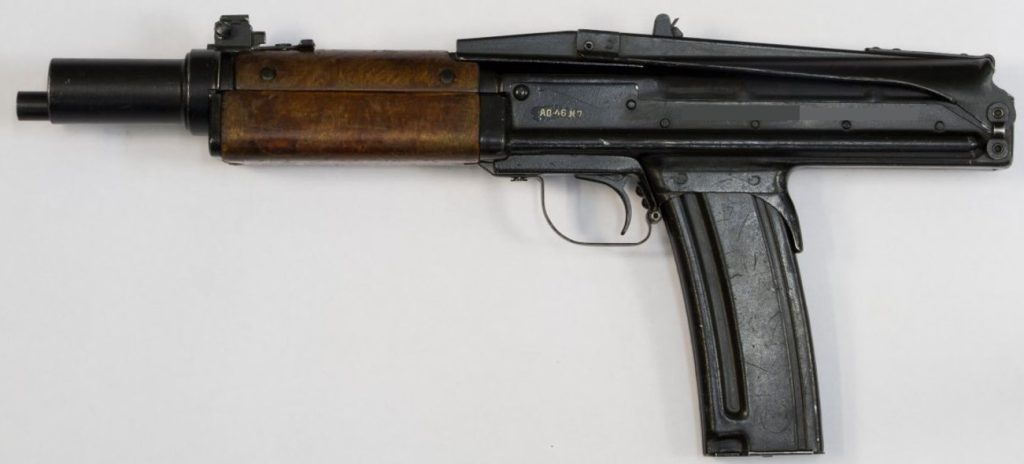
In the history of Soviet small arms, the AO-46 usually appears somewhere in the margins of the much larger Kalashnikov story. It was a small experimental assault rifle developed by Pyotr Tkachev at TsNIITochMash in the late 1960s. It never entered mass production, was never officially adopted, and the role of a compact weapon in the Soviet Army was eventually filled by the AKS-74U. At first glance, the story seems simple enough: another experimental design lost to the famous Kalashnikov family.
But what actually happened was considerably more interesting.
When Tkachev began working on the AO-46, the competition it supposedly lost to the AKS-74U did not even exist yet. Neither did the AKS-74U itself. The AO-46 emerged around 1969–1970 as a private initiative, and the results of its trials became one of the factors that helped the military formulate requirements for a future compact assault rifle. In 1973, those requirements evolved into the “Modern” competition, which several years later resulted in the selection of the shortened Kalashnikov.
That creates a rather unusual story.
The AO-46 did not really lose a competition to the AKS-74U. In a sense, the AO-46 helped create the competition that the Kalashnikov would eventually win.
Not Every Soldier Needs a Full-Size Rifle — but Sometimes a Pistol Is Not Enough
By the late 1960s, Soviet designers were facing a problem that seems obvious today. A modern army contains huge numbers of servicemen for whom a rifle is a secondary tool.
A tanker’s primary job is to operate a tank. An artilleryman serves a gun. An anti-tank missile crew operates its missile system. A radio operator carries communications equipment. A driver operates a vehicle. For all of them, a full-size assault rifle can be an inconvenience: it has to be stored inside a cramped fighting compartment, cab, or alongside other essential equipment.
But going without a weapon is not an option either.
If a vehicle is knocked out, a position is attacked, or a unit suddenly encounters the enemy, the crew needs more than a symbolic self-defense weapon. It needs something capable of delivering serious fire.
The Makarov pistol was compact, but the capabilities of its pistol cartridge were limited. The AKM was far more effective, but even with a folding stock it remained a relatively large weapon.
There was an obvious gap between the two.
Pyotr Andreyevich Tkachev decided to fill it.
The AO-46 was developed at TsNIITochMash around 1969–1971 primarily as an extremely compact weapon for tank crews, artillery and anti-tank teams, communications personnel, drivers, and other servicemen for whom carrying a conventional assault rifle was inconvenient. The earliest work used the experimental 5.6 mm 13MZhV cartridge, which eventually evolved into the production 5.45×39 mm Soviet round.
Tkachev was essentially asking a very simple question:
What if, instead of reducing the power of the weapon, we reduced the weapon itself?
Instead of a Pistol Cartridge, the Future 5.45×39 mm
This decision is essential to understanding the AO-46.
The easiest route to compactness already existed: the submachine gun. A small weapon chambered for a pistol cartridge could be made light, short, and relatively convenient for vehicle crews.
Tkachev chose another path.
He used the promising new low-impulse assault-rifle cartridge.
That immediately made the AO-46 a much more interesting system. The challenge was effectively to compress the capabilities of an assault rifle into something approaching the dimensions of a large submachine gun.
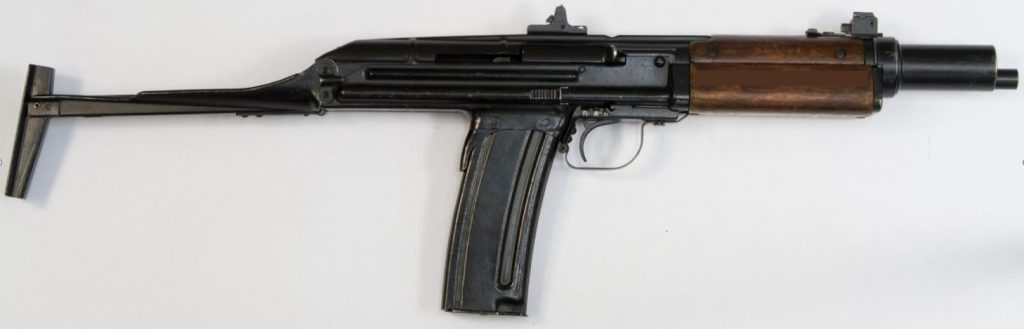
The resulting weapon weighed approximately 1.8–1.95 kg without a loaded magazine, measured roughly 655 mm with the stock extended and about 450–458 mm with it folded. Its cyclic rate was around 650–700 rounds per minute.
For comparison, the requirements later formulated for the “Modern” competition limited the weight of the future compact assault rifle to roughly 2.2 kg, with a length of approximately 750 mm with the stock extended and 450 mm folded.
In other words, Tkachev’s experiment had already demonstrated that a weapon of this class was physically possible.
But achieving such compact dimensions required serious compromises.
How Do You Fit an Assault Rifle Into 45 Centimeters?
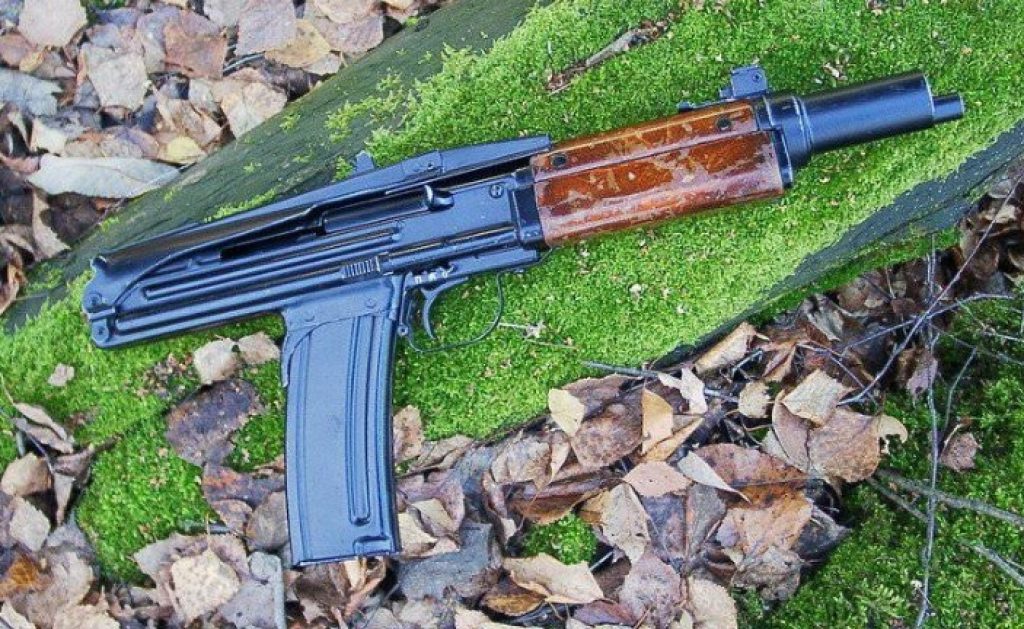
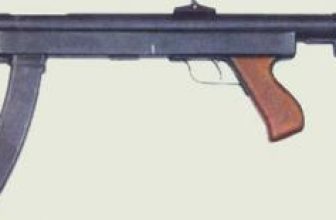
The most distinctive feature of the AO-46 is immediately obvious.
There is essentially no conventional pistol grip.
The magazine itself serves as the grip.
The basic idea was hardly new. Magazines housed inside pistol grips had long been used in submachine guns. But those weapons fired short pistol cartridges, allowing the grip to remain reasonably compact.
An assault-rifle cartridge makes the problem much more difficult.
The 5.45×39 mm cartridge is too long for a conventional magazine to form a comfortable grip. Tkachev therefore developed a special magazine in which the cartridges sat at an upward angle. This reduced the magazine’s longitudinal dimensions while preserving the extremely compact overall layout.
But this too required a compromise.
Different sources mention 15- and 20-round magazines. Museum and reference information on early AO-46 configurations often gives 15 rounds, while Maxim Popenker lists a 20-round magazine for the better-known later configuration. It is therefore unwise to claim that every AO-46 existed with only one magazine type.
Either way, the ammunition immediately available in the weapon was less than the standard 30 rounds carried by an AK.
And that illustrates the philosophy of the design perfectly.
The AO-46 was never intended to become the standard rifle of an infantry squad.
It did not have to replace the AK everywhere.
It simply had to be small enough to always remain with a serviceman for whom a conventional rifle would normally get in the way.
The Short Barrel Created Another Problem
Shortening an assault-rifle barrel is technically easy.
Making the resulting weapon function properly is much harder.
The AO-46 had a barrel approximately 245 mm long. Muzzle velocity is generally given as around 715 m/s, while the weapon was primarily intended for engagements at distances of roughly 200 meters.
But loss of velocity was not the only problem.
When a bullet leaves a very short barrel, propellant gas pressure remains high. This produces the familiar problems associated with short-barreled assault rifles: intense muzzle flash, sharp blast, and difficulties in making the gas-operated action function correctly.
Tkachev developed a rather unusual solution.
Instead of using a conventional gas port located farther back along the barrel, the AO-46 incorporated a large cylindrical expansion chamber near the muzzle, connected to the gas system. It participated in operating the action while also helping reduce the effects of the muzzle gases. TsNIITochMash itself has noted that the expansion chamber made it possible to maintain the weapon’s very short dimensions while keeping sound pressure near the shooter at an acceptable level.
This feature highlights just how different the AO-46 was from the later AKS-74U.
Tkachev was not simply taking an existing assault rifle and cutting away everything that seemed unnecessary.
He was designing a compact weapon as a compact weapon from the beginning.
Underneath the Strange Appearance, It Was Still a Real Assault Rifle
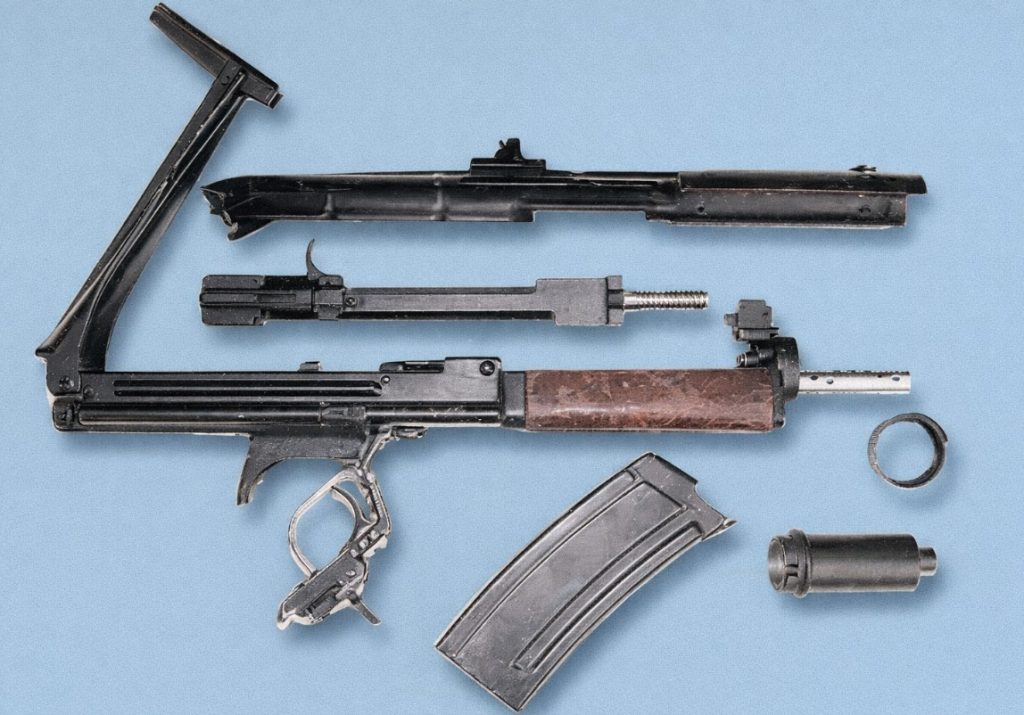
Behind its unusual exterior was serious rifle engineering.
The AO-46 used gas operation and a rotating bolt to lock the barrel. It was capable of both semi-automatic and fully automatic fire. A simple metal shoulder stock folded over the top of the weapon, while many components were manufactured from stamped sheet steel.
The result was a fascinating combination.
In dimensions — almost a submachine gun.
In weight — less than two kilograms.
In ammunition — an assault rifle.
In operating principle — a fully locked automatic weapon.
This is why describing the AO-46 today as an early analogue of the PDW — Personal Defense Weapon — is so tempting.
But there is an important qualification.
Calling the AO-46 “the First PDW” Would Be Going Too Far
The term PDW appeared much later and is primarily associated with Western requirements for compact weapons intended for second-line personnel. The best-known examples, the FN P90 and HK MP7, use specially developed small-caliber, high-velocity cartridges.
The AO-46 was developed in another country, in another era, under a very different system of requirements.
But the tactical problem was remarkably similar.
A weapon for someone whose primary job is not being a rifleman.
Smaller than a conventional assault rifle.
More effective than a pistol.
Capable of immediately delivering substantial firepower during an unexpected engagement.
In that sense, the Soviet experiment of the late 1960s really does resemble the concept that would much later become known as the PDW.
But Tkachev did not create a special cartridge.
He attempted to build the entire weapon around the Soviet Union’s prospective standard assault-rifle round.
From a logistical perspective, that potentially made the AO-46 particularly interesting.
Then the Military Realized It Actually Needed Such a Weapon
The AO-46 went through a complete cycle of trials at TsNIITochMash, including testing under adverse conditions. The experimental weapon did not enter production, but its results were convincing enough for the basic idea to continue.
In 1973, the Soviet military launched the “Modern” competition.
And this is where the history is often distorted.
A common version goes something like this:
The AO-46 competed in “Modern” and lost to the AKS-74U.
It is a convenient story.
But it oversimplifies what actually happened.
The AO-46 was a precursor to the competition. After its appearance, the military formulated requirements for a dedicated compact assault rifle, and an entire group of new designs subsequently competed under the “Modern” program.
Designs came from Kalashnikov, Stechkin, Simonov, Konstantinov, Dragunov, and other Soviet engineers. Yevgeny Dragunov, for example, developed the remarkably compact MA, Igor Stechkin produced the TKB-0116, while Simonov offered the AG-043.
In other words, the AO-46 accomplished perhaps the most important thing an experimental weapon can achieve.
It proved that the requirement itself was valid.
And Then Kalashnikov Entered the Picture
Mikhail Kalashnikov possessed a completely different advantage.
Not necessarily the best possible compact rifle.
But an existing system.
By this point, the Soviet Union was moving toward adoption of the AK-74 and its new 5.45×39 mm cartridge. Manufacturing, technology, training, maintenance, and logistics were increasingly being organized around the new Kalashnikov family.
Instead of introducing a completely new weapon, the Soviet military could take the AK-74 and adapt it as far as possible to the requirements of the “Modern” competition.
The result became the future AKS-74U.
Its layout was far less radical than that of the AO-46. It retained familiar controls, a separate pistol grip, the standard 30-round magazine, and the overall Kalashnikov architecture.
The resulting weapon was larger and heavier than what Tkachev had proposed years earlier.
But for an army there was another characteristic that never appears clearly in a conventional specification table.
Standardization.
Sometimes Common Parts Matter More Than a Few Extra Centimeters
This is one of the main reasons why the AO-46 story remains interesting today.
Imagine two alternatives.
The first is a technically original weapon weighing less than two kilograms. A special magazine. An unusual layout. Its own gas system. Unique components. Dedicated production tooling.
The second is a shortened member of a weapon family already being introduced across a massive army.
The soldier already understands how a Kalashnikov works.
The armorer already knows how to maintain it.
Industry already knows how to manufacture it.
The logistics system already handles the same magazines and ammunition.
Even training becomes easier.
And when the more original design does not provide a revolutionary advantage in combat effectiveness, an army inevitably begins to count money, spare parts, production capacity, and training hours.
That ultimately favored Kalashnikov. In 1977, the Soviet Main Missile and Artillery Directorate selected his design, with the ability to reduce production costs by using the existing AK-74 industrial base being one of its major advantages. Following troop trials, the AKS-74U was officially adopted at the end of the 1970s.
This was not simply a triumph of conservatism over technical innovation.
It was a triumph of the system over the individual weapon.
And the AKS-74U Was a Compromise Too
Shortening a standard assault rifle comes at a price.
The AKS-74U has a substantially shorter barrel than the full-size AK-74. Muzzle velocity drops, muzzle blast becomes more severe, external ballistics change, and effective range is reduced.
But the military received what mattered most.
One cartridge.
One standard magazine.
Familiar ergonomics.
A closely related maintenance system.
And a weapon that could be issued to armored vehicle crews, specialist teams, airborne personnel, and other categories of troops without creating an entirely separate logistical infrastructure around it.
In this sense, the AKS-74U was a less elegant answer to Tkachev’s problem.
But a much more convenient answer for a huge army.
Which Means the AO-46 Did Not Really Lose
And here the story comes full circle.
The AO-46 never became a production weapon.
It never received its own GRAU service index.
It was never manufactured in hundreds of thousands.
It did not serve through Afghanistan or the many conflicts that followed.
Today, it survives primarily as a museum piece and a fascinating chapter in the history of Soviet small-arms engineering.
But if an experimental weapon is judged not by the number produced, but by the influence it had, the picture changes.
Tkachev demonstrated that a weapon chambered for the prospective Soviet low-impulse rifle cartridge could weigh less than two kilograms and measure around 45 centimeters with its stock folded.
More importantly, he demonstrated that there really was a distinct tactical niche between the pistol and the conventional assault rifle.
The military subsequently formulated requirements.
“Modern” appeared.
A competition began.
And the eventual result was the AKS-74U.
The conclusion is almost ironic.
Seen behind museum glass, the AO-46 looks like the loser.
Look at the sequence of events, however, and the picture is almost reversed.
The Soviet Army did not adopt Tkachev’s rifle. It adopted Tkachev’s idea.
It simply implemented that idea in the much more familiar form of a Kalashnikov.
And that is why the AO-46 is more interesting not as an “AKS-74U killer that never got its chance,” but as the experiment after which the Soviet military effectively said:
All right, we really do need a weapon like this. Now let us find out who can build it for an army of millions.