“People like to say that the First Crusade began at Clermont. Perhaps, for history, that is true. But for me it began several days later, in a quiet chamber of the ducal palace at Rouen, where a handful of grown men argued over matters that a fifteen-year-old squire could barely understand.”
From the writings of Ansel de Nantes.
Almost immediately after the great autumn hunt, we left Caen. The journey back passed without incident, but the mood among the men had noticeably changed. Only a few days earlier, Geoffroi and Drogo had argued endlessly about the miller’s daughter, laughed at my embarrassment after speaking with Lady Agatha, and invented ever new reasons to make sport of me. Now every conversation returned sooner or later to the same letter brought by the papal messenger. No one knew exactly what it contained, but everyone understood that something important had happened.
Rouen greeted us with the familiar noise of a great city. After Caen, it had always seemed a very different place to me. Caen was first and foremost a fortress—stern, military, shaped by the life of its garrison. Rouen lived by trade. Even from a distance, dozens of ships could be seen upon the Seine. At the quays men unloaded barrels of wine, bales of wool, timber, and sacks of grain. Smoke rose from countless hearths above the markets, smiths’ hammers rang out, boatmen called to one another, and the streets were so narrow that two laden carts might wait for some time before one could make way for the other. This was where the heart of the duchy beat, and from here Robert governed Normandy.
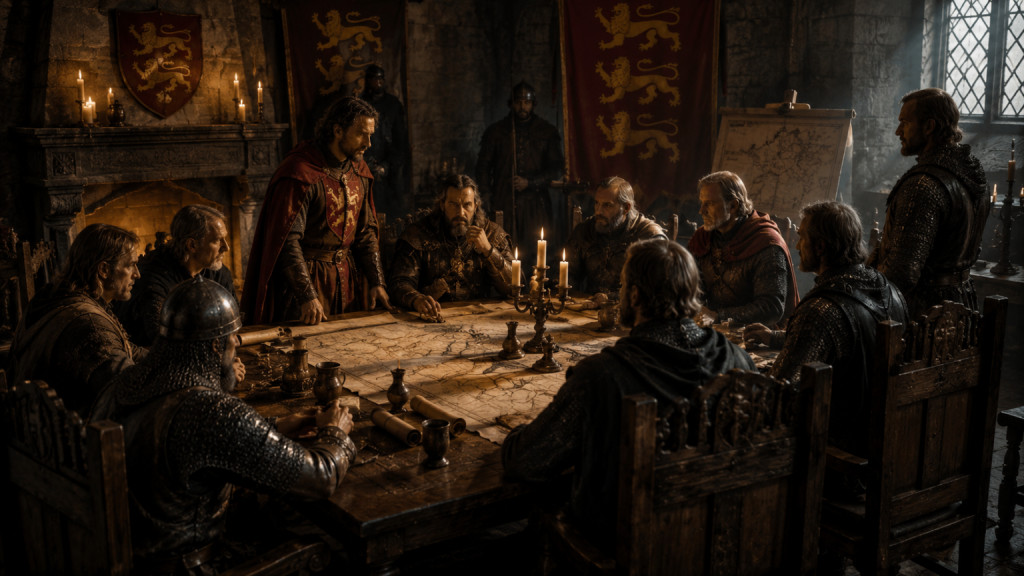
On the morning after our return, the duke ordered his closest advisers to assemble. The meeting took place not in some vast ceremonial hall, as I had once imagined such councils must, but in a spacious working chamber. At its center stood a long oak table covered with maps, scrolls, wax tablets, and the treasurer’s heavy counting boards. Maps of Normandy, southern Italy, and lands far beyond Constantinople hung upon the walls. Decisions were made in this room that would shape the lives of thousands.
As one of the duke’s squires, I was permitted to remain in the chamber. I stood behind Robert’s chair, trying not to miss a single word.
When everyone had gathered, Robert silently unfolded the letter he had received several days earlier.
“His Holiness Urban, Bishop of Rome, writes that at the Council of Clermont he appealed to the princes and lords of the West to aid the Christians of the East and liberate the Holy Land. The Emperor of the Romans, Alexios Komnenos, has asked for assistance against the Turks, who have seized much of Asia Minor.”
He carefully folded the letter and placed it upon the table.
“My lords… what do you think?”
One of the older barons spoke first.
“It is the Greeks’ misfortune. Let the Greeks deal with it.”
Several men nodded in agreement.
The Archbishop of Rouen calmly folded his hands before him.
“After Manzikert, they have rather fewer means of dealing with it themselves.”
The baron frowned.
“Manzikert was more than twenty years ago.”
“Which is precisely why the situation has become so grave,” the archbishop replied. “Emperor Romanos Diogenes was taken prisoner there, and the Seljuks gained the opportunity to occupy almost the whole of Asia Minor. Lands that had fed Constantinople for centuries were lost one after another. Today the Turks stand where, not so long ago, the richest Byzantine provinces once lay.”
For a moment, the chamber fell silent.
Robert slowly rose, walked to the map, and placed his hand upon the coast of Asia Minor.
“Many believe this is merely about Jerusalem,” he said quietly. “It is not.”
His finger moved slowly across the map.
“If the Romans lose these lands for good, the Seljuks will reach the Bosporus itself. Beyond the Bosporus lie the Balkans. Beyond the Balkans, the Adriatic. And after that comes southern Italy.”
He looked around the table.
“Apulia is not far away.”
No one contradicted him.
Everyone in the room knew perfectly well that Norman princes of the Hauteville family had themselves fought in southern Italy only a few years before. They understood better than most how close the Byzantine and Italian worlds truly were.
The treasurer broke the silence.
“If I may, my lord…”
Robert nodded.
“More goods from the East have passed through Rouen in recent years than ever before. Silk. Pepper. Cinnamon. Incense. Glass. Dyes. Medicines. Books.”
He turned several pages in his accounts.
“We buy all of them.”
Robert asked a question that, to me at the time, seemed to have nothing whatsoever to do with war.
“And what do they buy from us?”
The treasurer considered this.
“Some wool. Timber, sometimes. Iron…”
He shook his head.
“Very little.”
“Then,” Robert said calmly, “silver always flows east.”
No one argued.
“We pay for their riches,” the duke continued. “They have little need of what we produce.”
One of the younger barons shrugged.
“It has always been so.”
“That is precisely what troubles me,” Robert replied. “If silver flows in only one direction, sooner or later someone will run out of silver.”
The duke’s words made several of the advisers exchange glances. War was familiar enough to most of them, but Robert had once again shown himself to be a man accustomed to thinking not only about the battlefield, but about forces moving far beyond it.
Another baron, a grey-haired lord who possessed several small castles, unexpectedly changed the subject.
“Even if the Pope calls for an expedition, who will go?”
He gave a humorless smile.
“I have four sons. When I die, the eldest will inherit the land. The second will have the Church. And the two younger ones…”
He spread his hands.
“They will have only their swords.”
“As will thousands of others,” the duke’s marshal observed.
“Exactly.”
“They will find themselves a lord.”
“Or they will begin looking for land at swordpoint.”
Robert was silent for a while.
Then he said:
“Remember the Hautevilles.”
Everyone immediately understood whom he meant.
“They too were younger sons. There was almost nothing for them in Normandy. They went south… and carved out lands of their own.”
He looked at each man around the table.
“Europe has long since grown too small for its best warriors.”
For some reason, those words stayed with me more clearly than many sermons.
Only years later did I understand that they had not been speaking merely of a thirst for glory. Europe truly was passing through an age in which many young men of noble birth had been trained for one thing above all else: war. They were born not as heirs, but as men whose fathers might leave them little more than a horse, a coat of mail, a sword, and the good name of their family. Everything else they would have to win for themselves.
The council continued for a long time. They argued about money, risk, faith, and duty toward the Christians of the East. Each man brought his own reasons to the table, and what surprised me most was that nearly every one of them, in his own way, seemed to be right.
When at last the discussion subsided, Robert walked to the window. For a while he stood there in silence, looking down upon the grey autumn Seine, where merchant ships moved slowly with the current.
Without turning, he said:
“In a few days, I leave for Clermont.”
The chamber fell silent.
No one asked another question.
The council was over.
I was only fifteen years old then. I understood little of the movement of silver, the interests of states, the fate of Byzantium, or the laws of inheritance. It seemed to me that the grown men were once again discussing matters that could never concern an ordinary squire.
I was wrong.
Now, having lived a long life, I know that it was on that day, in a modest working chamber of the ducal palace at Rouen, that the First Crusade began for me.
No cry of Deus vult! had yet been raised. No one had sewn a cross onto his cloak, saddled a horse, or sworn a solemn vow.
But the decision was already taking shape.
History rarely changes the world with a single thunderous proclamation.
More often, it begins with a quiet conversation around an oak table.