230 Tons of Payload Without Diesel: China Builds the ZL230E Electric Mining Truck

Mining haul trucks seem like some of the least obvious machines to electrify. A vehicle weighing hundreds of tons has to carry ore continuously, climb long grades under load, and spend as little time stationary as possible. Yet this is exactly where electric drive can reveal some of its strongest advantages: enormous torque at low speed, regenerative braking on descents, and predictable operating routes that make it possible to design the charging infrastructure around the mine itself.
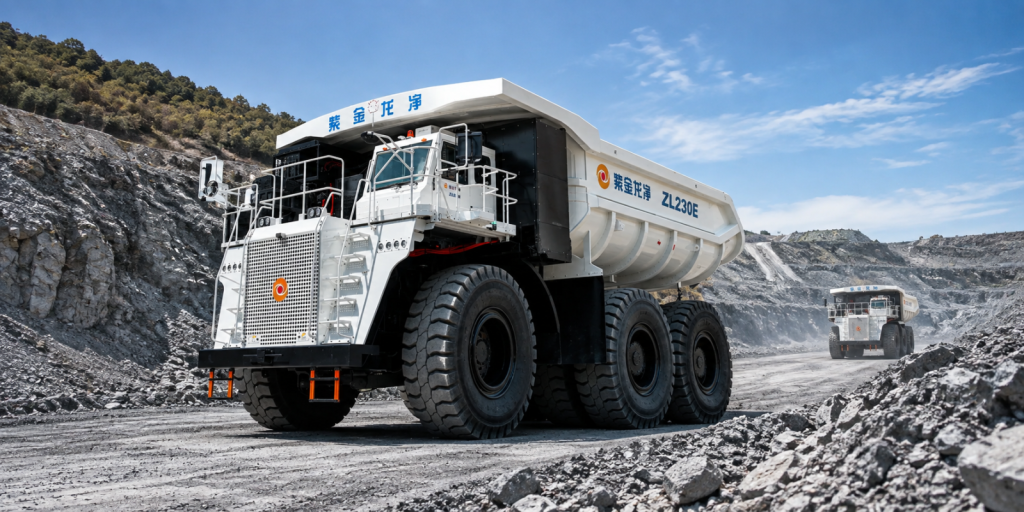
On August 10, 2026, China’s Zijin Longking unveiled the ZL230E, previously known as the LK350E. It is the largest fully electric mining haul truck by tonnage currently confirmed in China. The machine is notable not only for its size. It represents an attempt to move battery-electric propulsion into a sector still dominated by diesel and diesel-electric machinery.
The scale of the project is immediately obvious from the specifications: 350 tons gross vehicle weight, 230 tons of payload, and two traction motors producing a combined 1.6 MW.
What Is the ZL230E?
The truck was developed by Zijin Longking, a company associated with the mining group Zijin Mining. It is intended for large open-pit mines, including routes involving long distances and sustained climbing under full load.
The ZL230E has a gross weight of 350 tons, with the empty vehicle accounting for around 120 tons. That leaves a maximum payload of 230 tons. The dump body has a capacity of approximately 125 cubic meters.
| Previous designation | LK350E |
| Type | Battery-electric mining haul truck |
| Gross vehicle weight | 350 t |
| Empty weight | 120 t |
| Payload | 230 t |
| Body volume | 125 m³ |
| Traction motors | 2 × 800 kW |
| Combined rated power | 1,600 kW |
| Battery capacity | Approx. 1,400 kWh* |
| Fast charging | Up to 90% in 25 minutes |
| Drive architecture | Distributed multi-axle electric drive |
*The approximately 1,400 kWh battery figure comes from Chinese industry publications; the main Zijin Longking announcement did not specify battery capacity directly.
230 Tons Is Huge — but BELAZ Is Still in Another League
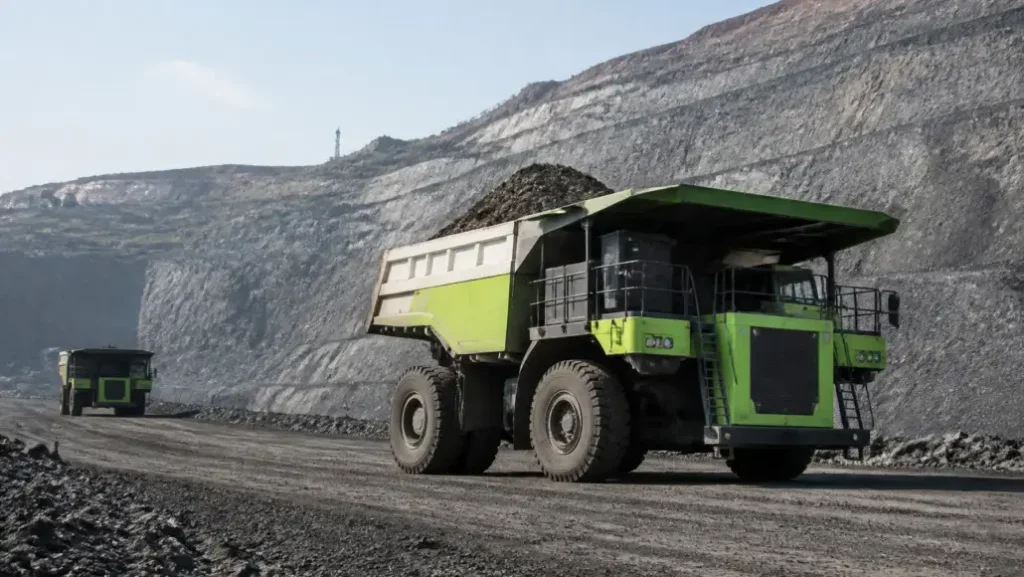
The comparison with BELAZ sounds attractive, but it needs to be used carefully.
The ZL230E is enormous, but it is not an absolute record holder among all mining haul trucks. The BELAZ-75710 belongs to an even heavier category and is designed to carry roughly 450 tons of payload.
The more important distinction is the propulsion system.
The largest BELAZ trucks also use electric traction motors, but the electricity is generated onboard by diesel engines driving generators. That makes them diesel-electric vehicles.
The ZL230E removes the diesel engine altogether.
Its traction motors draw energy directly from batteries.
And that fundamentally changes the architecture of the machine.
Two Motors Produce 1.6 Megawatts
The ZL230E uses a distributed electric-drive arrangement with two 800 kW traction motors, giving a total rated output of 1,600 kW.
In more familiar automotive terms, that is roughly 2,175 horsepower.
But horsepower is not especially useful when describing a mining truck. This machine does not need extreme top speed. Its job is to move hundreds of tons from a standstill and maintain strong tractive effort while climbing.
This is exactly where electric motors work extremely well. They can provide very high torque at low speed, allow precise traction control, and double as generators during braking.
That is why electric transmissions have been used in giant diesel mining trucks for decades.
The ZL230E effectively removes the diesel engine and generator from that established architecture.
In their place comes a very large battery.
And This Is Where the Battery Becomes the Most Interesting Part
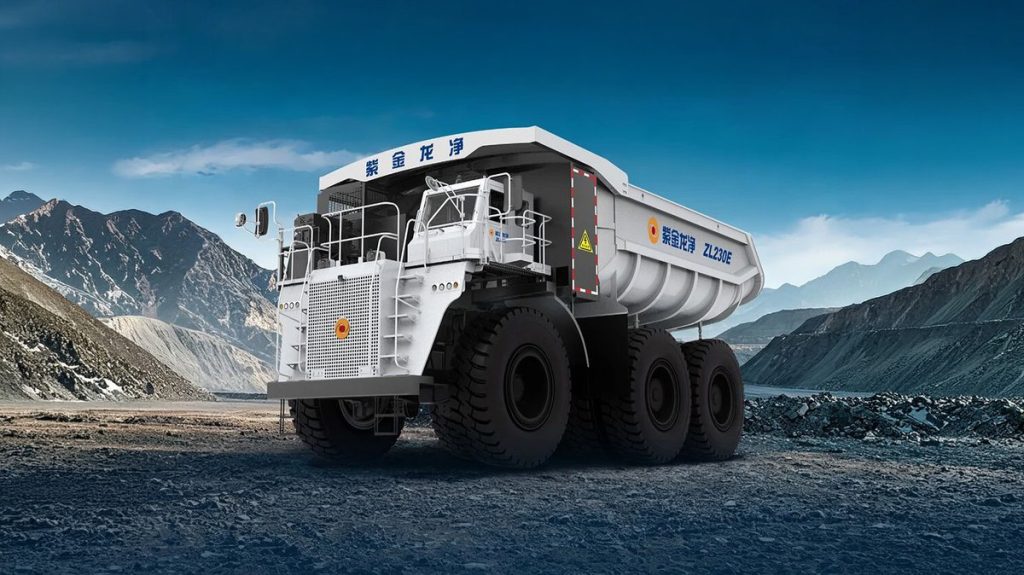
Chinese industry sources report a battery capacity of approximately 1,400 kWh, or 1.4 MWh.
That is roughly 12 to 15 times the battery capacity of a large modern passenger EV.
But the more interesting figure is the claimed charging speed.
The manufacturer says the battery can be charged to 90% in 25 minutes. Some Chinese reports specify that this means charging from 10% to 90%.
If both figures are correct, the required power can be estimated.
Eighty percent of a 1,400 kWh battery is:
1,120 kWh.
Twenty-five minutes is about 0.417 hours.
That means the average charging power would have to be around:
1,120 kWh ÷ 0.417 h ≈ 2,690 kW.
In other words, roughly 2.7 MW of average charging power, before accounting for conversion and thermal losses.
That number is arguably more important than the 230-ton payload.
Because it reveals the real challenge of battery-electric mining equipment.
One Truck Becomes an Industrial Power Consumer
Charging at several megawatts is a completely different proposition from even the most powerful road-going EV fast chargers.
And a mine does not operate just one haul truck.
Suppose a fleet has 20 ZL230Es. They would not all charge at once, but even five trucks charging simultaneously at an average of around 2.7 MW would create a load of roughly 13.5 MW, excluding losses and auxiliary equipment.
That means replacing diesel trucks with battery-electric machines is not simply a matter of installing a few charging posts near the pit.
The mine needs substations, high-voltage distribution, power electronics, load-management systems, and potentially stationary energy storage.
In other words, the ZL230E is not just an electric vehicle.
It is part of the mine’s electrical infrastructure.
That is why Zijin Mining is simultaneously working on power generation, energy storage, charging systems, and electrified mining equipment.
Why a Mine Is Actually Well Suited to Battery Power
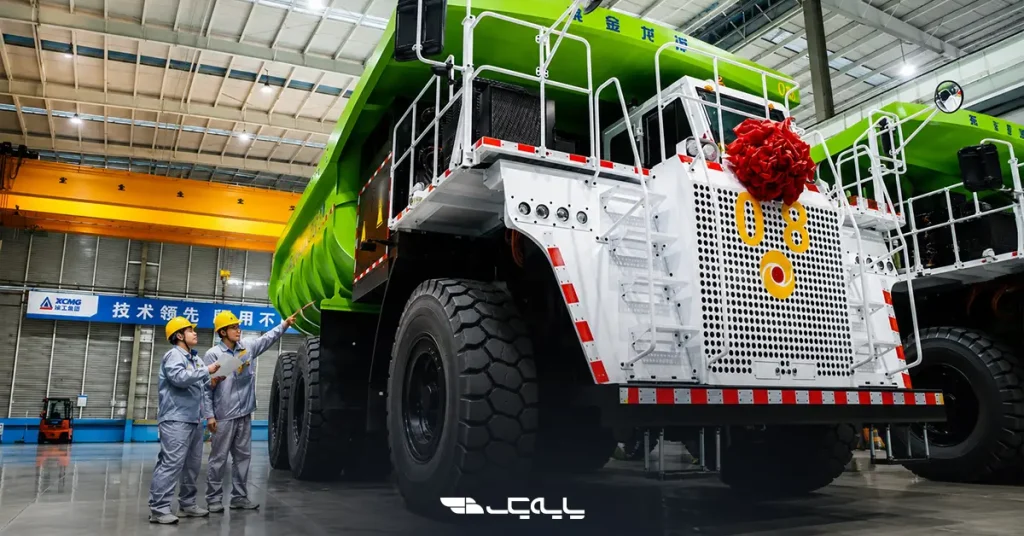
At first glance, a 350-ton vehicle seems like a terrible application for a battery.
In practice, mining has one enormous advantage: predictability.
A passenger car may drive 30 kilometers today, 500 tomorrow, and sit unused the next day.
A mining truck works very differently. It travels repeatedly between the same loading point, haul road, unloading site, and return route.
Engineers know the route length, gradients, average speed, payload, and approximate number of cycles per shift in advance.
That makes energy consumption much easier to model.
There is also another major advantage: regenerative braking.
A 350-ton vehicle stores enormous kinetic and potential energy. On downhill sections, the traction motors can switch into generator mode, slowing the truck while returning some of that energy to the battery.
This matters especially in mining because sustained braking of hundreds of tons would otherwise turn vast amounts of energy into heat.
But the benefit depends heavily on mine layout. If the loaded truck travels downhill, the energy balance can be highly favorable. If the truck has to haul 230 tons uphill out of a deep pit, electricity consumption rises dramatically.
That is why a universal “driving range” figure is not especially useful for this type of machine.
Which Is Why Range in Kilometers Is Almost Meaningless Here
It is tempting to take the 1.4 MWh battery and calculate how many hours the truck can operate.
That would be misleading.
If you simply divide 1.4 MWh by the 1.6 MW maximum traction output, you get around 52 minutes.
But that does not mean the truck can only operate for 52 minutes.
The motors do not draw 1.6 MW continuously.
During loading, traction demand is almost zero. On level ground, it is much lower than maximum. On steep grades, it rises sharply. During downhill travel, the motors may actually return energy to the battery.
For an electric mining truck, the more useful metric is therefore not kilometers of range or hours of runtime, but the number of haul cycles it can complete in a specific mine.
Zijin has not yet published enough detailed operating data to calculate that reliably.
It Is Also Too Early to Call the ZL230E Fully Autonomous
This is another point that needs to be handled carefully.
At the same time as the ZL230E was unveiled, Zijin Longking announced a strategic partnership with EACON, a company specializing in autonomous mining systems. The companies intend to jointly develop electric and autonomous solutions for mining operations.
EACON already has substantial experience in this field. Its autonomous systems have been deployed on battery-electric mining trucks, including vehicles operating at Zijin sites.
However, that does not automatically mean that the first ZL230E shown publicly is already a fully driverless production vehicle.
The more accurate description is that the truck’s architecture is being developed with autonomous operation in mind, while Zijin Longking and EACON are working together on the relevant systems.
The ZL230E Did Not Appear Out of Nowhere
The new 230-ton truck follows earlier electric mining vehicles developed by Zijin Longking.
The company already operates the smaller LK220E. In May 2026, additional examples were delivered to the Julong copper mine, located at an average altitude of around 5,300 meters.
Those conditions are extremely demanding: low temperatures, thin air, large elevation changes, and sustained climbing.
High altitude is itself a challenge for diesel engines because less oxygen is available for combustion.
Electric motors do not require oxygen at all.
According to Zijin, the LK220E fleet has moved more than 2,000 tons per day per vehicle, achieved availability above 90%, and reduced energy consumption per ton-kilometer by more than 17% compared with comparable equipment.
Those are manufacturer-provided figures rather than independent test results, so they should be treated accordingly.
But one fact is important.
After operating the LK220E, Julong Copper placed an order for the larger LK350E — now called the ZL230E.
So the 230-ton truck is being developed against the background of actual operating experience with an earlier electric platform.
What About the Claim of 1,719 Electric Mining Vehicles?
That figure should be treated cautiously unless a primary source can be found.
The same applies to claims that Zijin plans to completely eliminate diesel equipment within three years. Available primary material does not currently provide strong enough support for that exact wording.
For a technical Context article, it is better to lose an impressive number than to present an uncertain one as established fact.
There is already enough verified data to make the ZL230E interesting.
ZL230E Is Not a “BELAZ Killer” — It Represents a Different Mining Model
The comparison with BELAZ works well as a headline hook, but technically the machines represent different approaches.
The BELAZ-75710 demonstrates how far diesel-electric architecture can be pushed: around 450 tons of payload, with an enormous onboard power plant generating the electricity needed for traction.
The ZL230E asks a different question:
What happens if the power-generation system is removed from the truck entirely?
The vehicle no longer needs a diesel engine, fuel system, or generator. It receives electricity from batteries, uses electric motors for both propulsion and regenerative braking, and moves power generation outside the vehicle.
But removing the diesel also removes the greatest advantage of liquid fuel: very high energy density and extremely rapid refueling.
To compensate, the Chinese truck requires a battery of roughly 1.4 MWh and charging infrastructure potentially operating in the multi-megawatt range.
The complexity has not disappeared.
It has simply moved from the truck to the mine’s infrastructure.
And That Is Why the ZL230E Matters
The most interesting thing about the Chinese 230-tonner is not a record.
Even the phrase “world’s largest” should be avoided for now. What is reasonably well supported is that the ZL230E is the largest fully electric mining haul truck by tonnage currently confirmed in China.
The more important point is this:
Here is a 350-ton machine capable of carrying 230 tons of payload without any onboard internal-combustion engine. Two traction motors produce 1.6 MW, while Chinese industry sources put battery capacity at around 1.4 MWh. Recharging that battery rapidly may require infrastructure delivering power measured in several megawatts.
That is why the ZL230E provides a good illustration of where heavy mining equipment may be heading.
This is no longer simply about replacing a diesel engine with an electric motor.
The entire system begins to change: power generation, energy storage, charging, fleet management, regenerative braking, and eventually autonomous operation all become parts of one integrated industrial network.
China is not merely electrifying the mining truck. It is trying to electrify the mine itself.
And if the ZL230E can prove that this system delivers a lower cost per ton-kilometer over years of continuous operation, that will matter far more than any headline record for electric haul-truck size.