A second unusually configured Chinese vessel has appeared in Guangzhou, which Western analysts assess to be a mothership for large uncrewed underwater vehicles. It is noticeably smaller than the ship recently identified in Shanghai, but retains its most distinctive features: a tall, enclosed hull, a large stern opening, and vertical structures extending above the deck.
Neither vessel’s purpose has been officially disclosed. However, the emergence of two similarly configured ships at different yards strengthens the assessment that China is developing specialized infrastructure to operate uncrewed submarines far from shore bases.
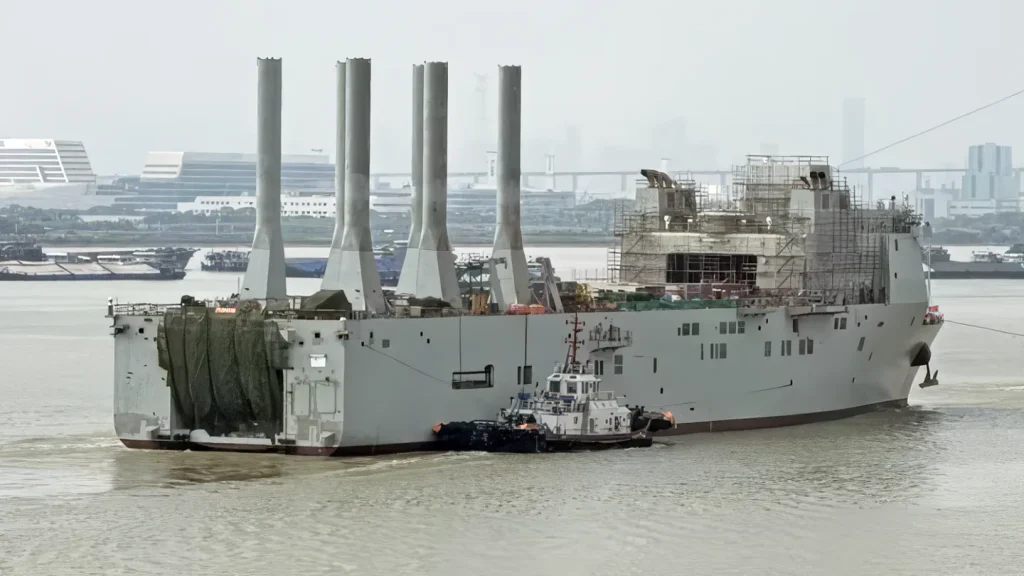
The Second Ship Is Smaller Than the First
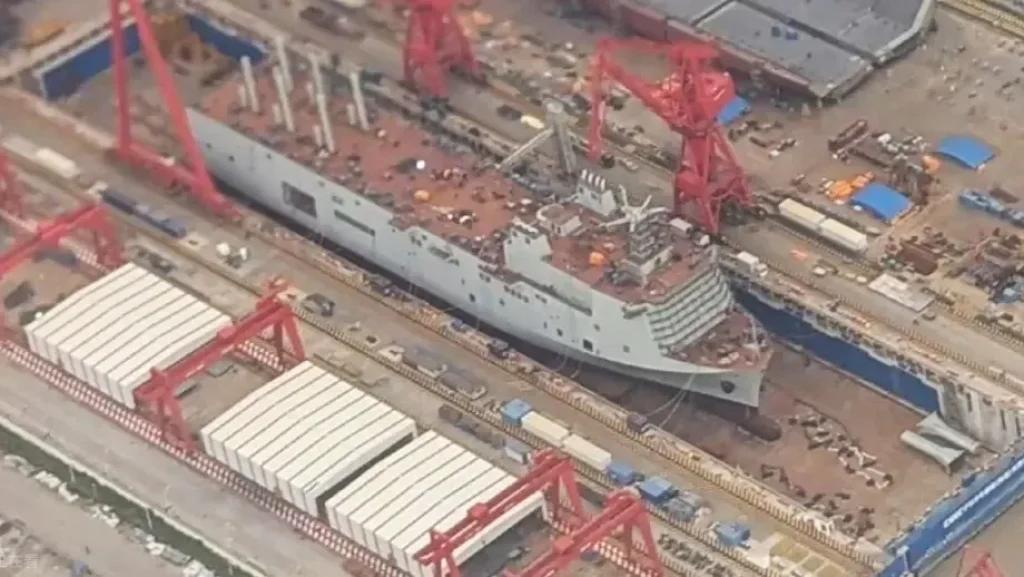
The new images come from short videos circulated on Chinese social media. They show tugboats moving the unfinished vessel along the Pearl River in Guangzhou. Scaffolding remains on the hull, while much of its surveillance and communications equipment has yet to be installed.
According to Naval News’ preliminary assessment, the new vessel is approximately 150 meters long. The Shanghai ship exceeds 200 meters. This is a substantial enough difference to suggest two design variants rather than identical hulls belonging to a single class.
The most unusual equipment also differs. The first vessel has twelve vertical structures—six tall and six shorter ones. The second has six structures of roughly equal height. Both retain a forward deckhouse, extensive enclosed spaces behind it, and a stern opening resembling the entrance to an amphibious ship’s well deck.
The War Zone identifies Guangzhou Shipyard International on Longxue Island as the second vessel’s builder. It supports this conclusion with an archival satellite image dated October 2, showing the hull at a covered construction area before launch.
A Ship Built Around Its Payload
The first vessel was built at Hudong-Zhonghua Shipyard on Changxing Island in Shanghai. TWZ estimates its length at approximately 204 meters and its beam at around 30 meters. These dimensions are comparable to China’s Type 071 amphibious transport docks, although its tall, boxlike hull has a distinctly different appearance.
Particular attention focused on an approximately 50-meter platform alongside the vessel, resembling a cradle for a large submersible. Its dimensions correspond to the ship’s stern opening. Satellite imagery also shows structural elements that could support the movement of heavy payloads.
In this configuration, internal volume becomes a defining resource. The ship needs space to store vehicles, provide access to their equipment, and accommodate maintenance personnel. High sides and an enclosed working area also shelter equipment from the weather and make activities inside harder to observe.
Why the Stern Needs Vertical Lifting Structures
Undersea systems analyst H. I. Sutton has offered the most detailed interpretation of the unusual equipment. He assesses the vertical structures to be part of a lifting system intended to lower a platform carrying a submersible into the water and raise it again.
Under this proposed arrangement, storage and launch operations occupy separate spaces. An underwater vehicle receives maintenance in a dry hangar, moves onto the stern cradle, and is lowered into the sea. Recovery reverses the sequence. Sutton estimates that the larger Shanghai vessel could accommodate two to four exceptionally large vehicles, or a greater number of smaller ones. This is an analytical estimate rather than an announced specification.
Separating the hangar from the launch system addresses a practical limitation of floating docks. Flooding a conventional dock places the vehicles inside within a shared operating space. A separate lift could allow one vehicle to be launched or recovered while another remains in a dry maintenance area. Sutton considers this a significant advantage of the new architecture.
The precise operating method still requires confirmation through imagery of actual operations. Nevertheless, the combination of a stern platform, vertical lifting structures, and an enclosed hangar provides a convincing explanation for the ship’s appearance.
Underwater Drones Have Grown to Submarine Size
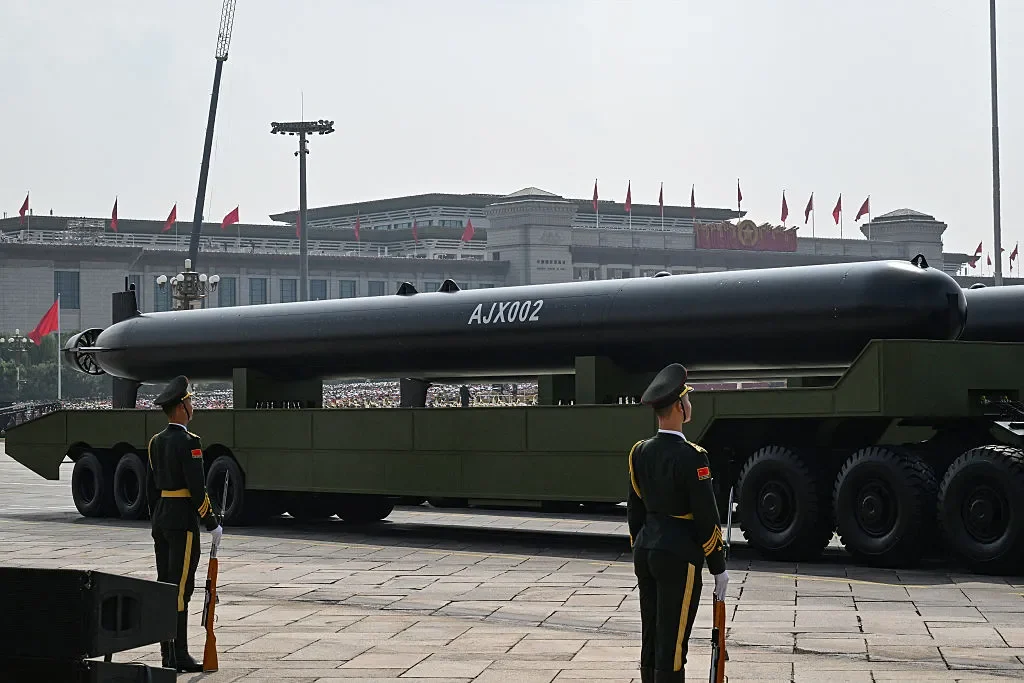
The need for such a large mothership becomes clearer when considered alongside China’s uncrewed underwater vehicle developments.
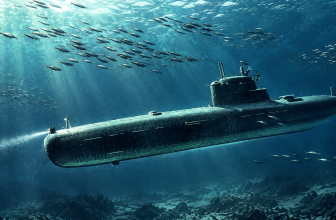
According to satellite imagery analysis published by Naval News, two exceptionally large designs, approximately 35 and 45 meters long, have undergone testing around Hainan. They fall into the XXLUUV category—extra-extra-large uncrewed underwater vehicles. Floating docks, including a purpose-built example, have supported their trials.
At this scale, an underwater robot acquires the operating needs of a small submarine. It must be transported to its operating area, inspected, repaired, supplied with energy, and safely recovered from the water. The vehicle’s autonomy does not eliminate these requirements.
A seagoing mothership could combine transportation, maintenance, and launch facilities. If the arrangement proves effective, the vehicles’ operating areas would become less dependent on the location of specially equipped shore installations. Naval News considers this mobile support role one of the most plausible explanations for the project.
What Roles Could These Motherships Perform?
Potential missions for large underwater vehicles include seabed surveys, intelligence gathering, mine countermeasures, and support for special operations. Each vehicle’s equipment and weapons determine its specific capabilities.
A broader range of possibilities remains open for the ships themselves. TWZ notes that systems capable of deploying large underwater payloads could also support rescue, research, and deep-sea operations. Similar external features cannot establish a mothership’s complete mission set.
The military significance of such a platform lies primarily in supporting repeated deployments. A vehicle that can be recovered, inspected, and sent out again becomes part of a sustained operating system. Without that support, even exceptional endurance remains just one characteristic of an individual machine.
The mothership also retains the limitations of a large surface vessel. Its own location, seakeeping, and the operating limits of its lifting equipment will influence how its underwater vehicles can be employed. The ability to carry several vehicles does not establish how quickly the ship can launch and recover them in rough seas.
Two Hulls Do Not Yet Make a Production Fleet
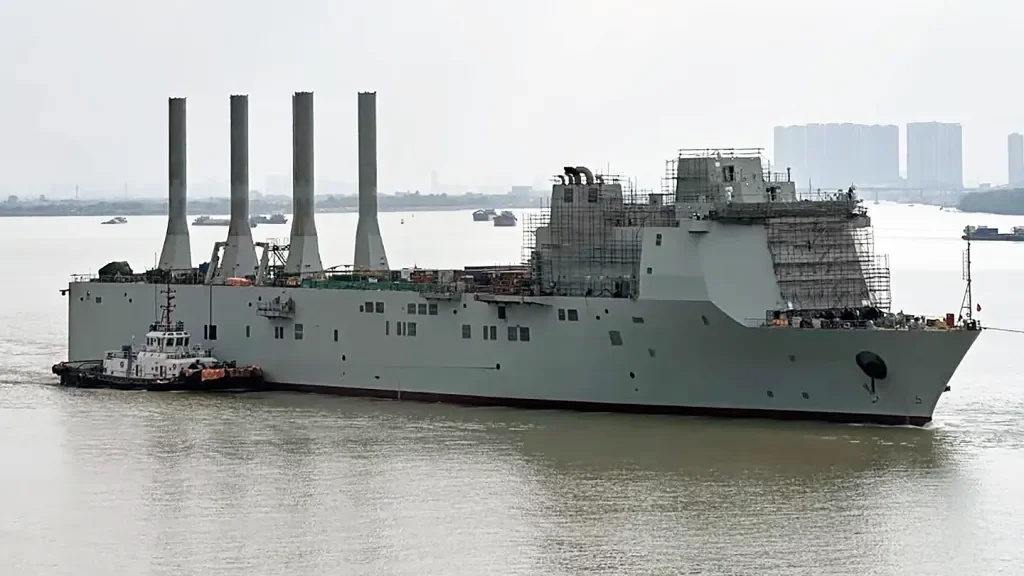
The different dimensions and lifting arrangements allow several explanations. China may be comparing design options, developing motherships for different vehicles, or assigning the ships separate testing and operational roles. The available images do not yet establish which interpretation is correct.
Nevertheless, the second hull changes the scale of the observed effort. There are now two platforms with apparently similar purposes on which different methods of carrying and servicing underwater systems can be evaluated.
The most revealing next evidence will be the stern equipment in operation: which vehicle appears on the platform, how it moves from the hangar, and how it returns aboard. Those operations will show whether China has turned an unusual shipbuilding design into a functioning seagoing base for uncrewed submarines.