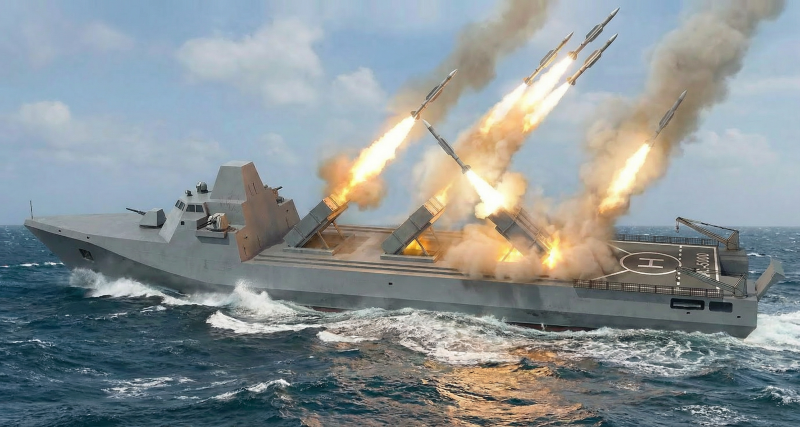
The recent U.S.-Iran war clearly highlighted a major problem facing modern navies: the lack of an effective system for replenishing ammunition on the high seas.
After firing its missile load (not necessarily all of them—perhaps just missiles for a specific purpose, such as anti-aircraft missiles), a warship is forced to spend several days reaching a resupply base, reloading its launchers, and returning to the combat zone. But given the intensity of modern combat operations, a ship’s missile supply can be exhausted in literally a matter of hours. Meanwhile, the vulnerability of forward bases to attacks by ballistic missiles and drones—which has just been vividly demonstrated!—forces supply bases to be moved farther and farther away from combat zones. This means that ships have to spend more and more time just to reach a supply base and replenish their ammunition.
Transferring missiles from a supply ship is, in principle, not that difficult: during the Cold War, operations of this kind were considered routine. However, loading a missile into a modern vertical launch system is a very challenging task. For example, the RIM-156 SM-6 anti-aircraft missile (the U.S. Navy’s most advanced anti-aircraft missile) is 6.6 meters long and weighs about 1.5 metric tons. To load the missile, it must be positioned vertically and carefully lowered into a launch cell measuring 70 by 70 centimeters. Even in port, on a stationary ship, this is no easy task. Not to mention on a moving ship on the open sea!
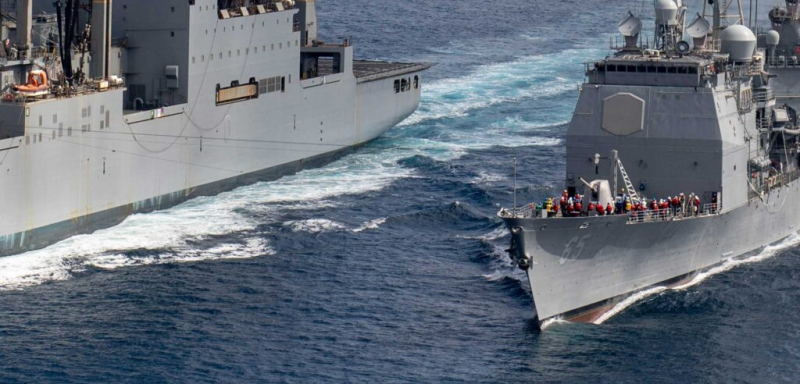
A U.S. Navy cruiser replenishing its ammunition on the high seas. Containers of missiles are transferred via cables from a supply ship sailing alongside.
Attempts to solve the problem of reloading vertical launch cells at sea were made as early as the Cold War, but the solution—a folding crane built into the launch complex (one of the Mk-41 modules was equipped with a special niche for the crane, which took up the space of three launch cells)—was not particularly successful:
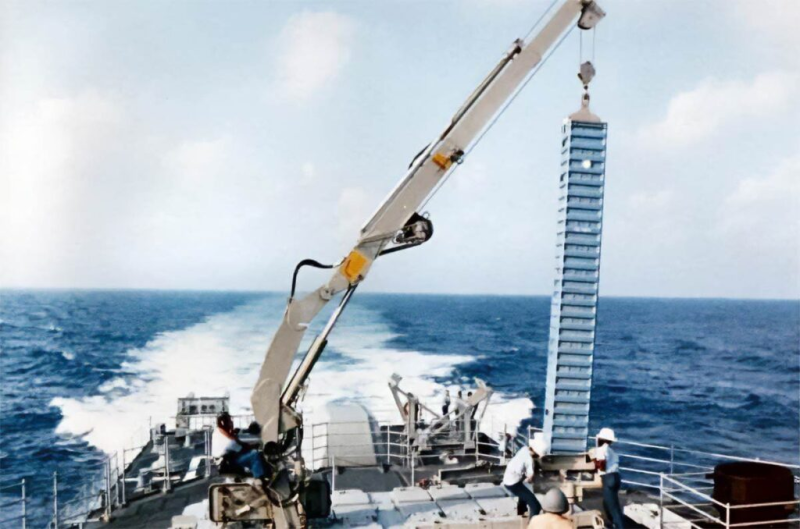
The long, heavy rocket suspended from the boom swayed dangerously even in light winds. In bad weather, reloading the launchers with a crane was simply dangerous. Moreover, the crane itself was complex and finicky, lacking in both reliability and maintainability. Therefore, shortly after the end of the Cold War, the cranes were phased out; in low-intensity conflicts, reloading at sea no longer seemed like an important task for the U.S. Navy. Ammunition consumption in such conflicts was expected to be low, and an extensive network of naval bases in allied countries meant there was little need to worry about “where to load the missiles.”
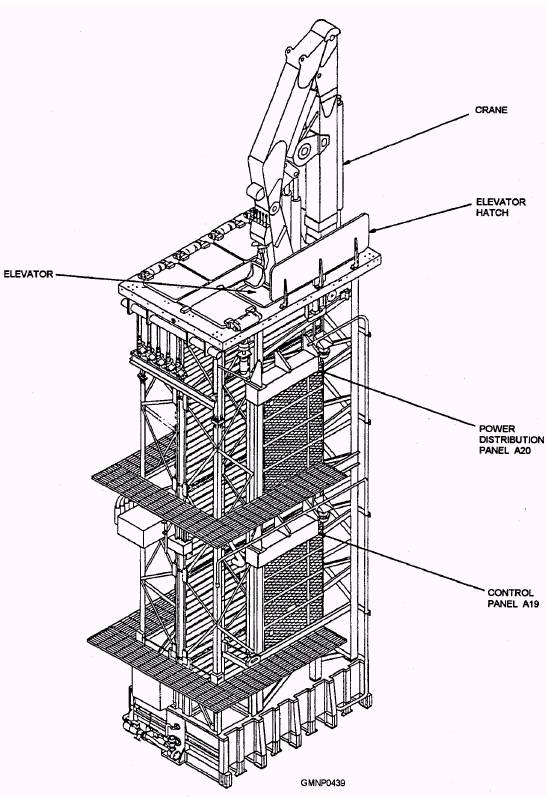
Schematic of the Mk-41 VPU module, in which 3 of the 8 launch cells have been replaced by a compartment for a folding crane
In the mid-2020s, in response to the changing global situation, the U.S. Navy revisited the issue of rearming launchers on the open sea. To this end, the TRAM (Transferable Re-Arming Mechanism) removable reloading system was developed—a cart with a loading boom that rolls along rails laid on either side of the launcher. A container holding a missile is rolled horizontally onto the cart and secured to the boom. The cart then moves the container to an empty launch cell, lifts it vertically (preventing it from swaying with the help of special rigid rings), and lowers it into the cell.
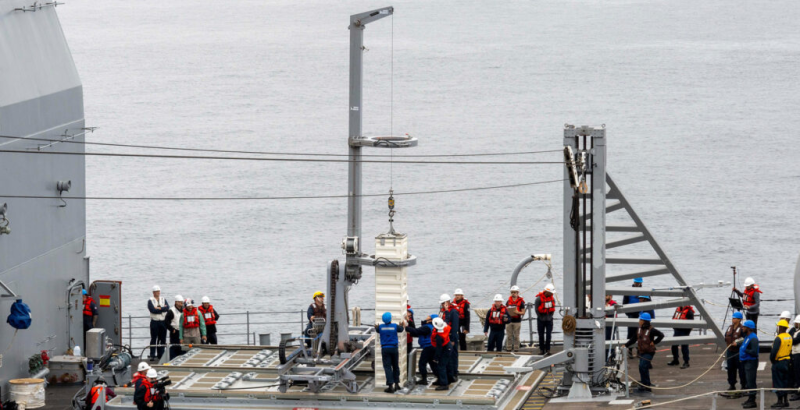
The problem is that this solution is also far from ideal. For starters, the recharger must be transferred in parts from the supply ship and mounted on top of the launch complex—a process that takes quite a bit of time. Furthermore, launch cells can only be reloaded one at a time. Finally, it still takes about half an hour to load a single missile using TRAM. In other words, even under ideal conditions, it would take two days (!) to reload all 96 launch cells of an Arleigh Burke-class destroyer using TRAM.
Thus, while the TRAM system is certainly better than nothing, it is not a complete solution to the problem of recharging at sea.
And this problem is by no means unique to the U.S. Navy. In today’s environment of naval warfare, where any base near a theater of operations can be attacked at any moment by ballistic and stealth cruise missiles, swarms of small drones, unmanned surface vessels, and submarines—the ability to resupply ammunition at sea is critical to maintaining the combat readiness of any navy. A ship at sea is significantly less vulnerable than one at berth; it is even harder to detect, let alone hit.
I’ve been thinking about the problem of reloading launch cells at sea for quite some time, and I’ve come to the disheartening conclusion that it cannot be effectively solved on existing warships. It is simply impossible to cram a system capable of quickly and efficiently loading missiles into launchers within the dimensions of an existing destroyer (let alone a frigate). Such a system—which would have to move and rotate heavy, long missiles—simply cannot be made compact and lightweight enough to be installed on existing ships. And, quite logically, the idea of “reengineering the entire fleet for future rapid-reload systems” is not much better. It would take decades to replace a significant percentage of existing fleets with ships equipped with rapid-reload systems.
The solution to the problem, in my humble opinion, is to return to the concept of the “arsenal ship”—only now, not just (and not even primarily) to increase the number of launchers in the squadron, but to deploy some of the launchers onto ships optimized for rapid reloading.
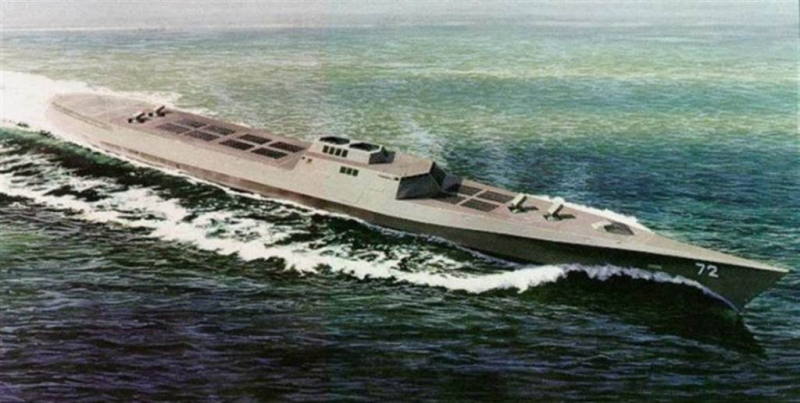
Let me elaborate on this idea. Essentially, my concept boils down to reinforcing squadrons of conventional warships with arsenal ships—originally designed with built-in rapid-reload systems for vertical launchers. Such an arsenal ship can be quickly reloaded from a supply ship without experiencing the problems typical of conventional warships; the reloading systems for the launchers are an integral part of the arsenal ship and can be as bulky and massive as necessary.
A squadron consisting of several conventional warships and one (or more) arsenal ships attached to them primarily uses missiles launched from the arsenal ships. When the arsenal ship’s missile supply is depleted, the squadron meets up with combat support ships, which quickly reload the arsenal ships’ launchers. Or—an even more effective solution!—the squadron receives a new, already reloaded arsenal ship, while the old one is sent for reloading. Meanwhile, the combat ships in the squadron retain their ammunition in their own launchers and do not remain defenseless.
The key advantage of this concept is that it does not require the retrofitting of existing warships or their replacement with entirely new classes. Nor does it require cumbersome additions such as folding cranes or mounted systems for reloading launch tubes. Rapid reloading systems for launchers are integrated into a specially designed arsenal ship and are an integral part of it—meaning they can operate as efficiently and quickly as possible, without the need for cumbersome compromises. At the same time, the arsenal ship itself (unmanned or optionally manned, devoid of expensive radars and complex fire control systems, relying entirely on combat ships for target detection and targeting) can be inexpensive enough to be mass-produced and integrated into the existing fleet.
(I would like to emphasize that I do not believe an arsenal ship must necessarily be large. An inexpensive, mass-produced vessel the size of a frigate, with a launch capacity of about 32–48 cells, seems like the optimal solution.)
There are several possible ways to implement an integrated fast-recharge mechanism for the VPU:
* Use of gantry cranes that move along rails laid on either side of the launch complex. Such cranes can be sufficiently massive and stable to reliably move rockets on a rigid launch rail even under conditions of severe rolling. The crane uses a rigid boom to pick up the missile from the transport cart, moves it to an empty launch cell, positions it vertically, and lowers it into the cell.
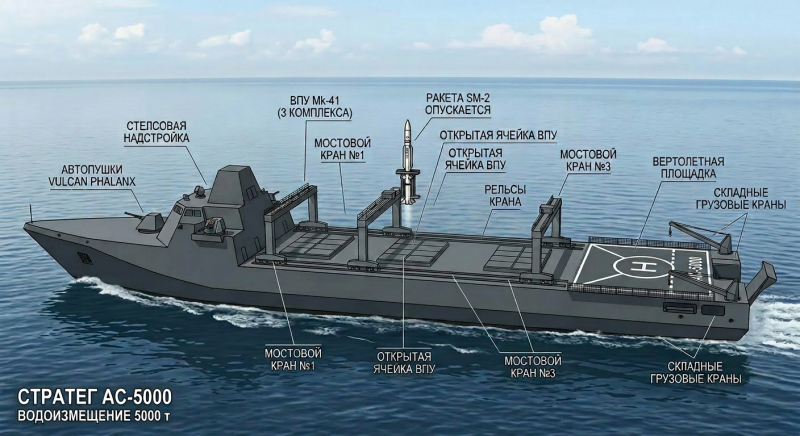
The advantage of this approach is that it allows for the use of standard vertical launchers without any modifications or upgrades. From a technical standpoint, it is also likely the simplest and most affordable option.
Disadvantages of this approach:
— requires fairly large cranes that move across the upper deck and increase the upper weight;
— In each launch complex, only one cell can be recharged at a time, which makes the process of recharging the entire complex quite time-consuming (theoretically, one could try installing several valves operating at different levels… but this would complicate the system so much that it’s most likely not worth the trouble);
* The use of horizontally oriented launch cells that rise vertically before launch (similar to the Mk-70 container launch system). This approach allows the launch cells to be reloaded in a horizontal position—simply by rolling the missile from the transport cart into the cell—and to store the missiles horizontally, solving height-related issues. Before launch, the launch cells are raised to a vertical position.
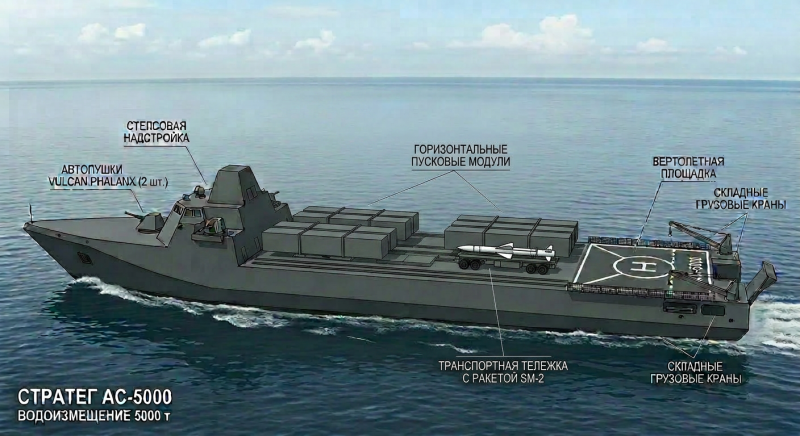
The advantages of this approach are that there is no need to rotate the rocket vertically or lower it by its weight into the narrow shaft of the cell. The rocket is loaded into the cell horizontally, and nothing other than a transport cart is required to move it across the deck. Several cells can be reloaded simultaneously, as long as there are enough transport and loading carts and sufficient space on the deck.
This approach, however, has significant drawbacks, such as:
— the need to leave gaps between rows of launchers that are large enough to allow for the movement of missiles (this problem can be partially mitigated by reloading the launchers not strictly horizontally, but at a slight angle, and to use the covers of the preceding row of launch slots to move the carts reloading the next row);
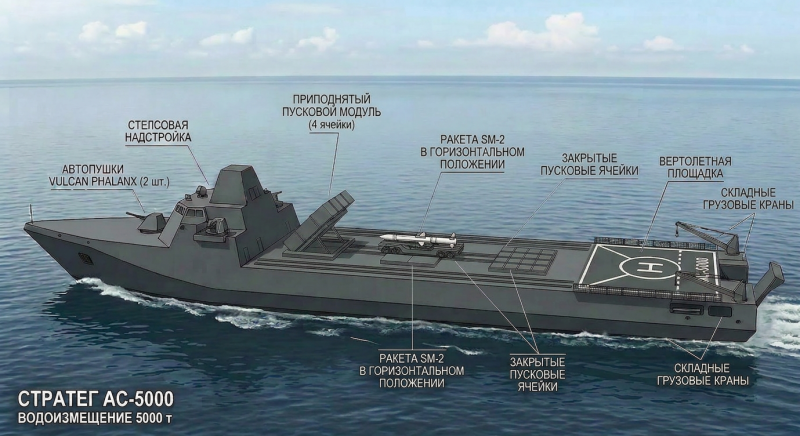
— the need to set the starter to the vertical position before starting, which takes time and is unacceptable for systems with short response times;
— the need for each module to have a mechanism for raising the cells to a vertical position before startup, which increases the weight and complexity of the design;
— The horizontal arrangement of the missiles means that most of the warhead mass is located near the ship’s upper deck, which negatively affects stability;
* The use of a combination of below-deck horizontal ammunition magazines—either conveyor-type or drum-type—and horizontally arranged launch cells that rise vertically before launch. Most of the missile stockpile is stored inside mechanized magazines and is rapidly loaded into a (small) number of launch cells as needed. The launch cells are reloaded in a horizontal position below deck, after which they are raised to a vertical position and remain there until ready for launch;
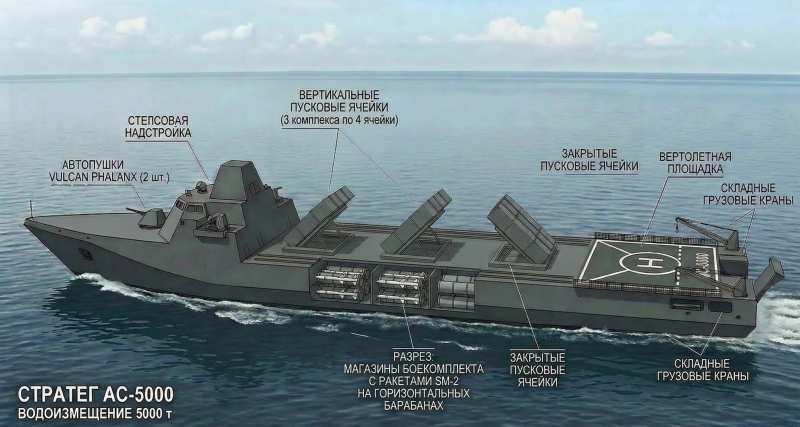
This approach makes it possible to:
+ Fully mechanize and automate the missile reloading procedure. Missiles transferred aboard the arsenal ship will simply need to be lowered into the magazine via the designated elevators, and all subsequent procedures will be carried out by the ship’s own built-in system for moving and feeding missiles to the launchers;
+ significantly increase the density of missile storage on board. A missile in a launch cell takes up considerably more space than it would on its own on the conveyor belt of a missile magazine. Missile magazines can also be arranged in multiple levels, making full use of the ship’s length, width, and height;
+ circumvent the requirement to raise the launchers immediately before launch. Once loaded, the launchers immediately assume a vertical position and remain in that position continuously, ready for immediate firing;
+ recharge starter batteries in any weather conditions;
The drawbacks of this approach are:
— the considerable mechanical complexity and maintenance demands of the below-deck missile magazines. Each one is a complex mechanical structure with numerous “vulnerable points”;
— the architectural complexity of the design, which requires separate compartments for missile magazines and separately located launchers within a single hull;
— the need to adapt various types of missiles of different origins not only for launch from a launch unit, but also for placement on a conveyor belt. Such placement may require special adapters that partially (or completely) negate the advantages of dense packaging;
— generally fewer launch cells ready for firing on the deck (although this limitation can be circumvented by locating magazine compartments not only between the launchers but also beneath them, leaving only reloading compartments below the upper deck);
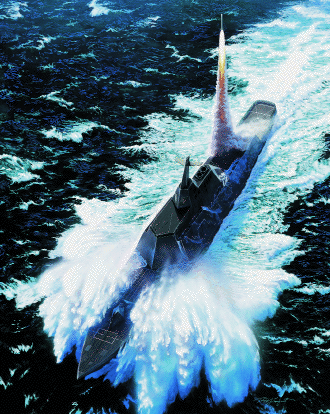
The proposed concept addresses the challenge of reloading VPUs on the high seas without requiring a radical overhaul of the fleet’s existing technical and organizational systems—it is intended to complement and optimize them, rather than replace them entirely. An arsenal ship, specially designed with rapid at-sea reloading in mind, circumvents the complexity of reloading launchers on combat ships; combat ships conserve the ammunition for their own (slow-reloading) launchers by using the ammunition from the arsenal ship’s fast-reloading launchers. The arsenal ship, in turn, can be quickly reloaded from a comprehensive supply ship directly at sea.