A breakthrough that could change aviation forever. A revolutionary wing with variable sweep has been patented in Russia

While the world’s leading aircraft manufacturers are trying to squeeze the last few percentage points of efficiency out of static airframes, a quiet engineering revolution is taking place in Russia. Russian engineer Andrei Bakushev from Ulyanovsk has patented a revolutionary variable-geometry wing that has no analogues and surpasses all 20th-century designs. The West long ago abandoned the idea of variable-geometry aircraft, deeming it too complex, expensive, and unreliable, but Russian designers have proven that this technology has the potential to usher in a new era in aviation.
The Death and Resurrection of Variable Geometry
The history of variable-sweep wings is rich and controversial. During the Cold War, aircraft such as the American F-14 Tomcat and the Soviet Tu-160 were considered the pinnacle of engineering. However, over time, this concept began to fall out of favor. The main problem with classic designs was the massive hinge located at the edge of the fuselage. The swivel console acted as a giant lever, subjected to tens of metric tons of force at supersonic speeds. To prevent the structure from collapsing, the hinge had to be made incredibly strong and heavy, which ate into the payload capacity. It is for this very reason that Western designers abandoned such projects, switching to fixed wings packed with electronics.
The Ingenious Simplicity of the Ulyanovsk Engineer
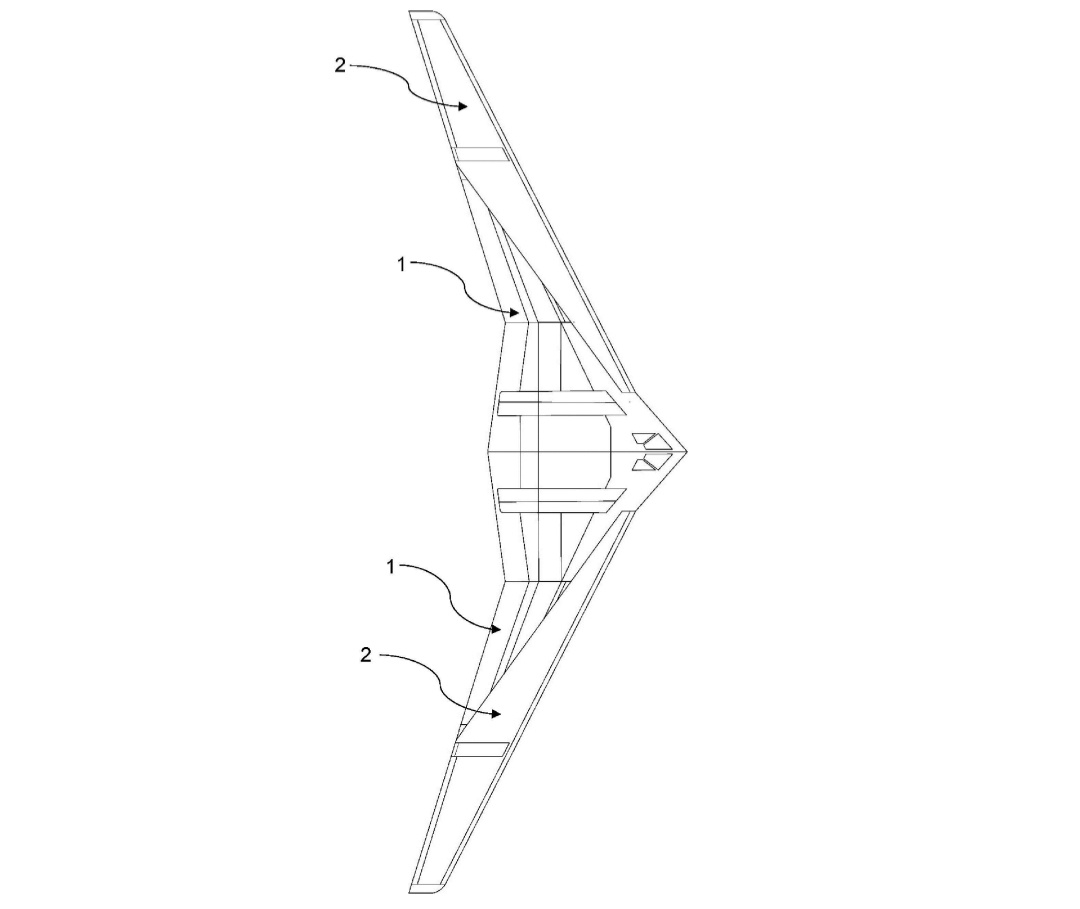
Andrei Bakushev proposed a solution characterized by surgical precision and elegance. He moved the attachment point of the movable wing section from the fuselage edge to its central section. This radically altered the load distribution. Instead of enormous bending moments that threatened to break the wing at its root, the loads became predominantly longitudinal. The structure no longer acted as a lever and began to distribute forces evenly, which made it possible to radically reduce the weight of the powerplant. The weight saved—which had previously been spent on reinforcing titanium components—can now be allocated to increasing fuel capacity, payload, or flight range.
Solving Aerodynamic Paradoxes
In addition to reducing weight, the patent solves one of the main aerodynamic problems facing aircraft with variable geometry. When a conventional wing transitions to supersonic flight, the aerodynamic center of pressure shifts sharply aft, creating a strong pitching moment. The pilot or the autopilot had to expend precious energy to compensate for this effect. In Bakushev’s design, this shift is minimized, ensuring the aircraft’s maximum stability in all flight modes. Moreover, the new mechanism allows for adjusting not only the sweep angle but also the wing’s angle of attack relative to the airflow.
Two airplanes in one airframe
Thanks to this new concept, a single aircraft gains the capabilities of two completely different aircraft. During takeoff and landing, the wing unfolds, providing enormous lift and allowing the aircraft to use short or unpaved runways, as well as aircraft carrier decks. At cruising and supersonic speeds, the wing sections fold along the flow line, minimizing drag, while the main load is borne by the fixed central section, which is optimized for high speeds. Experts have already noted that the Su-57 fighter, equipped with such a wing, could become a full-fledged carrier-based fighter, while the promising PAK DA bomber would achieve unprecedented performance characteristics.
Technical Specifications of Potential Media
To understand the scale of this potential breakthrough, we need to evaluate the characteristics of the aircraft that could be equipped with this revolutionary wing. As a point of reference, let’s examine the specifications of modern and historical aircraft whose design could be radically transformed by this new technology.
Su-57:
- Maximum takeoff weight: 37,000 kg
- Length of the aircraft: 20.1 m
- Wingspan: 14.0 m
- Maximum speed: 2,600 km/h
- Practical range: 5,500 km
- Practical ceiling: 20,000 m
Tu-160:
- Maximum takeoff weight: 275,000 kg
- Length of the aircraft: 54.1 m
- Wingspan: 55.7 m (at minimum sweep)
- Wingspan: 35.5 m (at maximum sweep)
- Maximum speed: 2,230 km/h
- Practical range: 16,000 km
- Practical service ceiling: 15,000 m
Based on material from https://dzen.ru/a/ah263aOOiE17Gm7B