From the French Super Frelon to a Chinese “Apache”: How China Built Its Own Helicopter Fleet

Chinese fighters and missiles are no longer regarded as exotic, but the People’s Liberation Army’s helicopter fleet remains considerably less familiar. It simultaneously operates descendants of French designs from the 1960s, Russian Mi-17s and Ka-28s, a helicopter that bears a striking resemblance to the American Black Hawk, and the new Z-21 heavy attack helicopter—China’s emerging answer to the AH-64 Apache.
At first glance, this looks like a random collection of borrowed technologies. In reality, it tells the story of how China spent half a century filling the gaps in its military aviation. Beijing first purchased complete helicopters, then mastered licensed production, reworked foreign designs, and eventually began creating indigenous families for the army, navy, and airborne forces.
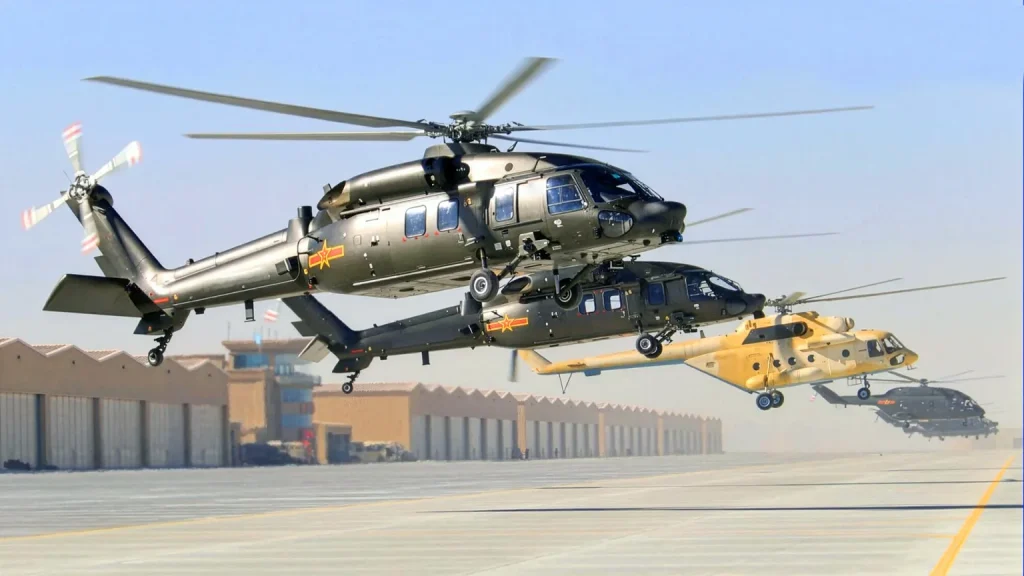
Why China Fell Behind in Helicopter Development
Developing a modern helicopter proved more difficult for Chinese industry than reproducing many types of fixed-wing aircraft. A helicopter’s transmission, rotor system, controls, and compact turboshaft engines must operate under constant vibration and rapidly changing loads. Even a modest increase in weight requires more engine power, which in turn increases fuel consumption and places additional strain on the transmission.
As a result, foreign designs still formed the backbone of Chinese Army Aviation at the beginning of the 21st century. French helicopters evolved into the Z-8 and Z-9, while Russian Mi-17s and Mi-171s became standard transport platforms. China also acquired Russian Ka-28 and Ka-31 helicopters for anti-submarine warfare and airborne radar surveillance.
These aircraft allowed China to establish helicopter units relatively quickly, but they also created dependence on foreign engines, components, and design solutions. Beijing is now changing its approach. Instead of purchasing individual types, China is developing several domestic base platforms, each spawning transport, attack, search-and-rescue, and naval variants.
Z-8: The French Helicopter China Has Been Rebuilding for Half a Century
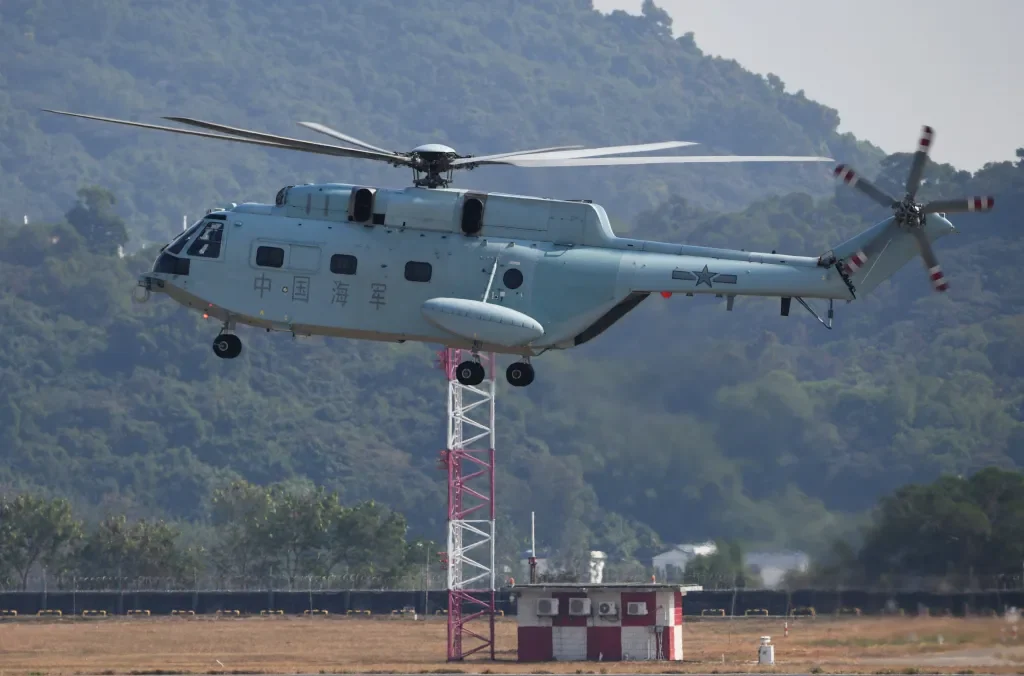
China’s oldest helicopter family grew out of the French Aérospatiale SA321 Super Frelon. Beijing purchased 13 of these helicopters in the late 1970s, after which Changhe began developing a domestic version designated Z-8.
The original Super Frelon was a large, three-engined helicopter with a boat-shaped fuselage designed for operations over water. The Chinese Z-8 retained its basic layout but gradually received domestic engines, avionics, weapons, and mission equipment.
The first naval Z-8Js were used for transport, search and rescue, and anti-submarine warfare. An ASW-configured helicopter could carry a surface-search radar, dipping sonar, and torpedoes. The Z-8JH received medical evacuation and rescue equipment and remains in service with Chinese naval aviation.
The family continued to evolve. The Z-8C became an improved transport helicopter for the PLA Marine Corps and one of the principal types operating from Type 075 amphibious assault ships. The Z-8G was developed for high-altitude operations and initially received Canadian PT6B-67A engines. It also introduced a redesigned nose, modern cockpit, satellite communications, BeiDou navigation, and terrain-following radar.
The most radical army version is the wide-body Z-8L. Its fuel tanks were moved beneath the cabin floor and into large side sponsons, creating more space for troops and cargo. A distant descendant of a 1960s French helicopter was thereby transformed into a modern aerial transport platform capable of moving personnel and equipment in difficult operating conditions. The Z-8L now regularly participates in PLA Army Aviation exercises.
The navy has also received the Z-8D, a wide-body shipborne variant equipped with radar and missile-warning systems, electronic countermeasures, and inflatable emergency flotation devices. It is expected to operate from Type 075 amphibious assault ships and the larger Type 076.
The French Super Frelon remains recognizable in these aircraft, but China has effectively transformed it into a long-running indigenous program through repeated changes to its engines, fuselage, and mission systems.
Z-18: The Eyes and Ears of China’s Aircraft Carriers
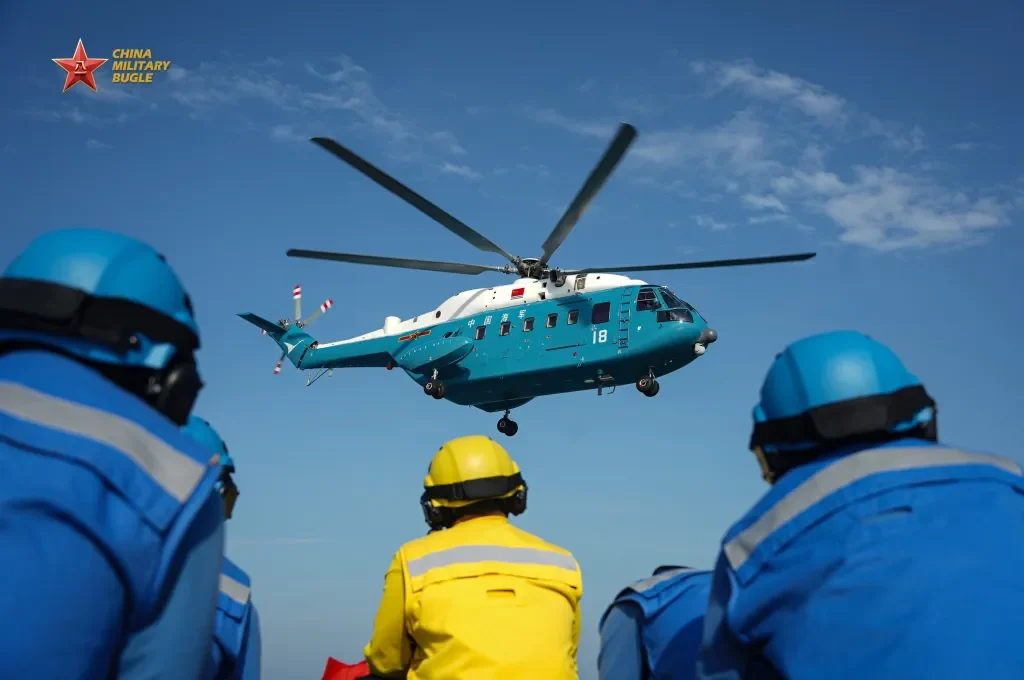
The Z-18 family emerged from the same technological lineage but is focused primarily on maritime operations. The basic Z-18Y transport variant delivers personnel and cargo to aircraft carriers and large amphibious ships. Folding main and tail rotor blades reduce its dimensions for hangar storage.
The specialized versions are considerably more interesting. The Z-18J provides airborne early warning. A retractable radar antenna is housed beneath its rear fuselage and lowered during operation to provide 360-degree coverage. By operating above the carrier group, the helicopter extends the radar horizon and helps detect low-flying aircraft and anti-ship missiles earlier.
A helicopter cannot fully replace a fixed-wing airborne early-warning aircraft. It flies lower and slower and cannot remain airborne for as long. Nevertheless, the Z-18J remains an important surveillance platform for carriers without catapults and for large amphibious assault ships.
The Z-18F is intended to hunt submarines. It carries a surface-search radar, dipping sonar, sonobuoys, and anti-submarine torpedoes. Some versions can also employ YJ-9 anti-ship missiles. China continues to replace foreign components and engines within the Z-18 family with domestic alternatives. Chinese carriers already operate transport, anti-submarine, and airborne early-warning variants of the helicopter.
Z-9: The French Dauphin in Chinese Service
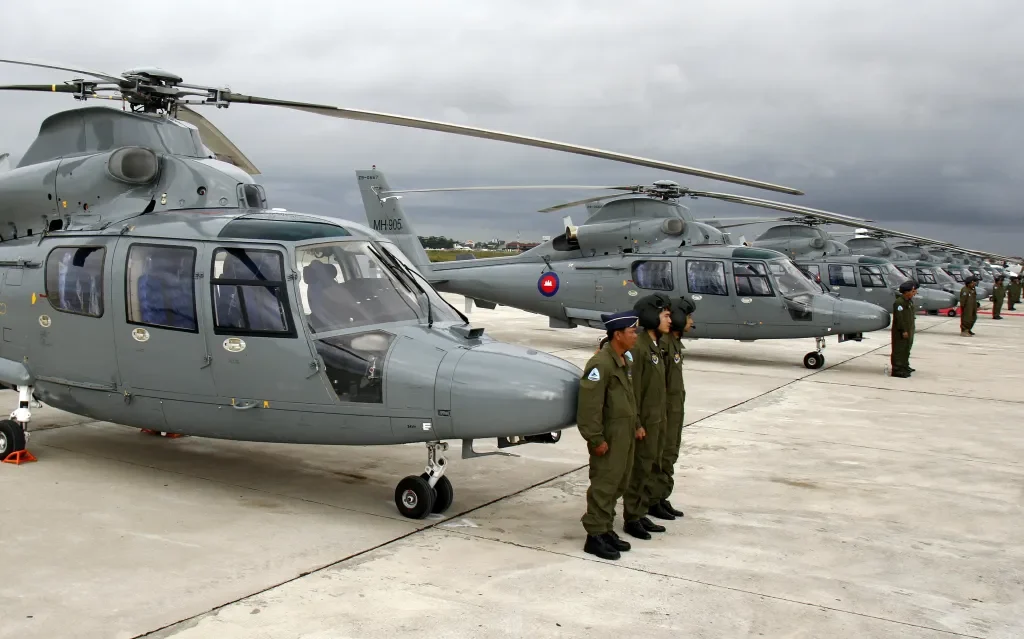
The second major French ancestor of China’s helicopter fleet was the Aérospatiale AS365 Dauphin. China first acquired complete helicopters and later established licensed production under the Z-9 designation.
The Z-9 was smaller and lighter than the Z-8 and consequently found use in almost every role: liaison, training, transport, reconnaissance, and shipboard operations. The proportion of Chinese-made components gradually increased, while the original utility helicopter became the basis for several combat variants.
The shipborne Z-9C received a surface-search radar and dipping sonar, as well as the ability to carry two anti-submarine torpedoes. The strike-oriented Z-9D has an enlarged nose radome and stub wings capable of carrying four YJ-9 anti-ship missiles. The newer Z-9F introduced an improved sonar, digital cockpit, and upgraded search radar.
Its compact size is both the Z-9’s greatest advantage and its primary weakness. It can operate from ships too small for a Z-18, but its endurance is limited and it cannot carry a full suite of heavy anti-submarine equipment. It is therefore expected to be gradually replaced by the naval Z-20F.
Z-10: China’s First True Attack Helicopter
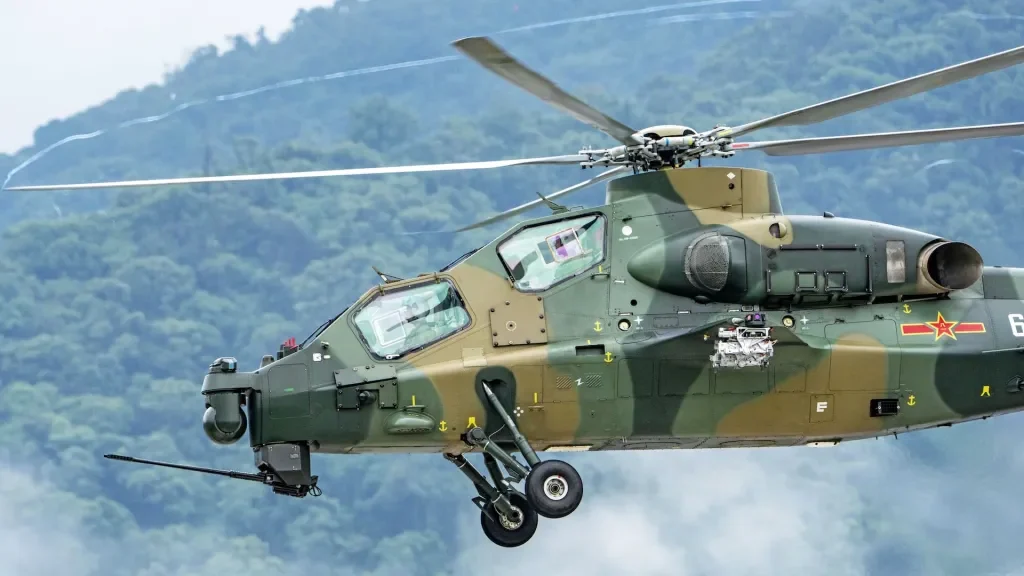
Before the Z-10, China did not possess a dedicated modern attack helicopter. Armed versions of the Z-9 could employ anti-tank missiles, but they remained converted utility aircraft.
The Z-10 was designed from the outset as a combat helicopter, with a narrow fuselage and tandem seating: the weapons operator sits in front, with the pilot behind. It made its first flight in 2003 and entered service around 2010.
Russia’s Kamov design bureau contributed to the early stages of the program, although the production Z-10 uses a conventional layout with a single main rotor and tail rotor. A 23mm cannon is mounted beneath the nose, while the stub wings can carry KD-9 and KD-10 anti-tank guided missiles, unguided rocket pods, and air-to-air missiles.
The engines became one of the program’s main problems. Prototypes flew with Canadian PT6C-76C engines, but production aircraft had to adopt the less powerful Chinese WZ-9. The loss of power forced designers to reduce the weight of armor, sensors, and weapons.
Later versions received additional ceramic armor, missile-warning sensors, satellite communications, and more advanced guided missiles. The export-oriented Z-10ME has been displayed with a mast-mounted radar, allowing it to detect targets while remaining concealed behind terrain.
The Z-10 has become the PLA Army’s principal attack helicopter, but its weight and protection still place it closer to the medium category. It is not a direct equivalent of the heavier AH-64 Apache.
Z-19: The Scout Flying Alongside the Gunships
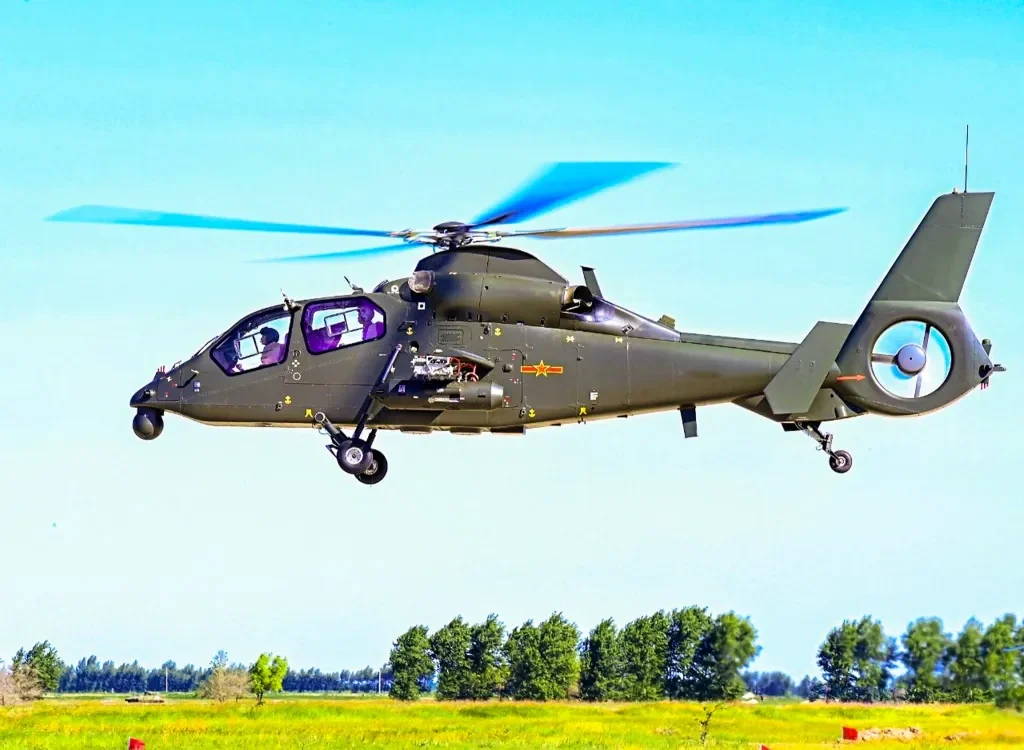
The lighter Z-19 uses mechanical components derived from the Z-9 family. It also has a narrow fuselage and tandem cockpit but is primarily intended for reconnaissance, target acquisition, and cooperation with the larger Z-10.
It can be fitted with a mast-mounted radar that allows the crew to observe terrain while remaining largely concealed behind an obstacle. Its armament includes anti-tank guided missiles, air-to-air missiles, unguided rockets, and gun pods.
The Z-19 and Z-10 combination resembles the former American approach in which light OH-58 Kiowa reconnaissance helicopters found targets for heavier AH-64s. Modern drones are gradually taking over some reconnaissance missions, but the Z-19 remains a crewed platform capable of conducting attacks independently.
In 2026, Z-10s, Z-19s, and Z-20 transports were already training together as part of the same Army Aviation brigade.
Z-21: China’s Attempt to Build an Apache
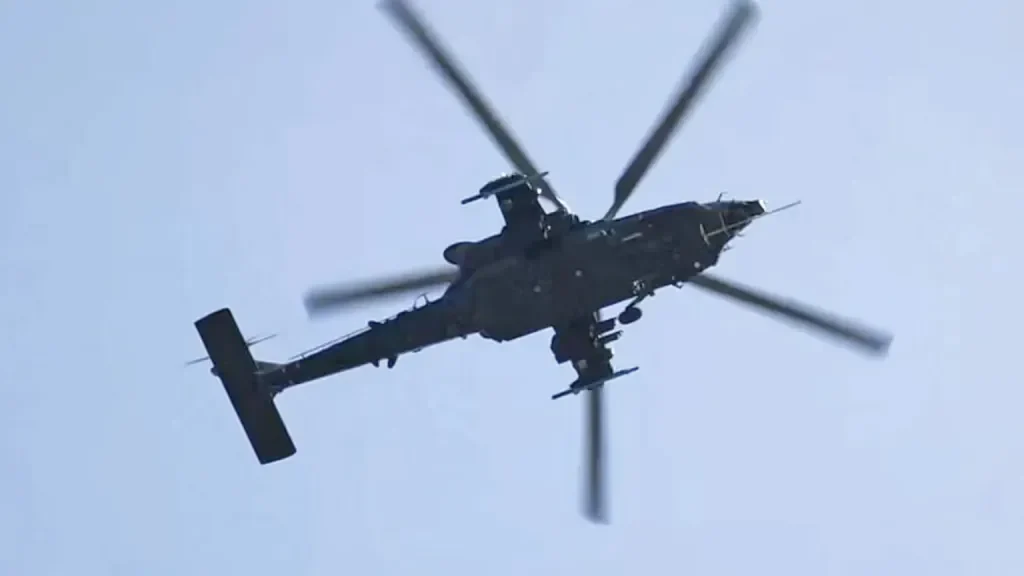
A new heavy attack helicopter, provisionally designated Z-21, was first observed in 2024. Its dynamic system—including engines, transmission, and rotor—appears to be related to that of the Z-20 medium transport helicopter.
In size and intended role, the Z-21 is considerably closer to the AH-64 Apache than the Z-10. It has a large armored fuselage, tandem cockpit, mast-mounted radar, and an extensive defensive-aids suite. Large cheek fairings may house missile-warning, electronic-support, and jamming equipment.
A 30mm cannon is expected beneath the forward fuselage. Each stub wing has three weapon stations for new long-range anti-tank missiles, air-to-air weapons, and other payloads.
The Z-21 remains an experimental aircraft. Its actual engines, weight, payload, and protection have not been officially disclosed. The direction of the project is nevertheless clear: China wants a heavily armed and armored helicopter that retains acceptable performance in high-altitude regions.
Z-20: China’s Black Hawk Becomes the Main Platform
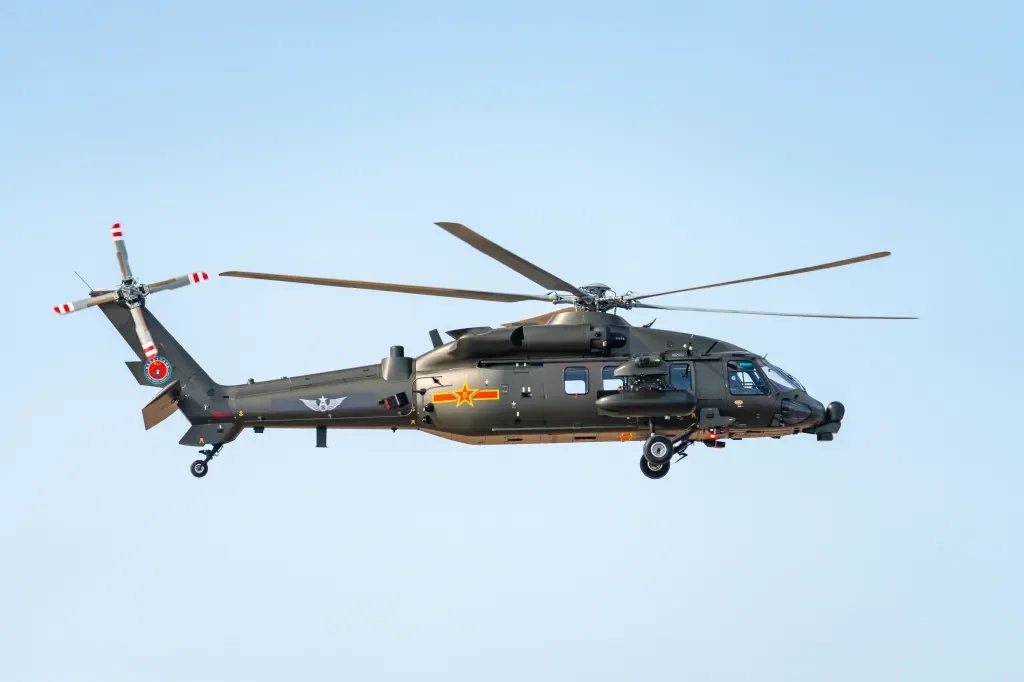
While the Z-21 is the most visually impressive new design, the Z-20 is far more important to the PLA’s everyday capabilities. It is intended to become the standard utility helicopter for both the Chinese army and navy.
China purchased a small number of American Sikorsky S-70Cs during the 1980s. They performed well in high-altitude regions and clearly influenced the design of the Z-20. The Chinese helicopter certainly resembles the Black Hawk, but it has a five-blade main rotor, domestic WZ-10 engines, fly-by-wire controls, and Chinese avionics.
The Z-20 made its first flight in 2013, while its appearance at a military parade in 2019 confirmed that it had entered service. In its transport configuration, it can carry up to 13 fully equipped soldiers. Two large side doors allow rapid disembarkation, including fast-rope operations.
Army Z-20s transport troops and cargo, perform search-and-rescue missions, and can receive stub wings carrying rockets, gun pods, and auxiliary fuel tanks. The Z-20T assault variant carries heavier armament and additional armor, effectively becoming an armed transport and direct-support helicopter.
The Z-20K was developed for airborne units, while the Z-20KS search-and-rescue version received an electro-optical turret, searchlight, and rescue hoist. Some variants have a folding tail section to simplify transportation aboard military cargo aircraft.
The naval branch is even more important. The Z-20J is intended for troop transport and fire support during amphibious operations. In 2026, it participated in exercises with Type 071 landing platform docks and Type 075 amphibious assault ships. It can also operate from Type 052D and Type 055 destroyers and Type 054A frigates.
The anti-submarine Z-20F is China’s equivalent of the American MH-60R Seahawk. It has folding rotor blades and a folding tail, a surface-search radar, dipping sonar, and a sonobuoy dispenser. It can carry torpedoes and anti-ship missiles.
The Z-20F fills a longstanding gap in Chinese naval aviation. The light Z-9 cannot carry a comprehensive ASW sensor package, while the Z-18 is too large for most frigates and destroyers. The medium Z-20 offers the required balance of size and payload and could eventually become China’s standard shipborne helicopter.
Why Russian Helicopters Remain in Service
Despite the rapid development of domestic platforms, China continues to operate Russian-built Mi-17 and Mi-171 helicopters. They transport troops and cargo and support special operations and search-and-rescue missions. The newer Mi-171Sh combines weapons with a comprehensive defensive-aids suite.
The reason is straightforward: these helicopters are already available in significant numbers, have established support systems, and have proven reliable. Replacing the entire fleet immediately would require large numbers of Z-20s, the retraining of personnel, and a complete overhaul of maintenance arrangements.
At sea, Ka-28 anti-submarine helicopters and Ka-31 airborne radar platforms also remain in service. Their missions, however, are gradually being assumed by the Z-18F, Z-18J, and Z-20F. Russian helicopters still supplement the Chinese fleet, but the long-term trend points toward decreasing reliance on imported designs.
What the Chinese Helicopter Fleet Has Become

The modern core of Chinese Army Aviation can be represented by four primary platforms. The Z-20 transports assault troops, the wide-body Z-8L carries heavier loads, the Z-10 provides attack power, and the Z-19 performs reconnaissance and target acquisition. These were the four principal operational Army Aviation helicopters displayed at the 2025 Tianjin Helicopter Exposition.
A different structure is taking shape at sea. The Z-8C and Z-8D transport Marines from large amphibious ships, the Z-18J provides radar surveillance, the Z-18F hunts submarines, and the more compact Z-20J and Z-20F can operate not only from carriers and amphibious vessels but also from frigates and destroyers.
China still lacks an indigenous production helicopter equivalent to the American CH-47 Chinook or CH-53K heavy lifter. Its fleet remains excessively diverse, while some aircraft continue to depend on foreign engines or design solutions developed decades ago. The capabilities of the newest helicopters are also known primarily from official presentations and open-source observations rather than operational experience.
Nevertheless, the transition has already occurred. China’s helicopter fleet can no longer be described simply as a collection of French licenses and Russian purchases. The Z-20 is becoming a common platform for the army and navy, the Z-8 and Z-18 cover heavy transport and maritime missions, while the Z-10, Z-19, and prospective Z-21 form an independent line of combat helicopters.
China began by copying and adapting individual aircraft. It is now building an entire helicopter ecosystem designed around amphibious assault ships, aircraft carriers, high-altitude airfields, and cooperation with unmanned systems. That systematic approach—not the Z-20’s external resemblance to the Black Hawk—is the most important result of half a century of development.