A Cruise Missile Was Hung Under a Mi-28 — But Why? What Can a Helicopter Give the Banderol That an Ordinary Truck Cannot?

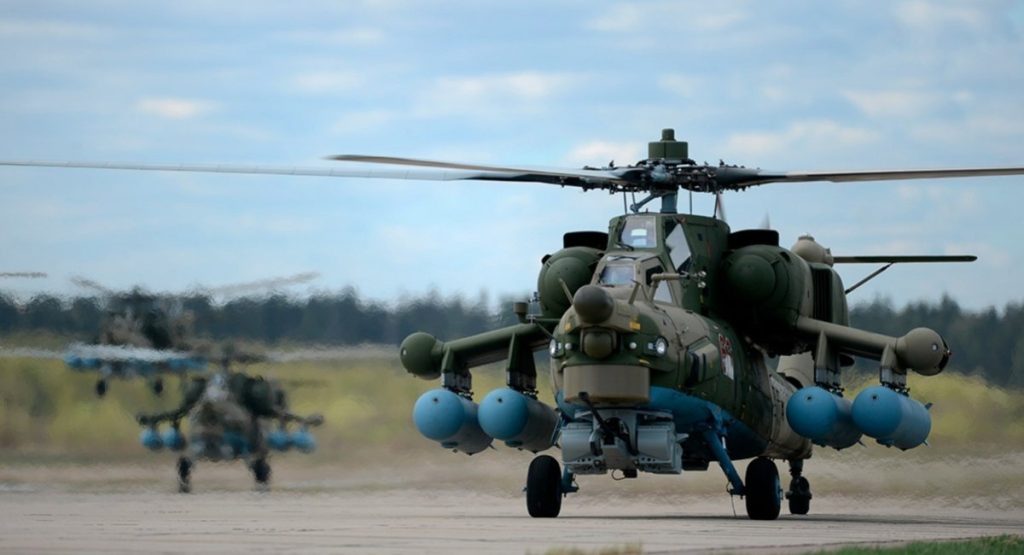
Photos that appeared in September 2026 showing a Mi-28 carrying a small cruise missile under its stub wing initially look like a perfectly logical development of the Russian attack helicopter. The aircraft has long served as a carrier of guided weapons, the S8000 Banderol is relatively compact, and the possibility of adapting it to the Mi-28 had been mentioned before. Now, for the first time, there is visual evidence of such an integration, although identifying the exact weapon from the photograph remains difficult: it could be the S8000 itself or the externally similar Dan-T, another relatively low-cost cruise missile for which several different launch platforms are reportedly being considered.
But if we look at this combination not simply as another expansion of the Mi-28’s weapons inventory, but as an engineering system, a rather strange question appears. Why carry a cruise missile on an expensive combat helicopter, consuming aircraft life, fuel, and crew time, if the same weapon can potentially be mounted on a much cheaper ground launcher? This is where the story becomes more interesting than the photograph itself, because the S8000 and weapons like it demonstrate an important trend: the modern low-cost cruise missile is gradually ceasing to be the weapon of one specific carrier. Aircraft, drones, helicopters, and trucks are beginning to become merely different ways of delivering the same munition to its launch point.
The Banderol Was an Unusual Missile From the Beginning
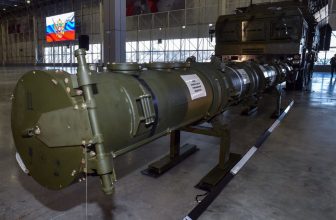
The S8000 occupies a space somewhere between a conventional cruise missile and a large jet-powered attack drone. According to data published by Ukrainian military intelligence, it is approximately five meters long, has a body diameter of around 300 mm and a wingspan of roughly 2.2 meters. Its cruising speed is estimated at 520–560 km/h, maximum speed at approximately 620–650 km/h, and range at up to about 500 kilometers. Examined examples have reportedly contained a small Chinese Swiwin SW800Pro-A95 turbojet engine as well as foreign electronic components, servos, and communications equipment.
In other words, this is not simply a miniature Kh-101. The design philosophy is different. Whereas an expensive strategic cruise missile is expected to combine long range, sophisticated navigation, a substantial warhead, and a high probability of penetrating air defenses, the S8000 attempts to achieve useful range and reasonably high speed with much simpler means. The result is a weapon faster than conventional propeller-driven one-way attack drones but potentially much cheaper than traditional cruise missiles. For systems of this kind, therefore, one of the most important characteristics is not maximum speed or range but the ability to manufacture and employ them in large numbers. Recent reporting indicates that the Banderol has become an increasingly common threat, illustrating precisely this low-cost mass-use logic.
This creates another layer between mass-produced attack drones and expensive cruise missiles. A slow propeller-driven drone is relatively easy to detect and can potentially be engaged by cheaper interceptors, although a mass attack can still place enormous pressure on air defenses. A high-end cruise or ballistic missile is considerably more dangerous but also much more expensive. The jet-powered Banderol attempts to sit between these extremes: retain relatively simple construction and moderate cost while increasing speed enough to shorten the defender’s reaction time. And for a weapon intended to be used in significant numbers, the choice of launch platform becomes particularly important.
The Drone Makes Sense. The Mi-28 Is More Complicated
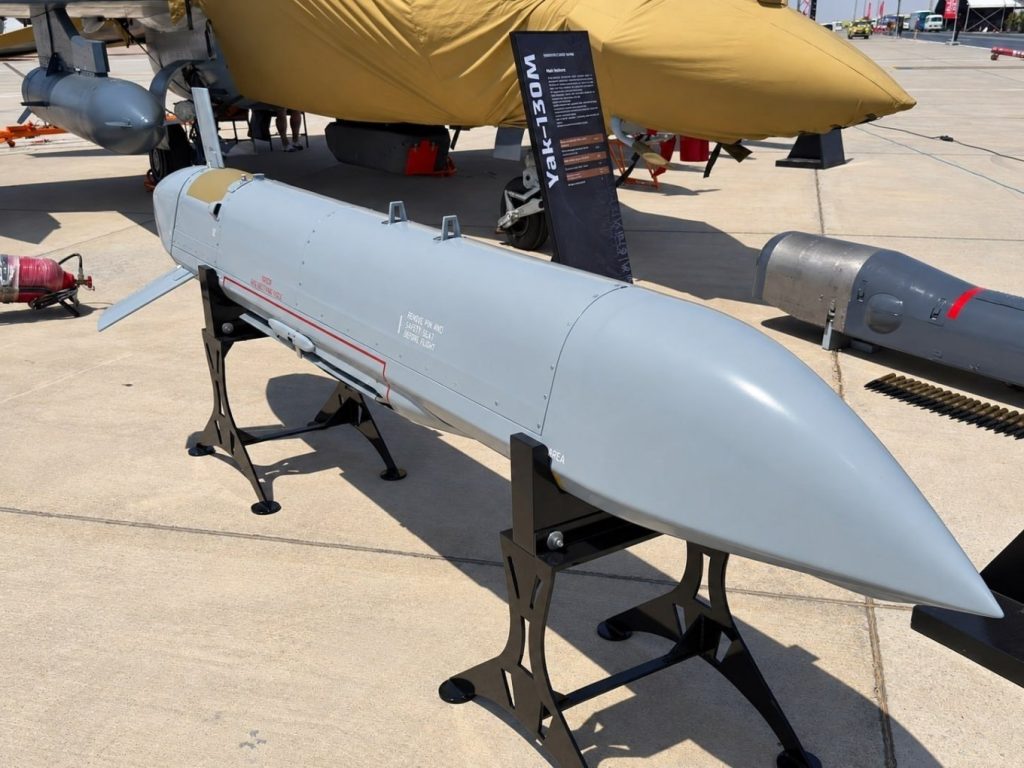
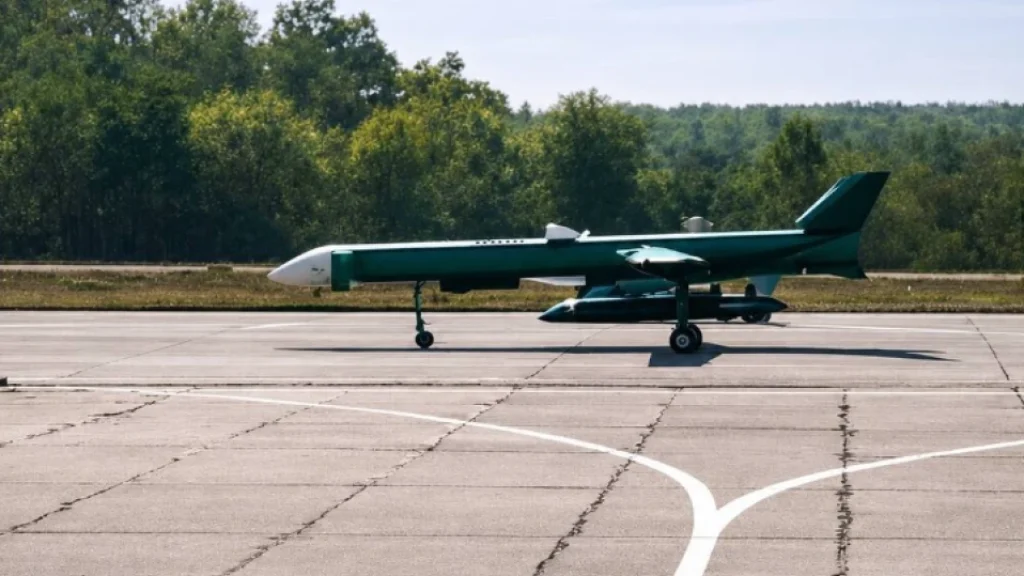
One known carrier of the S8000 is the Russian Orion/Inokhodets medium-altitude long-endurance reconnaissance and strike UAV. The logic here is fairly straightforward. A large reconnaissance-strike drone operating against dense air defenses faces an uncomfortable contradiction: to employ relatively short-range guided weapons, it has to approach the enemy’s engagement zone, while a large, slow, and not particularly stealthy MALE drone is poorly suited to doing so. A long-range missile allows the UAV to remain in a comparatively safe area and effectively become an airborne launcher. It can stay aloft for an extended period, receive a mission, move into the required area, and send a much faster weapon forward.
The Orion has an important limitation, however: it carries only one such missile. The Mi-28 looks more attractive in this respect. Defense Express estimates that a helicopter could potentially carry two or perhaps four S8000/Dan-T missiles. It can also move relatively quickly between airfields and temporary operating locations, carrying the missiles toward the required launch area. Air launch can provide the missile with an energy advantage as well: the carrier gives it altitude and some initial velocity before release, meaning that the weapon begins its own flight without having to accelerate from a stationary ground position.
In that sense, the Mi-28 can indeed be viewed as a reusable “zero stage.” It lifts the missiles, carries them hundreds of kilometers, brings them to the desired launch point, releases them, and returns home. From an engineering standpoint, the concept makes sense — until a truck carrying a ground launcher is parked next to the helicopter. At that point, the economics begin to look very different.
A Truck Does Almost the Same Job Without Having to Fly
Launching a missile from a Mi-28 requires a combat helicopter, a trained crew, aviation infrastructure or a suitable forward operating site, fuel, and maintenance. The aircraft has a finite service life and is simultaneously useful for numerous other missions. A ground launcher is fundamentally simpler: a vehicle chassis, launch rails or containers, communications and fire-control equipment, a crew, and the missiles themselves. Once a mission is received, the vehicle moves into position, launches, and leaves. Losing a truck and losing an attack helicopter are also very different events in terms of both cost and replacement difficulty.
The contradiction becomes particularly obvious when the weapon itself is intended to be inexpensive and mass-produced. The cheaper the missile becomes, the less attractive it is to employ an extremely expensive carrier unless that carrier provides a unique advantage. This is one reason mass-produced missile systems so often end up on wheeled chassis. An aircraft makes sense if it provides enormous relocation range, high speed, or the ability to attack from an unexpected direction; a large UAV can remain on station for long periods without risking a crew. A helicopter sits awkwardly in the middle: far more complicated and expensive than a truck, yet much slower and shorter-ranged than a fixed-wing aircraft.
There is another problem. Defense Express noted that the missile visible in the published photograph does not appear to have a separate solid-fuel launch booster. If this really is an air-launch configuration, the weapon may need the helicopter to provide sufficient altitude and speed before release. Yet one of a combat helicopter’s greatest advantages is its ability to fly extremely low, exploit terrain, and remain below the radar horizon. For an efficient cruise-missile launch, it may have to do the opposite — climb, potentially making itself much more visible to radar. A ground launcher equipped with a booster, meanwhile, could remain concealed until almost the moment of launch. The paradox is that the expensive airborne carrier could not only be more complicated than the ground alternative but, under some conditions, provide advance warning that a launch is being prepared.
So Why Put This Missile on a Mi-28 at All?
The simplest answer is that integrating a weapon across several platforms has value of its own. If the missile already exists, the Mi-28 already exists, and their weight, dimensions, and interfaces allow them to be combined without excessive expense, the military gains another employment option. It does not necessarily have to become the primary one. In fact, a ground launcher will almost certainly be economically superior for many routine missions. But there are situations in which the ability to move several missiles rapidly by air can genuinely matter — shifting them to another sector, launching from an area where no ground system has been deployed, or rapidly changing the geography from which an attack can originate.
That last advantage is especially interesting. If a ground-launched missile has a range of around 500 kilometers, its potential engagement area is determined by the location of its launcher. A helicopter can first move the launch point itself by hundreds of kilometers and only then release the missile. This changes not only the maximum reach of the weapon but also the directions from which it can approach. Air defenses may have to monitor a much larger area, while missile routes can potentially be planned around particular detection and interception zones. The real value of an airborne carrier is therefore not necessarily a few additional kilometers of range, but the ability to change the geometry of weapon employment.
There is, however, an important condition: the mobility provided by the carrier has to justify its cost. With a strategic bomber, the calculation is obvious — it can carry large numbers of long-range missiles thousands of kilometers. A fighter-bomber provides high speed. A large UAV provides endurance and removes the risk to a crew. The Mi-28 is slower than a fixed-wing aircraft, limited in range, carries relatively few missiles of this size, and may have to climb to exploit the full benefits of air launch. Calling it an ideal carrier is therefore difficult. As one of several possible carriers, however, it begins to make considerably more sense.
Then Dan-T Appears — and the Story Becomes Bigger Than the Banderol
Recent reporting has also focused on another relatively inexpensive Russian cruise-missile project, Dan-T. Open-source estimates have attributed a range of around 500 kilometers and a warhead of roughly 135 kilograms to the weapon, although detailed specifications remain uncertain and should be treated cautiously. Reports have also discussed potentially very large future production plans, but such figures remain public estimates rather than confirmed production totals.
What is more interesting is the apparent emphasis on multiple possible launch platforms, including ground systems and aircraft. If that approach develops further, we are no longer looking at a “missile for the Mi-28” or even a “missile for aviation,” but an attempt to create a comparatively inexpensive universal munition that can be launched from as broad a range of platforms as practical.
That matters much more than the photograph of a helicopter.
A traditional air-launched missile is closely tied to its carrier: weapon-control systems, pylons, interfaces, targeting, and appropriate software all have to be integrated. But the more autonomous the missile becomes after launch, the less the platform itself has to do. If the weapon receives its mission before release, navigates independently, and flies toward the target area on its own, the carrier’s job becomes comparatively simple: transport it to the launch point, provide the necessary data, and ensure safe separation. The carrier gradually changes from an integral part of the weapon system into transportation for the missile.
And That Leads to a Much More Uncomfortable Concept: A Missile That Barely Cares Where It Is Launched From
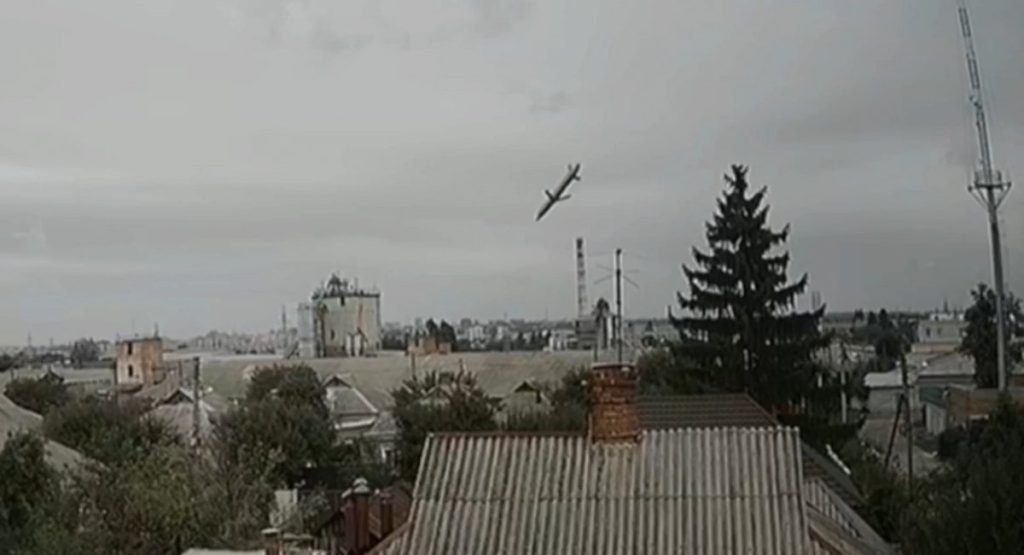
Instead of imagining a single S8000 hanging beneath one particular Mi-28, imagine a family of mass-produced cruise missiles compatible with several fundamentally different launch platforms. Ground launchers provide low cost, prolonged concealed readiness, and the ability to carry multiple weapons. Helicopters can rapidly relocate launch points between different sectors. Fixed-wing aircraft provide speed and range. UAVs can remain airborne for long periods and launch weapons without risking a crew. The missile itself, meanwhile, remains largely the same.
For air defense, such standardization creates a more complicated problem than merely increasing the number of missiles. When a particular weapon is closely associated with a specific aircraft, detecting the carrier provides at least some indication of the likely direction and timing of an attack. When the same type of weapon can arrive after being launched from a truck, drone, aircraft, or helicopter, the geography of the threat expands. Defenders have to monitor more potential launch areas while accounting for different employment profiles of essentially the same munition.
This is why a ground-launched version could ultimately prove much more important than the Mi-28 integration. A wheeled chassis is exceptionally efficient at carrying missiles: it is cheap, can transport several weapons, requires no pilots, consumes no scarce aviation flight hours, and can wait concealed for hours or days before receiving a launch order. Recent attack patterns have already led Defense Express to argue that ground-based Banderol launches may be occurring, although the evidence does not yet definitively establish the full operational launch architecture. If the S8000 or Dan-T gains a mature ground-launch capability on a large scale, the need for an expensive airborne carrier declines sharply. The Mi-28 then becomes not the principal means of launch, but merely another option — and that may actually make the overall system more flexible.
Because the Most Troublesome Missile Is Not Necessarily the Fastest One
Modern long-range weapons are developing in two almost opposite directions. At one end are extremely expensive systems designed to penetrate air defenses through speed, stealth, complex trajectories, or exceptional range. At the other is a very different philosophy: make the missile good enough, make it as inexpensive as practical, manufacture it in large numbers, and give it as many launch options as possible. The S8000 is interesting precisely because it appears to belong to this second category. Its reported use of a small commercial-class turbojet and numerous accessible electronic components gives it a technological philosophy that in some respects is closer to modern unmanned systems than to traditional strategic cruise missiles.
That does not necessarily make such a weapon primitive. It potentially makes it scalable. And that is where the strange photograph of the Mi-28 begins to make more sense. The real question may not be whether the helicopter is the best carrier for the S8000 or Dan-T. It probably is not: a truck is cheaper, a fixed-wing aircraft is faster, and a large UAV can remain on station longer without putting a crew at risk. But if all of these platforms can employ essentially the same missile, the carrier can be selected according to the mission rather than the weapon. One strike may favor a truck, another a rapidly repositioned helicopter, and another an aircraft or drone.
That is why the photograph of a small cruise missile under a Mi-28’s wing is interesting for reasons that go well beyond the Russian attack helicopter receiving another weapon. In fact, the Mi-28 may turn out to be one of the less rational ways to employ such a missile in large numbers. The broader trend matters far more: the low-cost cruise missile is gradually separating itself from its carrier, while the aircraft, drone, helicopter, and truck become merely different ways of transporting it to a launch point.
And that gives the question of whether launching a Banderol from a Mi-28 makes sense a rather unexpected answer. Perhaps it does not make much sense at all.
But that may not be the most important part of the story.
Things become much more interesting when the same missile no longer needs the Mi-28 at all.