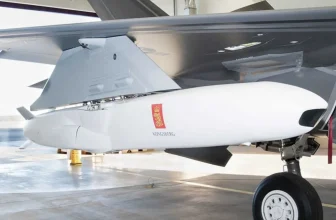
The rocket is 600 millimeters in diameter and approximately 8.6 meters long. Its demonstrated range reaches 380 kilometers, while the claimed maximum is between 400 and 420 kilometers. The projectile follows a ballistic trajectory, uses aerodynamic control surfaces, and can carry a conventional—or, according to Pyongyang, nuclear—warhead.
Almost any other country would classify such a weapon as a short-range ballistic missile. North Korea continues to describe it as a “super-large multiple rocket launcher.”
The system, designated KN-25 in the West, genuinely occupies the space between two weapons categories. From a multiple-launch rocket system, it inherits a multi-round launcher, salvo firing, and integration into artillery units. From a ballistic missile, it gains its range, dimensions, guided flight, and ability to strike targets far beyond the conventional frontline.
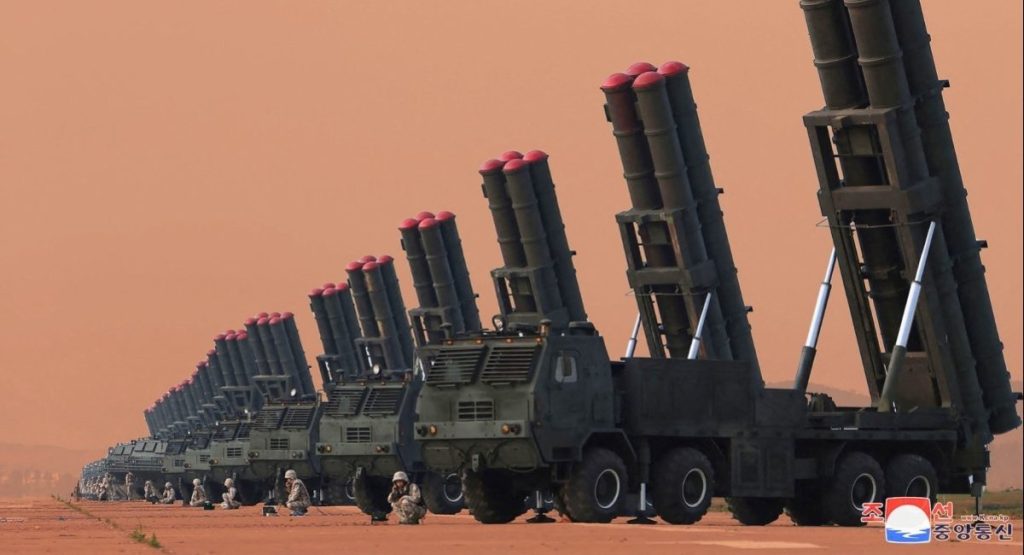
By 2026, the KN-25 was no longer an experimental curiosity. North Korea had established large-scale launcher production, introduced a new five-round version, and repeatedly demonstrated coordinated salvos by entire units.
Six Hundred Millimeters Is No Longer Just a Caliber
The KN-25 was first tested in 2019. During one of its initial launches, two missiles flew approximately 380 kilometers and reached an altitude of almost 100 kilometers. That performance led the United States military to classify the system as a short-range ballistic missile despite North Korea’s preferred terminology.
For comparison, the Soviet Smerch and its modern derivatives use 300mm rockets. The KN-25 is twice as wide, giving it approximately four times the cross-sectional area. That additional volume can accommodate substantially more propellant, a guidance system, and a heavier warhead.
The KN-25 uses a solid-propellant motor. It does not require lengthy fueling before launch: the launcher can reach its position, prepare to fire, deliver its salvo, and leave the area. The rocket has fixed rear stabilizers and movable control surfaces near the nose, allowing it to adjust its trajectory during flight.
The missile’s total mass and warhead weight have not been officially disclosed. Its primary version probably carries a high-explosive fragmentation warhead. Pyongyang also claims that the KN-25 can carry the Hwasan-31 tactical nuclear warhead, although its compatibility with the missile has not been independently confirmed.
The stated maximum range also requires clarification. The KN-25 has repeatedly flown between 350 and 380 kilometers, which has been confirmed through external observation. The figure of 400 or 420 kilometers remains a North Korean claim, although it appears technically plausible.
Why Is It Still Called an MLRS?
A conventional ballistic missile is generally launched from a single- or twin-round transporter and assigned to strike a specific high-value target. Multiple-launch rocket systems operate differently: several vehicles fire large numbers of projectiles simultaneously, covering an area or overwhelming defensive systems.
The KN-25 combines both approaches. Each round resembles an individual ballistic missile in size and capability, but the launchers are organized into artillery units and designed to deliver massed salvos.
In May 2024, North Korean forces fired 18 KN-25 rockets almost simultaneously. According to Pyongyang, they struck an island target approximately 365 kilometers from the launch site. The accuracy claim cannot be independently verified, but the salvo demonstrated the system’s intended role: North Korea does not treat the KN-25 as a single precision weapon but as a means of concentrated fire.
When one battalion launches dozens of guided missiles within a short interval, the defender faces more than an isolated ballistic attack. Even intercepting most of the incoming weapons does not guarantee that the remaining missiles will fail to reach their targets.
Quantity is what distinguishes the KN-25 from many conventional ballistic-missile systems. North Korea is attempting to combine missile-like range and precision with the volume of fire normally associated with rocket artillery.
From Four Tubes to Five
The original KN-25 appeared on a four-axle wheeled launcher carrying four tubes. It was followed by a heavy tracked vehicle with six launch containers. At the end of 2022, North Korean industry reportedly delivered 30 of these systems to the military.
The tracked chassis could carry a larger salvo and travel beyond good roads, but the resulting vehicle was heavy and comparatively slow. North Korea later returned to a wheeled platform, increasing its payload from four rounds to five: three tubes are arranged on the lower level and two above them.
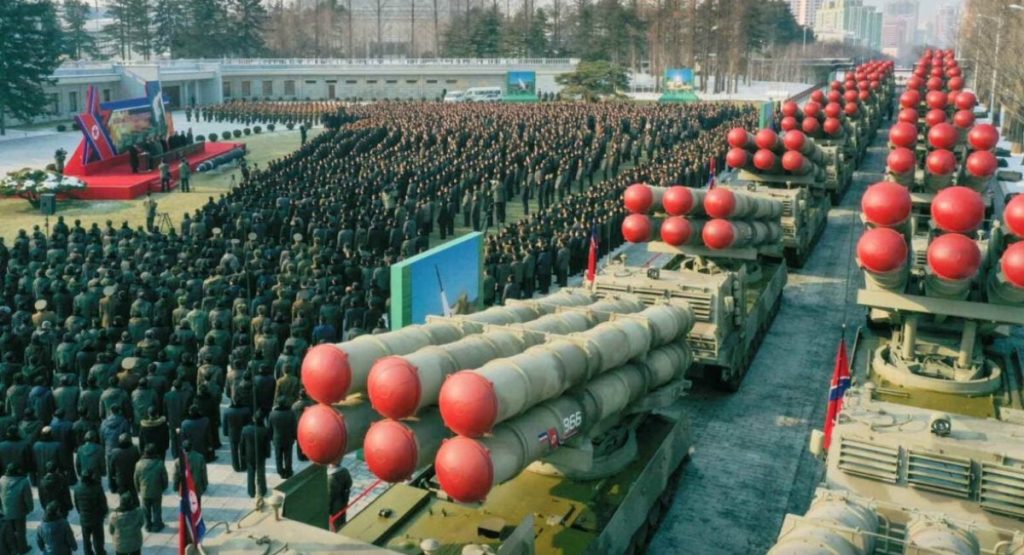
This configuration represents a compromise between mobility and salvo size. In February 2026, Pyongyang displayed 50 new five-round launchers being transferred to military units. Together, those vehicles could carry 250 ready-to-fire missiles—far more than would be required for an exclusively nuclear role. This suggests that the KN-25 is also expected to operate extensively with conventional warheads.
In March 2026, twelve of the new launchers participated in a major exercise, firing missiles at a target approximately 364 kilometers away. On October 29, the upgraded system—now called the “Sniper”—appeared again during a demonstration involving ballistic missiles, cruise missiles, and several types of drones. South Korean forces detected approximately ten launches from the Wonsan area, with the missiles flying around 250 kilometers.
The KN-25 has therefore evolved from an unusual prototype into one of North Korea’s most frequently demonstrated long-range strike systems.
How Accurate Is It?

The KN-25 is clearly a guided weapon. Its forward aerodynamic control surfaces allow the missile to alter its flight path, while numerous tests have presumably helped refine its guidance system.
The original versions probably relied on inertial navigation, possibly supplemented by satellite updates. North Korea does not possess its own complete global satellite-navigation constellation, however, and must either use accessible foreign signals or rely on an autonomous system.
In 2026, Pyongyang claimed that the upgraded KN-25 had received a “self-steered precision guidance system” capable of operating without outside assistance. North Korean statements also mentioned artificial intelligence and compound guidance. These descriptions may refer to an improved inertial-navigation system that does not require satellite correction, but no detailed specifications or independently verifiable results have been released.
North Korean reports regularly claim that every missile struck its target. Such statements cannot be accepted literally. Photographs can confirm the launches and the approximate impact area, but they do not reveal the system’s circular error probable.
Without high accuracy, the KN-25 remains most useful against large-area targets such as airfields, storage facilities, and major military positions. If its accuracy is measured in tens of meters, it becomes capable of striking individual buildings and infrastructure components. The real performance of its guidance system therefore remains the KN-25’s most important unknown.
Neither Artillery nor Quite a Ballistic Missile
The debate over the KN-25’s classification is largely artificial. Its name does not change what happens after launch.
The system differs from a conventional MLRS in its enormous range, sophisticated guidance, and the high cost of each round. It is not intended to provide continuous fire against targets close to the frontline. Reloading five enormous containers requires a specialized resupply vehicle and considerable time.
It differs from a traditional ballistic missile system through its multi-round launcher and emphasis on coordinated mass firing. This is not simply “one missile for one particularly important target.” It is an attempt to launch dozens of guided weapons against a distant area at nearly the same time.
The best description of the KN-25 may therefore be long-range guided rocket artillery. Systems of this kind erase the old boundary between multiple-launch rocket systems and theater ballistic missiles. Modern artillery rockets are gaining missile-like navigation and range, while ballistic missiles are increasingly being fired in artillery-style salvos.
Its Strength Lies in the Battery, Not the Individual Missile
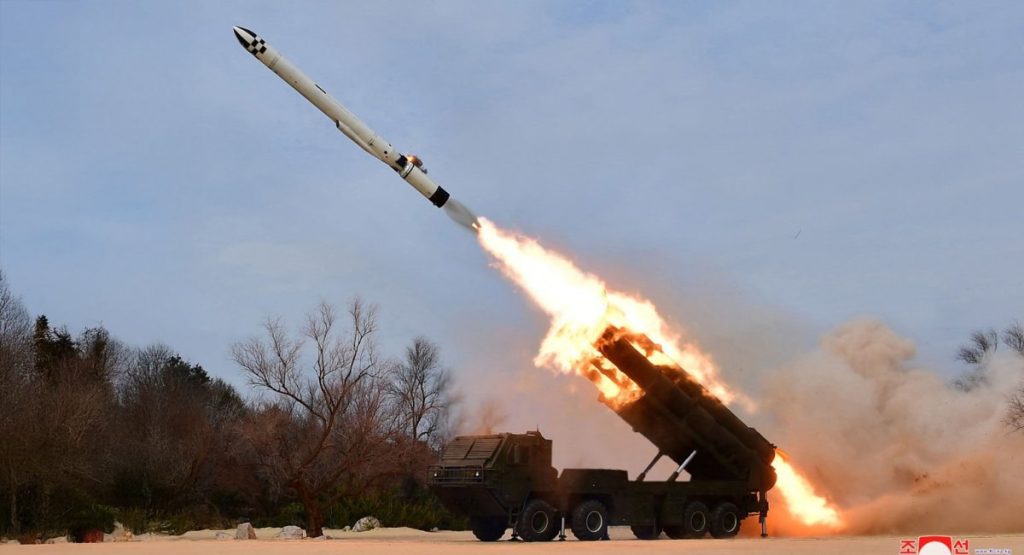
One KN-25 is not a revolutionary weapon. It can be detected and, under suitable conditions, intercepted. Its launcher is large, requires reloading after firing, and remains dependent on reconnaissance, communications, and accurate target coordinates.
The scale of deployment creates the real threat. Five missiles per vehicle, dozens of launchers, and an integrated fire-control system allow North Korea to assemble a large salvo rapidly. Other ballistic missiles, cruise missiles, and drones can be added, forcing defensive systems to engage targets approaching at different altitudes and along different trajectories.
North Korea demonstrated precisely this mixed-strike model in October 2026. The KN-25 did not operate alone but as part of a broader system involving reconnaissance and attack drones, air-launched weapons, and cruise missiles.
In this context, the five-round launcher matters more than claims about artificial intelligence. Even moderate accuracy can be partially compensated for through missile volume. The ability to concentrate fire from several batteries makes the KN-25 useful with both conventional and claimed special warheads.
Could the KN-25 Appear Outside North Korea?
Since 2023, there has been recurring speculation about possible KN-25 exports. Its potential transfer to Russia has attracted particular attention. The reason is understandable: the system sits between a heavy multiple-launch rocket system and a ballistic missile and could theoretically supplement existing weapons.
As of early November 2026, however, no such transfer has been confirmed. The KN-25 has not been reliably observed outside North Korea, while its rockets and launchers have not been identified in any foreign military. Defense Express likewise notes that reports of a possible acquisition remain speculation rather than evidence.
Exporting the system would require more than delivering launchers and missiles. It would also involve transport-loading vehicles, maintenance equipment, fire-control systems, spare parts, and crew training. For a country that already operates its own ballistic missiles and heavy rocket artillery, establishing a separate logistics chain for the KN-25 might not be economically or operationally rational.
For now, it is more reasonable to view the system primarily as a North Korean weapon developed for the geography and military structure of the Korean Peninsula.
The Caliber That Erased the Boundary
The KN-25 is not significant merely because North Korea has created an exceptionally large rocket. Its defining feature is the disappearance of the traditional boundary between artillery and missile forces.
A multiple-launch rocket system no longer has to fire relatively simple unguided projectiles over tens of kilometers. A ballistic missile no longer has to launch alone from a dedicated single-round vehicle. The KN-25 offers a different formula: five guided solid-propellant missiles on one launcher and dozens of launchers connected through a common command system.
It can be described either as a super-large MLRS or as a short-range ballistic missile system. In practical terms, what matters is that North Korea now possesses a mobile weapon capable of delivering a full missile salvo to a distance approaching 400 kilometers.
Once an artillery rocket grows to 8.6 meters, acquires its own guidance system, and receives a claimed nuclear role, the question of what to call it becomes secondary. The artillery has already transformed into a missile force—it has simply retained several launch tubes on each vehicle.