A Giant “Stealth” Drone for Display, Hundreds of FPVs for Combat: What North Korea Showed at Its UAV Exhibition

At the “Unmanned Aeronautical Technology Development 2026” exhibition, which opened on October 29, North Korea attempted to display almost everything at once: strategic reconnaissance aircraft, heavy attack drones, loitering munitions, FPV quadcopters, and even a large jet-powered “stealth” design resembling some of the most advanced projects from the United States, China, and Russia.
A large tailless flying wing occupied the center of the exhibition hall. It was clearly intended to become the star of the official photographs. The most dangerous part of the display, however, stood around it — on storage racks filled with hundreds of small and relatively inexpensive drones.
Pyongyang may still be a long way from developing a genuine low-observable combat aircraft. The mass production of simpler reconnaissance drones, loitering munitions, and FPV systems, however, is already within the capabilities of North Korean industry.
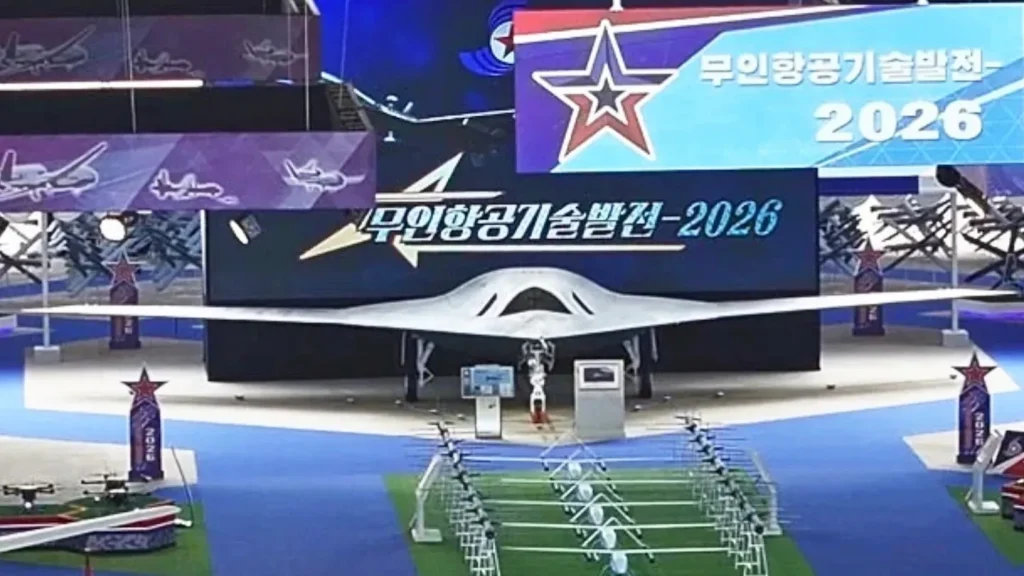
A large flying wing that has not yet flown anywhere
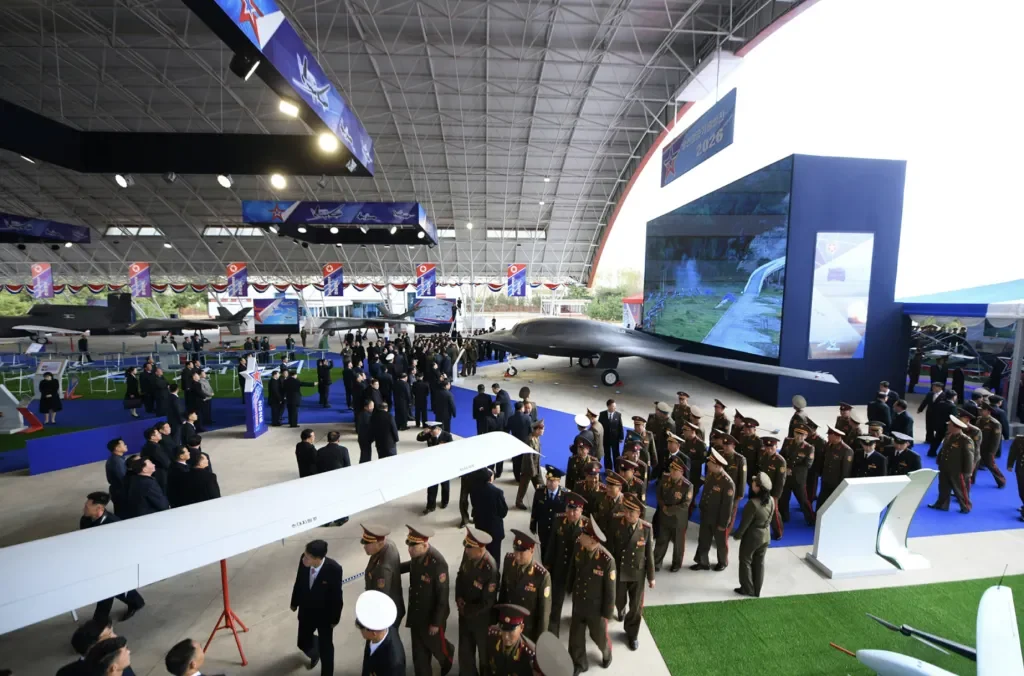
The exhibition’s most unusual object was a large tailless UAV. Based on available photographs, its wingspan has been estimated at approximately 17–20 meters, while its height may be around three meters. The aircraft features a dorsal air intake, a broad central fuselage blended into the wing, and retractable tricycle landing gear.
In appearance, it resembles several well-known designs at once: the American experimental X-47B, China’s GJ-11 Sharp Sword, Europe’s nEUROn, and Russia’s S-70 Okhotnik. All use the flying-wing configuration to reduce radar signature and accommodate weapons inside the airframe.
An identical silhouette, however, does not make an aircraft stealthy. Genuine low observability begins where the external resemblance ends. It requires radar-absorbent materials, precisely fitted panels, carefully designed engine intakes and exhausts, engine shielding, internal weapons bays, and antennas that do not create strong radar reflections.
Making a large tailless wing fly safely is an even more difficult task. Such aircraft require sophisticated digital flight-control systems that constantly correct their attitude. Reliable satellite communications, reconnaissance sensors, navigation equipment, and safe weapons-control systems must then be added.
North Korea revealed nothing about the aircraft’s engine, payload, or intended mission. There is also no evidence that the displayed airframe has ever flown. For now, it appears to be a full-size declaration of intent — a demonstration of the type of system Pyongyang wants to develop, rather than a combat-ready UAV.
The Global Hawk and Reaper lookalikes can already fire weapons
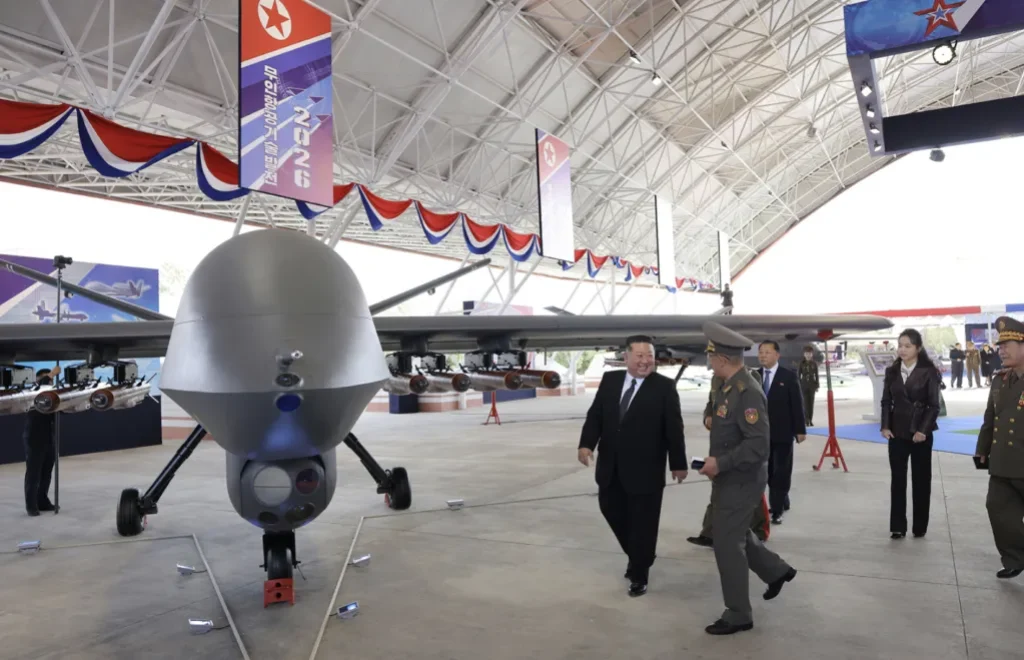
Displayed alongside the new “stealth” aircraft were the familiar Saetbyol-4 and Saetbyol-9 — “Morning Star 4” and “Morning Star 9.” Both were first unveiled in 2023.
The Saetbyol-4 closely imitates the appearance of the American RQ-4 Global Hawk high-altitude reconnaissance aircraft. The Saetbyol-9 resembles the MQ-9 Reaper, featuring a long straight wing, V-tail, turboprop engine, and external weapons stations.
External similarity does not imply equal performance. The real value of the Global Hawk and Reaper lies not in their airframes but in their radars, electro-optical sensors, satellite communications, software, and ability to share intelligence with other forces. Almost nothing is known about the quality of North Korea’s electronics.
The Saetbyol-9, however, has already been demonstrated in flight and carrying weapons. In newly released footage, it employed air-to-surface missiles, including a weapon resembling the American Hellfire. North Korean media claimed that drones, cruise missiles, and other systems struck island targets with perfect accuracy, although the claim cannot be independently verified.
The Saetbyol-9 should therefore be taken more seriously than the new flying wing. Its actual range, altitude, and optical equipment may fall far short of the MQ-9, but it is already a flying platform capable of conducting reconnaissance and launching weapons.
North Korea’s catalog of foreign ideas
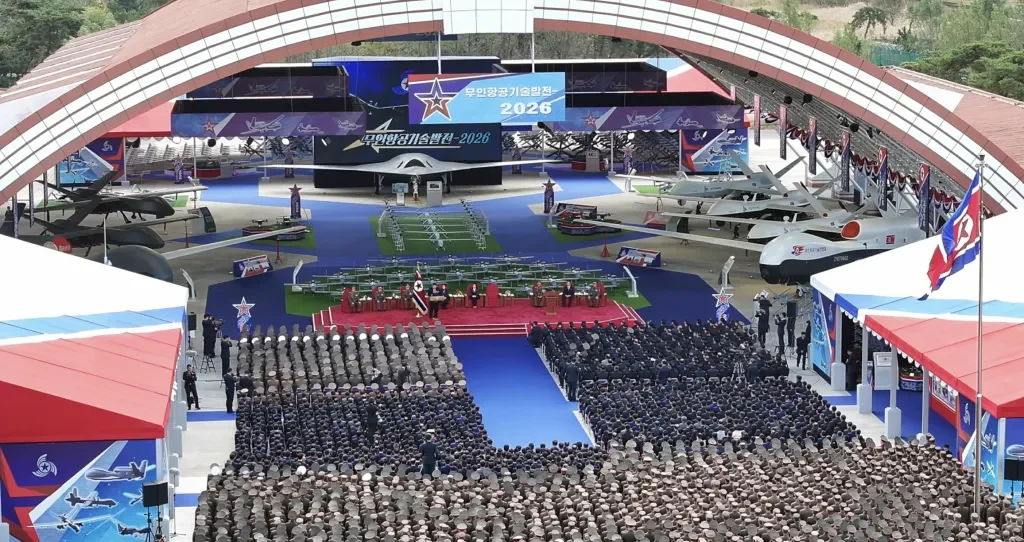
Much of the exhibition resembled a catalog of the most successful drone designs developed in recent years. Pyongyang is making little effort to conceal where it finds inspiration.
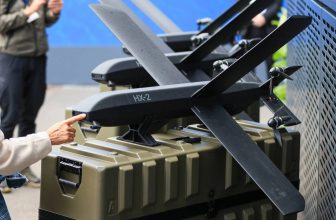
The displayed systems included loitering munitions resembling Israel’s Harop, Russia’s Lancet, and the American Switchblade family. There were X-shaped attack drones intended to engage armored vehicles, small fixed-wing designs launched from containers, and low-cost UAVs with simplified airframes.
During live demonstrations, North Korean drones attacked mock-ups of a South Korean border guard post, a K9 self-propelled howitzer, and a U.S. M1 Abrams tank. Other UAVs launched guided missiles at ground targets. At the same time, a battery of 600 mm multiple-launch rocket systems struck an island range.
Copying an aircraft’s appearance does not necessarily mean duplicating its internal systems. For a relatively simple attack drone, however, that may not be necessary. Once the basic aerodynamic configuration is known, selecting an engine, autopilot, camera, and warhead is considerably easier than developing an entirely new system.
North Korea has spent decades developing missile production, electronics, machine tools, and the mass manufacture of weapons. A medium-class loitering munition is therefore a much more realistic undertaking than a jet-powered stealth UAV.
The most important exhibit stood on an ordinary rack
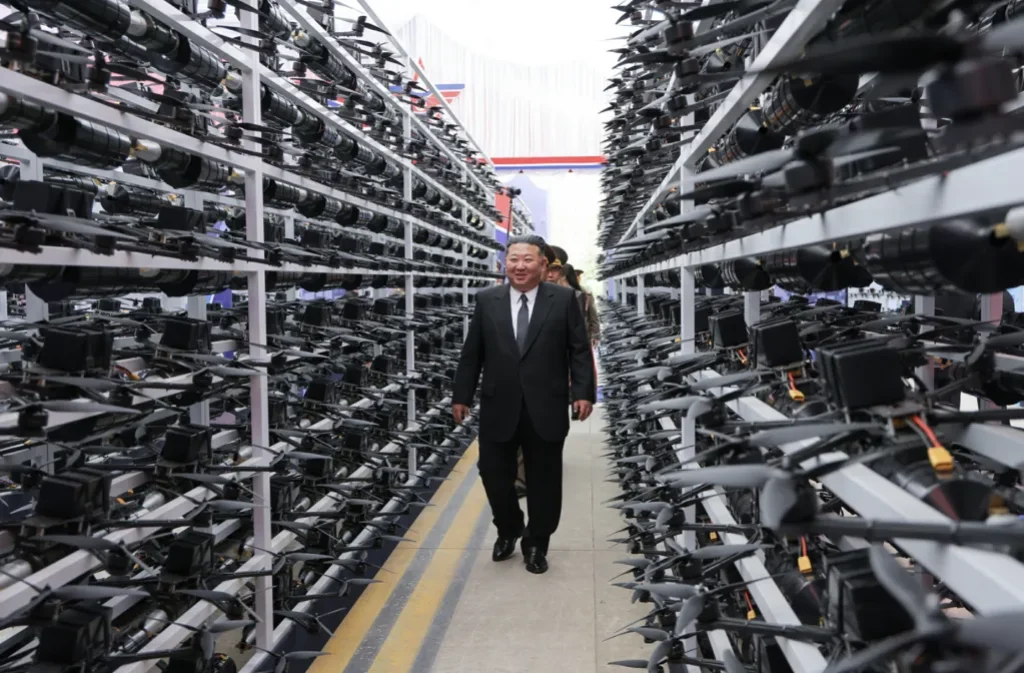
Photographs from the exhibition hall show hundreds of FPV quadcopters arranged on multi-level storage racks. Some appear to carry cylindrical spools resembling fiber-optic control systems.
A conventional FPV drone receives commands over a radio link. Electronic warfare can disrupt that connection between the operator and the aircraft. A fiber-optic drone unspools a thin cable behind it, transmitting video and control commands through a physical link. Conventional radio-frequency jamming has little effect on such a system.
The solution has disadvantages. The spool adds weight, the cable limits range, and it can become entangled in obstacles. Over relatively short distances, however, it allows the operator to retain control even in an environment saturated with electronic interference.
This technology would be particularly dangerous on the Korean Peninsula. The distances between opposing positions are small, while the border region contains dense concentrations of fortifications, artillery, radars, and command posts. A range of 1,000 kilometers is often unnecessary. What matters is the ability to fly several dozen kilometers and accurately strike a selected vehicle or firing position.
The hundreds of UAVs displayed on the racks may partly have been arranged for visual effect, but they also reveal the direction of North Korean development. Pyongyang does not need a small number of highly sophisticated drones if it can manufacture simple attack quadcopters by the thousand.
Artificial intelligence remains largely a slogan
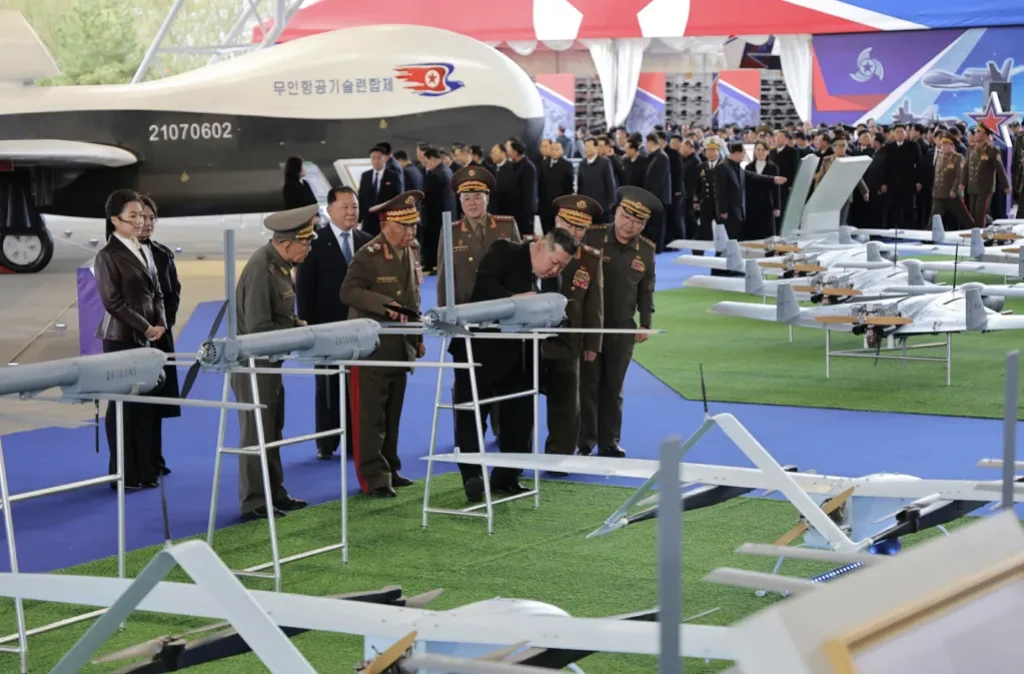
Kim Jong Un declared the achievement of “absolute superiority” in unmanned technology to be one of the country’s priority objectives. He placed particular emphasis on introducing artificial intelligence into military systems. State media reported plans to accelerate unmanned aviation development and create increasingly autonomous platforms.
There is, however, an enormous gap between using the term “artificial intelligence” and producing a genuinely autonomous combat UAV. Independent target detection and recognition require large datasets, powerful computers, reliable algorithms, and high-quality cameras. A software error could direct the weapon toward friendly forces or a civilian object.
Simpler forms of automation are considerably more realistic: flying along a predetermined route, returning after communications are lost, keeping a selected object in the camera’s field of view, and guiding itself toward a visually distinct target during the terminal phase. Such functions already improve a drone’s effectiveness without requiring technology equal to that of the world’s leading developers.
North Korea’s claims about military artificial intelligence should therefore be treated as a development objective rather than proof that fully autonomous weapons are already operational.
Why the small drones matter more than the large “stealth” aircraft
The enormous flying wing is perfect for propaganda photographs. It advertises technological ambition and allows North Korea to place itself visually alongside countries developing low-observable combat aircraft.
The exhibition’s real military significance lies elsewhere.
Simple reconnaissance drones can direct artillery fire. Loitering munitions can attack radars, air-defense positions, and armored vehicles. FPV quadcopters can engage individual vehicles and firing points. Larger one-way attack drones can follow complex routes and overwhelm air-defense systems.
They do not have to be technologically perfect. Even a slow and noisy drone becomes a serious problem when dozens of similar aircraft approach simultaneously. An interceptor missile may cost many times more than the drone it destroys, while stocks of expensive air-defense munitions are always limited.
Researchers had already identified the rapid expansion of North Korea’s drone program before the latest exhibition. The Saetbyol-4 and Saetbyol-9 represented the visible beginning of that process. Pyongyang is now demonstrating a transition from a few prestigious projects to a complete family of systems in different weight and mission categories.
The exhibition’s most important message was therefore not located beneath the enormous flying wing. It was contained in the hundreds of small machines standing around it.
North Korea may remain incapable of producing a genuine stealth combat drone for years. It does not have to wait for one. Much simpler aircraft can already observe an opponent, direct artillery fire, attack armored vehicles, and force expensive air defenses to expend their missiles.
The large “stealth” aircraft represents a dream. The racks of FPV drones represent a plan.