Nearly Half a Ton of Explosives on an S-75 Launcher: The Story of the K-15 Ajkula Missile

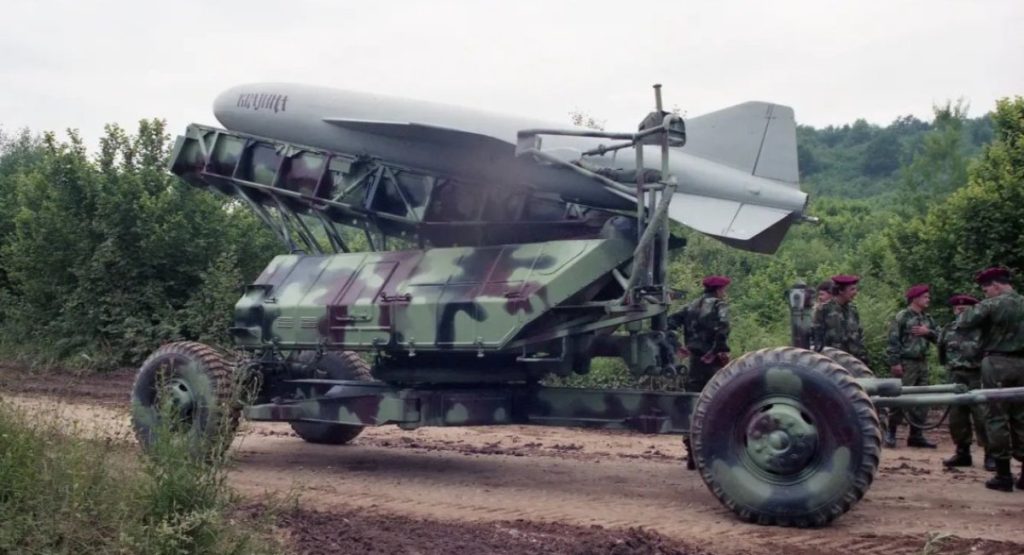
In June 1995, the Vidovdan-95 military parade was held at a training ground near the town of Slunj. Tanks, artillery pieces, and air defense systems of the Army of the Republic of Serbian Krajina rolled past the reviewing stand. But the most mysterious exhibit was a huge winged missile mounted on a two-axle launch platform.
The system was presented as the K-15 Krajina. Some sources also refer to it by its project name, Ajkula—“Shark.” At first glance, it could easily be mistaken for a new ballistic missile. In reality, the spectators were looking at an unusual military hybrid: a Soviet P-15 Termit anti-ship missile, naval launch equipment, and a modified platform from an S-75 surface-to-air missile system.
The resulting weapon was intended to attack targets on land rather than ships. However, the only reliably documented “operational appearance” of the K-15 was that parade.
The Missile Survived, but Its Ship Was No Longer Needed
At the beginning of the 1990s, the Yugoslav Navy possessed approximately ten Project 205 missile boats and a considerable stock of P-15-family missiles. One modern reconstruction puts the number at 74. The boats themselves were already considered obsolete and were approaching retirement, but their armament still packed a formidable punch.
The P-15 had been developed in the Soviet Union as a heavy anti-ship missile. It was approximately 6.5 meters long, weighed more than two tons at launch, and could carry a warhead containing around 480–500 kilograms of explosives. A solid-fuel booster accelerated the missile during launch, after which its liquid-propellant sustainer engine took over. Early versions had a maximum range of approximately 40 kilometers.
To hit a ship, the Termit relied on an autopilot, an altimeter, and an active radar seeker. This arrangement made sense over the sea: the missile flew above a relatively uniform water surface and searched for a large, radar-reflective target during the final stage of its flight.
Over land, the situation was completely different. Following Yugoslavia’s disintegration, some of the missiles remained available, but the vessels and supporting coastal infrastructure needed to operate them were no longer there. This produced a proposal typical of wartime improvisation: if the naval missile could no longer be used at sea, why not launch it at a target on land?
How the Termit Became the Ajkula
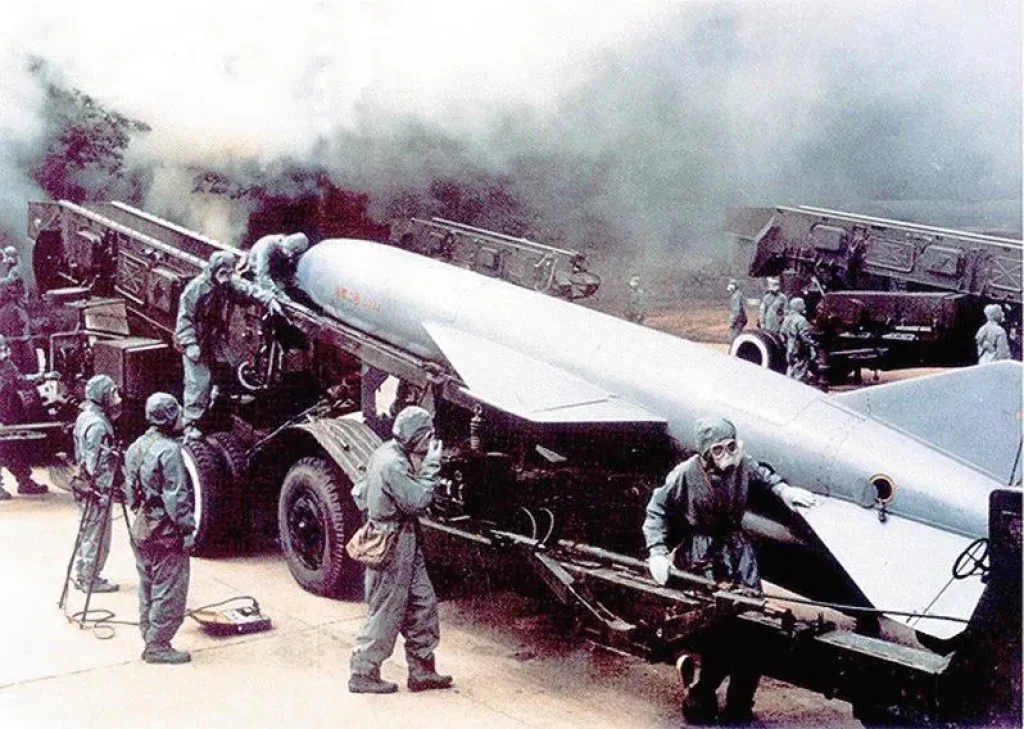
The initiative reportedly came from specialists at the Kosmos plant in Banja Luka, which repaired and maintained military equipment. In June 1993, its engineers proposed converting some of the surviving P-15s into surface-to-surface missiles.
The military approved the idea. A KT-97 launcher and elements of the launch-control system were removed from one of the Project 205 missile boats. They were then delivered to the plant together with ten Termit missiles.
Guidance presented the most serious problem. The Termit’s radar seeker had been designed to detect ships, not buildings, bridges, or concentrations of vehicles. The proposed solution was to remove the seeker and direct the missile toward predetermined coordinates using an inertial guidance system. During the final stage, the K-15 was supposed to enter a steep dive. Some accounts suggest that its wings would fold before impact.
In effect, a guided anti-ship missile was being turned into an extremely heavy but not particularly accurate rocket. A miss measured in dozens or perhaps hundreds of meters might have been acceptable when attacking a large area target. Using the K-15 against an individual building or a small position would have been considerably more difficult.
Why the S-75 Launcher Was Needed
Mounting a two-ton naval missile on an ordinary truck was no easy task. The system required a platform capable of supporting the missile’s weight, providing the necessary launch angle, and absorbing the forces generated when its booster ignited.
The land-based system was built around a modified two-axle launcher from the S-75 air defense system. Elements of the P-15’s naval launch equipment were installed on top of it. The result was a genuine missile construction kit: an air defense launcher, equipment taken from a missile boat, and an anti-ship missile with a modified guidance system.
Describing it simply as a “P-15 on an S-75 launcher” somewhat oversimplifies the design. The platform held and aimed the missile, but the launch still required electrical and control equipment originally intended for naval use.
Operation would also have been complicated. The Termit used a liquid-propellant sustainer engine, and maintaining such missiles required trained personnel, specialized equipment, and strict safety procedures. The launcher was large and highly visible, while preparing it for a launch and leaving the firing position would have been considerably harder than with a modern mobile missile system.
The 150-Kilometer Range Became Part of the Legend
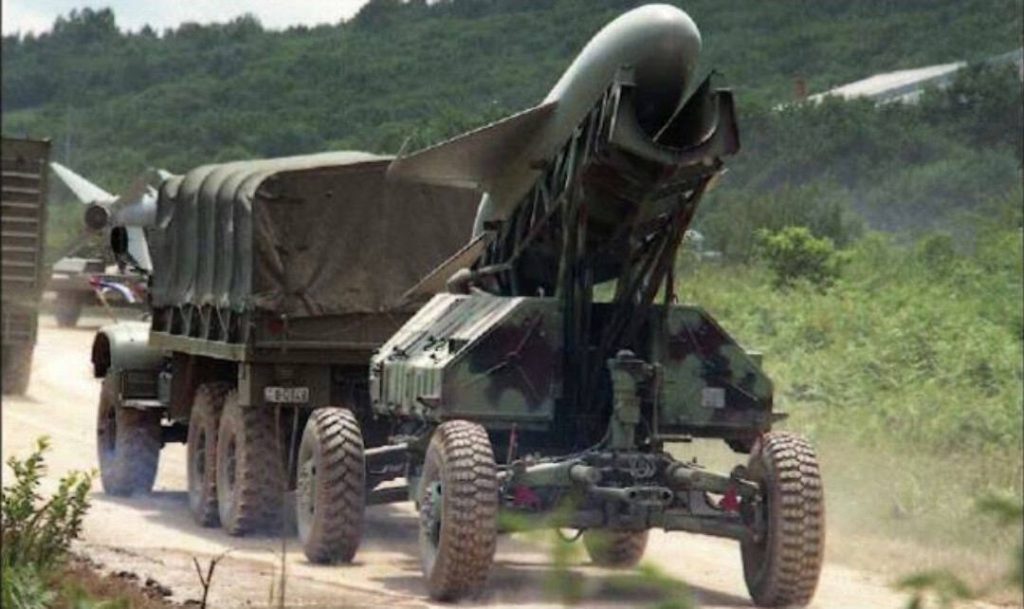
A mythology began to grow around the K-15 soon after the parade. Reports published in 1995 credited it with a range of up to 150 kilometers, while later reference works frequently described it as a tactical ballistic missile. These claims were repeated from one publication to another for decades.
However, such an estimate appears doubtful. Increasing the range of the P-15 almost fourfold would have required major changes to its engine, fuel system, aerodynamics, and flight-control algorithms. There is no reliable evidence that such extensive work was ever undertaken.
More recent reconstructions point to a much more modest objective: adapting the available missiles for land attack while retaining as many existing components as possible. If so, the K-15’s actual range would have remained close to that of the original Termit—approximately 40 kilometers.
The K-15 is therefore better described not as a new ballistic missile, but as a modified P-15 cruise missile stripped of its standard seeker. Its primary advantage was neither range nor accuracy, but its enormous warhead.
A Weapon of Intimidation
A single missile could deliver nearly half a ton of explosives. A direct hit on an ammunition depot, railway junction, large bridge, command post, or troop concentration could have caused severe damage.
Its psychological effect may have been just as important. The K-15 looked impressive during the parade: a large winged missile mounted on a massive launcher created the impression that the Krajina forces had acquired their own long-range strike weapon. Under the circumstances of 1995, the spectacle may have mattered more than the system’s actual capabilities.
By that point, apparently only one launcher existed, together with around ten missiles intended for conversion. This was sufficient for an impressive demonstration and potentially several strikes, but not enough to form a proper operational missile unit.
Why the K-15 Never Fired
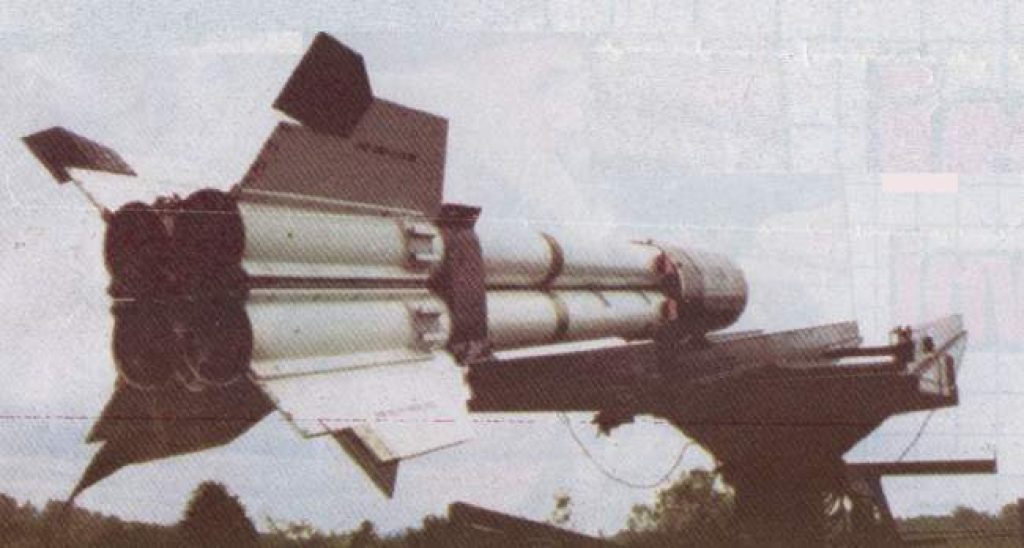
The Ajkula appeared too late. It was publicly displayed on June 28, 1995, but the Republic of Serbian Krajina effectively ceased to exist in August. Later that year, the Dayton Accords ended the war in Bosnia and established an arms-control environment in which continuing such a project no longer made practical sense.
The claim that the Dayton Accords “killed” the K-15 is therefore only partly correct. The immediate reason was the rapidly changing military situation: the engineers simply ran out of time to bring the system into full operational service. No reliable evidence of a combat launch has been found.
Project Ajkula was not a wonder weapon. It was an attempt to extract military value from equipment left behind after the disintegration of a large armed force. Its designers combined a naval missile, elements of a shipboard control system, and a launcher taken from an air defense complex. They probably could have made the missile fly, but turning it into an accurate, mobile, and practical weapon was a much harder task.
The K-15 never had an opportunity to prove itself. Nevertheless, it earned a special place in the history of wartime improvisation—a two-ton missile Frankenstein whose most successful launch was the launch of its own legend.