The “Flying Blanket”: A U.S. Startup Has Developed Mobile Camouflage Against Drones and Satellites

The modern battlefield has become almost transparent. Optical cameras, thermal imagers, and synthetic-aperture radars can detect military equipment even where the human eye sees nothing but vegetation and patches of bare ground. American startup Vigil Autonomy proposes an unusual solution: suspend a large camouflage screen above a vehicle using four drones.
The concept looks both ingenious and paradoxical. To hide one vehicle from drones, four more drones must be launched above it—complete with rotors, batteries, electric motors, and communication links.
A Camouflage Net That Needs No Supports
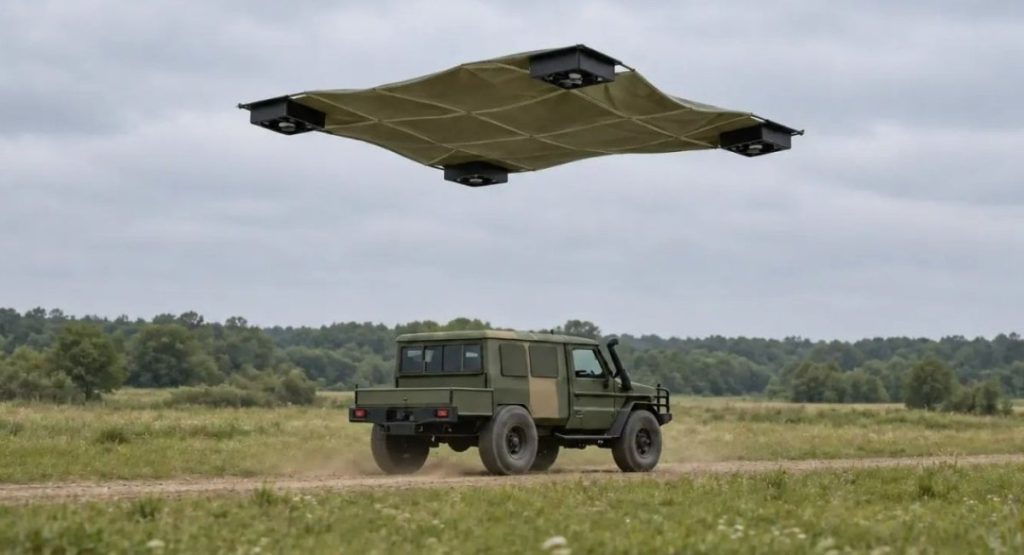
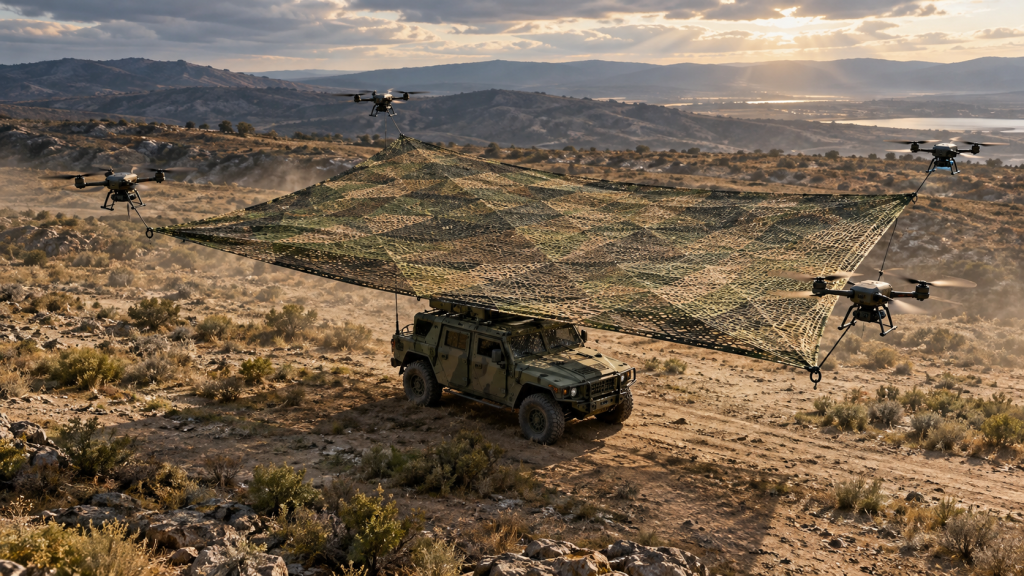
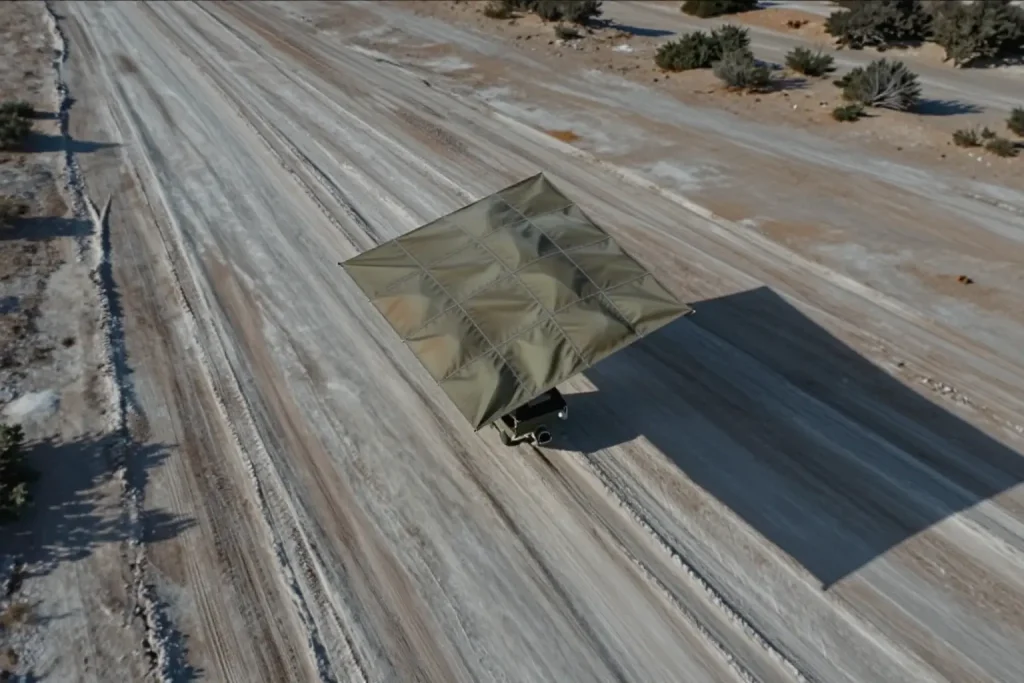
The system is called Air Cover. In its largest configuration, it consists of a 10-by-10-meter sheet with a multicopter attached to each corner. Together, the four aircraft lift the screen above a vehicle, piece of equipment, or small position.
The drones are intended to keep the material properly stretched and move together with the protected object. The stated maximum operating altitude is 10 meters, while the largest version is expected to remain airborne for up to two hours. Vigil Autonomy also presents smaller configurations covering four and nine square meters, intended for individual personnel and small units. Their target endurance is three to four hours.
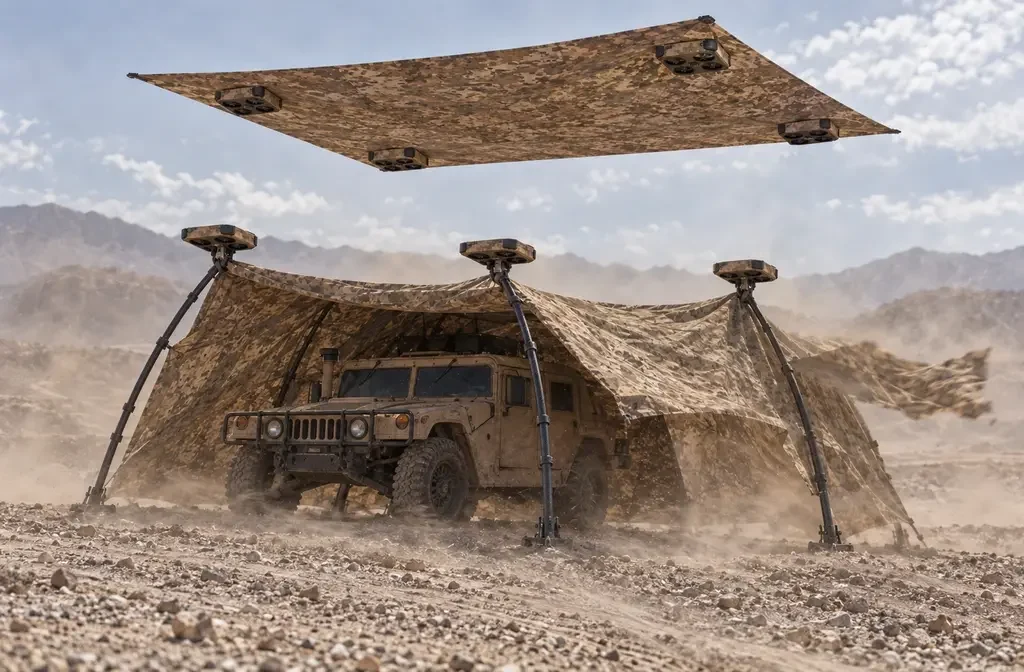
When flight is unnecessary, the screen can be mounted on conventional supports. In this configuration, Air Cover becomes a more traditional camouflage shelter while retaining the ability to change position quickly or switch back to airborne operation.
The system’s main advantage is mobility. An ordinary camouflage net must be spread out manually, secured to supports, and removed before the vehicle can move. Air Cover is theoretically capable of following a vehicle and then flying to another object without requiring personnel to dismantle the entire structure.
What Is the Screen Supposed to Conceal?
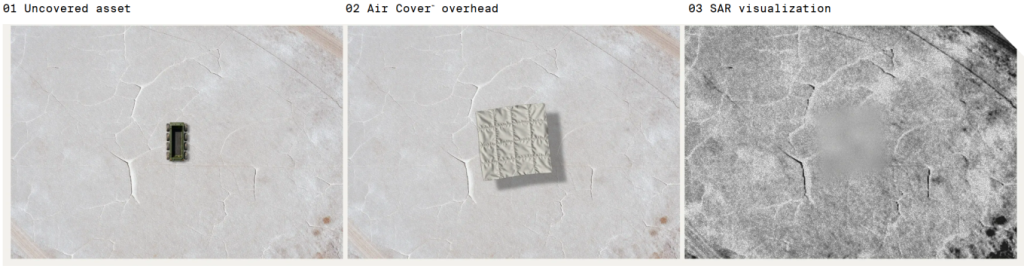
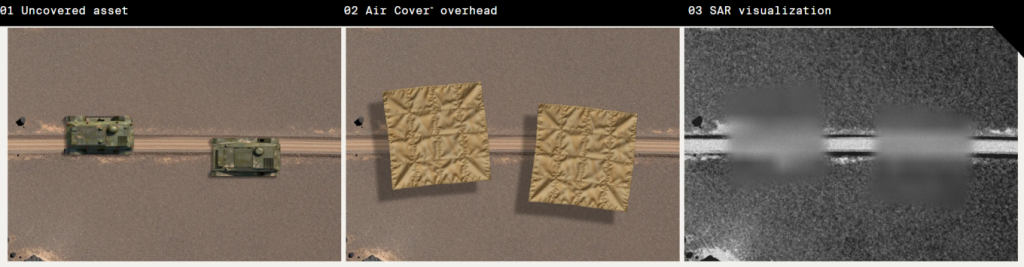
The developer is promising more than visual camouflage. Air Cover is designed to manage an object’s signature across several parts of the spectrum, particularly thermal infrared and radar.
Against an ordinary camera, the canopy obscures the recognizable shape of a vehicle when viewed from above. Instead of a cab, cargo bed, turret, or engine deck, the observer sees a surface whose color and pattern can be matched to the surrounding terrain. This could be particularly useful in open areas where equipment cannot easily be parked beneath trees or hidden inside buildings.
Thermal imaging presents a more complicated problem. The screen may block a direct view of a hot engine, roof, and other heated components, but it cannot make the heat disappear. Cooling air and exhaust gases must still escape somewhere, while the material itself will gradually warm up. The system is therefore more likely to reduce thermal contrast and alter the shape of the heat signature than make the vehicle completely invisible.
A similar limitation applies to radar. Specialized material may absorb or scatter part of the incoming signal while breaking up the recognizable geometry of a large metal vehicle. However, radar satellites and aircraft do not necessarily observe the ground from directly overhead. When viewed from an angle, the sides, wheels, and space beneath the canopy may remain exposed.
Air Cover is therefore not an invisibility cloak. It is a mobile roof designed to make a target more difficult to recognize from certain directions and with certain sensors.
One Hundred Square Meters Against the Wind
The most obvious challenge is aerodynamic. A 100-square-meter sheet is effectively a giant sail. Even moderate winds could pull it sideways, make it oscillate, or cause it to fold. The four aircraft would have to make constant corrections, consuming additional energy.
Then there is rotor downwash, which could make the material vibrate and deform. Rain would increase its weight, dust could interfere with the motors, and trees, power lines, and other obstacles would severely restrict movement.
The claimed endurance also raises questions. Two hours would be respectable for multicopters carrying such a large screen, but it would not be enough for prolonged concealment. The system would require replacement batteries, charging stations, or additional drones ready to take over.
Vigil Autonomy has not yet published independent test results, detailed wind-resistance figures, real payload capacity, or measured multispectral performance under different conditions. The advertised endurance and camouflage effectiveness should therefore be regarded as development targets rather than verified specifications.
Will the Drones Reveal the Vehicle?
Four multicopters create four additional sets of detectable signatures. They can be seen by optical cameras, heard from the ground, and possibly detected through the heat produced by their motors and batteries. If they rely on radio links, their transmissions could also attract the attention of electronic-surveillance systems.
A large, geometrically regular sheet hovering above the ground is unusual in itself. It might hide the vehicle from an automated recognition algorithm while simultaneously telling a human operator that something valuable is concealed underneath.
The reliability of the entire arrangement also depends on its weakest component. The failure of a single drone would disrupt the screen’s tension. Losing two could cause the material to collapse onto the vehicle, its antennas, or nearby personnel. If navigation and communication signals are jammed, the four aircraft would need enough autonomy to maintain coordinated flight without external control.
For these reasons, following a fast-moving vehicle appears to be the system’s most difficult operating scenario. Air Cover may be considerably more practical over a stationary vehicle during maintenance, unloading, refueling, or a brief halt at a temporary position.
Why Not Use an Ordinary Camouflage Net?
A conventional camouflage net is cheaper, quieter, and does not require batteries. It can be draped directly over a vehicle, concealing both the roof and sides. Electronic warfare cannot disable it.
Traditional camouflage, however, requires time and personnel. The net has to be unpacked, spread out, secured, and collected again before departure. If a unit frequently changes position, this process becomes burdensome. Poorly placed material can also become entangled with antennas and moving components.
Air Cover attempts to automate this work. A vehicle stops, four drones deploy the screen above it, and after receiving a command, they carry it to another location. The canopy could also provide temporary cover while equipment is being repaired or supplies are being transferred.
The Decoy May Be More Valuable Than the Camouflage
Air Cover also has a Decoy Mode. In this configuration, the system is intended to reproduce a selected thermal or radar signature at some distance from the real object. Different payloads and signature simulators could be fitted depending on the target being imitated.
This mode may prove more valuable than trying to make a vehicle disappear. If the airborne screen can generate a convincing false return, it could persuade a reconnaissance drone to inspect an empty area or cause an opposing force to mistake a decoy for real equipment.
In that scenario, the visibility of the four drones becomes an advantage rather than a weakness. They help draw attention toward the false target. Even two hours of operation could be sufficient to imitate a temporary position, a halted convoy, or a supply point.
A Striking Concept That Still Has to Prove Itself
Vigil Autonomy is not offering a revolutionary material that makes objects invisible. Its real innovation lies in how the camouflage is deployed. Instead of soldiers, poles, and ropes, autonomous aircraft hold the screen in place. This allows it to be moved quickly, assigned to another vehicle, or used to create false signatures.
For now, however, Air Cover remains an early-stage concept. The developer still needs to demonstrate its performance in strong winds, over difficult terrain, under electronic interference, and against sensors observing from different angles. Cost, deployment time, and the ability of four aircraft to operate safely around personnel and equipment will be equally important.
The “flying blanket” may eventually find a useful niche—protecting vehicles during short halts, concealing temporary positions, or creating mobile decoys. Yet its central paradox remains: it can hide a vehicle only if the four drones holding the screen do not reveal it first.