A Few Thoughts on Tyrann’s Foreign Policy – 8. An Unplanned War. In the Forests and Swamps of the Northwest-2

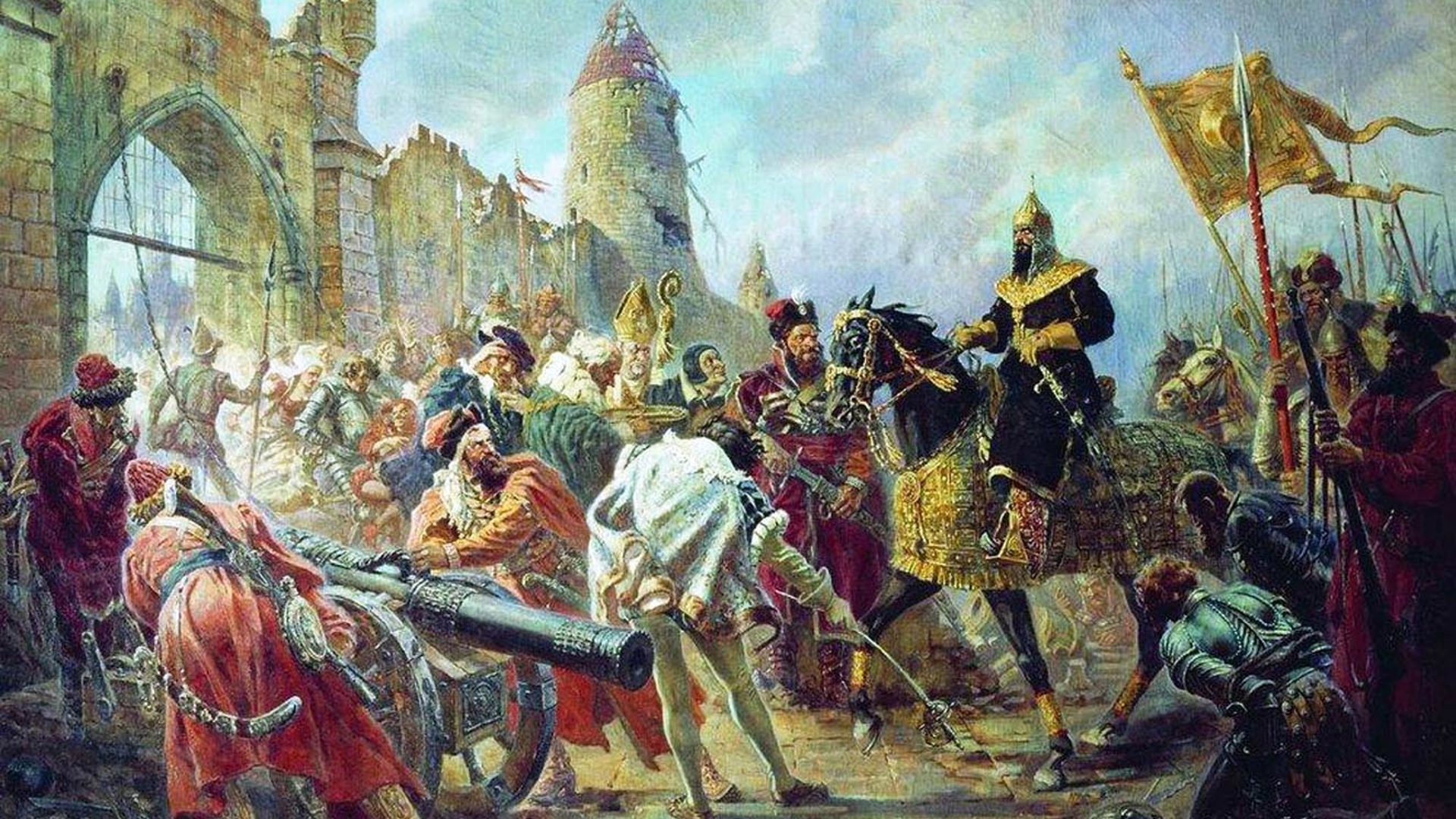
Here is the next installment in an interesting series of articles from VK by medieval historian Vitaly Pensky, which I think will be of interest to readers and colleagues.
Yesterday we looked at the events from the Livonians’ perspective, and today we’ll look at them from the other side—the Russian perspective. Here, it’s worth highlighting three key points: Pskov, Novgorod, and Moscow.
Let’s start with Pskov. For the people of Pskov, the most important issue in their relations with the “Confederation”— or more precisely, with the Order and the Bishop of Dorpat, was the territorial issue (no, trade also played a role, but I would still put the territorial issue first). The Pskov-Livonian border was quite extensive by the standards of the time and, unlike today, was not properly marked (no border posts, no checkpoints, or any other such trappings), there’s even a term for this in the literature—“mental border”—meaning borders that exist in people’s minds rather than on the ground. Understandably, this “mental” border could easily shift in the desired direction depending on the situation, especially since it was difficult to demarcate all sorts of farmland, pastures, fishing grounds, and apiaries (meaning hives); yet the interest in using them was mutual. There you have the groundwork for constant conflicts, disputes, and other grievances, and from there it was a short step to mutual raids and incursions—the one with the longer sword and spear is right, and since the length of a sword and spear is a variable quantity, it is not difficult to predict how events would unfold. Small-scale warfare on the Pskov-Livonian border was a common and familiar occurrence, and it was only a short step from small-scale warfare to large-scale war—especially when both sides shared a mutual desire for it.
In the 15th century, the initiative gradually shifted to the Pskov side—the Order was going through difficult times, engaged in a constant struggle with Riga and the Archbishops of Riga. And as internal colonization continued to develop, pressure on the border from the Pskov side became increasingly intense, and conflicts grew more frequent. The main point of contention was an area called Purnau, which separated Opotchka and its volost from the Order’s Ludzen Castle and its surrounding district. Having secured Moscow’s support, the people of Pskov gradually wrested the disputed territories from the Livonians, thereby laying the groundwork for further conflicts. And somewhere here, amid these border disputes and grievances, lies the infamous “Yuryev tribute,” the nature and origin of which remain a subject of debate to this day; but one thing is clear—something like that actually existed, and it no longer matters exactly what this tribute consisted of. It was needed merely as a pretext that, at the right moment, could be pulled out of a desk drawer and presented to negotiating “partners” to demand satisfaction.
The people of Novgorod faced significantly fewer border-related problems—the very demarcation of the border contributed to this, and the Narva River served as an excellent and clearly visible boundary. But there was another problem here—one related to trade. Trade had traditionally served as the connecting link—the “bond”—that kept both sides, Russian and Livonian, from sliding into large-scale conflict. But the closer the end of the 15th and the beginning of the 16th centuries drew, the more problematic trade itself became. It faced serious difficulties, stemming not so much from the sanctions and restrictions imposed by the Livonians on the Russians as from changes in the very nature of trade. The range of goods offered by the parties was changing, and the very nature of trade was gradually shifting (the former “goods-for-goods” principle was gradually being phased out), new actors emerged, along with new forms and methods of trade—and even the same “ordinary” trade began to extend beyond the framework of previously established customs that had regulated the exchange of goods between Russians and, first and foremost, Hanseatic merchants.
An interesting story: In the 1530s, Metropolitan Daniel lamented the entrepreneurial fever that had gripped so many people—he said the common folk had abandoned their traditional occupations, farming and the like, and had flocked in droves to trade. And this trading frenzy was directly linked to events on the Russian-Livonian “frontier”—whereas trade had previously been conducted in a more or less centralized manner and could be controlled and protected if necessary, now, under the new conditions, during “ordinary” trade, such lone merchants faced a serious risk of being cheated, robbed, or even killed—and, as often happened, as a retaliatory measure, it was not the actual perpetrators of the crime against the merchant or merchants who were punished, but rather the first available tribesmen of the offender—those who had the misfortune of finding themselves with their goods in the wrong place at the wrong time.
Now let’s put ourselves in Ivan III’s shoes. Yes, he managed to significantly expand his territories by annexing (incorporating, conquering, reclaiming what was his—call it what you will) Novgorod and establishing a protectorate over Pskov. But in those circumstances, when power rested not only—and not so much—on violence as on a certain consensus and compromise between the rulers and the ruled, whose loyalty determined the stability of that power and depended on the extent to which the former met the expectations of the latter, the sovereign of all Rus’, by definition, could not shirk his duties as the defender and guardian of the interests of all Orthodox Christianity, including those of Pskov and Novgorod. The border issues in Pskov and the trade problems in Novgorod had now become his problems and those of his heirs—a classic case of the tail wagging the dog. Moscow couldn’t care less about the Pskovians’ problems with Purnau when the issue at hand is Kazan or the Horde’s advance, but it’s also impossible to simply ignore the Pskovians’ squabbles over the bortei, the floodplains, and fishing rights — after all, how would they take it? Similarly, it was impossible to ignore the commercial interests of the Novgorod guests (especially since they were now, for the most part, if not entirely, guests of Moscow) and the Cathedral of Saint Sophia. It is not merely the people of Novgorod who are now being robbed and wronged, but the subjects of the Sovereign of Rus’. And, of course, one must not forget the issue of status. It’s one thing when it comes to the exchange of ambassadors and other details of diplomatic protocol between Novgorod and Pskov on one hand and the Livonian Landsknechts on the other, and quite another when Moscow is involved. In short, Ivan and his heirs now face even more headaches, along with the causes of potential new conflicts…
To be continued…