A flying boat that could have changed the history of aviation. Why did the Bartini A-57 strategic bomber never take to the skies?

In the mid-1950s, when the world was gripped by the specter of a nuclear standoff, Soviet aircraft designers were seeking unconventional solutions for delivering strategic weapons. One of the boldest and most futuristic projects of that time was the A-57 supersonic amphibious bomber, developed under the leadership of Robert Ludvigovich Bartini. This aircraft, capable of taking off from water, ice, and snow, could have radically changed the strategy of long-range aviation. However, fate had other plans: the project never made it past the drawing board. Why didn’t this brilliant idea come to fruition?
From Mathematical Calculations to a Real-World Project
The history of the A-57 began back in 1952, when Bartini, who was then working at the S.A. Chaplygin Siberian Aviation Research Institute, developed a design designated T-203. What made his approach unique was that the designer, being an outstanding mathematician, literally “calculated” the aerodynamic configuration of the aircraft, which featured a wing with variable sweep along the leading edge. This made it possible to avoid costly wind tunnel testing during the early stages of development.
Three years later, Bartini presented the A-55 project—a supersonic medium-range flying boat bomber. The concept called for the ability to refuel at sea from surface ships or submarines, which made the aircraft virtually invulnerable to preemptive strikes against fixed airfields. However, the project was initially rejected: the claimed performance specifications were deemed unrealistic. Only after consulting with Sergei Pavlovich Korolev, who helped experimentally validate Bartini’s calculations, was it possible to resume work. Dozens of models with various wing configurations were built and tested, confirming the viability of the idea.
In April 1957, Bartini was seconded to Moscow to continue work on a strategic variant—the A-57. Specialists from TsAGI and TsIAM joined the project, researching water takeoff modes and the aircraft’s ability to remain afloat for extended periods.
Revolutionary design: a tailless aircraft with an integrated layout
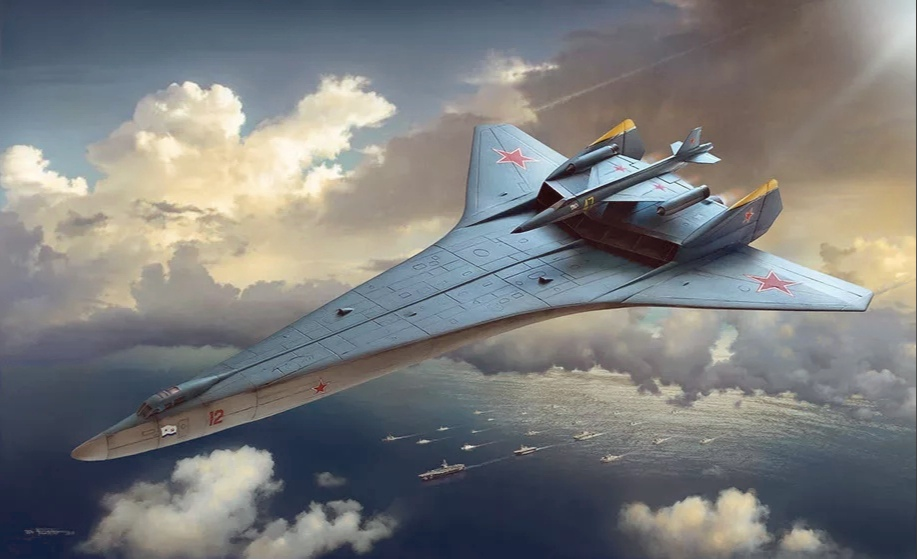
The A-57 was not just an aircraft, but an entire strategic system. The aircraft was designed as a “tailless” aircraft with a distinctly integrated layout: the fuselage as such was practically nonexistent, and the payload was housed within the wing. The wing, which had variable sweep along the leading edge, was “self-balancing”—balance was achieved through torsion across the wingspan. A supercritical airfoil—concave downward in the central section and convex upward at the wingtips—was used, which minimized wave and inductive drag at supersonic speeds.
A unique feature of the design was the absence of a conventional wheeled landing gear. For takeoff and landing on water or ice, a retractable hydrofoil was provided, located beneath the central section of the fuselage. When conventional airfields were required, wheeled landing gear that could be jettisoned after takeoff could be used. This design allowed the A-57 to be based on drifting Arctic ice floes, in the open ocean, or on undeveloped coastal areas, which significantly increased the system’s stealth and survivability.
The three-person crew was housed in a pressurized cockpit. The aircraft was equipped with everything necessary for autonomous operation: piloting equipment, a passageway running the length of the fuselage, and a medical compartment. All maintenance operations could be performed without stepping outside the wing and tail surfaces—that is, directly on the water.
Equipment and Armaments: Technologies of the Future
By the standards of the late 1950s, the A-57’s onboard equipment represented the pinnacle of technical excellence. The aircraft was to carry the SVR-1 onboard radar station, the “Roza” and “Venik” active electronic warfare systems, and the TRS-45 passive jamming system. Navigation was provided by the “Veter” system, communications by the “Planeta” system, and the “Okhotsk” hydroacoustic system was intended for communication with submarines.
The A-57’s primary weapon was the “244N” thermonuclear bomb, weighing 3,000 kg, which was housed in an internal thermally stabilized bomb bay. Additionally, an RSS cruise missile, developed by P.V. Tsybin’s Design Bureau, could be mounted above the power plant. This combination made it possible to strike strategic targets from both high and extremely low altitudes using a missile carrier.
Technical Specifications of the A-57
- Wingspan: 37.10 m
- Length: 72.50 m
- Height: 7.50 m
- Wing area: 755.00 m²
- Normal takeoff weight: 250,000 kg
- Maximum takeoff weight: 320,000 kg
- Engine type: 5 NK-10B turbojet engines (or, temporarily, NK-6)
- Thrust: 5 × 26,000 kgf (for the NK-10B) or 5 × 22,500 kgf (for the NK-6)
- Maximum speed: 2,500 km/h
- Practical range: 12,000–14,000 km
- Practical ceiling: 18,000–23,000 m
- Crew: 3 people
- Armament: one “244N” thermonuclear bomb weighing 3,000 kg and/or an RSS cruise missile.
Why Didn’t the Project Take Off?
Despite the positive conclusion of the MAP interdepartmental commission—which included representatives from TsAGI, TsIAM, NII-1, as well as the Tupolev and Myasishchev Design Bureaus, the government never made a decision to build a prototype of the A-57. The reasons for this decision were multifaceted.
First, the project required enormous financial and production resources at a time when the Soviet aviation industry was already fully occupied with the mass production of the Tu-95 and the development of the Tu-22. Second, by the late 1950s, the concept of ocean-based strategic bombers had begun to give way to the development of submarine-launched ballistic missiles and land-based intercontinental missiles, which provided a more reliable and rapid retaliatory strike. Third, the technological risks associated with creating a supersonic amphibious aircraft of such mass and complexity remained extremely high even with Korolev’s support.
Bartini continued to develop the concept of supersonic amphibious aircraft until 1961, working on several more variants—the R, F-57, and R-57AL, including a design with a nuclear power plant. However, none of them progressed beyond the conceptual design stage.
The Legacy of a Brilliant Engineer
The A-57 project went down in history as one of the boldest and most technologically advanced concepts in Soviet aviation. The ideas conceived by Bartini—an integrated layout, a variable-sweep wing, and multi-role capabilities—were reflected in later developments, including programs for supersonic passenger and military aircraft.
Today, the A-57 is seen not as a failure, but as a symbol of an era when engineering knew no bounds. Bartini’s flying boat could have changed the history of aviation, but even without ever taking to the skies, it continues to inspire new generations of designers, reminding us that sometimes the most important flight takes place not in the air, but in the realm of human imagination and scientific foresight.